 The House of Blues, Cleveland: What It Suits and What It Does Not
The Cincinnati Art Museum: The Venue’s Own Logic
Every decision here was made for paintings, not for faces.
A museum has one organising principle and it is not hospitality: everything in the building was decided in order to light a painting properly.
That is worth stating plainly because it explains every condition a photographer meets here, and most of them are consequences rather than choices.
A painting needs even illumination across its surface, no specular glare, and no ultraviolet or infrared — heat and UV degrade pigment and varnish. So the gallery light is diffuse, indirect, low in level, and filtered. Direct sun is excluded absolutely, either by blanking the windows or by daylighting from above through diffusers.
That produces, for a face, light that is soft and even and almost entirely without direction. It is flattering in the sense that it hides nothing and emphasises nothing — and it is difficult in the sense that a portrait needs a shadow somewhere to describe a shape, and a well-lit gallery has no shadows to offer.
The second consequence is level. Galleries are kept dim, often at fifty lux or less on sensitive works, which is far darker than it appears to the eye once it has adapted. A camera reads it honestly: high ISO, wide aperture, and a shutter speed that will not freeze a moving subject.
The third is colour. Museum lighting is heavily controlled and frequently warm and narrow-spectrum, which means skin can render oddly and no single white balance serves the whole building. Galleries lit for one collection will not match galleries lit for another.
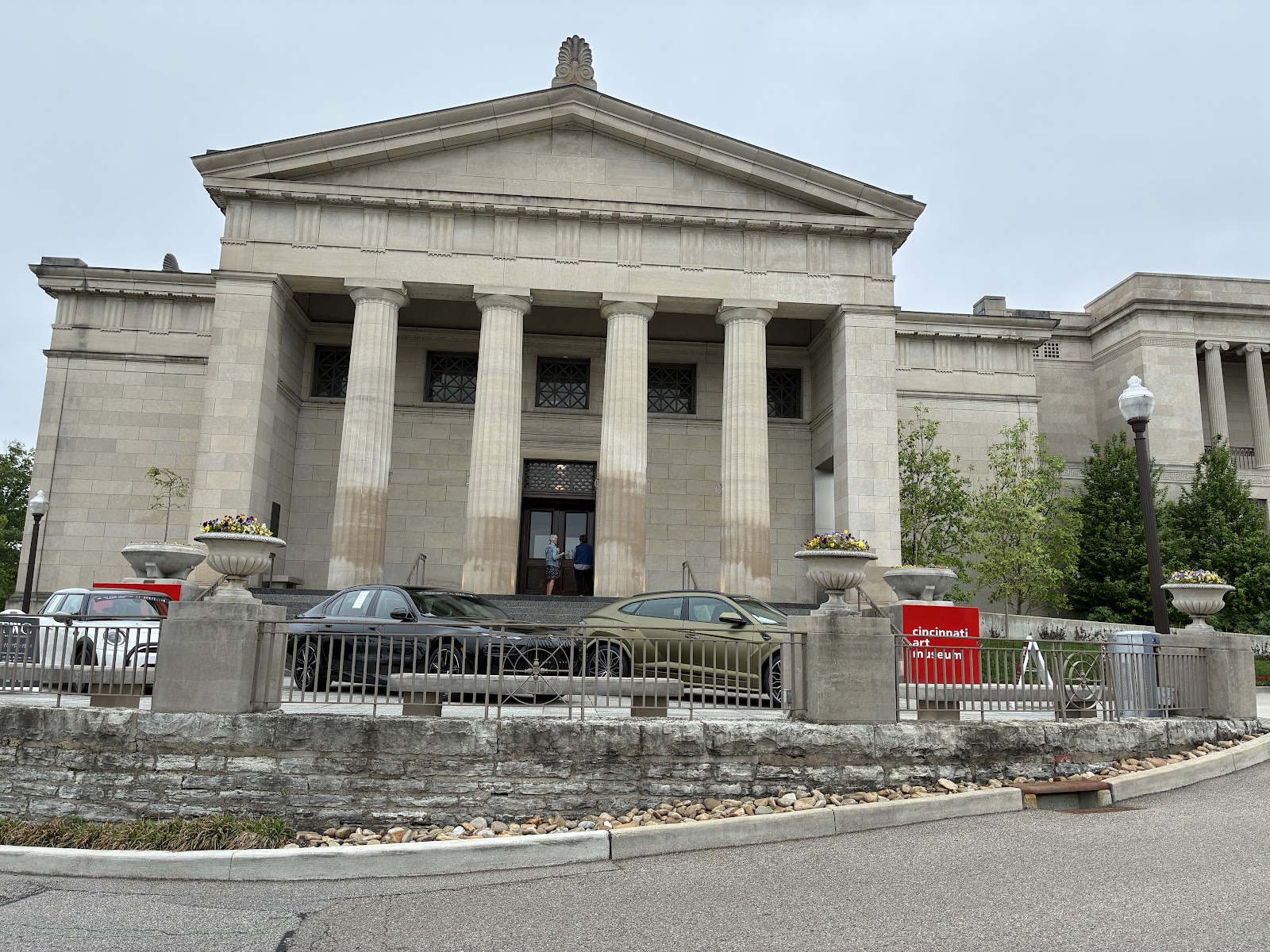
The building itself is 1886 Romanesque Revival in stone, added to repeatedly across the following century, and it sits on a hilltop in a large park above the Ohio River valley — which gives it something most museums do not have, which is a view and a landscape.
Cincinnati sits at about thirty-nine degrees north; this hilltop is around eight hundred and fifty feet, some three hundred above the river. The June noon sun reaches around seventy-four degrees, the December noon sun about twenty-eight, and civil twilight is roughly thirty minutes.
We have not photographed a wedding here. Which galleries and halls are available, whether flash is permitted and the permitted hours are questions for the museum — and the flash question governs everything below.
The Cincinnati Art Museum at a glance
| Where | An 1886 Romanesque Revival museum on the Eden Park hilltop, Cincinnati |
| The logic | Every lighting decision was made to protect and display paintings |
| What that gives | Soft, even, directionless light at very low levels, in mixed colour |
| The advantage | A hilltop in a park, three hundred feet above the river valley |
| Ask first | Whether flash is permitted, and in which rooms |
Working with conservation light
The first question to settle is whether flash is allowed, because the answer splits the day into two completely different jobs.
Many museums prohibit it outright in galleries, and the reason is genuine rather than bureaucratic: repeated exposure to light accelerates pigment fading, and while a single flash is negligible, a policy has to be absolute to be enforceable. Some permit it in atria, halls and function rooms but not among the works. Establish which rooms allow what, in writing, before the day.
Where flash is prohibited, the technique is a fast lens, a high ISO and an accepted compromise on depth of field. A modern sensor at 6400 or 12800 handles gallery light adequately, and grain in a dim ornate room is a far smaller problem than motion blur.
The shutter is the discipline. Gallery light tempts a photographer down to a thirtieth or a fifteenth, and at those speeds a subject who breathes is soft. Hold a hundred and twenty-fifth as a floor for anyone standing still and a two-hundred-and-fiftieth for anyone moving, and pay for it in ISO.
Because the light is directionless, the photographer has to supply direction by position. The one reliable trick in a gallery is to find the local brightest source — a skylight, an uplit wall, a lit vitrine, a doorway into a brighter room — and to place the subject so it falls on them from one side. That converts flat light into modelled light without adding anything.
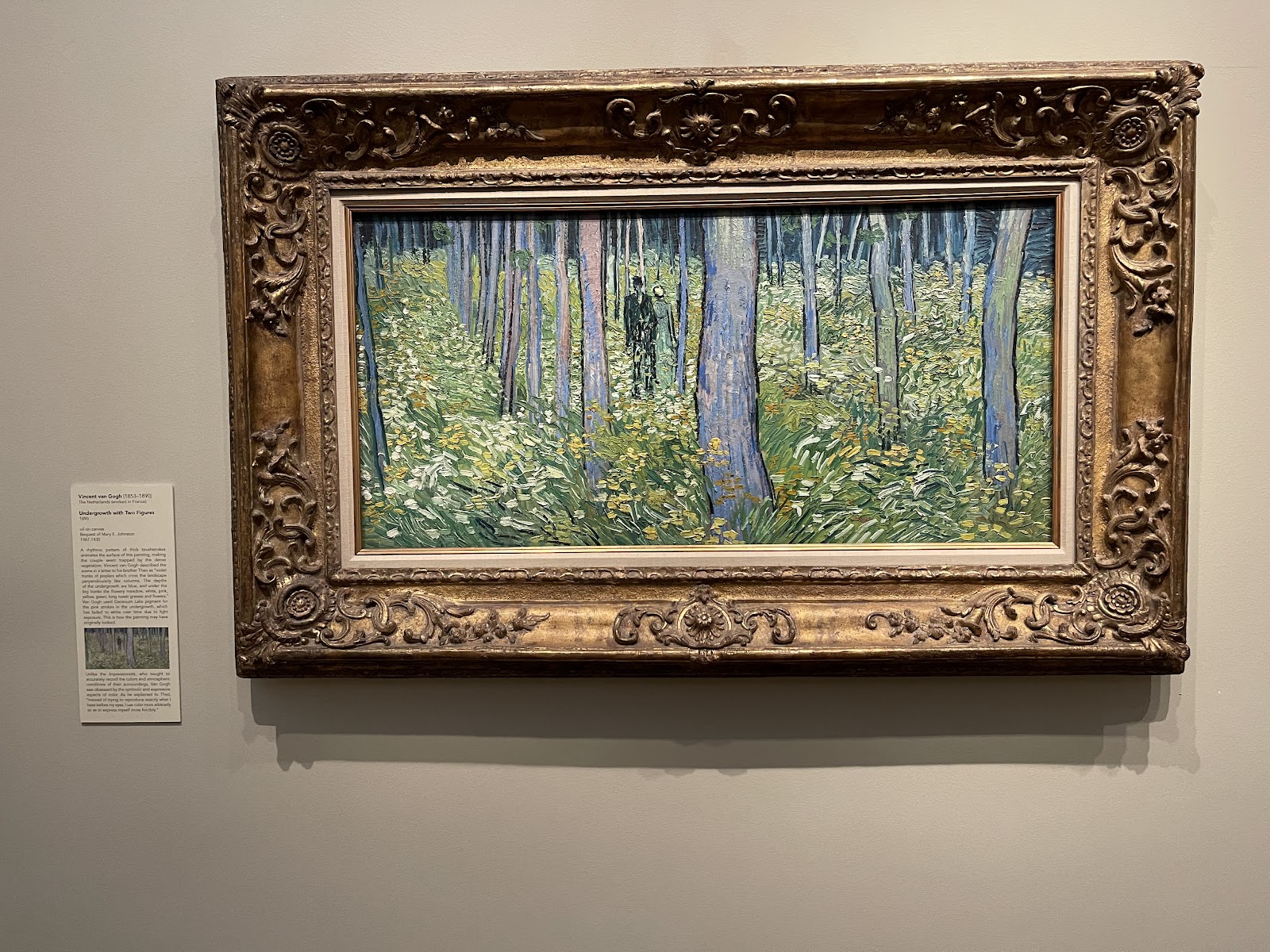
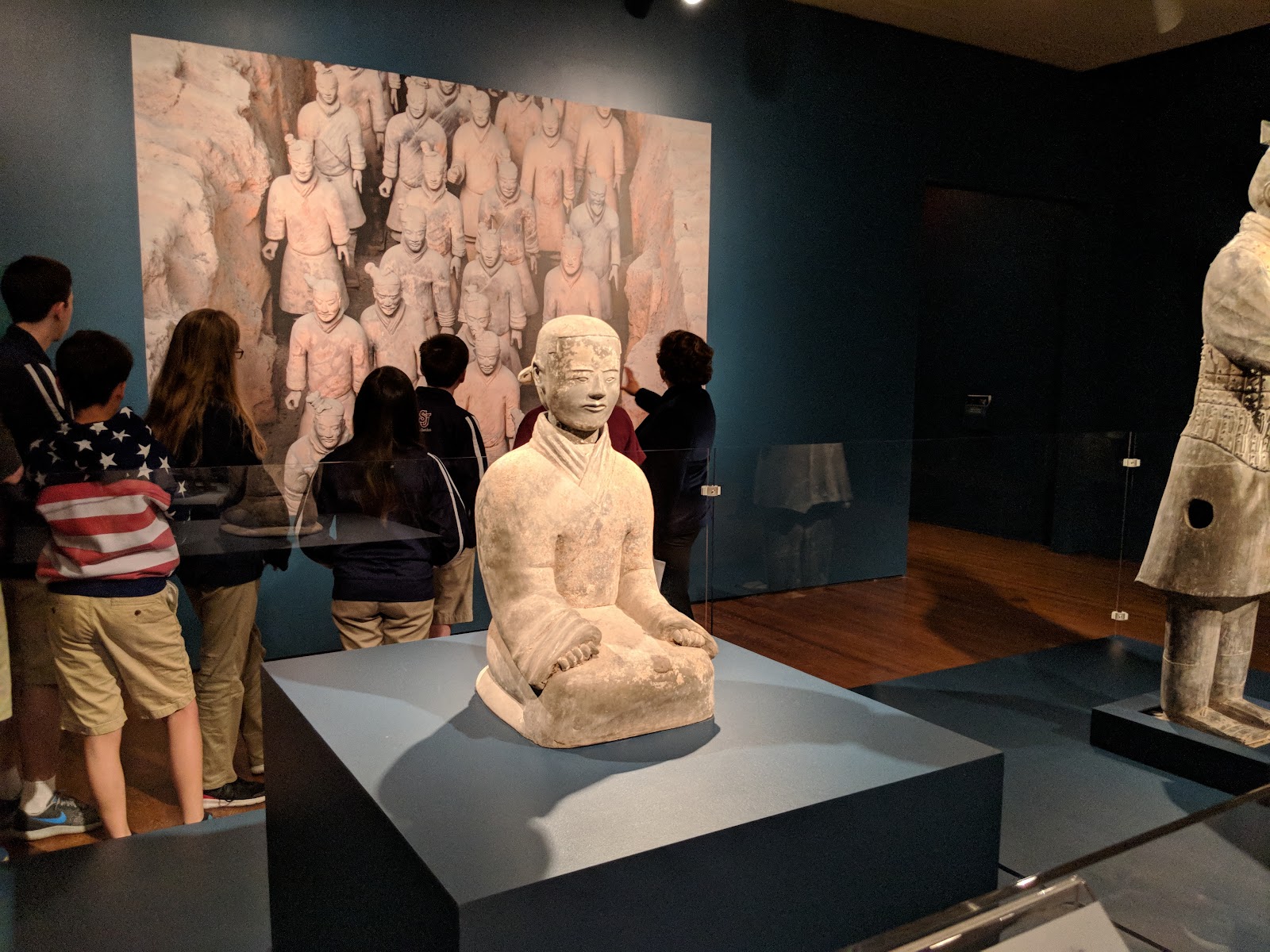
A lit vitrine is the underused version of that. A glass case with internal lighting is a small bright source at close range, and a face turned toward one picks up a defined key with rapid falloff, which in a dark gallery is genuinely dramatic. It also puts a museum object in frame, which is the point of being here.
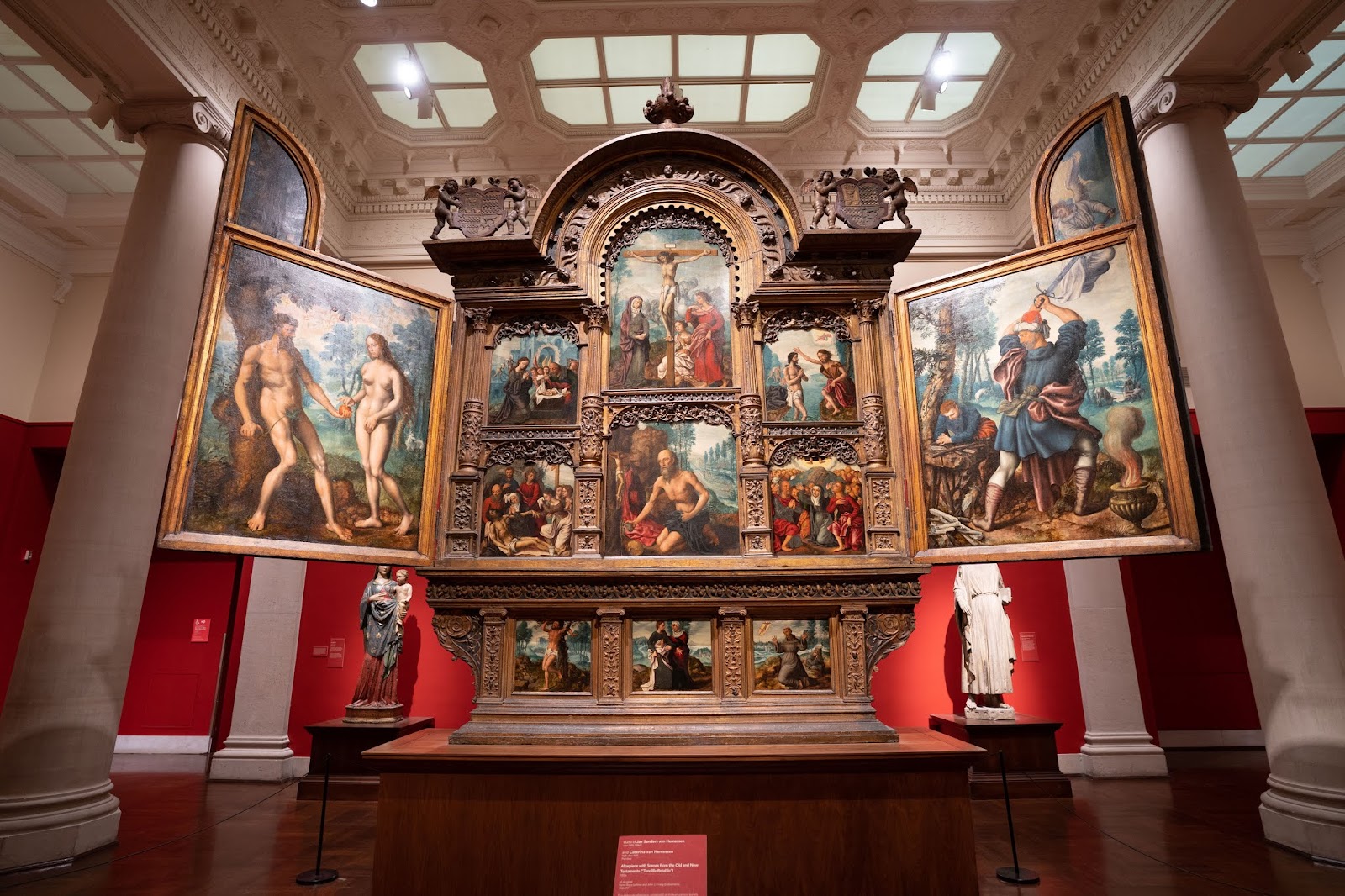
Where flash is permitted, bounce is usually the answer rather than direct light, and the surfaces decide it. A gallery with pale walls returns a soft warm key from a single source aimed sideways; a gallery painted a deep saturated colour — and modern curatorial practice favours strong wall colours — returns that colour onto skin, which needs checking on a face rather than assumed.
That colour problem is specific to galleries and it catches people out. A room painted deep green or oxblood will tint every bounced photograph taken in it, and the correction fights the wall colour that made the room look good in the first place. In strongly coloured rooms, direct light through a modifier is cleaner than bounce.
Never bounce off a painting, and keep flash off glazed works entirely. A framed work under glass is a mirror, and a flash anywhere near the axis will put a bright rectangle across it — which ruins the frame and, more to the point, is exactly what the museum’s policy exists to prevent.
The galleries’ real gift is the geometry rather than the light. A long enfilade of rooms with aligned doorways gives a receding sequence of frames within frames, and a couple placed three rooms deep with a moderate telephoto compressing the openings is a picture only a museum can produce. It needs the doorways genuinely aligned, so it is worth walking the floor to find where they are.
The architecture, and the hill
Outside the galleries the building relaxes its rules, and that is where most of the usable frames are.
A Romanesque Revival museum of the 1880s gives heavy round arches, rusticated stone, short thick columns and deep window reveals. The material is the point: rusticated stone has a strongly textured face, and it renders well only in raking light, because a frontal sun flattens the texture it exists to display.
So the exterior is a morning or evening subject and a poor midday one, which is the reverse of the galleries inside. That opposition is useful — it means the day has a natural shape, with exteriors at the ends and galleries through the middle.
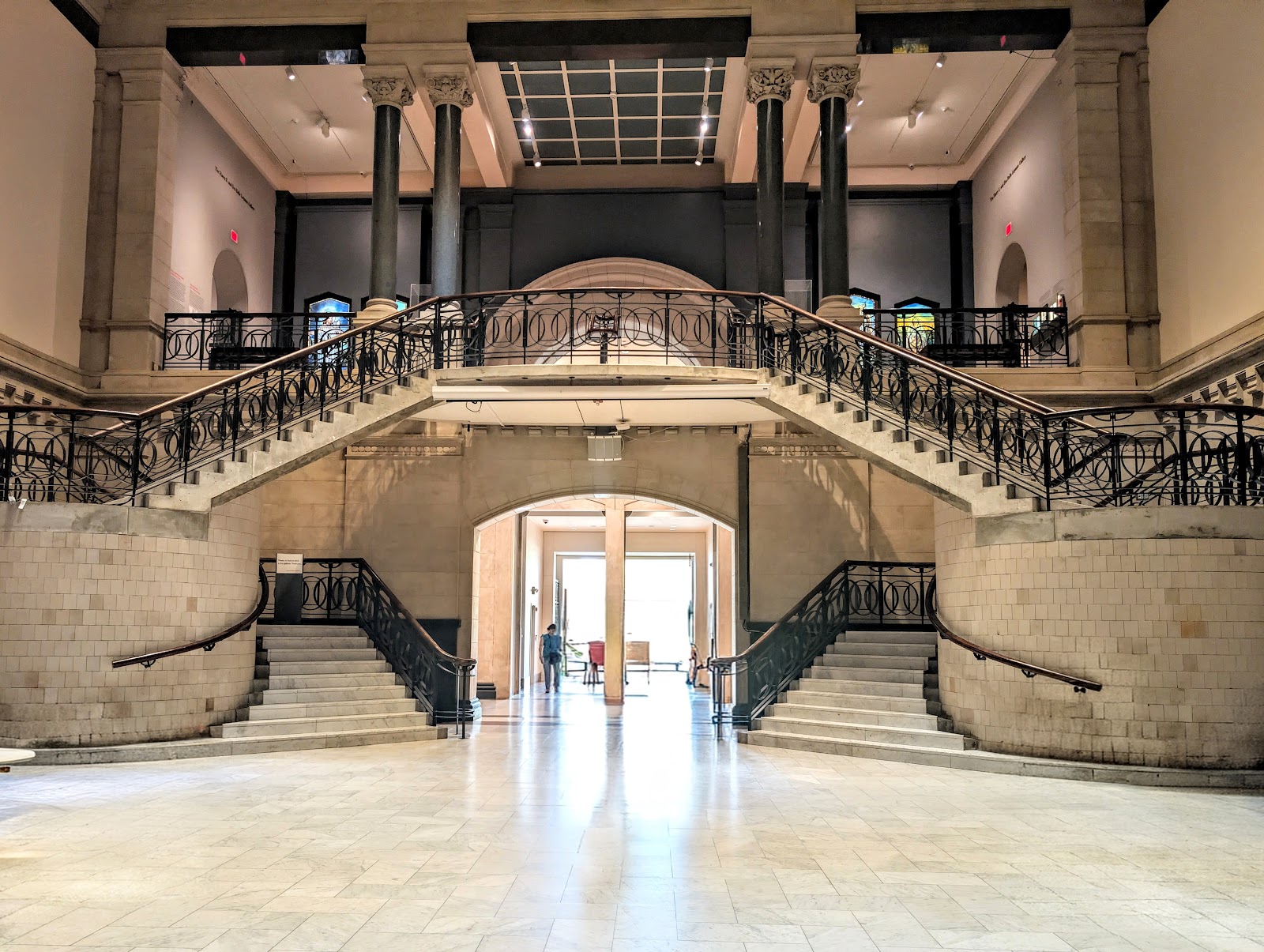
The entrance hall is usually a museum’s best interior, and for a specific reason: it is the one large space designed for people rather than objects, so it is lit brighter, finished paler, and often daylit from above. A top-lit atrium is a very large soft source directly overhead, which on a face gives even coverage with shadowed eye sockets — so the fix is a low reflector or a modest fill from the front, not more light from above.
A grand stair, if there is one, gives the reliable three frames: from below looking up, which makes the subjects dominant; from the landing looking down, which suits a group on the treads; and from across the hall at landing height, which is the one that actually shows the architecture and the one most often skipped.
The hilltop is this museum’s genuine differentiator and it should not be treated as a car park. Sitting in a large park some three hundred feet above the Ohio River, the site has a view over the valley and the city, and mature parkland around it.
The view wants a long lens. A wide shot of a city from a hillside renders the buildings at true angular size and they become a low smear along the horizon; a moderate telephoto compresses the river valley, the bridges and the downtown into something with mass. Expose for the city and lift the subjects with a warm-gelled source at about a stop over whatever ambient is on them.
The valley also does something atmospheric that is worth planning around. The Ohio River basin traps cool air overnight, and on clear calm mornings — especially in autumn — fog forms in the valley below while the hilltop stays clear. That produces the frame of a lifetime for a venue like this: a couple on a hilltop terrace with a city submerged in fog three hundred feet beneath them.
It is unpredictable and it is most likely in September and October, after a cool clear night following a warm damp day. Worth setting an alarm for on the off-chance rather than planning around.
The parkland gives the shade, and Ohio’s trees are worth knowing individually. Sugar maple is the dominant hardwood here and it has a dense rounded crown that casts genuine solid shade — a completely different proposition from the Sonoran desert’s filigree, and a reminder that shade is a regional variable rather than a constant.
Sycamore grows along the river and its bark is the distinctive one: mottled white, grey and tan, peeling in irregular plates, so a mature sycamore trunk is a pale abstract pattern and one of the best natural portrait backgrounds in the region. Buckeye, the state tree, is smaller, palmately five-leafleted, and turns early — often the first colour in the park.
Humidity is the climatic contrast worth naming. Ohio summers are humid, and water vapour scatters light, which fills shadows and softens shadow edges — so a sunlit lawn here at noon has perhaps two stops less contrast than the same sun angle in a dry climate. That makes midday outdoor portraits genuinely workable, which in the desert they are not.
Mid to late October is the best window outdoors: sugar and red maple in scarlet and orange, hickory and oak in bronze, and the valley’s relief meaning the colour reads in mass. The cost is that the good light is short — civil twilight around thirty minutes, and a day down to under ten hours by December.
Winter’s honest condition is grey. The Ohio basin sits under inversions for long stretches, giving weeks of flat overcast — soft even light that flatters faces and destroys architecture, since rusticated stone without shadow has no texture at all. That is the weather for working indoors, which this building is entirely equipped for.
- Settle the flash policy room by room, in writing, before the day
- Find the local brightest source and put it on one side of the face
- Never bounce toward a glazed work — it is a mirror
- Strongly coloured gallery walls tint bounced light; go direct instead
- Compress the river valley with a telephoto; a wide lens flattens the city
What the building suits
A museum is an unusual wedding venue and it is worth being straight about the shape of what it offers.
It suits a party that wants the pictures to be about a place with content. A frame in a gallery contains art, and that art is specific and identifiable — which means the photographs say where they were in a way that a hotel ballroom never can. For some couples that is the entire reason to book.
It suits a small to medium count moving through spaces rather than sitting in one. Galleries are a route, and a group of thirty walking an enfilade produces enormous variety in a short time — more distinct backgrounds in twenty minutes than most venues offer in a day.
It suits the shoulder seasons, because the hilltop and the parkland are the differentiator and they need leaves or colour to work. A wedding here in late October uses everything the site has.
It does not suit a large seated reception, unless the museum has a purpose-built hall. Galleries cannot take catering near the works, which means the event spaces are a defined subset of the building and usually the least art-filled part of it — so a large wedding here is largely in a function room adjacent to a museum rather than in the museum.
It does not suit a party unwilling to be governed. A museum has conditions that are not negotiable: where food and drink may go, what may be touched, how close anyone stands to a work, whether confetti exists at all, and often a hard finish time because the building has to be secured. Those are reasonable and they are absolute, and a couple who chafe at them will have a worse day than one who treats them as the price of the setting.
It does not suit anyone who needs flash-lit formal portraits in the galleries, if the policy forbids it. That is why the policy question comes first — a photographer who arrives expecting to light the Renaissance room and finds they cannot has lost the frames they planned the day around.
And it does not suit a rainy day as well as it should, which is counterintuitive for an indoor venue. The problem is that the building’s best pictures combine the interior with the hilltop and the park, and a wet day removes half of that while the galleries’ own light is unchanged. An all-indoor day here is perfectly good and it is a narrower day.
Two practical notes to close. Tripods are often restricted even where flash is not, which matters for the long exposures that dim galleries otherwise invite — so a fast lens and a high ISO are the plan rather than a fallback.
And the museum is usually open to the public. Unless the booking is genuinely outside hours, there will be visitors in the background of every gallery frame, which is normal and worth expecting. An evening booking after closing is a materially different product: empty rooms, the whole floor, and the freedom to place people where the light is rather than where the crowd is not.
More frames from The Cincinnati Art Museum
The Cincinnati Art Museum wedding photography: common questions
Why is gallery light so difficult?
It is designed to protect paintings — diffuse, indirect, low-level and UV-filtered. That means no direction anywhere, and a portrait needs a shadow to describe a shape.
How dim is it really?
Often fifty lux or less on sensitive works, far darker than it looks once your eyes adapt. Plan on high ISO and hold a hundred and twenty-fifth as a shutter floor.
How do I get direction without flash?
Find the local brightest thing — a skylight, an uplit wall, a lit vitrine, a doorway to a brighter room — and place the subject so it falls on one side of the face.
What about coloured gallery walls?
They tint anything you bounce. In a deep green or oxblood room, use direct light through a modifier rather than bouncing off the wall.
What is the hilltop worth?
A view over the Ohio valley three hundred feet below, and on clear autumn mornings valley fog with the city submerged beneath a clear hilltop.
Does it suit a large reception?
Less well. Catering cannot go near the works, so a big wedding happens in a function room adjacent to the museum rather than among the collection.
More Cincinnati, OH venue guides
We are writing a photographer’s guide to every venue we would happily shoot in Cincinnati, OH. Here are three more, plus the full index:
- The Cincinnati Music Hall: A Walk Through the Building
- The Cincinnati Zoo: The Problem, and Four Ways Out of It
- The Hard Rock Casino, Cincinnati: The One Decision That Governs Everything
Planning a wedding at The Cincinnati Art Museum?
A building built for looking. Tell us your date.