 The Laniakea YWCA: A Building Organised Around Its Courtyard
The St. Regis Princeville, Kaua’i: One Frame and How It Is Made
A bay, a crescent of sand, and a wall behind it that runs with water.
There is one frame at Princeville that is worth planning the whole day around, and it depends on rain having fallen.
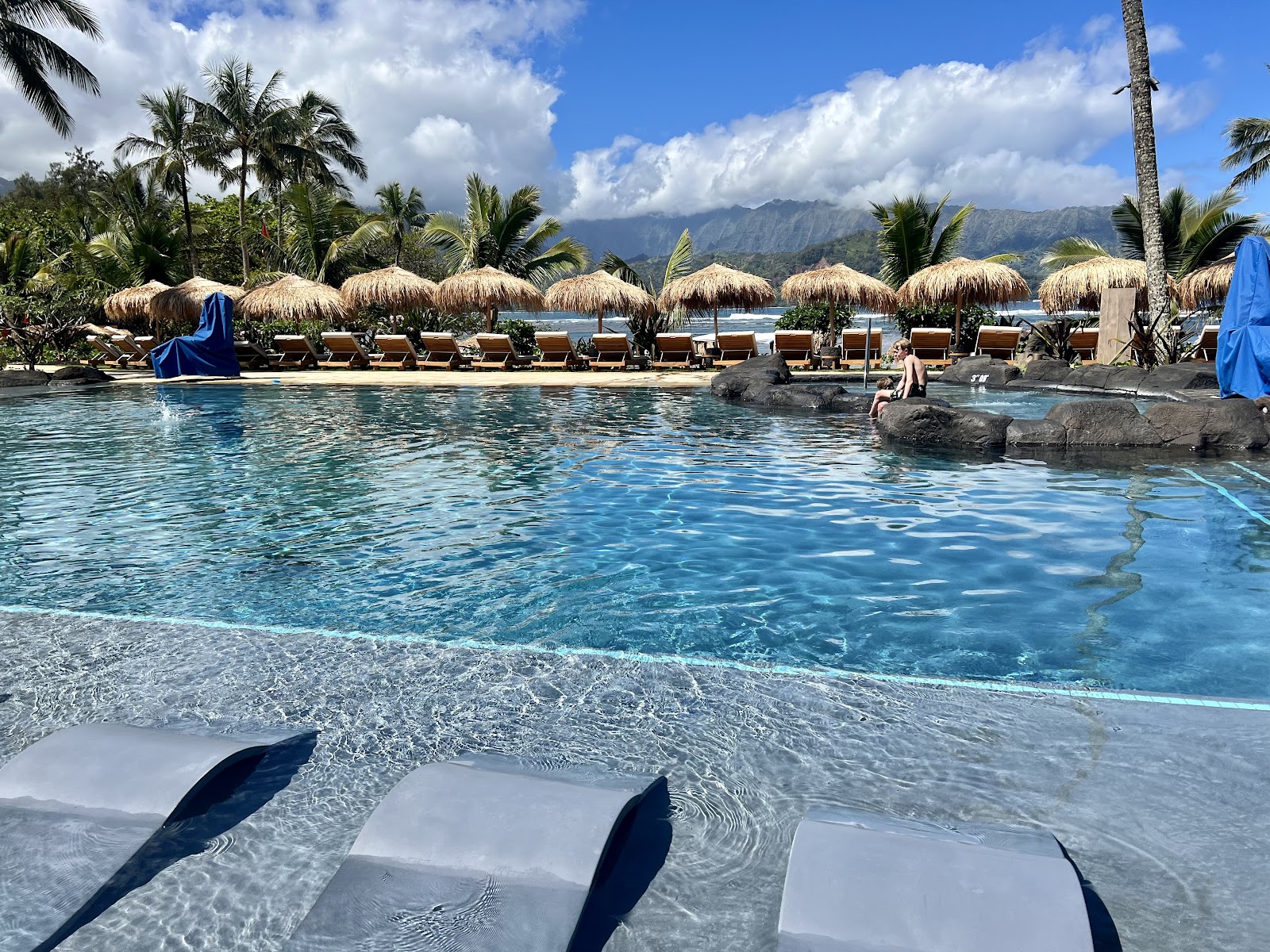
The resort stands on a bluff above Hanalei Bay on the north shore of Kaua’i. The bay is a broad crescent with a beach along it and a river mouth at one end, and behind the beach the land rises into a wall of green — an eroded volcanic range, fluted into ridges and gullies, running along the whole back of the bay.
That wall is the frame’s third element and the reason it is distinctive. After rain, and this is a wet coast, the gullies run and the wall carries waterfalls — sometimes dozens of them at once, thin white lines down a dark green face, visible from the bluff and from the beach.
So the frame is: the couple with the bay behind them, the crescent of beach beyond that, and the waterfall wall behind everything. Four planes if the river mouth is included, three if not, and each with a completely different character.
It is made of four decisions and the first of them is not photographic: whether it has rained. The waterfalls appear within hours of significant rain and fade within a day or two of it stopping, which means the frame’s best version depends on weather that has already happened rather than on the weather on the day.
Kaua’i’s north shore is among the wetter places in the islands — the island’s interior peak is one of the wettest places on earth, and this coast sits on its windward flank — so rain is frequent rather than occasional. A photographer who treats it as a problem will have a difficult day here; one who understands that the previous night’s rain is what makes the frame will plan differently.
Princeville sits at about twenty-two and a quarter degrees north — the highest latitude in these islands. The June noon sun reaches about eighty-eight degrees, the December noon sun about forty-four, days run only from about eleven hours to thirteen and a third, and civil twilight is around twenty-three minutes.
We have not photographed a wedding at this resort. Which spaces and grounds are included, what beach and bluff access allows, what covered alternatives exist and what the permitted hours are, are questions for their team.
The St. Regis Princeville at a glance
| Where | A resort on the bluff above Hanalei Bay, north shore of Kaua’i |
| The frame | The couple, the bay, the beach crescent, and a waterfall wall behind |
| The condition | The falls appear within hours of rain and fade within a day or two |
| The coast | Windward and among the wetter places in the islands — rain is frequent |
| Ask first | Included spaces, beach and bluff access, covered alternatives, hours |
Building the frame
The waterfalls come first because they are the variable and because they cannot be arranged. What can be done is to know the rule: the falls run after rain, they are at their most numerous within hours of it, and they thin over the following day or two.
That means the best version of this frame follows a wet night, which on this coast is common — and it means a forecast of rain before the date is good news rather than bad. It also means the frame has three usable versions rather than one, which is what makes the venue workable in any conditions.
Wall running with falls: the classic version, with thin white lines down a dark green face. This needs the wall lit or at least not in deep shade, because a white line on a dark face reads only when there is tonal separation.
Wall clear but green: the falls are absent or reduced to one or two, and the wall reads as a fluted green mass. This needs low light raking across it to show the flutes, or it flattens.
Wall in cloud: the top or the whole of it is gone. That turns the frame into bay, beach and mist, which is a genuinely good photograph and one nobody plans — and on this coast it is frequent.
Knowing all three in advance means the day works whatever has happened, which at a wet windward venue matters more than at any other.
The light on the wall is the second decision and the geometry settles it. Hanalei Bay opens broadly north, which means the wall behind it faces north too — and a north-facing wall at this latitude is lit obliquely at the ends of the day rather than frontally at any point.
In practice that means the wall is best in the early morning and the late afternoon, when the low sun comes across it from the east or west and rakes the flutes; and flattest in the middle of the day, when the light comes from above and the face reads as a uniform green.
The exposure is the third decision and it is a multi-plane problem of the hardest kind. The couple in the foreground, the bay in the middle, and the wall behind are frequently three or four stops apart — and the waterfalls, being white water on a dark face, add a fourth level at the top of the range.
Expose for the wall, because the wall is what the frame is about, and lift the subjects with a close source, warm-gelled where the light is warm, at about a stop over the ambient on them. Metering on the faces renders the wall as a pale green wash and loses the falls entirely.
Where the range is simply too wide, reduce the planes rather than compromise: a frame with the couple and the wall, or the couple and the bay, is a better photograph than a wide one in which none of the three is right.
The fourth decision is the scale, and it is the one people resist. The wall is large and the bay is broad, which means the frame works when the subjects are small — a tenth of the frame height, well separated so they read as two figures rather than one shape, placed on clean ground at a point the composition wants a mark.
The instinct at the moment of shooting is always to move closer. The frames that survive are taken from further back than felt right, and one or two of those in a set do more than five middle-distance attempts.
And the lens: a moderate telephoto, not a wide one. A wide lens renders the wall at its true angular size, which flattens it into a green band along the top of the frame; compression brings it forward so it fills the space behind the bay at something closer to the scale the eye perceives.
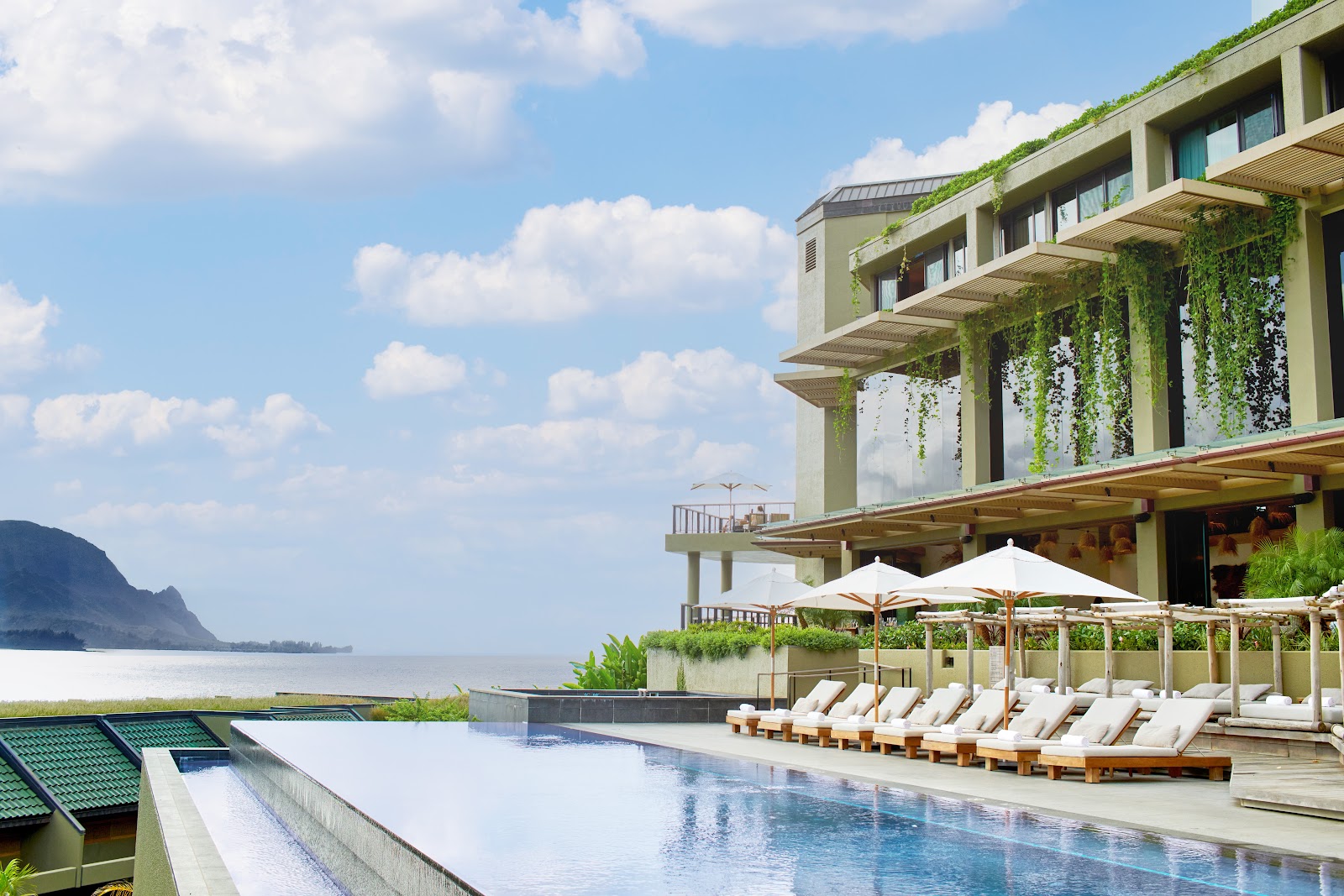
The bay, the river and the wet coast
The bay is the second environment and it behaves differently from an open ocean shore.
A broad crescent bay is partly sheltered, which means the water inside it is calmer than the open coast outside — so reflections are possible here at hours when an exposed shore is broken, and a still bay reflecting the waterfall wall is the second-best frame on the property.
The reflection rule applies: a reflection is about a stop darker than what it reflects, so compose so the reflection is of the dark green wall rather than of the bright sky, and the two sit within a stop of each other and need nothing at all.
The bay’s shelter also reverses seasonally and that is dealt with below, because a north-facing Hawaiian bay in winter is not a sheltered place at all.
The river mouth is the third element and it is a distinctive one. A river entering a bay brings fresh water, sediment and — after rain — a visible plume, which changes the water’s colour where it enters. That gives a frame with two water colours in it rather than one, and it gives a genuinely different foreground: a river mouth is flat, reflective and still in a way a surf-washed beach is not.
It also brings the valley behind it into view, which on this coast is a valley of taro fields — a cultivated wetland landscape of flooded terraces that reflect the sky and the wall above them. That is a frame of real distinction and whether it is accessible is a question worth asking.
The bluff is the fourth and it is the resort’s own position. Elevation above a bay gives what the beach cannot: a view down onto the water and the crescent, with the wall behind at eye level rather than above — which flattens the vertical relationship and makes the layering read more clearly. The bluff frames are the establishing ones and the beach frames are the intimate ones, and a set wants both.
The species distinction that governs every venue in these islands applies here and is absolute. Broadleaf canopy — monkeypod, mango, and the dense tropical understorey that a wet coast grows abundantly — blocks almost all light and gives soft reliable cover. Palms do the opposite: a frond is a row of stiff parallel blades, and with the sun within two degrees of vertical its shadow falls straight down a face as hard stripes that no exposure recovers.
Ironwood is the third and on a north-facing shore it is planted as a windbreak: fine-foliaged but dense in a stand, giving usable mottled shade and genuine shelter from the trades.
The architecture is the reliable cover and on a wet coast it matters more than on a dry one. Depth back from any covered edge is the whole lighting control: at the edge flat and frontal, two or three metres back dramatic with the ground beyond four or five stops down. And it works in rain, which on this coast is not a contingency but a regular event.
Two practical matters. Kaua’i’s red volcanic soil is famous and it stains fabric permanently — a genuine hazard to a white dress anywhere off the built surfaces, and worth a word before rather than a discovery after. And mosquitoes are a real consideration in a wet windward landscape with standing water, at any time of year rather than seasonally.
- The falls follow rain — a wet night before the date is good news
- Have three versions ready: falls running, wall green, wall in cloud
- The wall faces north: it rakes at the ends of the day and flattens at noon
- Expose for the wall and lift the faces; reduce the planes if the range is too wide
- Compress with a telephoto — wide flattens the wall into a green band
The north shore year
Hawai’i has two seasons rather than four and on Kaua’i’s north shore the difference is emphatic, because this is the wettest and most exposed coast in these guides.
The wetter season runs roughly November to March. The trades bring showers, winter frontal systems bring more, and Kona reversals bring heavy rain from the south-west — and this coast, on the windward flank of one of the wettest mountains on earth, receives a great deal of all of it.
For the frame this page is about, that is good news. The waterfall wall runs most reliably and most spectacularly in the wetter months, the green is at its most saturated, the cloud on the wall is at its most dramatic, and rainbows are at their most frequent — because a rainbow needs sun behind the photographer and rain in front, which on a north-facing windward coast in winter is a regular combination.
The light is better too. The December noon sun at about forty-four degrees is the lowest of the year, which means the wall is modelled for a substantially longer period than the hour after dawn that summer allows.
The costs are substantial and they need stating. This is the big-surf season on a north-facing Hawaiian shore: from November to February the North Pacific swell arrives on this coast at a scale that closes beaches and makes the water’s edge genuinely hazardous. A sheltered crescent bay is much less sheltered than it looks when a large winter swell is running into it.
Heavy rain also closes roads and access on this coast with some regularity, which is a logistics matter rather than a photographic one but a real one.
The drier season runs roughly May to September. The trades are steadier, the showers are briefer and more localised, and the swell drops away — often to flat calm, which makes the bay glassy, blue and reflective.
That is when the bay is at its best as water: a still crescent reflecting the wall, the river mouth flat and mirror-like, the beach wide and dry, and the whole shoreline walkable.
The costs are the sun and the falls. A near-vertical noon sun is at its worst in these months, which pushes the whole usable day to its ends. And the waterfall wall runs less — often reduced to one or two persistent falls, or none — which removes the element that makes the venue distinctive.
So the trade is unusually clean and worth stating plainly: winter for the waterfalls, the light and the drama, at the cost of a hazardous shoreline and unreliable access. Summer for the calm bay, the walkable beach and the reflections, at the cost of the falls and the hardest sun of the year.
There is no autumn colour in these islands and no dormant season. Tropical vegetation holds its leaves year-round — and on a coast this wet it is green in every month regardless. Nothing in an image made here says what month it is except the state of the sea, the number of waterfalls and the angle of the light.
What does change is flowering, and on a wet windward coast the tropical flowering trees are abundant and on their own cycles — a question for the resort’s grounds staff rather than an assumption. And central Pacific hurricane season runs from June to the end of November; direct strikes are rare but Kaua’i has been hit, and it belongs in a planning conversation for a late-summer date.
More frames from The St. Regis Princeville
The St. Regis Princeville wedding photography: common questions
What makes the frame distinctive?
The wall behind Hanalei Bay runs with waterfalls after rain — sometimes dozens at once, thin white lines down a dark green face.
So when is it best?
After a wet night. The falls appear within hours of significant rain and fade over a day or two, which means rain before the date is good news.
What if there are no falls?
Have three versions ready: falls running, wall green and fluted, or wall in cloud with the frame becoming bay, beach and mist. All three work.
When is the wall modelled?
At the ends of the day. The bay opens north, so the wall is lit obliquely in the early morning and late afternoon and flattens at noon.
How do I expose so many planes?
For the wall, and lift the subjects with a close source. If the range is too wide, reduce the number of planes rather than compromise the exposure.
Winter or summer?
Winter for the waterfalls, the lowest sun and the drama, at the cost of a hazardous shoreline. Summer for a calm reflective bay and a walkable beach, at the cost of the falls.
More Hawaii venue guides
We are writing a photographer’s guide to every venue we would happily shoot in Hawaii. Here are three more, plus the full index:
- Turtle Bay Resort, O’ahu: A Walk Through the Site
- Waikoloa Beach Marriott: What It Suits and What It Does Not
- Waimea Valley, Haleiwa: A Walk Through the Site
Planning a wedding at The St. Regis Princeville?
A wall that runs with water after rain. Tell us your date and we will watch the forecast.