 The Laniakea YWCA: A Building Organised Around Its Courtyard
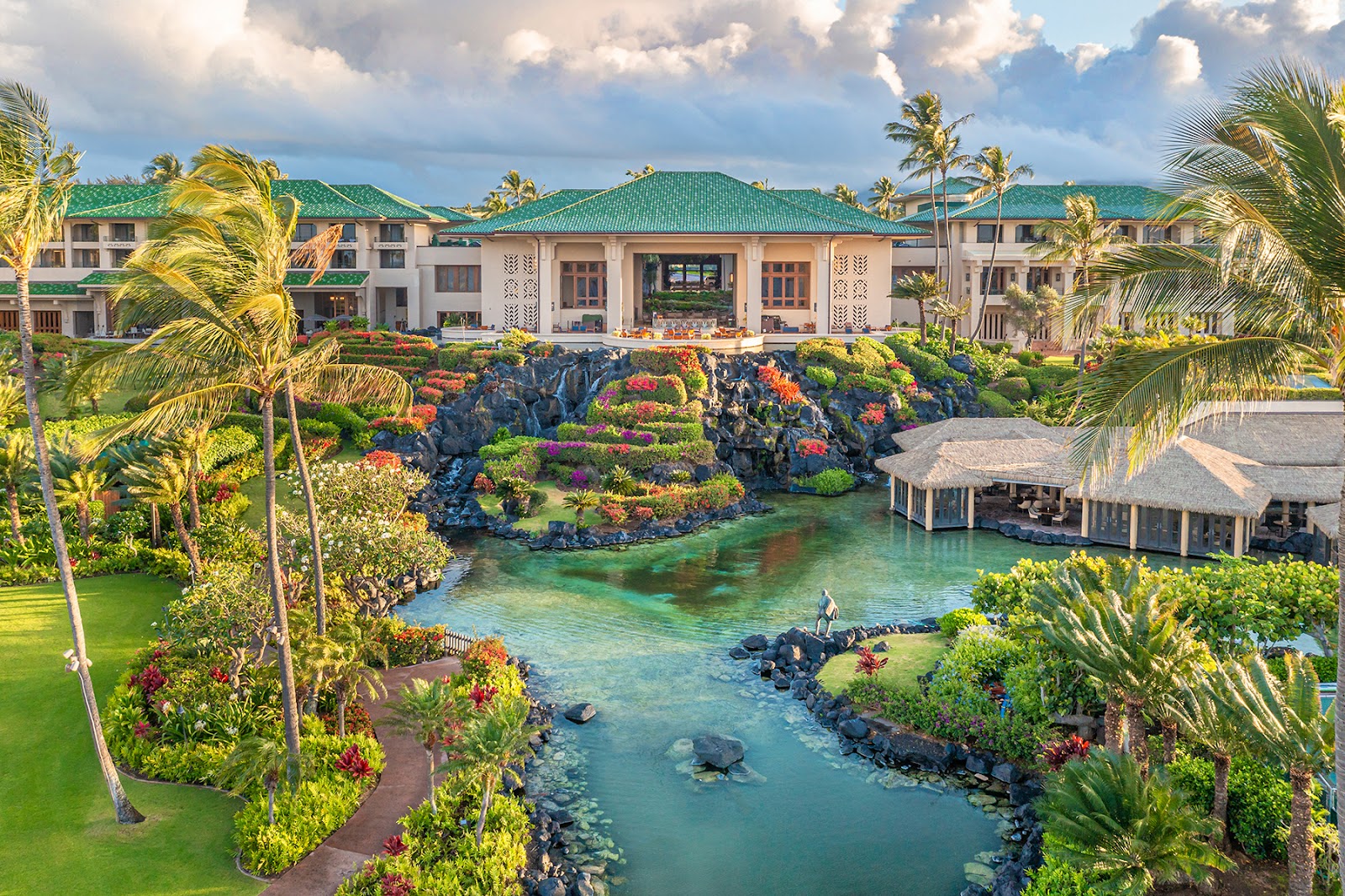
Grand Hyatt Kaua’i, Koloa: What It Suits and What It Does Not
Semi-arid, a few miles from one of the wettest places on earth.
A resort on Kaua’i’s south shore is a particular proposition and the honest way to describe it is by what a semi-arid coast on an old island suits and does not suit.
The rain shadow here is the most extreme in these guides. Kaua’i’s interior peak is one of the wettest places on earth, receiving many hundreds of inches a year; the south shore, a short distance away in its lee, is semi-arid and receives a fraction of that. A photographer working on this island can drive from a rainforest to a dry coast in under an hour.
The practical consequence is reliability. The south shore is sunny and dry when the north shore is not, which makes it the island’s dependable coast — and that dependability is the venue’s real product.
The second fact is the island’s age. Kaua’i is the oldest of the main Hawaiian islands by a wide margin, which means its rock has had far longer to weather. The result is deeply eroded terrain, a thick red soil, and a shoreline of lithified sand and old weathered rock rather than the young black basalt of Hawai’i Island — which changes the colour palette entirely.
Instead of black rock, white sand and blue water, the south shore of Kaua’i gives tan and ochre rock, red soil, dry golden vegetation and blue water. That is a warmer, lower-contrast palette than the younger islands offer, and it behaves completely differently in a frame.
The third is the latitude. Koloa sits at about twenty-two degrees north, which means the June noon sun reaches about eighty-eight degrees — effectively vertical — and even at the December solstice it still reaches about forty-four.
Days run only from about eleven hours to thirteen and a third, and civil twilight is around twenty-three minutes — among the shortest in this guide.
We have not photographed a wedding at this resort. Which spaces and grounds are included, what beach and shoreline access allows, what covered alternatives exist and what the permitted hours are, are questions for their team.
Grand Hyatt Kaua'i at a glance
| Where | A large resort on the semi-arid south shore of Kaua’i |
| The rain shadow | The most extreme in these guides — a rainforest and a dry coast within an hour |
| The rock | Old and weathered: tan and ochre rather than young black basalt |
| Suits | Reliability, a warm low-contrast palette, extensive planting, and groups |
| Does not suit | Midday, palm shade, red soil near a white dress, or a leisurely dusk |
What it suits
It suits reliability, and on Kaua’i that is worth more than at any other island in these guides. The north shore is spectacular and frequently rained out; the south shore is dependable. A plan made here usually happens, and for a wedding that is the decisive practical fact.
It suits the warm palette, which is worth understanding because it is the opposite of the younger islands’. Old weathered rock here is tan, ochre and grey-brown rather than black; the soil is a strong red; the dry-country vegetation is golden rather than deep green for much of the year.
That gives a frame in which the warm tones dominate and the water supplies the only cool one — which is a considerably easier tonal range than the near-black-to-near-white extremes of a young lava coast. A subject on this shore sits in a coherent warm palette rather than between two extremes, and a white dress reads clearly against tan rock without any of the exposure difficulty that black lava produces.
The red soil is the strongest colour available and it should be used deliberately. Kaua’i’s red dirt is famous, and a subject on a red track against green or golden vegetation under a blue sky is a three-colour frame that no other venue type in these islands offers.
The warning that goes with it is serious and belongs early: red volcanic soil stains fabric permanently. That is a genuine hazard to a white dress and it needs saying before anyone walks off a built surface rather than after.
It suits the lithified rock along this shore, which is the coast’s most distinctive material. Old consolidated sand dunes weathered into cliffs and platforms give a surface that is bedded, layered and fine-textured — quite unlike the coarse broken texture of young lava — and it takes raking light beautifully, showing the bedding planes as fine horizontal lines.
That makes it a first-or-last-hour surface: under a high sun it is a flat tan field, and under low light crossing it, it becomes a layered structure. A five-minute check of which faces point which way is worth more than an hour of walking.
It suits the planting, which at a large resort on a dry coast is extensive and irrigated. That matters because it supplies what the natural landscape here does not: dense broadleaf canopy for cover, and strong flowering colour against a warm-toned background.
The species distinction in these islands is absolute and it decides where a portrait can be made. Broadleaf canopy — monkeypod above all, plus banyan and mango — blocks almost all light and gives soft reliable cover. Palms do the opposite: a frond is a row of stiff parallel blades and with the sun within two degrees of vertical its shadow falls straight down a face as hard stripes.
It suits groups on the beach. The sand here is pale and has a high albedo, which returns light upward and fills faces from below — precisely where a vertical sun leaves them dark — and a broad dry beach is level, clean and generous. The exposure caution is the standard one: compensate positively by a stop or more and check on skin.
And it suits the south-shore swell calendar, which is worth naming because it is the reverse of the north’s. A south-facing Hawaiian shore is sheltered from the big winter North Pacific swell and exposed to summer’s southern swells — which means the water here is calmest from November to March and liveliest in summer, exactly opposite to the famous north-shore pattern.
What it does not suit
It does not suit the middle of the day. At about twenty-two degrees north the June noon sun reaches eighty-eight degrees, which is effectively vertical: eyes in shadow, foreheads lit, and no position on open ground that fixes it. A dry coast has fewer clouds to soften it than a wet one.
The answers are architectural and botanical. Depth back from any covered edge — a lanai, a colonnade, a porte-cochère, a doorway — is the whole lighting control: at the edge flat and frontal, two or three metres back dramatic with the sunlit ground beyond four or five stops down. And under the irrigated broadleaf canopy, which on a dry coast is deliberate planting rather than natural cover and therefore has to be located.
It does not suit palm shade, and at a resort planted with many palms that needs saying plainly. They are background and silhouette material — good ones — and never cover.
It does not suit red soil anywhere near a white dress, and this is the venue’s most practical warning. Kaua’i’s red dirt stains permanently, it is fine enough to become airborne in wind, and it is present anywhere off the irrigated ground and the built surfaces.
That means the usable positions on the drier parts of the property are the paths, the lawns and the beach — and that a walk into the dry scrub for a frame is a decision with a cost. A photographer can go where the party cannot, which means a long lens from the red ground with the subjects on clean ground is the version worth planning.
It does not suit an unplanned dusk. Civil twilight here is about twenty-three minutes and the sun descends steeply at this latitude, which means the fall from usable light to dark is abrupt. A plan assuming a leisurely golden hour will lose most of it.
The south shore’s orientation compounds this. A south-facing coast does not get the sun going down into the water squarely — the sun sets to the west, which from a south-facing beach is along the shore rather than out to sea. That means the backlit-over-water frame is oblique here rather than head-on, and the strongest low-light frames are the ones that use the sun crossing the beach rather than setting into it.
The practical consequence is that side light is the south shore’s characteristic condition at the ends of the day: a low sun raking along the beach, modelling faces from one side, with the water as a bright field rather than a backdrop. That is easier than backlight and it is the frame to plan for.
It does not suit anyone expecting Kaua’i’s famous landscapes. The island’s celebrated features — the fluted cliffs, the waterfall walls, the rainforest canyons — are on the wet north and west sides, not on the dry south. A couple who chose Kaua’i for those and booked a south-shore resort will need to travel for them, and that transit is substantial on an island with one coastal road.
Whether such a trip is possible on the day is a question worth asking early rather than assuming, because it changes what the whole set can contain.
And two practical matters. Salt aerosol on an exposed south shore settles on front elements within minutes rather than hours. And the trades reach this coast around the island’s flanks rather than head-on, which makes the wind moderate by Hawaiian standards but persistent — a lightstand is still a liability.
- A warm coherent palette: tan rock, red soil, gold vegetation, blue water
- Lithified rock shows its bedding under raking light and flattens at noon
- Red soil stains permanently — the photographer goes there, the dress does not
- On a south shore the low sun rakes along the beach rather than setting into it
- Irrigated monkeypod is the cover; palms are background only
The south shore year
Hawai’i has two seasons rather than four and on Kaua’i’s south shore the rain shadow flattens the difference — which is the whole appeal.
The drier season runs roughly May to September. The trades are steadiest, the rain shadow is at its most effective, and the south shore is genuinely dry and sunny.
The costs are the sun and the swell. The near-vertical noon sun is at its worst in these months, with few clouds to diffuse it. And summer is the south shore’s swell season: southern-hemisphere swells arrive on this coast between roughly April and October, which means the water is liveliest and the beaches are most affected in exactly the months the north shore is flat.
That reversal is worth planning around. A beach ceremony at the water’s edge is a different proposition in July than in January on this coast, and it is the opposite of what someone familiar with the north shore would assume.
The dry season also browns the vegetation, which changes the palette. Dry-country grass and scrub go golden, which against tan rock and red soil gives an unusually warm and coherent landscape — arguably the most photographically distinctive state this coast reaches, and one that a green tropical expectation does not anticipate.
The wetter season runs roughly November to March. Even on the south shore the rain increases in these months, and Kona reversals bring heavy rain from the south-west, which is the one condition that genuinely wets this coast.
For photographs the wetter season is better in four ways. The December noon sun at about forty-four degrees is the lowest of the year, which means the middle of the day is workable rather than hostile and the lithified rock is modelled for far longer than the hour after dawn that summer allows. Cloud is more frequent, which softens the contrast. The sea is calmest, because a south-facing shore is sheltered from the winter swell. And the vegetation greens.
And it is whale season: humpbacks are in Hawaiian waters from roughly December to April and they pass this coast, which means a frame looking out over the water in those months can contain them.
Winter also brings more rain to the island’s interior, which matters indirectly but significantly: the waterfalls and the green of Kaua’i’s famous wet side are at their best in exactly the months the south shore is most pleasant — which makes a winter date the one that makes an island-wide day worthwhile if travel is possible.
There is no autumn colour in these islands and no dormant season in the ordinary sense, but the dry-country vegetation here does have a genuine seasonal change: green after winter rain, golden through the dry months. That is the only real seasonal cue available at this venue and it is the reverse of a temperate one — the landscape is greenest in winter and driest in summer.
Central Pacific hurricane season runs from June to the end of November. Direct strikes on the islands are rare, but Kaua’i has been struck, and it belongs in a planning conversation for a late-summer date rather than in a forecast.
The honest summary: this coast is chosen for reliability and it delivers it. Winter gives the better light, the calmer sea, the greener ground and the whales; summer gives the golden palette, the steadiest trades and a livelier shore. Either way the middle of the day belongs to the architecture and the canopy, and the red soil stays away from the dress.
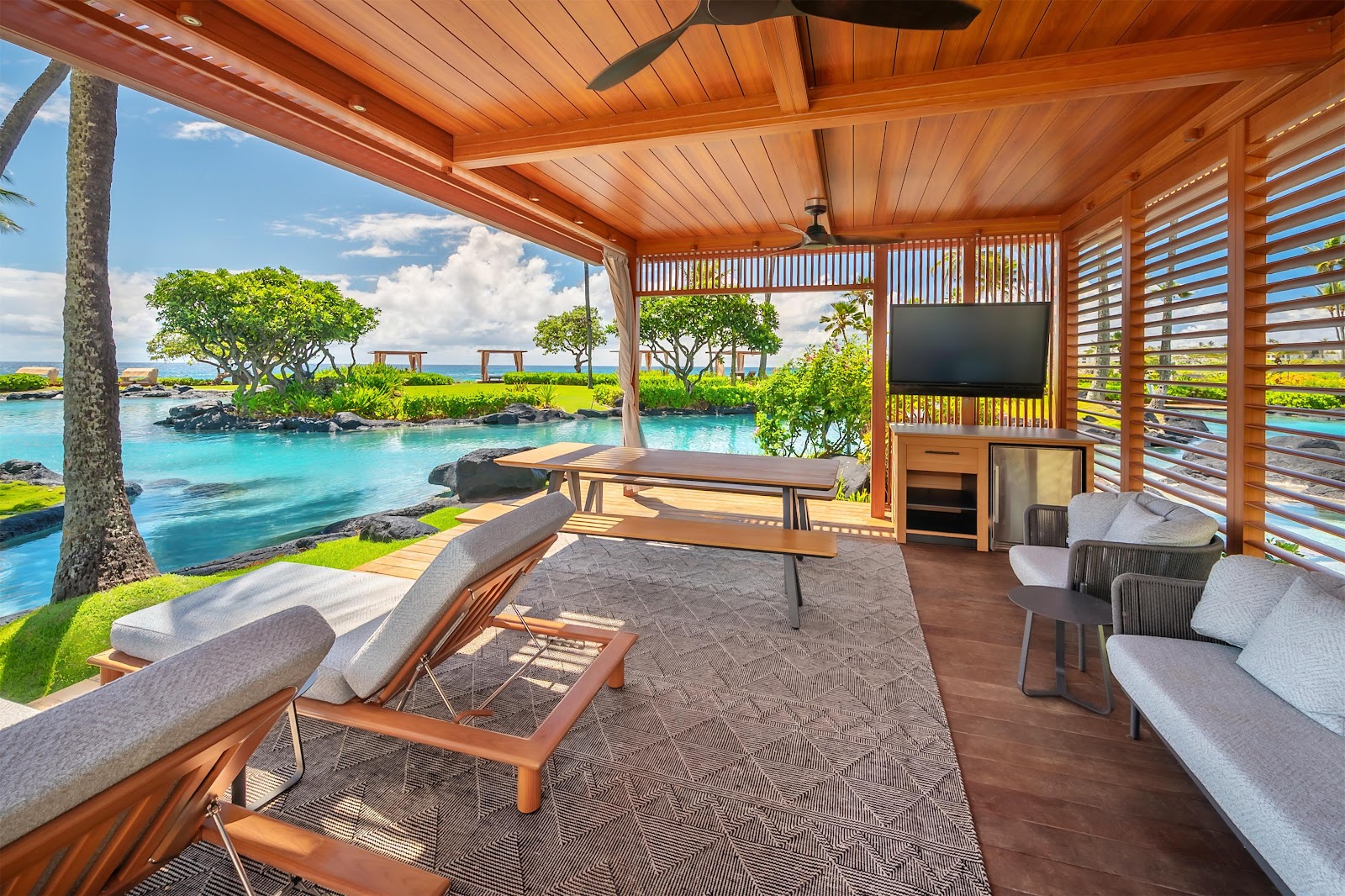
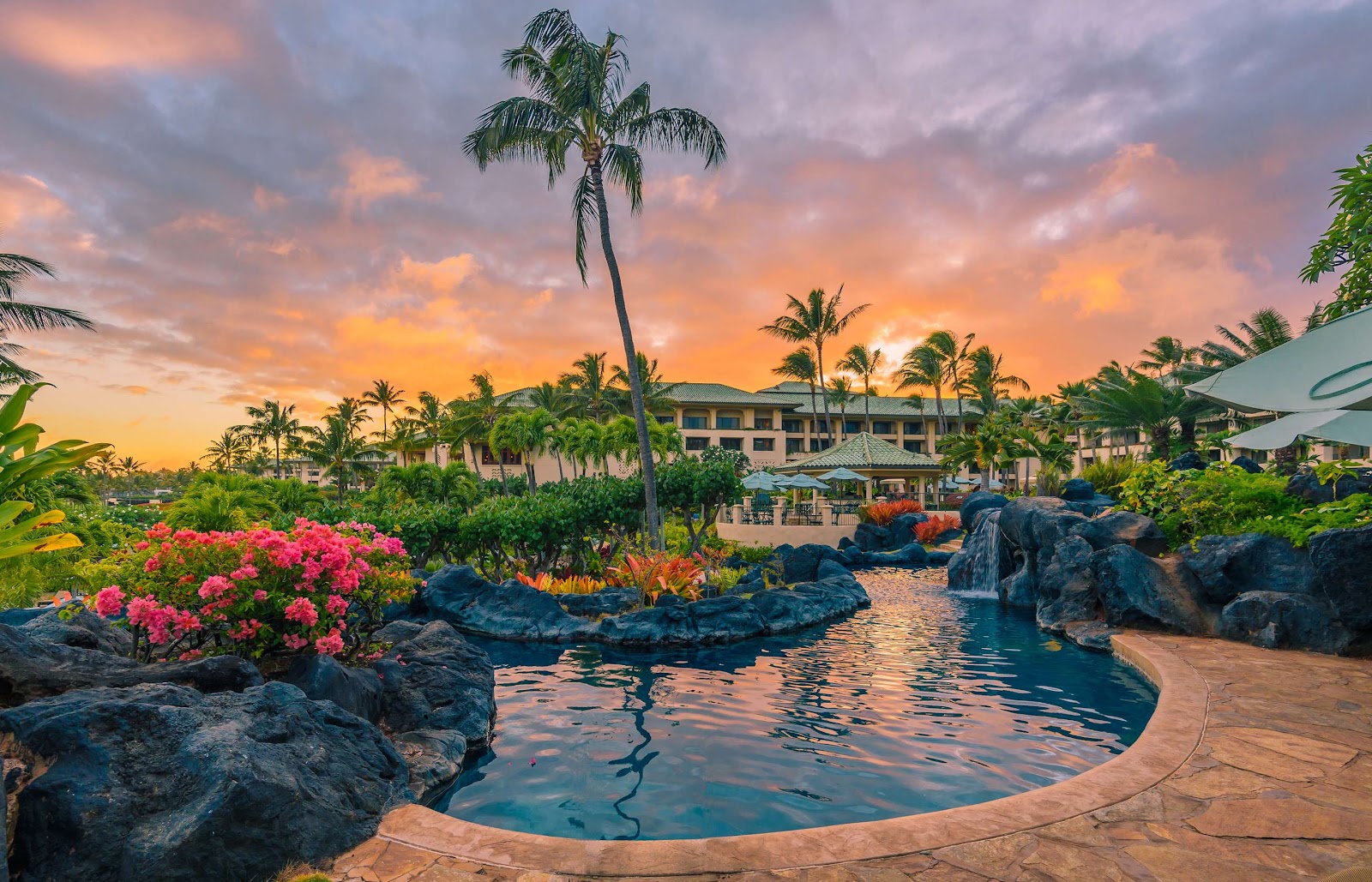
More frames from Grand Hyatt Kaua'i
Grand Hyatt Kaua'i wedding photography: common questions
Why choose the south shore?
Reliability. It sits in the rain shadow of one of the wettest mountains on earth, so it is sunny and dry when the north shore is not.
What is different about Kaua'i's rock?
The island is the oldest of the main Hawaiian islands, so its rock is deeply weathered — tan and ochre rather than black — which gives a warm, coherent, low-contrast palette.
What is the warning about the soil?
Kaua’i’s red dirt stains fabric permanently. The photographer can work from it; the dress stays on the built surfaces and the lawns.
Does the sun set into the water here?
Not squarely. On a south-facing shore the sun sets along the beach rather than out to sea, which makes side light the characteristic evening condition.
How does the swell season work here?
The reverse of the north shore. This coast is calmest from November to March and liveliest in summer, when southern swells arrive.
When is the coast at its best?
Winter: the lowest sun of the year, more cloud, the calmest sea, greener ground and whales offshore — and the island’s wet side at its best if travel is possible.
More Hawaii venue guides
We are writing a photographer’s guide to every venue we would happily shoot in Hawaii. Here are three more, plus the full index:
- Grand Wailea, Wailea: How the Light Moves on a Leeward Resort
- Hā: Breath of Life, Laie: One Frame and How It Is Made
- Ho’omaluhia Botanical Garden, Kaneohe: One Frame and How It Is Made
Planning a wedding at Grand Hyatt Kaua'i?
The island’s reliable coast. Tell us your date and we will keep the dirt off the dress.