 The Laniakea YWCA: A Building Organised Around Its Courtyard
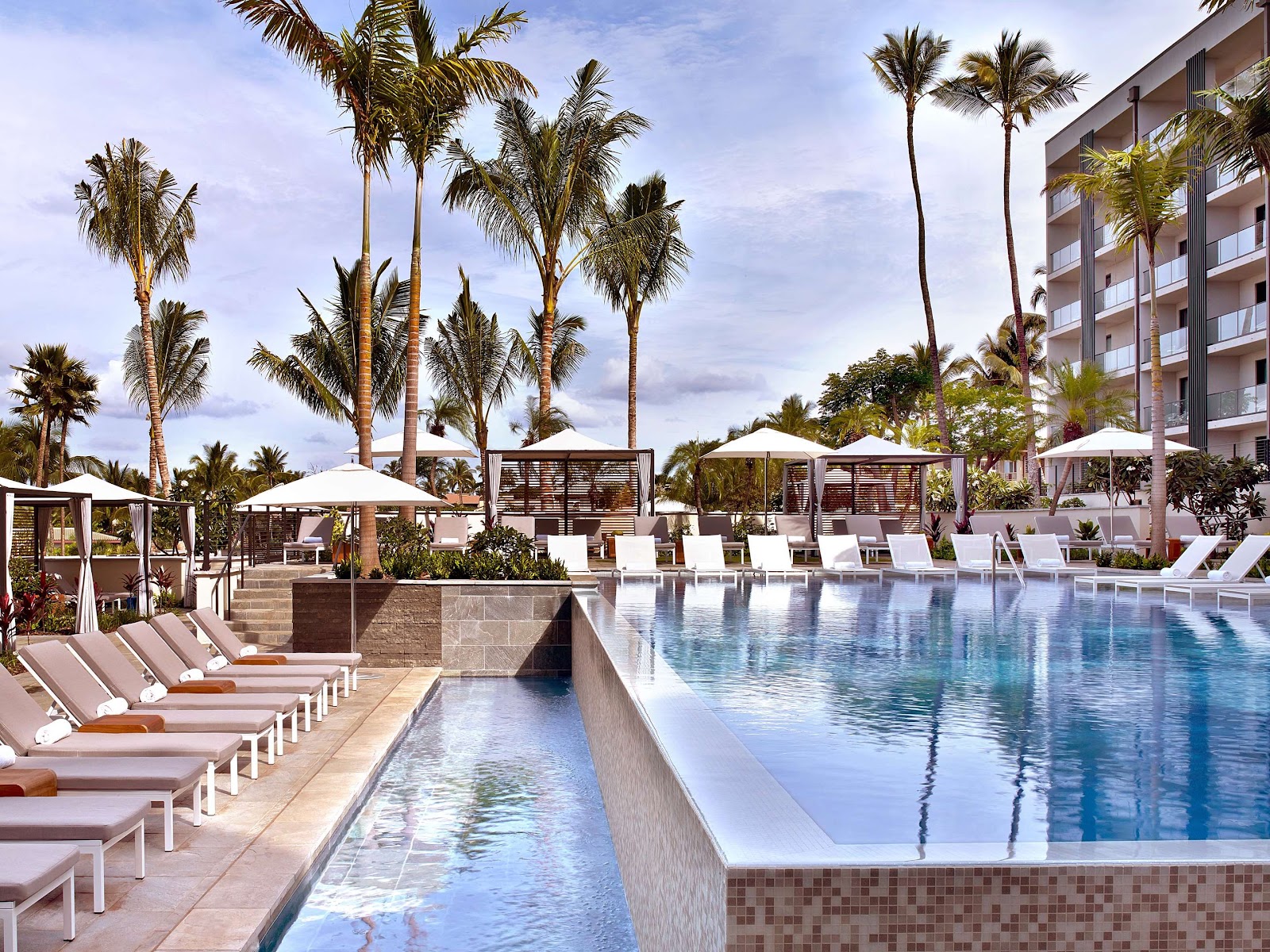
Andaz Maui at Wailea: A Walk Through the Site
Terraced down a slope, and built as geometry rather than decoration.
The best way to describe this property is to walk down it, because it is terraced — a sequence of levels stepping from the entrance at the top to the beach at the bottom — and each level is a different photographic environment.
The architecture is the second organising fact and it is worth naming precisely. This is contemporary design rather than plantation revival or resort vernacular: flat planes, straight lines, right angles, water held in geometric terraces, and a restricted palette of stone, concrete, timber and glass.
That means the building is not a backdrop in the way a decorated one is. It is a set of shapes, and a photograph containing it is partly about those shapes — which gives two coherent approaches and one incoherent one, exactly as at any assertive piece of architecture.
Geometry as the subject: the couple placed where a line or a plane wants a figure, small enough that the composition reads, with the architecture carrying the frame. Geometry excluded: close frames, a plain section of stone or plaster, a subject against the sea or the sky, with nothing angular in shot.
The incoherent middle is a portrait at conversational distance with half a wall, a corner of a terrace and a diagonal of handrail behind the subjects, none of it legible and none of it chosen. That frame happens by default at any modern building.
The third fact is the setting: the dry leeward south coast of Maui, in the deep rain shadow of a ten-thousand-foot volcano, facing west. That makes it reliable, sunny and — decisively — a coast where the sun sets into the ocean.
Wailea sits at about twenty and seven-tenths degrees north. The June noon sun reaches about eighty-eight degrees and passes exactly through the zenith twice a year, in late May and mid-July; the December noon sun still reaches about forty-six. Days run only from about eleven hours to thirteen and a quarter, and civil twilight is around twenty-two minutes.
We have not photographed a wedding at this resort. Which spaces and grounds are included, what beach access allows, what covered alternatives exist and what the permitted hours are, are questions for their team.
Andaz Maui at Wailea at a glance
| Where | A contemporary terraced resort above a beach on Maui’s dry leeward south coast |
| The architecture | Modern geometry: flat planes, straight lines, right angles, water in terraces |
| The decision | Geometry as the subject, or excluded entirely — never half-visible |
| The walk | Terraces stepping from the entrance down to the sand |
| Ask first | Included spaces, beach access, covered alternatives, permitted hours |
The terraces and the geometry
Start at the top, because the upper terraces are where the architecture is most assertive and because the light there is the most controlled.
Modern geometry gives two things a decorated building does not. The first is plain surfaces: large uninterrupted areas of stone, concrete or plaster, which are the most colour-neutral backgrounds available anywhere — mid-toned, almost entirely unsaturated, and therefore kind to skin and to a white dress. In a landscape of blue water, pale sand and green planting, one genuinely neutral field is what lets everything else be judged.
The cost of a plain surface is that it is unforgiving. A blank plane shows every misalignment, which means a frame a degree off level against a concrete edge reads as an error immediately, and a subject placed almost-but-not-quite deliberately looks careless. Precision matters more at a modern building than at a textured one, and there is nothing to hide in.
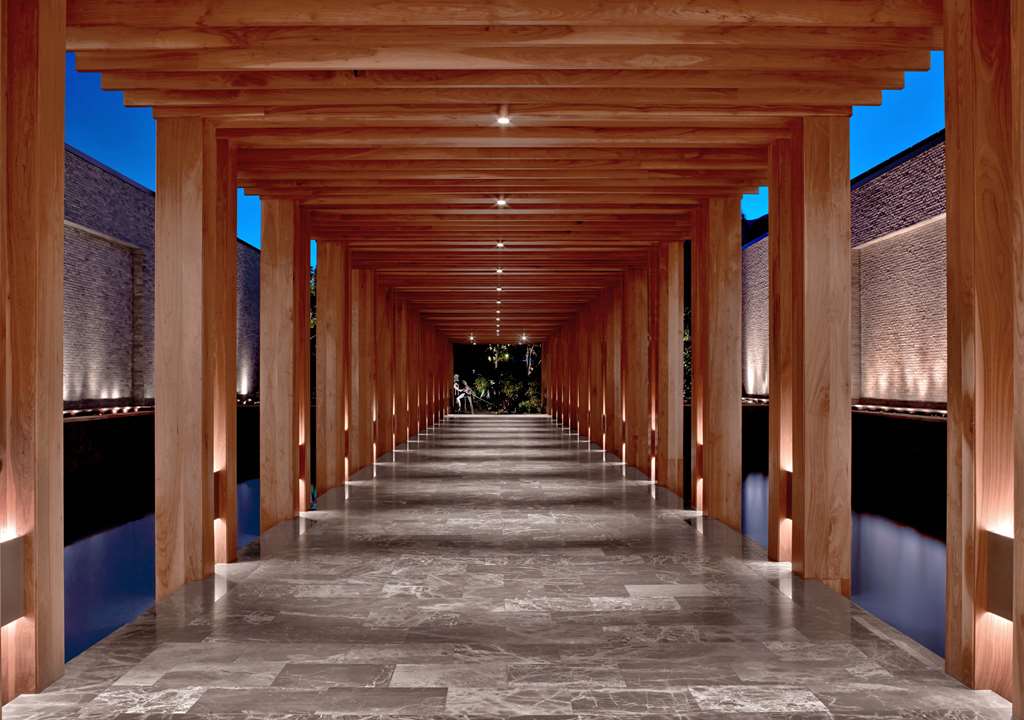
The second thing geometry gives is lines, and they have to be used rather than tolerated. A straight edge running to a vanishing point is a leading line; a level change is a horizontal; a stair is a diagonal; a repeated colonnade or fin is a rhythm. Each of those is a strong compositional element, which means a subject placed on one is composed by the building and a subject placed near one is fighting it.
The rule is the same as for any strong element: a line either arrives at the subjects or it should be out of frame. A line that passes them pulls the eye out of the picture.
The water terraces are the site’s signature and they do something ornamental water rarely does: they are geometric, which means their reflections are geometric too. A rectangular still pool reflects a rectangular piece of sky and a straight edge of building, and a subject standing at its edge is doubled precisely rather than loosely.
That is worth exploiting, and the reflection rule applies: compose so the reflection is of something dark — a stone wall, a planted mass, a shaded soffit — rather than of the bright sky, and the two sit within a stop of each other and need nothing at all.
Geometric water is also calm more often than natural water, because it is enclosed and sheltered by the building itself — which means the reflections here are available at hours when the ocean below is broken and even a sheltered bay is textured. On a trade-wind coast that is a genuine advantage.
The covered edges are the third element on the terraces and they are the whole midday answer. Depth back from any roofed edge — a lanai, a soffit, a colonnade, a porte-cochère, a doorway — is the lighting control: at the edge flat and frontal, two or three metres back dramatic with the sunlit terrace beyond four or five stops down.
Modern architecture gives these in a specific form worth noting: a deep flat soffit over a terrace is a very clean mask, with no decoration and a hard straight edge, which makes the fall-off unusually abrupt and the transition line itself a compositional element. A subject standing exactly at the line between lit and shaded terrace, with the shade behind them, is a frame the building supplies.
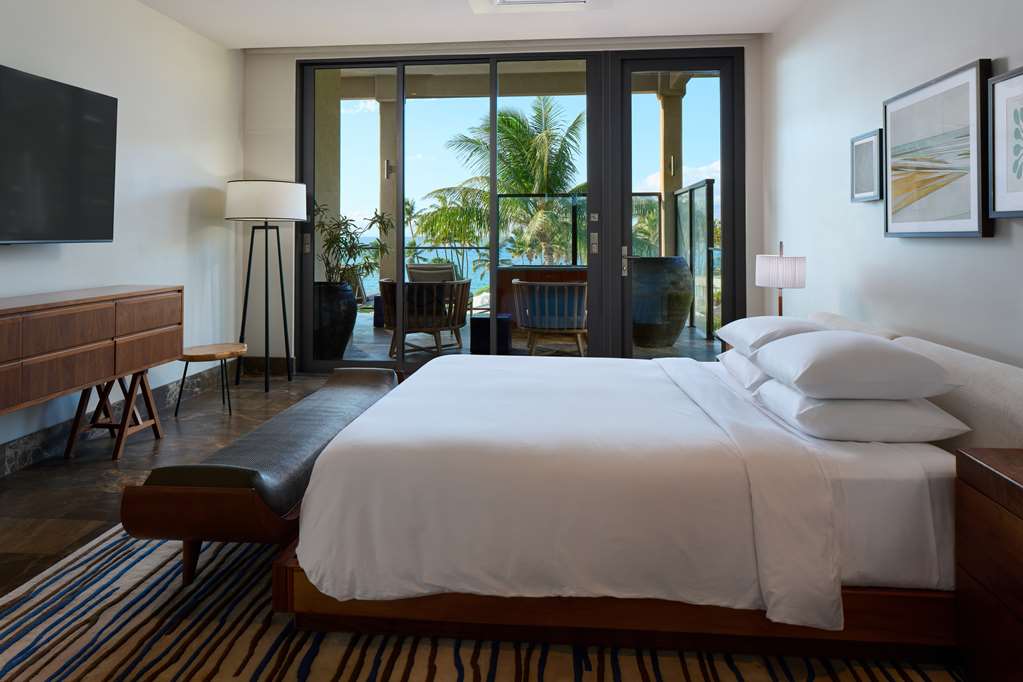
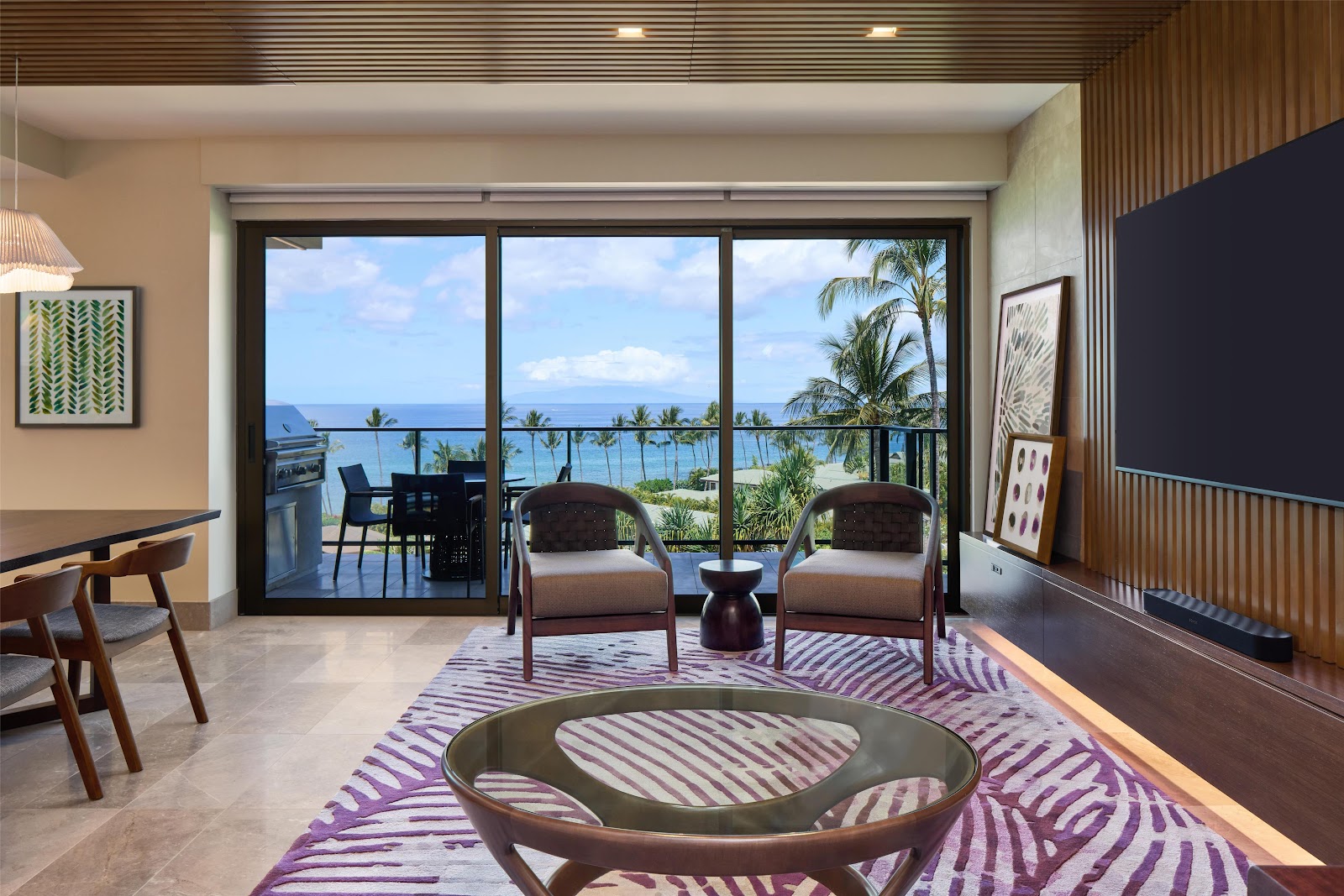
And the glazing. A large window wall is a room-sized softbox, and on this coast the light coming through it has bounced off pale sand and bright water rather than off vegetation — brighter, cleaner and cooler than any inland window. A subject at forty-five degrees to it gets a lit side and a shadow side; the white balance goes on a face, because sand-and-sea light is noticeably cool.
The planting, the beach and the leeward evening
Walking down, the planting becomes the dominant element between the terraces and it does two jobs that the architecture cannot.
The first is colour. A restricted palette of stone, concrete, timber and glass has almost no saturation in it, which means the planting supplies all of it — and a subject in front of a dense flowering mass at portrait distance, thrown soft, has a colour field behind them that nothing else on the property provides.
The bounce caution applies: a large mass of saturated colour in sunlight reflects its own hue onto skin at close range, which is an effect if intended and a problem if not. Control it with distance — at two metres it dominates, at six it is a cast, at fifteen it has gone.
The second is darkness. Modern architecture on a bright coast is overwhelmingly pale, and dense planting is the only near-black mass available — which makes it disproportionately valuable. A subject a metre inside a dense broadleaf planting, facing out toward the lit terrace, has soft directional light in front and three or four stops of dark behind.
The species distinction in these islands is absolute and it decides which planting is cover and which is background. Broadleaf canopy — monkeypod above all, which has an enormous spreading crown of small dense leaves and gives the best natural shade in Hawai’i, plus banyan and mango — blocks almost all light. Palms do the opposite: a frond is a row of stiff parallel blades and with the sun within two degrees of vertical its shadow falls straight down a face as hard stripes.
A resort of this kind is planted with many palms, and on a terraced property they are often placed deliberately as vertical accents against the horizontals of the architecture — which is a genuinely good use of them, as background and as silhouette, and never as cover.
The beach at the bottom is the last stage and it is a different venue from the terraces above it.
The sand is pale with a high albedo, which returns light upward and fills faces from below — precisely where a near-vertical sun leaves them dark — which means a beach portrait here survives hours that would be unusable on the terraces. And it fools a meter by a stop or more, which needs deliberate positive compensation checked on skin.
Sea level is the second difference: a subject on the beach has the ocean behind them as a horizon rather than below them as a plane, which makes a silhouette against a clean sea horizon possible in a way it is not from a terrace.
And wet sand at the water’s edge is a mirror, which a low camera can use to double a coloured sky — the one reflective surface on the property that is not geometric.
The leeward evening is the reason to be on this coast and it is reliable. A west-facing shore in a deep rain shadow gets the sun going down into the ocean on most evenings, and the three backlight answers apply: a close warm-gelled source at a stop over the ambient with the exposure set for the sky and water; a silhouette exposed for the sky alone; or turning around and using the low sun frontally with the terraced architecture behind — which on a modern building lit low and warm is a strong frame and the one people forget.
Two practical notes. Civil twilight here is about twenty-two minutes, which means the evening sequence must be decided in advance and cannot include a descent. And salt aerosol on an exposed leeward shore settles on front elements within minutes rather than hours, while vog — volcanic haze from Hawai’i Island — drifts onto this coast with some regularity, softening distance and reddening the low sun.
- Geometry as the subject or excluded — and precision, because nothing hides
- A line either arrives at the subjects or should be out of frame
- Geometric water is calm more often than natural water, and reflects precisely
- Depth back from a flat soffit gives an unusually abrupt fall-off
- Planting supplies all the colour and all the darkness on a pale property
The leeward year
Hawai’i has two seasons rather than four and on a coast in the rain shadow of a ten-thousand-foot volcano the rain barely arrives.
That makes this among the most weather-reliable venues in these guides, and for a terraced outdoor property the reliability is the product: a plan made here usually happens in any month.
The drier season runs roughly May to September. The trades are steadiest, the rain shadow is at its most effective, and the sunset over water is available on most evenings.
The costs are the sun and the vog, and both fall hardest on this kind of property. The near-vertical noon sun is at its worst in these months, with the two overhead-passage dates in late May and mid-July, and a modern building of pale flat planes under a vertical sun is the least flattering combination it ever presents — the surfaces blow, the shadows are hard-edged and black, and there is no decorative texture to hold anything.
And vog softens distance, which removes the long views out across the channels that a terraced property is positioned for, and reddens the low sun.
The wetter season runs roughly November to March and on this coast it is not very wet. The trades are interrupted more often by Kona weather — a south-west reversal, the one condition that brings real rain here — and cloud is generally more frequent.
For photographs the wetter season is better in four substantial ways at this venue specifically. The December noon sun at about forty-six degrees is the lowest of the year, which means the middle of the day is workable rather than hostile and the architecture’s planes are modelled rather than blown. Cloud is more frequent, which softens the extreme contrast that pale stone and concrete produce under a tropical sun — and modern architecture photographs considerably better under soft light than under hard, because its interest is in shape rather than in texture.
Vog is less persistent, so the long views are clear more often. And it is whale season: humpbacks are in Hawaiian waters from roughly December to April and the channels off south Maui are where they concentrate most densely, which means a seaward frame from a terrace can contain them.
Winter also brings the calmest sea of the year to a south-facing coast, which is the reverse of the north shores: the big North Pacific swell arrives on the north side from November to February while the south stays placid, and the south’s swells come in summer. For a beach ceremony at the bottom of the terraces that is directly useful.
And a chance of snow on Haleakala’s summit above, which from this coast is visible — a snow-capped volcano above a modern terraced resort is an unlikely juxtaposition and a genuinely good frame.
There is no autumn colour in these islands and no dormant season. The planting is irrigated tropical and holds its leaves year-round, which removes the seasonal cue photographs elsewhere in this guide depend on — so nothing in an image made here says what month it is except the angle of the light, the clarity of the air, the state of the sea and whether there are whales in it.
What does change is flowering, and on a property where the planting supplies all the colour that is the single most useful question to ask the grounds staff before a date. Central Pacific hurricane season runs from June to the end of November, though direct strikes are rare.
More frames from Andaz Maui at Wailea
Andaz Maui at Wailea wedding photography: common questions
What is the decision about the architecture?
Geometry as the subject, with the couple placed where a line wants a figure — or geometry excluded entirely. The half-visible middle says neither.
Why does precision matter more here?
A plain plane shows every misalignment. A degree off level against a concrete edge reads as an error immediately, and there is no texture to hide in.
What is special about the water terraces?
They are geometric, so the reflections are precise rather than loose — and being enclosed and sheltered, they are calm at hours when the ocean is broken.
What does the planting do?
Everything the architecture cannot: it supplies all the saturated colour and all the near-black mass on an otherwise pale property.
Where is the midday shade?
Depth back from a flat soffit or colonnade — modern architecture gives an unusually clean mask and an abrupt fall-off — or inside dense broadleaf planting.
When does the building photograph best?
The winter months. Soft cloud and a lower sun suit architecture whose interest is shape rather than texture, and they stop the pale planes blowing out.
More Hawaii venue guides
We are writing a photographer’s guide to every venue we would happily shoot in Hawaii. Here are three more, plus the full index:
- Byodo-In Temple, Kaneohe: One Frame and How It Is Made
- The Fairmont Orchid, Kohala Coast: Field Notes, Problem and Solution
- Four Seasons Resort Hualalai, Kailua-Kona: What It Suits and What It Does Not
Planning a wedding at Andaz Maui at Wailea?
A building of lines and a coast that delivers. Tell us your date.