 The Portland Regency: A Season-by-Season Guide
Norumbega Inn, Camden: A Walk Through the Site
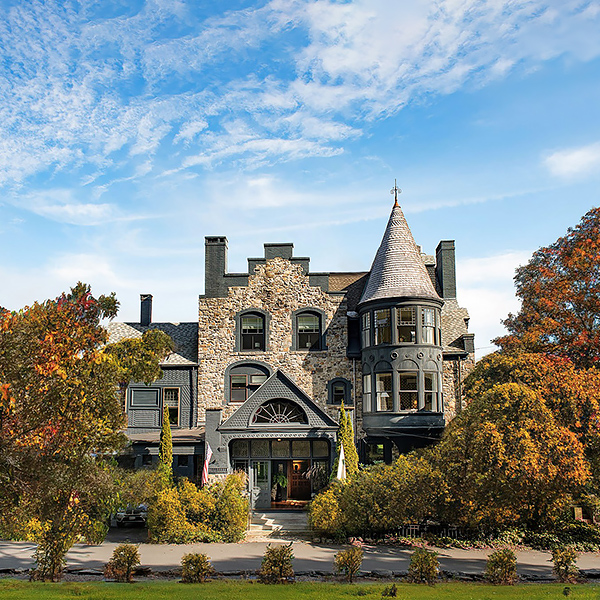
Built of the local granite and lined with dark timber. Both absorb.
The useful way to describe this building is to walk it, because it is made of two materials and each one does something specific to light.
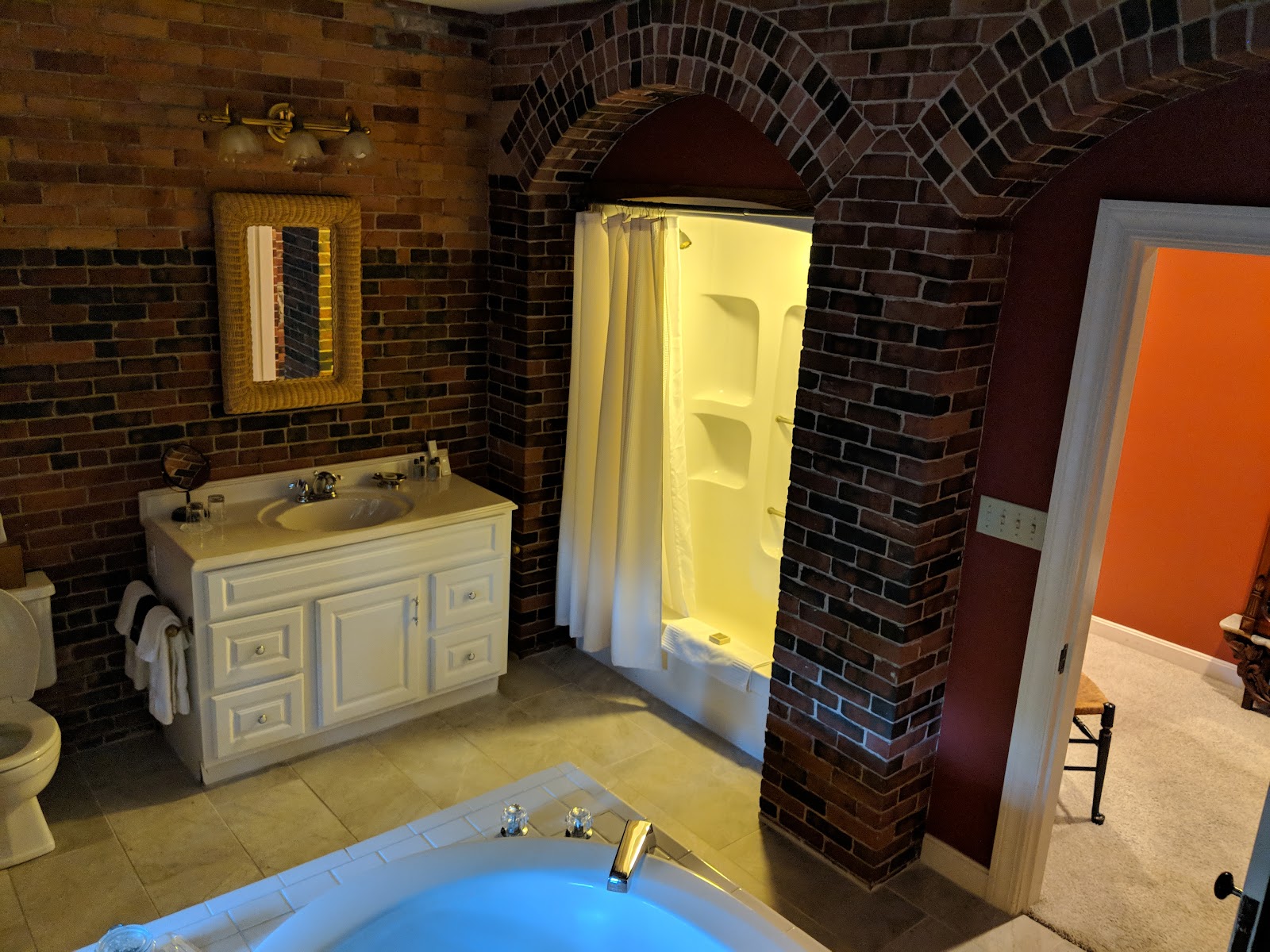
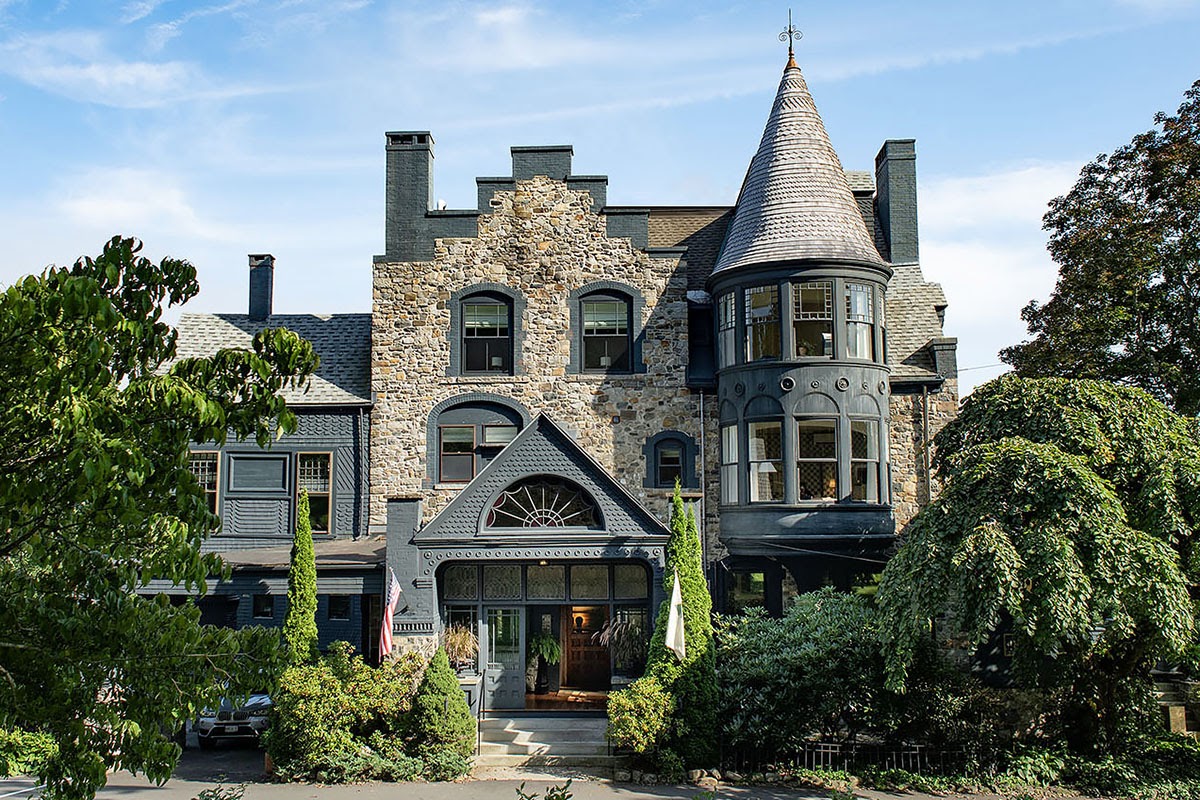
It is a stone mansion from the end of the nineteenth century, standing above Penobscot Bay on the Maine midcoast — one of the substantial houses put up along this shore in the era when rail and steamer brought wealthy summer visitors to the coast. It is built of granite, and its interiors are lined with dark hardwood: panelling, beams, staircases and joinery.
Both of those materials absorb rather than reflect, and that governs the whole photographic approach. The exterior granite is coarse-grained, pink-grey, crystalline and low in saturation — a high-frequency texture that is spectacular under raking light and reads as a flat grey field under flat light. The interior timber is dark, warm-toned and absorbent, which means the ambient inside sits one to two stops below what the eye estimates and the fall-off from a window is steeper than in any plastered room.
That last point is the building’s gift rather than its difficulty. A window in a dark panelled room gives a drop of four stops or more to the wall behind a subject, which means a lit face against a black ground is available with no equipment at all.
The walk runs stonework, interiors, grounds, bay — from the most controlled light to the least — and it is the right order for a working day.
Camden sits at about forty-four and a fifth degrees north, with the Camden Hills rising behind the town and Penobscot Bay in front of it. The June noon sun reaches around sixty-nine degrees, the December noon sun about twenty-two, days run from about eight hours forty-five to fifteen hours thirty-five, and civil twilight is around thirty-six minutes — the most generous dusk in this guide.
We have not photographed a wedding at this inn. Which rooms and grounds are included, what access there is to the shore, and what the permitted hours are, are questions for their team.
Norumbega Inn at a glance
| Where | A nineteenth-century granite mansion above Penobscot Bay at Camden, Maine |
| The materials | Granite outside, dark hardwood inside — both absorb rather than reflect |
| The gift | Four stops or more of fall-off from a window in a panelled room |
| The sequence | Stonework, interiors, grounds, the bay |
| Ask first | Included rooms and grounds, shore access, permitted hours |
The stonework and the interiors
Start outside with the stone, because it is the building’s face and it is the element most dependent on timing.
Granite is a high-frequency texture: an irregular surface of blocks, joints, tool marks and crystal faces at a scale of millimetres to centimetres. Under light arriving face-on, every part of it is lit equally and the texture disappears — a granite wall in frontal light is a flat grey field with a faint pattern. Under light raking across it at a shallow angle, every projection casts a shadow and the texture appears in full relief.
The consequence is that each wall of the building is worth photographing for roughly twenty or thirty minutes once a day, and that window depends entirely on which way the wall faces. A five-minute check of the orientations on arrival is worth more than an hour of walking, and in Camden it needs one extra check: the hills to the west take the direct sun off this shore earlier than the published sunset, sometimes by a substantial margin.
Put the subjects against the wall rather than away from it. A couple two metres out is photographed with the stone as a background; a couple standing against it, almost touching, is photographed within the surface — and the second is what raking light is for, because the texture and the people are then in the same plane and the same light.
Standing against a wall also means the light on the people is the same raking light that is on the stone: very low, very directional, from almost exactly one side. That gives strong modelling with a genuinely dark shadow side, which needs a decision rather than a correction — left alone it is dramatic, filled with a reflector on the shadow side it is conventional, and both are right.
Expose for the stone. It is the brightest thing in the frame and it holds the detail the picture is about, and since the subjects are in the same light, exposing for the stone exposes them correctly too.
Then inside, where the dark timber inverts the exterior’s requirements entirely.
Meter on skin, always, and never on the scene. A camera reading a dark panelled room with a bright window will settle on an exposure that is wrong for both, and the correction is a change of method rather than a compensation value: read the light on the face, set it, and let everything else fall where it falls.
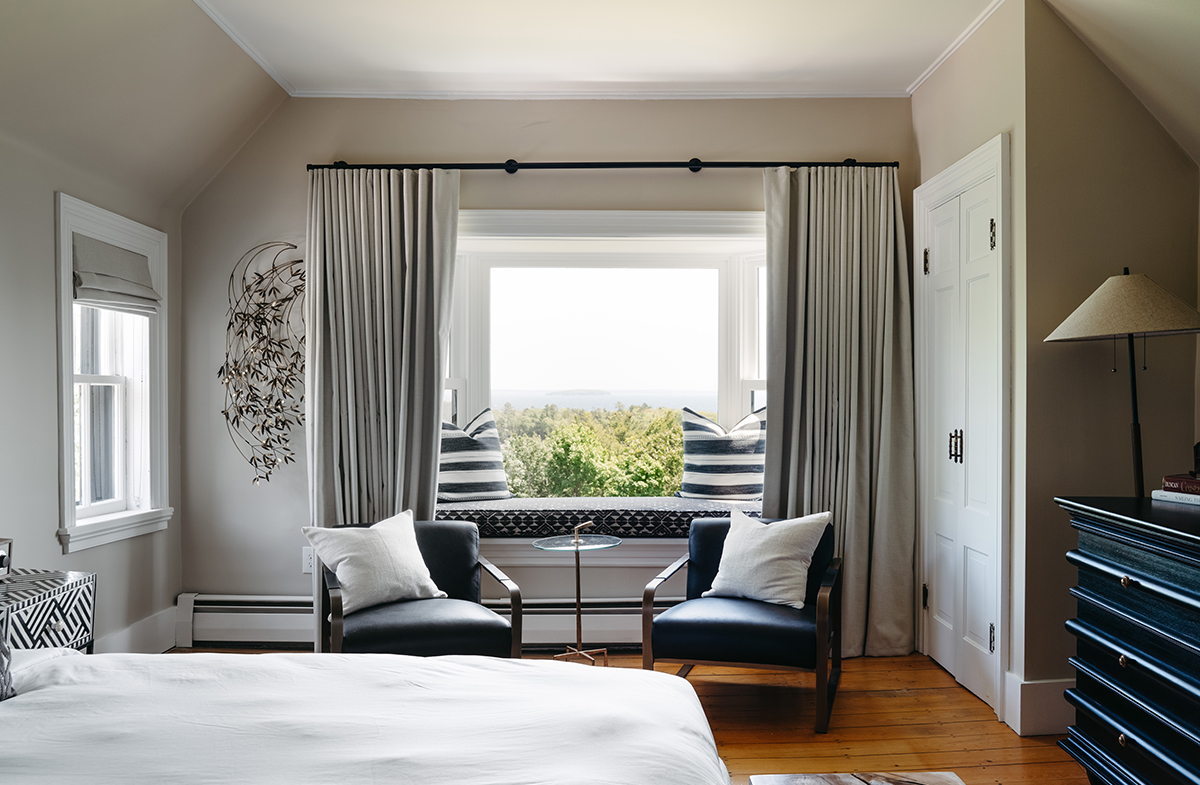
Then use each window as a studio source. Subject at forty-five degrees to it, at a distance that sets the ratio, with the room falling away behind. Because the panelling absorbs and gives no fill back, moving the subject a metre further from the window increases the ratio noticeably — which makes precision worthwhile and gives finer control than a bright room ever offers.
A nineteenth-century mansion’s staircase is usually its best interior structure: a level change, a heavy balustrade at exactly the height a leaning or seated subject occupies, and — where there is a landing window — a directional source with very fast fall-off. A subject on a stair below a landing window, in a dark-panelled hall, is the single strongest interior frame a building of this type produces.
Corridors are the other sleeper: a hallway with a window at one end has several stops of fall-off along its length.
Artificial light in a house of this period is warm, low and mounted high, which produces a top-heavy pool-and-gap pattern. Balance for the fittings rather than for a flash, gel any added source warm so the subjects belong to the room, use the pools as key rather than filling them out, and let the dark panelling go black. Never bounce off a ceiling in a dark-timbered room — most of the light goes into the wood and does not come back.
The grounds and the bay
The grounds of a coastal Maine mansion are lawn, planting and mature trees on ground that slopes toward the water, and the slope is the most useful thing about them.
A gradient gives a camera a choice that flat ground cannot: from below the subjects they stand against open sky with no horizon behind them, which is the cleanest background available in any conditions and which drops every building, path and guest below their level out of frame. From above them the grounds and the bay fill the space behind.
Two completely different photographs from one spot, by walking twenty metres.
The trees are the shade, and on this coast the species distinction is absolute. Red spruce, white spruce and balsam fir hold dense evergreen canopies that block almost all light, which makes their margin the darkest natural background in the northeast — a subject a metre inside a spruce edge has soft directional light in front and three or four stops of near-blackness behind.
Northern hardwood — sugar maple, beech, birch — gives soft even light with a green cast, corrected by standing two metres inside the edge and facing out rather than going deeper. And white paper birch against dark spruce is the highest-contrast natural background in New England: luminous pale verticals on near-black, which needs nothing added.
In the middle of a summer day at sixty-nine degrees of sun elevation, those margins and the building’s own shaded elevations are the only usable portrait positions on the property.
The bay is the last stage and Penobscot Bay is a particular kind of water. It is a large, island-studded, glacially drowned bay — cold, nutrient-rich, and reading deep blue-grey to slate rather than clear blue, taking its colour largely from the sky. That makes it a darker element in a frame than most water, which suits a grey granite building well.
The islands are the compositional asset. A bay with land in it gives a layered horizon rather than a flat one — successive headlands and islands at different distances, which in clear low light separate into distinct tonal bands. That is a long-lens frame and it depends entirely on air clarity, which on this coast is best in September and October and worst in the humid heart of summer.
The tide is the practical variable and on this coast it is large: the range increases north-eastward along the Gulf of Maine, and on the midcoast it runs to something like ten feet, two highs and two lows a day. At high water the sea reaches the rock and a shoreline frame is clean; at low water there is ten feet of exposed intertidal banded with dark brown rockweed over barnacle and blue mussel.
That band is an excellent dark foreground and a genuinely slippery surface, which means photographing it from dry ground with a longer lens rather than standing in it. Looking up the tide is a two-minute job that decides what any shoreline frame looks like.
The cold water produces this coast’s characteristic weather: sea fog, formed when warm humid air moves over it, most frequent in June and July and capable of arriving within half an hour. Fog is an enormous diffuser that removes every shadow and erases the horizon — beautiful once, monotonous five times — and it does one useful thing to a stone building: it makes the granite look darker and more saturated, because the stone is damp.
Two practical matters. Salt aerosol on an exposed shore settles on front elements within minutes rather than hours. And a bay surrounded by hills funnels the wind locally and unpredictably, which makes a lightstand a liability.
- Check every wall’s orientation, and check the western ridgeline too
- Put the subjects against the stone, not away from it
- Expose for the granite; the subjects are in the same light
- Meter on skin indoors — the panelling will fool the camera every time
- Look up the tide: ten feet of range on this coast
The Penobscot Bay year
Four sharply separated seasons, and a stone building that gains from the two nobody books.
Winter is the best season for the stonework and it is worth being emphatic about. The December noon sun at around twenty-two degrees never rises high enough to flatten anything, which means a wall facing anywhere near the sun rakes for the whole short afternoon rather than for twenty or thirty minutes — so the texture the building is made of is available for hours instead of minutes.
Bare hardwood also opens the grounds completely, which means light reaches the ground everywhere and the building is visible from positions that summer foliage conceals. And the bay runs slate to near-black under a low sun, which is the best background a grey granite house can have.
Snow on granite is the best natural fill available, lifting shadows to within a stop and fooling a meter by about two, so open up deliberately. Snow on spruce above slate water is the characteristic midcoast winter image. Sea smoke on a very cold still morning is spectacular.
The interiors gain too, and this is the counter-intuitive part. Snow outside a window is a very large bright neutral reflector, which raises the light level coming into a dark panelled room substantially and softens it — so a nineteenth-century interior is better lit on a bright February day than in leafy July, when the exterior is green and absorbing. It is also much cooler in colour, which makes the white balance reading essential.
The costs are cold, an eight-hour-forty-five-minute day, wind at its worst of the year, hills that take the sun very early, and glass that fogs coming indoors.
Spring is very late on this coast. The cold sea holds the air temperature down, so leaf-out on the midcoast runs into late May — April and early May are bare, grey and raw. It is also the start of the fog season, and blackflies are severe inland from mid-May into June.
Summer is the season and the days are the longest in this guide: over fifteen and a half hours at the solstice with thirty-six minutes of civil twilight. The grounds are at their best, the bay is busy with working boats and schooners, and the light at both ends of the day is excellent.
The costs are fog at its most frequent in June and July, summer haze that removes the layered-island frames, the middle of the day, and crowds. Lupines flower along this coast in mid to late June.
Early autumn is the strongest window overall. September brings drier, clearer air than August, the end of the fog season, a sea at its warmest of the year so the light over it is stable, thinning crowds, and the clearest views across the bay — which is precisely what the island frames depend on.
The colour arrives on the midcoast in the first half of October, and on the hillside above the town earlier than at sea level. Red maple scarlet, birch yellow and oak russet against near-black spruce and grey granite is a quieter and better-matched autumn than the inland version, and against a granite mansion it is the strongest combination of the year.
By November the trees are bare, the sun is very low all day, the air is at its clearest, and the stonework rakes from morning to dusk. It photographs austerely and extremely well, and nobody books it.
More frames from Norumbega Inn
Norumbega Inn wedding photography: common questions
What do the two materials do?
Both absorb. Granite outside is a texture that needs raking light; dark timber inside drops the ambient and steepens the fall-off from every window.
What is the interior gift?
Four stops or more from a face at a window to the wall behind it, which gives a lit face against a black ground with no equipment.
How should the stone be photographed?
With the subjects standing against it, in light raking across it at a shallow angle — and exposed for the stone, since the people are in the same light.
What is the best interior frame?
A subject on the staircase below a landing window in a dark-panelled hall: a level change, a balustrade at leaning height, and very fast fall-off.
Does the tide matter?
Ten feet of range on this coast, twice a day. It decides whether the shoreline frame is clean water at the rock or exposed rockweed.
When is the building at its best?
Winter and late autumn. A sun that never rises above twenty-two degrees rakes the granite for whole afternoons, and snow outside improves every interior window.
More Maine venue guides
We are writing a photographer’s guide to every venue we would happily shoot in Maine. Here are three more, plus the full index:
- Portland Head Light, Cape Elizabeth: One Frame and How It Is Made
- Spring Point Ledge Lighthouse, South Portland: The One Decision That Governs Everything
- Spruce Point Inn, Boothbay Harbor: Field Notes, Problem and Solution
Planning a wedding at Norumbega Inn?
Two absorbing materials and one very good staircase. Tell us your date.