 Dry Tortugas National Park: A Walk Through an Island Fort
Vizcaya Museum & Gardens, Miami: A Walk Through the Site
Formal European geometry, built out of coral rock, in a tropical climate.
The best way to describe Vizcaya is to walk it, because the site is organised as a sequence — house, then terrace, then descending formal garden, then the bay — and each stage of that sequence offers a camera something different.
The proposition is an unusual one: an Italianate villa and formal gardens, built in the second decade of the twentieth century on the shore of Biscayne Bay, executed in the local stone and planted with what would grow there. The result is European geometry in a tropical climate, which is a productive contradiction rather than a compromise. The axes, balustrades and parterres are straight; the material they are made of is full of holes and the plants growing through them are subtropical.
The stone is worth understanding, because it governs how the place photographs at close range. South Florida’s building stone is an oolitic limestone often called keystone or coral rock: a fossil reef, pale cream to grey, and riddled with visible coral structure and voids.
Optically that is a very high-frequency surface. It takes raking light beautifully and turns to noise under flat light, which means the same balustrade is either the most interesting texture in the frame or the ugliest, depending entirely on the angle of the sun. It also means it is unforgiving of a background out of focus by a small amount — a slightly soft coral-rock wall reads as mush rather than as bokeh, so either commit to the texture or throw it well out.
Miami sits at about 25.8 degrees north, which places the June noon sun within two degrees of vertical. The formal gardens are open, which means the middle of a summer day in the geometry is the hardest light on the site, and the compensations — the banyans, the loggias, the shaded grottoes — are all at the edges.
We have not photographed a wedding at Vizcaya. Which areas are included, what the restrictions are on the house interiors and the gardens, whether the bay frontage is available and what the hours allow are questions for their team.
Vizcaya Museum & Gardens at a glance
| Where | An Italianate villa and formal gardens on Biscayne Bay, Miami |
| The material | Oolitic coral rock: high-frequency texture that needs raking light |
| The sequence | House, terrace, descending formal garden, the bay |
| The shade | Banyan and live oak block; palms do not |
| Ask first | Interior access, garden restrictions, bay frontage, permitted hours |
The house and the terrace
Start inside and work outward, because the interiors are the darkest and most controlled part of the sequence and everything after them is brighter.
A house of this kind is a set of rooms with deep-set openings and heavy interior finishes, which means the ambient is well below what the eye reports and the windows are the only light. The working method is the one that suits every historic interior: place the subject at about forty-five degrees to an opening, meter on skin, and let the room fall away.
The fall-off does the separation for free, because a room with dark panelling and a high ceiling absorbs rather than bounces, and the drop from a face near a window to the wall two metres behind it is often three stops or more.
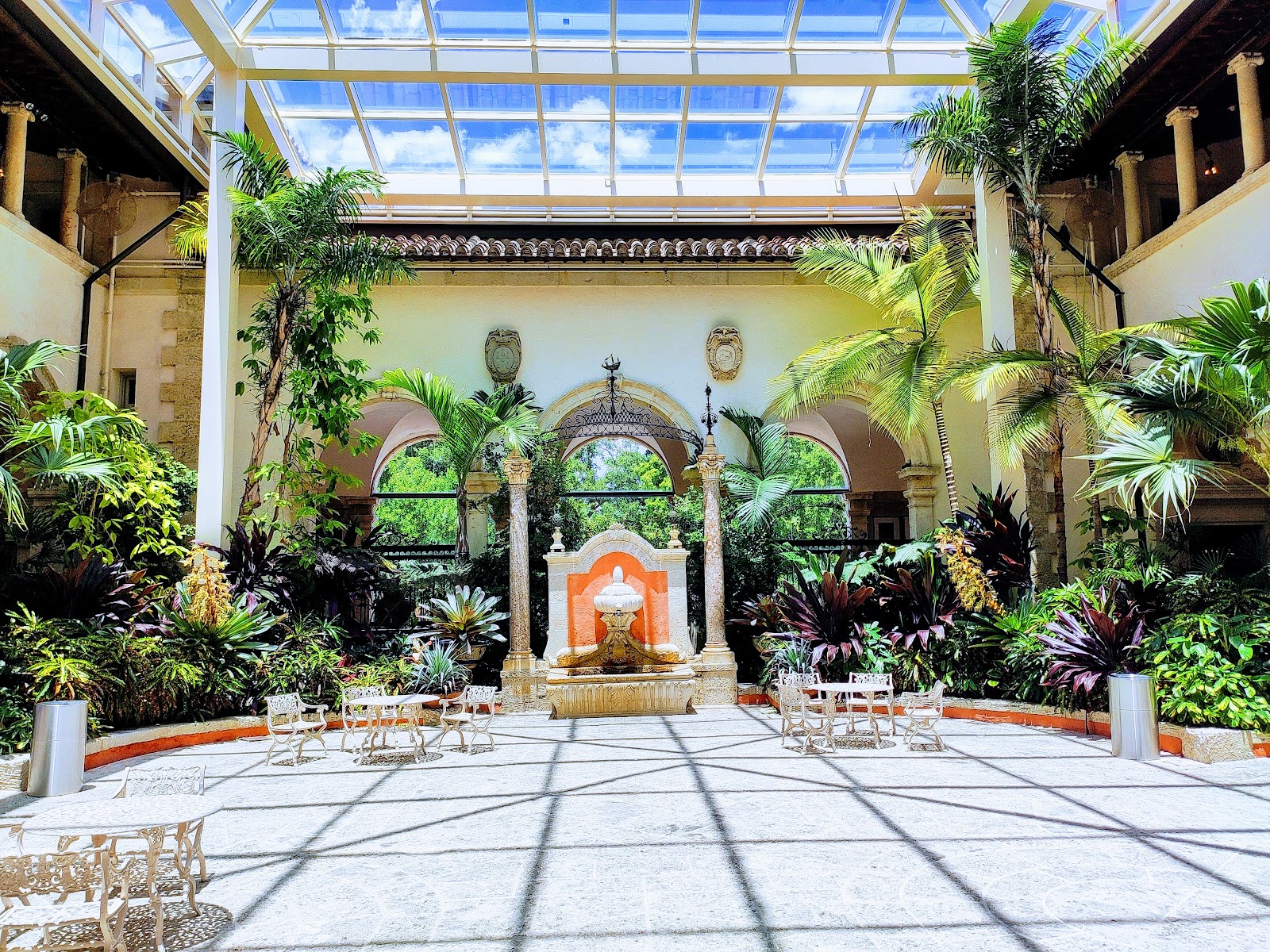
The courtyard at the centre of a house like this is the transition. It is an open-topped room, which means it is the one interior space that carries daylight, and its behaviour changes completely with the sun’s angle — a hard bright square at noon, a single directional bounce off one lit wall early and late. If a covering has been added over such a space, expect the light beneath it to be softened, dimmed and tinted, and to have to set white balance on a face rather than on a preset.
The terrace on the bay side is the hinge of the whole site. It is where the architecture hands over to the water: stone underfoot, balustrade at the edge, the bay beyond, and nothing overhead.
Biscayne Bay is shallow, and the bottom is pale carbonate sand and mud, which is why it reads turquoise rather than blue and why it is brightest at midday when the sun penetrates. That brightness is the terrace’s problem and its gift. It is a very large low reflector, so faces on the terrace are filled from below more generously than anywhere else on the site — but a meter pointed anywhere near it underexposes, and a sky-plus-water frame at noon has almost no tonal separation between the two.
The terrace works best in the last ninety minutes of the day, when the water goes from turquoise to gold and then to a deep slate that the stonework sits against cleanly.
Down the garden, and the shade at its edges
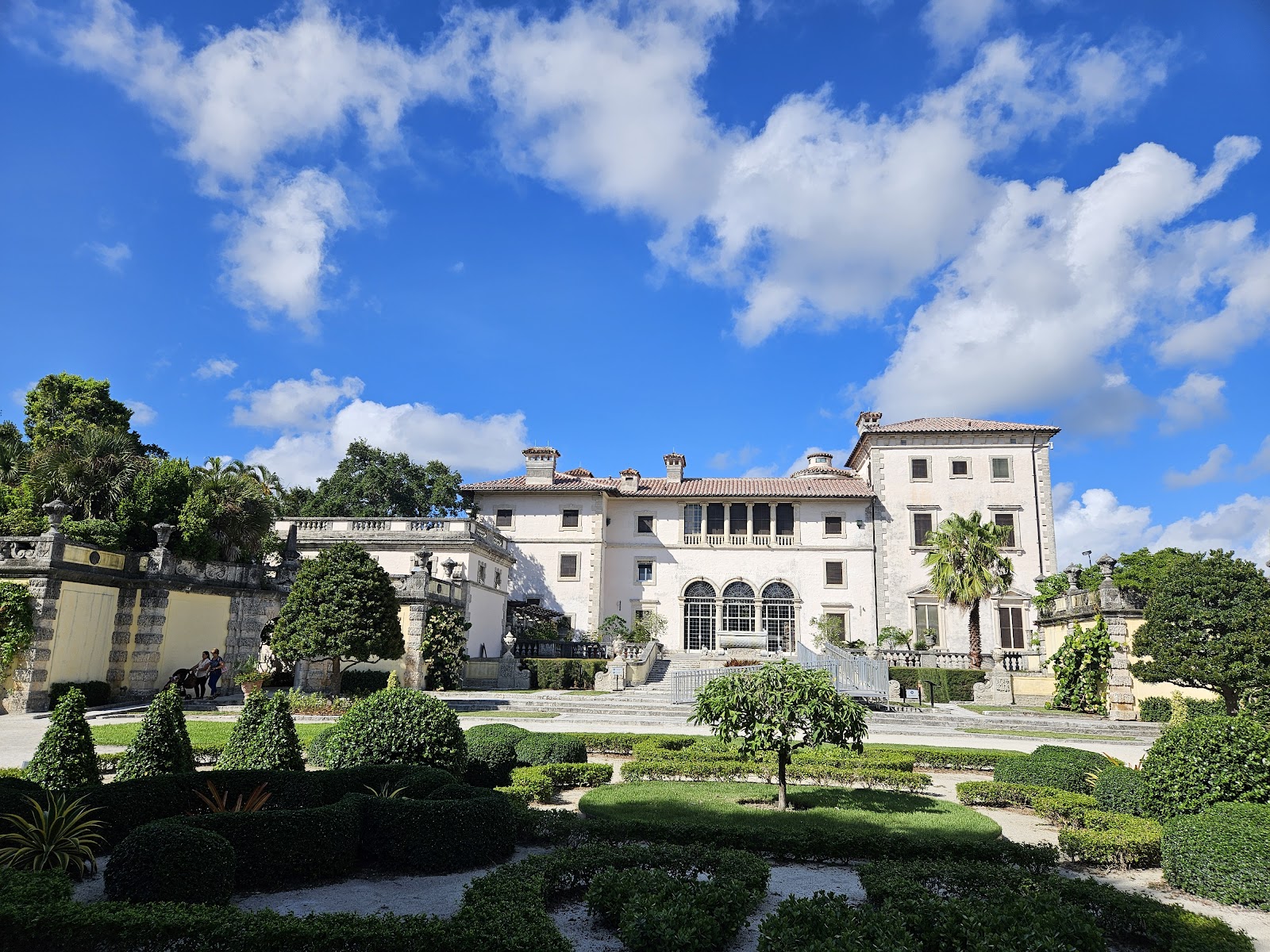
The formal garden descends away from the house in terraces, and its logic is the axis. Everything is arranged to be seen from a particular point along a particular line, and a camera placed on that line gets the composition the designer built; a camera placed a few metres off it gets a confusing jumble of parterre edges.
That is a stronger constraint than it sounds. The practical method is to find the axis, shoot along it, and then deliberately abandon it for close frames rather than drifting off it by accident.
The parterres themselves are low, which means they read from above and disappear from eye level. A frame that shows the pattern needs elevation — a terrace step, a landing — and a frame taken standing in the garden shows only hedges. Choosing which of those two pictures is wanted before walking down is worth thirty seconds.
The open garden is the hardest light on the property and there is no honest way around it. Between roughly ten and four in the summer months the sun is high enough that a face in the open has shadowed eyes and a lit forehead, and the pale stone underfoot returns enough uplight to fill without softening.
The answers are all at the edges. Anything with a roof — a loggia, an arched recess, a grotto, a covered stair — works exactly as the Biltmore arcades do, as a directional source with rapid fall-off, and the depth of the subject inside it sets the ratio. A grotto is the extreme version: near-darkness inside, blazing light at the mouth, and a subject placed a metre in gets a five-stop background for nothing.
The living shade divides sharply by species and the division is the most useful thing to know about photographing anywhere in South Florida. Live oak and banyan hold dense evergreen canopies with heavy overlapping foliage, and they block: the light beneath them is dim, soft-edged and reliable, and a portrait there needs no intervention. A banyan adds aerial roots that drop in vertical curtains, which is a compositional gift — a natural set of frames-within-the-frame at every scale.
Palms do the opposite. A frond is a row of stiff parallel blades and its shadow is a hard slatted stripe, which on a face is the worst light on the property. Coconut and royal palms are architecturally the most striking plants in the garden and photographically the least useful as shade. Use them as background and never as cover.
Spanish moss, where it hangs, is neither a moss nor a parasite but an epiphytic bromeliad living on air, and photographically it matters because it further softens the edge of an already dense oak canopy and because it moves in wind that is otherwise invisible in a still frame.
- Find the garden’s axis and use it deliberately, or leave it deliberately
- Parterres read from elevation and vanish at eye level
- Loggias, recesses and grottoes are the only usable shade in the geometry
- Banyan and live oak block; palms slat
- Meter for the terrace, not for the bay
The bay, the hours and the year
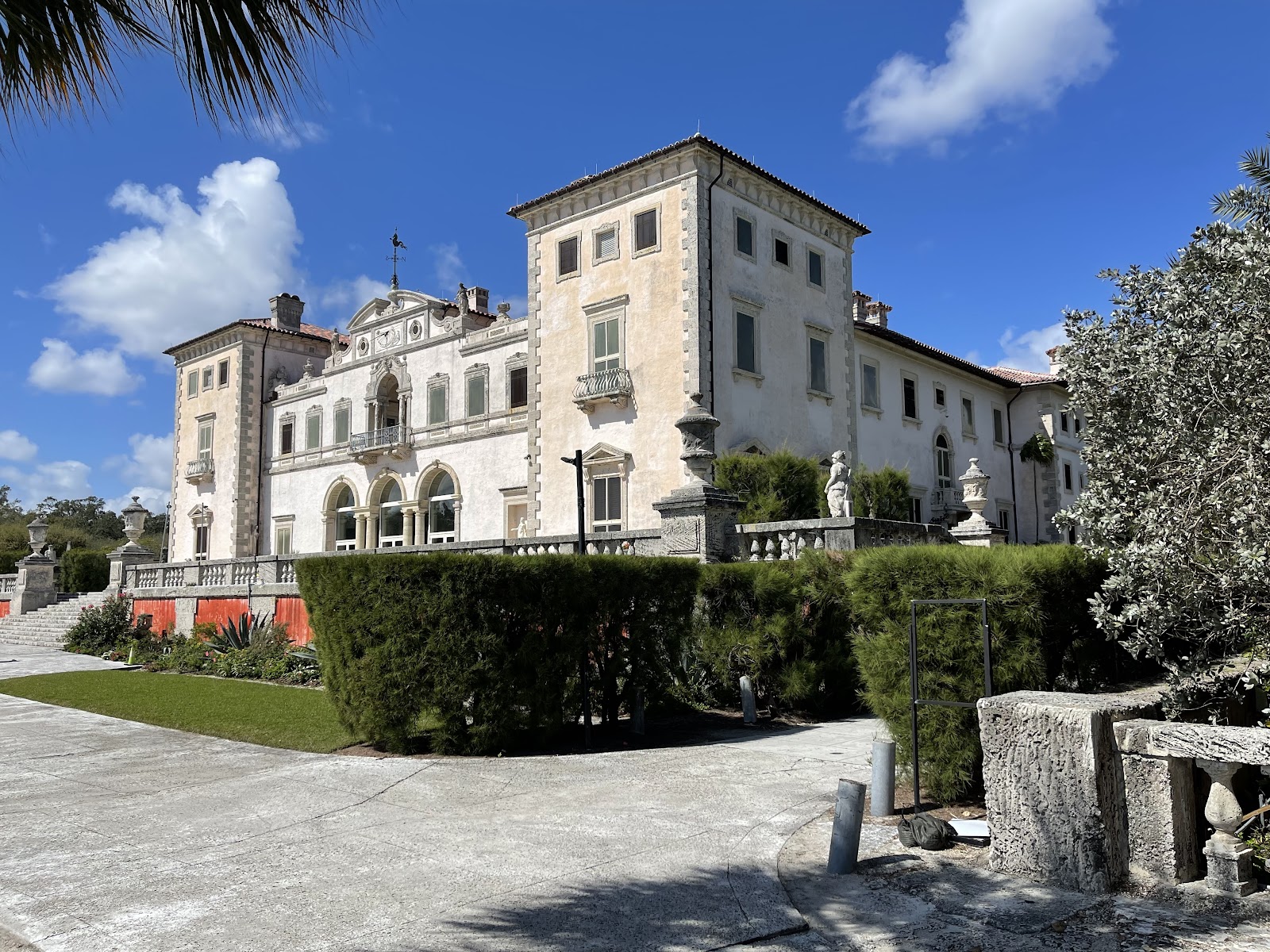
The water frontage completes the walk and it has a property that decides scheduling: Biscayne Bay lies east of the house. That means the sun rises over the water and sets behind the building.
The consequences are precise. At sunset the bay is not lit by the sun at all — it is lit by the sky, which at this latitude means a brief, even, cool afterglow with the house rim-lit from behind. That is a genuinely beautiful frame and it is not the one most people imagine when they hear waterfront. At sunrise the reverse holds: the water is lit directly, the house is in its own shadow, and the light is the warmest and most directional of the day.
Anyone who wants sun over water at a Miami venue on the Atlantic side has to get up for it.
The second scheduling fact is the speed of dusk. At twenty-six degrees north the sun descends at a steep angle rather than sliding along the horizon, which compresses twilight: civil twilight here runs a little over twenty minutes, against thirty-five or more in the northern states. Golden hour is correspondingly short and the drop from usable to dark is abrupt.
Practically, that means a plan that assumes a leisurely hour of low light will lose half of it. Work the sequence faster than instinct suggests, get the frames that need direct low light done first, and treat the blue period that follows as a separate deliberate session rather than as the tail of the last one.
The tidal range in Biscayne Bay is small — well under a metre — which is worth saying because it removes a variable that dominates elsewhere. Unlike a northern estuary, the water’s edge here is where it was an hour ago, and a seawall frame composed in the morning still composes in the evening.
The seasons run opposite to the rest of this guide. The dry season from November to April is the good one: lower humidity, clearer air, better contrast at distance, no afternoon storms, and a noon sun around forty degrees that models rather than flattens.
The wet season from May to October brings dew points in the mid-twenties Celsius, which is haze rather than fog — it takes contrast out of every distant frame and puts a bloom around every light — and it brings the daily convergence storm, formed where the sea breezes from the Atlantic and the Gulf meet over the peninsula. Those cells arrive in the afternoon with some reliability, which makes a named covered alternative a requirement for any open-garden ceremony between June and September.
They also clear, and the hour after one of them passes is the best light the wet season produces: broken cloud lit from below, washed air, and wet coral rock returning every bit of it.
Two smaller notes. Mosquitoes are a real consideration at dusk anywhere near mangrove or standing water, which includes a bayfront garden. And salt in the air off the bay settles on front elements faster than anyone expects — a cloth and a routine, not a crisis.
More frames from Vizcaya Museum & Gardens
Vizcaya Museum & Gardens wedding photography: common questions
Which way does the bay face?
East. The sun rises over the water and sets behind the house, so the classic sun-over-water frame here belongs to dawn, not dusk.
How long is golden hour?
Short. At this latitude the sun descends steeply and civil twilight runs a little over twenty minutes, so the usable low light ends abruptly.
What is the stone and why does it matter?
Oolitic coral rock — a fossil reef full of visible voids. It is spectacular in raking light and turns to visual noise under flat light.
Where is the usable shade?
Loggias, arched recesses and grottoes, and under banyan and live oak. Not under palms, whose fronds throw a hard slatted shadow.
When is the open garden unusable?
Roughly ten to four in the summer months, when the sun is near-vertical and the pale stone fills without softening.
Which season is best?
The dry season, November to April: clearer air, more contrast, no afternoon storms, and a lower sun that models faces.
More Florida venue guides
We are writing a photographer’s guide to every venue we would happily shoot in Florida. Here are three more, plus the full index:
- The Casa Monica Hotel, St. Augustine: One Frame, and How It Is Made
- The Hyatt Regency Grand Cypress, Orlando: The Light Through the Day
- The Lightner Museum, St. Augustine: The Problem, and Four Ways Out of It
Planning a wedding at Vizcaya Museum & Gardens?
Coral rock, banyan shade and an east-facing bay. Tell us your date and we will plan around all three.