 Dry Tortugas National Park: A Walk Through an Island Fort
Gaylord Palms Resort, Kissimmee: The Venue’s Own Logic
An outdoor landscape with a roof on it. The roof changes everything.
The logic of this building is a single move: put a landscape indoors and glaze the roof over it.
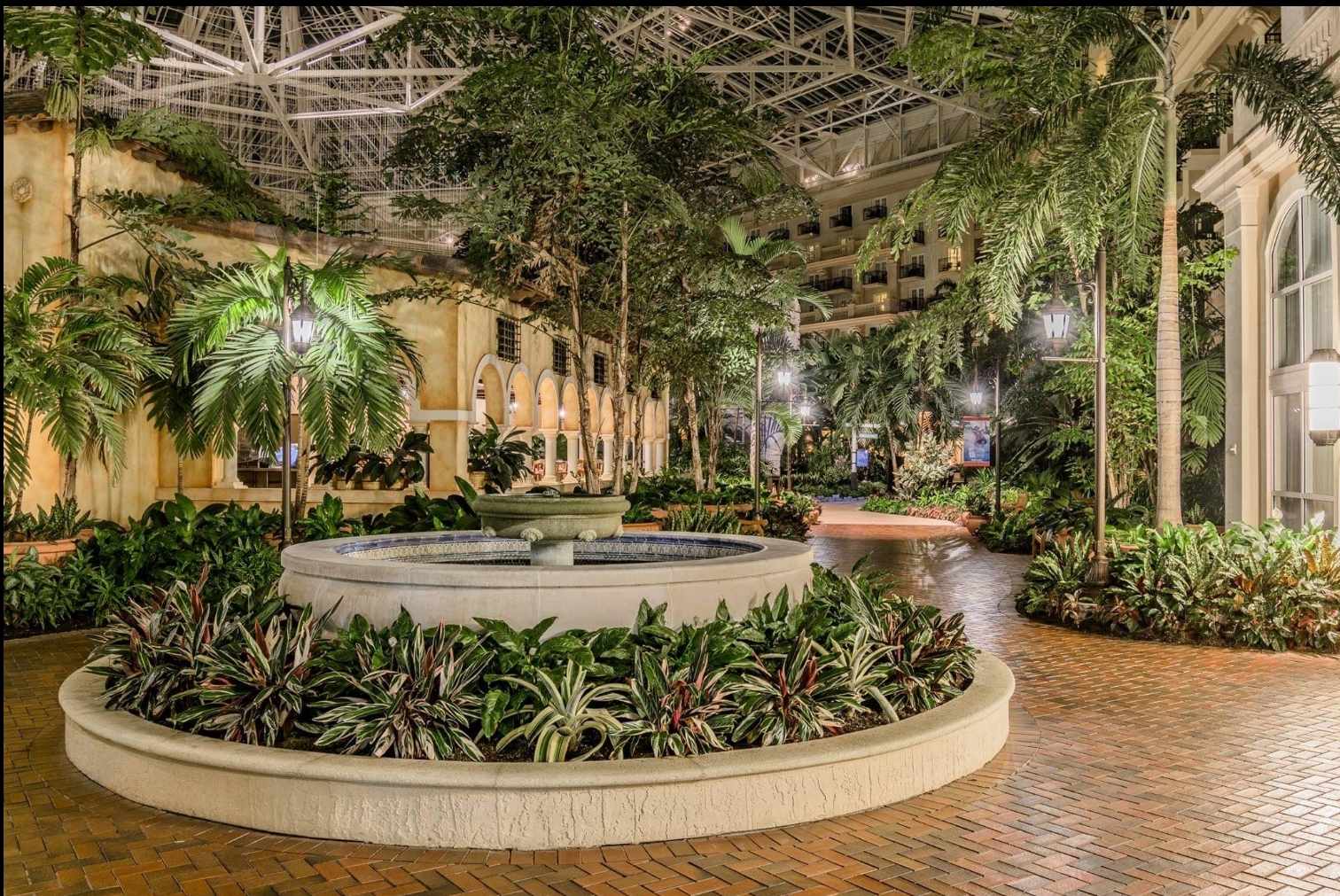
Gaylord Palms is organised around a very large atrium containing planting, water, built structures and paths, with guest rooms looking inward onto it and a glass roof overhead. The intent is a Florida landscape that works in August and in a thunderstorm — climate-controlled, insect-free, weatherproof and open at the same time.
Understanding that intent is the whole photographic brief, because it tells you what to expect from the light: this is neither an interior nor an exterior but a third thing, and the ways it differs from both are consistent and predictable.
It differs from an exterior in four ways. The light comes from overhead and only from overhead, because a glazed roof over a deep volume means the sky is above and the walls are guest-room balconies. It is diffused, because the glazing and its structure scatter what passes through. It is much dimmer than outside, typically by several stops, because glass, structure and any applied coating all subtract. And it is tinted, because glazing is not colour-neutral and the structure and surrounding surfaces add their own casts.
It differs from an interior in one crucial way: the light level changes all day and with the weather. An atrium at noon on a clear February day and the same atrium at four on an overcast August afternoon are two or three stops apart, which means a settled exposure does not stay settled.
Kissimmee sits at about twenty-eight and a quarter degrees north, in the central Florida interior. Outside the building, the June noon sun reaches around eighty-five degrees and the December noon sun about thirty-eight. Inside, those numbers matter only as the source feeding the roof.
We have not photographed a wedding at this resort. Which atrium areas are available, what the restrictions are on setting up, whether the exterior grounds are included and what the permitted hours are, are questions for their team.
Gaylord Palms Resort at a glance
| Where | A large resort in Kissimmee, central Florida, built around a glazed atrium |
| The logic | An outdoor landscape with a roof on it: weatherproof, insect-free, open |
| The light | Overhead only, diffused, several stops down, and tinted |
| The variable | Atrium light changes all day and with the weather — exposure does not settle |
| Ask first | Available atrium areas, setup restrictions, exterior grounds, hours |
Working under glass
The first problem is that overhead light is top-heavy, and it is the same problem as a near-vertical sun with the harshness taken out. Soft light from directly above still puts the eye sockets in shadow and lights the forehead, nose and cheekbones — which is why a portrait in the middle of an atrium looks subtly wrong even though nothing about the light is harsh.
The solution is to stop standing in the middle. Every vertical surface in the atrium is a reflector, and moving a subject close to one converts part of the overhead light into side light. A pale wall two metres away turns a top-heavy soft source into a directional one; a dark wall on the other side deepens the shadow side and increases the ratio. Position, not equipment, does most of the work in here.
The second solution is anything with a roof under the roof. A pavilion, a colonnade, a bridge, a balcony overhang, a dense tree — any of these blocks the overhead component and leaves only the light arriving from the sides, which is exactly what a face wants. A subject standing just inside the edge of a covered structure inside the atrium is getting conventional directional light in a space that otherwise has none, and those positions are the best portrait locations in the building.
The third is a source of your own, and in here it needs less output than instinct suggests. Because the ambient is several stops below outdoor daylight, a modest light at close range is already a stop or two above it, which means the whole frame can be shaped rather than merely filled. A single source at forty-five degrees and slightly above eye level, a stop over ambient, restores the modelling the roof removed. That is a very simple setup producing a disproportionate improvement.
The colour needs a decision rather than a correction. Glazing tints, structural steel and paint add casts, the planting reflects green, and the resort’s own architectural lighting is a warm point-source layer mixed into all of it. The result is a space whose neutral is not neutral and which varies from one part of it to another.
The working method is to set white balance on skin, in the actual position, for each area — not once on arrival — and to accept a slight green or cyan residue in the foliage rather than neutralising it and turning the plants grey. A custom balance taken in three or four locations during a scout is worth more here than any amount of correction afterwards.
And the level changes. In practice this means checking exposure at each new position rather than each new hour, and it means that the difference between the brightest part of the atrium — directly under a clear span — and the darkest — under a balcony overhang on a cloudy day — can be four or five stops. That is a wide range to move a group through, and it is worth walking the intended route in advance with a meter or a test frame at each stop.
The landscape inside, and the rooms around it
The planting is the part that makes the atrium read as a landscape, and it behaves the way planting behaves everywhere with one exception: nothing moves. There is no wind under a roof, which means water is always still and foliage is always sharp.
The consequence for water is significant. Any pool or channel in here is a mirror at every hour of every day, which is something no outdoor venue in this guide can offer. A reflection frame that requires a dawn visit at a lake is available at four in the afternoon here, and it is available reliably. That is the single most exploitable property of the space.
The consequence for foliage is that a long exposure stays sharp, which makes the atrium unusually forgiving of low shutter speeds — useful, since the light is several stops down. A tripod and a slow frame in here produce results that the same approach outdoors would not.
The planting is also predominantly palm and tropical broadleaf, and the usual species distinction applies even under glass: broadleaf canopy blocks and gives soft reliable shade, palm fronds slat. Under a glazed roof the slatting is softer than it would be in direct sun, because the light arriving at the frond is already diffused — which means palms are less of a hazard in here than outdoors, and still not a solution.
Built structures inside the atrium are the most useful locations and they should be treated as the real venue rather than as scenery. A bridge gives a platform, a leading line and elevation; a pavilion gives directional light; a colonnade gives rhythm and a dark background. Those four things are what a portrait needs and they are all inside the building.
Elevation is the atrium’s other gift. Guest-room balconies and upper walkways look down into the volume, which gives a vantage no outdoor venue offers — a wide frame of the whole landscape with the ceremony inside it, or a top-down frame of a couple on a path. Whether those positions are accessible is worth asking, because they produce pictures that cannot be got any other way.
The ballrooms and function rooms are a conventional problem: low warm ambient, patterned carpet, high ceilings that absorb, and chandeliers or downlights reading as hot points. Gel the flash warm, balance for the room, light the people and let the ceiling volume go dark rather than trying to fill a space that large.
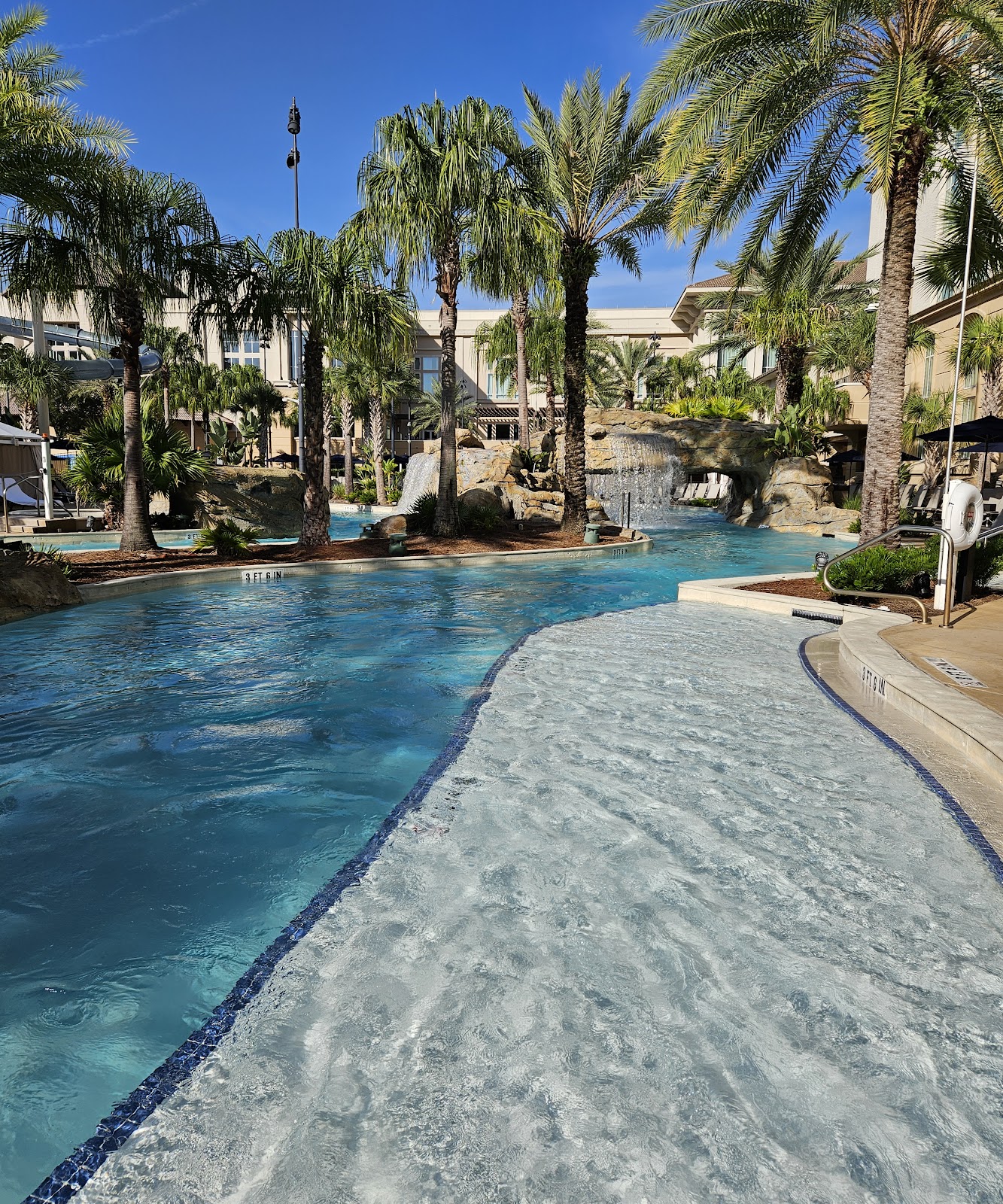
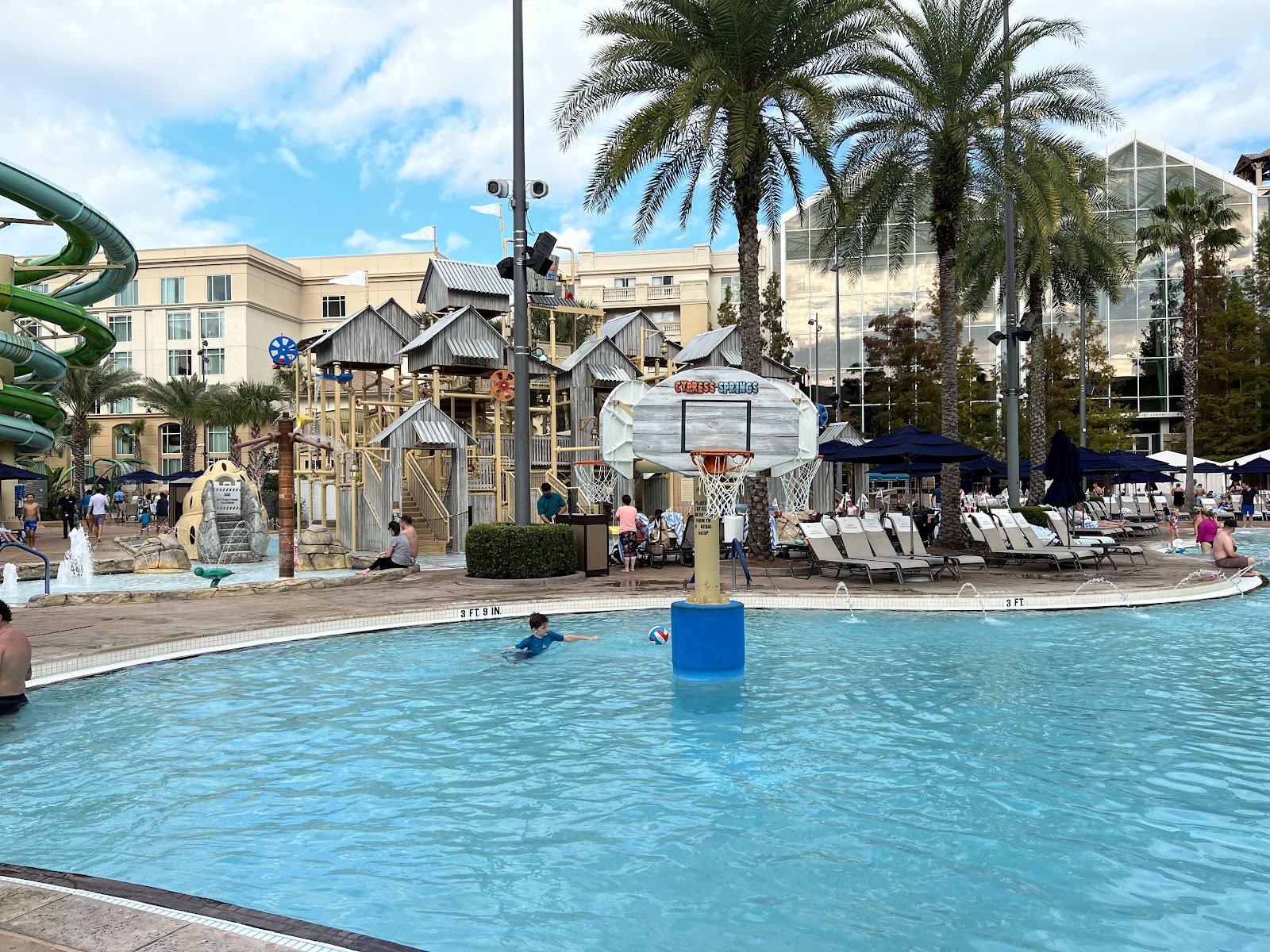
The exterior grounds and the pool areas are where the pictures that do not look like an atrium come from, and any set made here needs some of them. Central Florida outside the building is flat, open and bright, with the full near-vertical noon sun and the full afternoon storm risk — which is the trade: the atrium is reliable and the outside is real.
One genuinely useful consequence of the building’s logic deserves stating plainly. A glazed atrium removes every weather risk that dominates the rest of this state. A June ceremony in here is unaffected by the afternoon convection that makes an outdoor date a gamble, unaffected by the humidity, and free of mosquitoes. For a summer wedding in central Florida that is not a small advantage; it is the reason the building exists.
And the condensation problem, which is the standing hazard everywhere else in Florida, is halved here. Moving between the air-conditioned atrium and the air-conditioned ballrooms costs nothing. It only bites on the way outside, which means the outdoor part of the day should be planned as a block rather than as repeated trips.
- Move subjects close to a vertical surface — it converts overhead light to side light
- Anything with a roof under the roof is a portrait position
- A modest close source a stop over ambient restores the modelling
- Set white balance on skin per area, not once on arrival
- Water inside is a mirror at any hour, every day
The season, inside and out
The building’s whole purpose is to make the season not matter, and it largely succeeds — but the light under the roof still comes from the sky, so the season changes the atrium too, just less than it changes everything else.
In the dry season, roughly November to April, the light entering the atrium is cleaner and more directional. A clear low winter sun at around thirty-eight degrees at noon comes through the glazing at an angle rather than straight down, which means the atrium briefly has genuine side light — shafts across the volume, a lit wall and a shaded one, and modelling on faces without help. That is the best light the space gets all year and it belongs to the middle of the winter months.
It is also the season when the atrium is brightest relative to outdoors, because the sun is low enough to pass through the glazing obliquely rather than being partly reflected.
In the wet season, roughly May to October, the sun is near-vertical and the light arriving through the roof is at its most top-heavy: straight down, evenly diffused, and lacking direction entirely. The space is at its most even and its least flattering, which is exactly when the positional and lighting solutions above matter most.
The wet season is also when the building earns its keep. Afternoon convection over central Florida is close to daily between June and September, driven by sea breezes pushing inland from both coasts and colliding over the peninsula — the mechanism that makes this state the most lightning-prone in the country. An outdoor ceremony anywhere in this region in July needs a real alternative. In here, the storm arrives as sound on the glass and as a drop of two or three stops in the ambient, and nothing else changes.
That drop is worth anticipating rather than discovering. A cell overhead takes the atrium down substantially and quickly, which means an exposure set twenty minutes earlier is wrong, and a ceremony timed for the middle of a stormy afternoon may need a light where a clear afternoon would not.
Rain on a glass roof is also a photographic subject in its own right — the one frame this building offers that no outdoor venue can, which is weather seen from inside a landscape.
Hurricane season runs June to the end of November and peaks from mid-August into mid-October. Central Florida is inland, which moderates the wind exposure relative to the coasts without removing it, and for a fully enclosed venue the practical concerns are access and power rather than the ceremony itself.
The planting under glass is evergreen and climate-controlled, which means it gives no seasonal signal at all. Combined with the absence of weather, that has one real consequence for a set of photographs: nothing in them says what time of year it is. If that matters — and for some couples it does — the answer is to spend part of the day outside, where central Florida will say so immediately.
More frames from Gaylord Palms Resort
Gaylord Palms Resort wedding photography: common questions
What kind of light is an atrium?
Neither interior nor exterior. Overhead only, diffused, several stops below outdoor daylight, and tinted by the glazing and structure.
Why do portraits in the middle look wrong?
Because soft light from directly above still leaves the eye sockets dark. Move close to a vertical surface, or under a structure, to get side light.
How much light do I need to add?
Less than you would outside. The ambient is several stops down, so a modest source at close range is already a stop or two over it.
How should I handle the colour?
Set a custom white balance on skin in each area rather than once on arrival, and leave a little cast in the foliage rather than turning the plants grey.
What can this venue do that no outdoor venue can?
Give a perfect mirror on still water at any hour of any day, and hold a June ceremony that is entirely unaffected by the afternoon storms.
When is the atrium light at its best?
The winter months, when a low sun enters the glazing obliquely and the space briefly has genuine directional side light.
More Florida venue guides
We are writing a photographer’s guide to every venue we would happily shoot in Florida. Here are three more, plus the full index:
- The Homestead Resort, Homestead: Field Notes, Problem and Solution
- ZooTampa at Lowry Park, Tampa: The One Decision That Governs Everything
- Miami Seaquarium: What It Suits and What It Does Not
Planning a wedding at Gaylord Palms Resort?
A venue where the forecast stops mattering. Tell us your date and we will plan the light under the glass.