 Dry Tortugas National Park: A Walk Through an Island Fort
The Biltmore Hotel, Coral Gables: The Logic of a Pre-Air-Conditioning Building
A building designed around shade, in a place where the noon sun is nearly overhead.
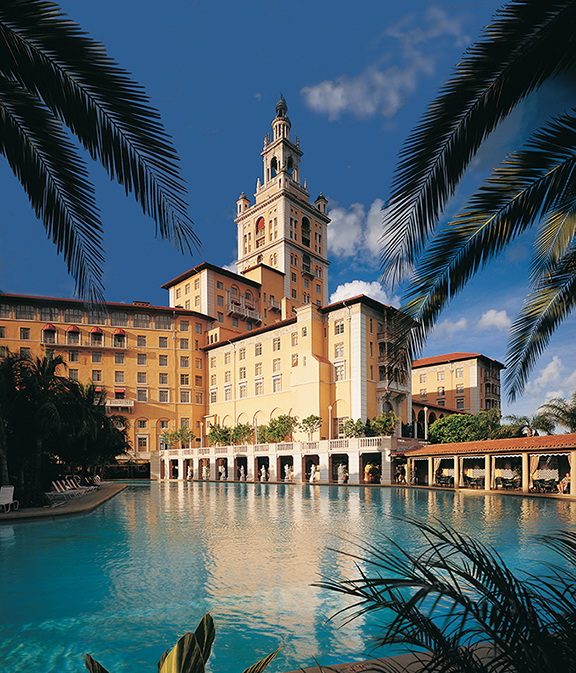
Every building has a logic, and the fastest way to photograph one well is to find out what it was solving for. The Biltmore was built in 1926 in Coral Gables, in a subtropical climate, before air conditioning existed to make that climate irrelevant to architecture.
That single fact explains the whole building. A hotel that could not be cooled mechanically had to be cooled by its own geometry: deep arcades so that walls were never in direct sun, courtyards so that air could move through rather than around, loggias between inside and outside so that there was a graduated path from one to the other, high ceilings so that hot air had somewhere to go, and small deep-set openings rather than large flat panes.
Every one of those decisions was made about light and heat, which means every one of them is a decision a photographer inherits. The arcades are the point. A deep covered walkway with an open side is, in optical terms, a very large soft source with a hard mask: light arrives from one direction only, wraps because the ground and the opposite surfaces bounce it, and falls off fast toward the back.
That is a softbox the size of a corridor, and the building has them at multiple levels running the length of the courtyards. In a place where the alternative is a near-vertical sun, they are the most valuable resource on the property.
Coral Gables sits at about 25.7 degrees north, which is only two degrees north of the Tropic of Cancer. At the June solstice the noon sun reaches about eighty-eight degrees above the horizon — within two degrees of straight overhead. Even in late December it still reaches about forty degrees, which is higher than a New England midsummer evening.
We have not photographed a wedding at the Biltmore. Which spaces are included, what access the arcades and courtyards allow, whether the tower interiors are available and what the restrictions are around the pool are questions for their team.
The Biltmore Hotel at a glance
| Where | A 1926 Mediterranean Revival hotel in Coral Gables, Miami-Dade |
| The logic | Built before air conditioning, so organised around arcades and courtyards |
| The resource | Deep arcades: a corridor-sized soft source with directional fall-off |
| The sun | Near-vertical at noon in summer; still forty degrees at the winter solstice |
| Ask first | Arcade and courtyard access, tower interiors, pool restrictions |
Reading the arcades
Work the arcades from the inside out, not the outside in. An arcade is directional light, and the direction is set by the open side — which means the photographic decision is entirely about how far back from the opening the subject stands.
At the opening the light is nearly frontal and bright, the ratio is low, and the result is flat and slightly hot. A metre back the ratio opens to something like two to one and the light acquires a direction. Two or three metres back the ratio is dramatic, the fall-off behind the subject is total, and the exposure difference between the subject and the sunlit courtyard beyond can run to four or five stops.
That last position is the most useful one in the building, because it produces the effect that people associate with expensive portraiture — a lit face against a dark ground — with no equipment at all. The courtyard beyond blows to white and the arch framing it goes black, which reads as deliberate rather than as a mistake because the architecture supplies the frame.
The columns are the metronome. An arcade is a rhythm of repeated openings, and a camera moved a few inches changes whether a column bisects a face, frames it or disappears. Aligning deliberately — one subject per bay, or the couple centred in a single arch with the rhythm receding behind them — turns the repetition into structure.
The stone and stucco matter to colour. Warm pale surfaces bounce warm light, which is flattering on most skin and is the reason arcade portraits here look better than the equivalent frame under a grey concrete overhang. It also means the white balance drifts warm as the subject moves deeper in, because more of the light reaching the face has bounced off ochre stucco and less arrives directly from the sky.
The correction is to set white balance on skin in the actual position rather than trusting a preset, and to accept a little of the warmth rather than neutralising it entirely — the warmth is what the building looks like.
The courtyards, the pool and the tower
A courtyard is an open-topped room and it behaves like one. The walls around it bounce, which means the light inside a courtyard at midday is brighter and more even than open ground of the same size — but the sun is still overhead, and overhead is the problem.
The practical rule is that a courtyard is a midday problem and a morning and evening solution. Early and late, the sun is low enough that one wall is lit and the opposite one is in shadow, which turns the whole space into a single enormous bounce: stand the subject in the shade facing the lit wall and the fill is free, even and directional. That is the best courtyard light of the day and it lasts about an hour at each end.
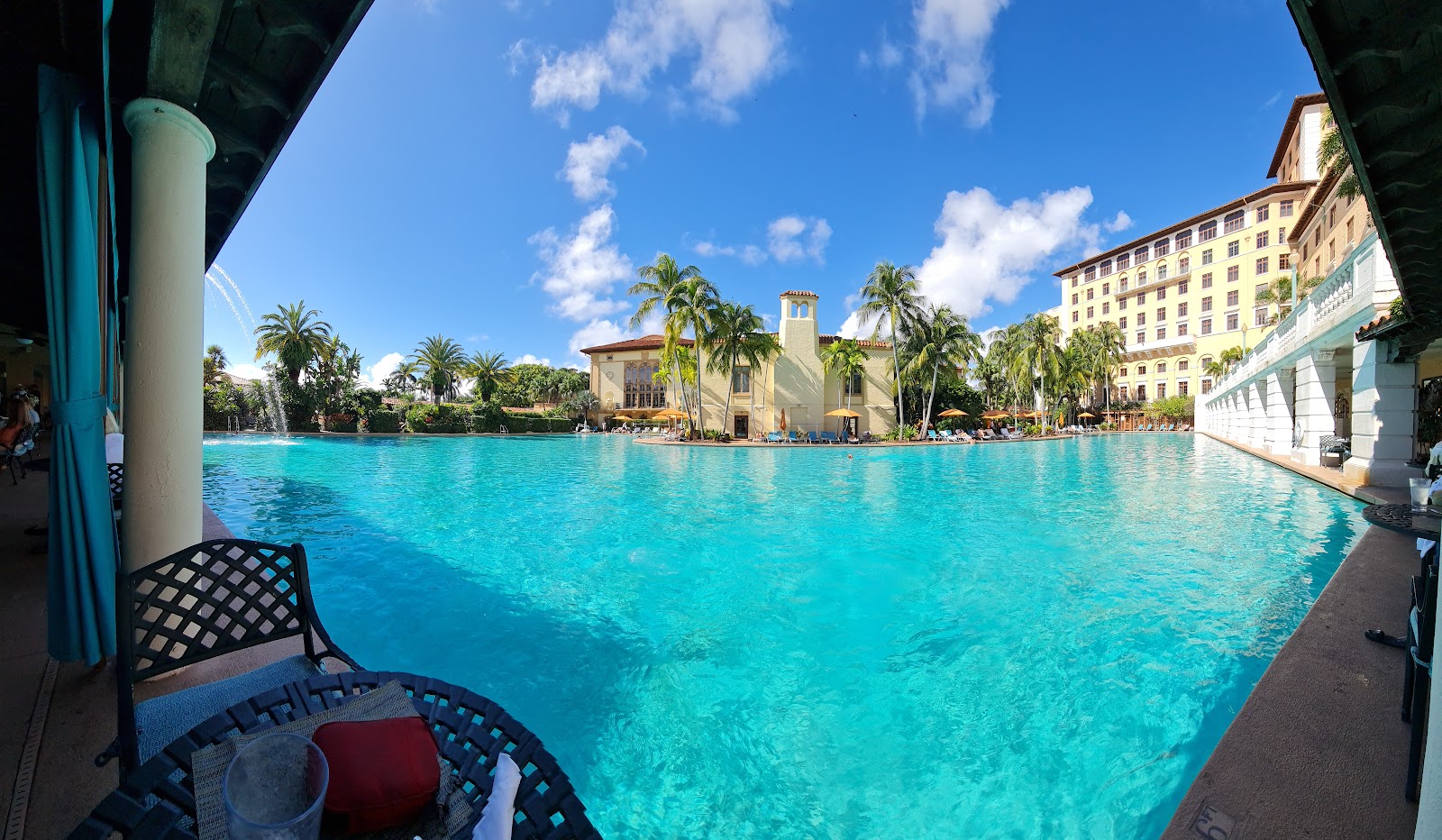
The pool is the other large reflector, and it behaves differently from the walls. A water surface returns light from below, which fills under the brow and the chin — the two places a high sun leaves dark — and it is the reason a portrait at the edge of a large pool at eleven in the morning is more salvageable than the same portrait on dry paving.
The colour it returns is not neutral. Pool water reads distinctly cyan, which means an unmodified uplight on a face pushes the shadows cool while the stucco pushes the highlights warm. That split is attractive if intended and muddy if not; the fix is either to embrace it or to add a close warm source at about a stop above ambient.
The tower is the building’s signature and the hardest thing in it to include well. It is tall and narrow, which means any frame containing all of it either places the subjects very small or requires a wide lens close enough that the tower leans dramatically. Both are legitimate. The leaning version is more honest about how the building is experienced from its base; the small-subjects version is the picture people expect.
The compromise that usually works best is to include the tower as a partial vertical — the top two-thirds, cropped at a roofline — which keeps the shape recognisable and lets the subjects stay at a reasonable size. Late light on the tower is the only time it separates properly from a bright sky, because a Florida midday sky is close enough in value to pale stucco that the silhouette disappears.
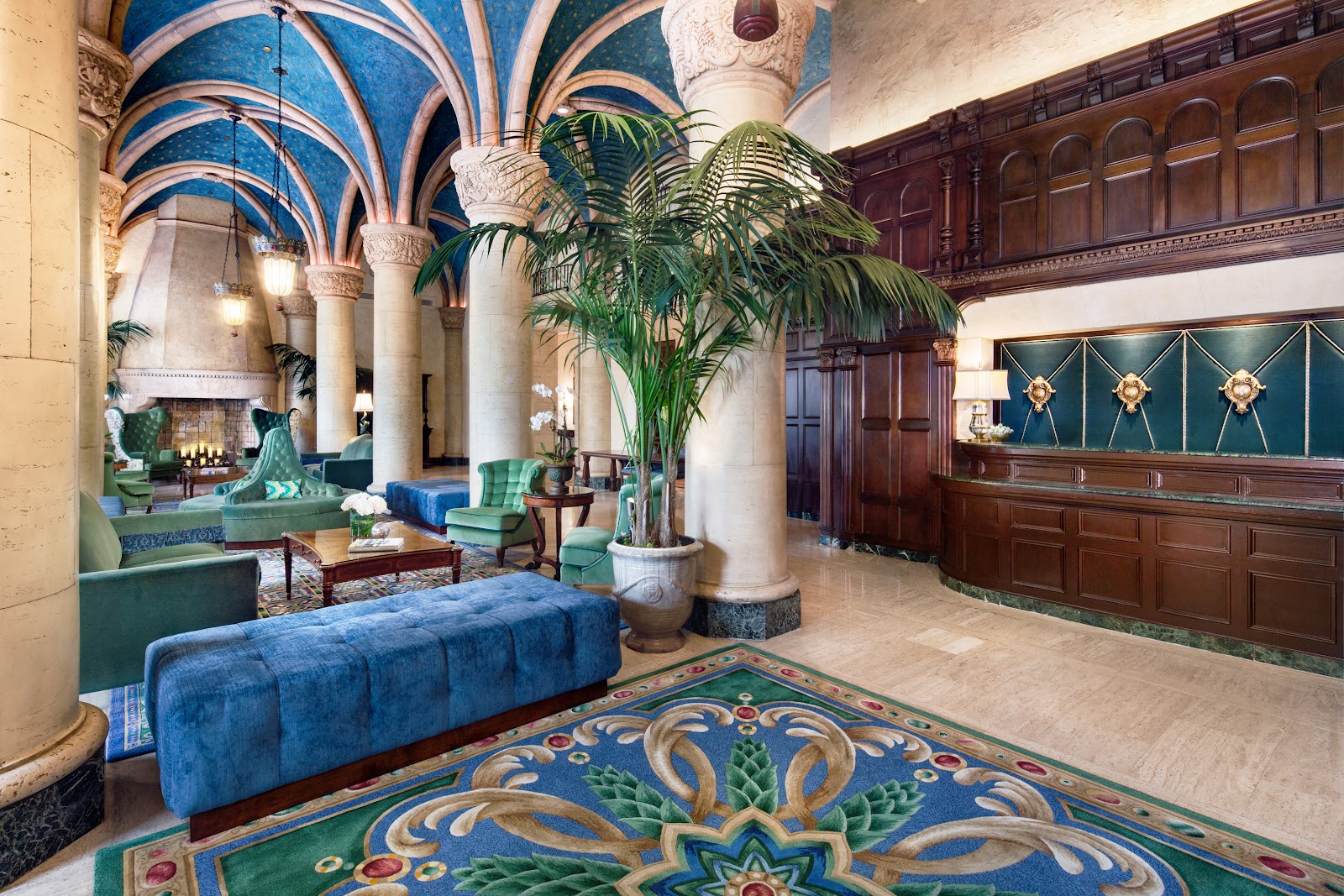
The lobby is the indoor equivalent of the arcades: high vaulted ceiling, deep-set openings, and an ambient level well below what the eye estimates. Meter on skin, let the vault go dark, and treat the openings as directional sources rather than as backgrounds — a subject at forty-five degrees to a deep-set window in a room this size gets the fall-off of a studio setup for free.
At night the room is lit by fixtures at a low colour temperature, which means a flash at daylight balance produces a blue subject in a warm room. A warming gel on the source and a white balance set for the room fixes it in one move.
- Depth back from an arcade opening sets the lighting ratio — choose it deliberately
- Courtyards are a midday problem and a morning and evening solution
- The pool fills from below and does it in cyan
- Include the tower as a partial vertical rather than fighting for all of it
- Gel the source warm indoors at night and balance for the room
The South Florida year
South Florida has two seasons rather than four, and they run opposite to the rest of this guide: the pleasant, reliable, photographically easy season is winter.
The dry season runs roughly from November to April. Humidity drops, the air clears, the afternoon storms stop, the light gains contrast and distance holds detail. The December noon sun at this latitude is about forty degrees above the horizon — high by northern standards but low enough that it models a face rather than flattening it — and the whole day is workable rather than just its ends.
The cost of the dry season is that it is also the busy season, and that the days are short: Miami’s shortest day is about ten and a half hours.
The wet season runs roughly from May to October and it is a different climate. Dew points sit in the mid-twenties Celsius, which is haze rather than fog — it lowers contrast at distance and puts a soft bloom around light sources, and no amount of contrast added afterwards restores what the moisture removed.
It also creates the single most Florida-specific technical problem a photographer meets here: condensation. Air-conditioned interiors are far below the outdoor dew point, which means glass carried from a cold room into humid air fogs instantly, inside and out, and takes ten to twenty minutes to clear. At a wedding that moves repeatedly between a cooled ballroom and an open courtyard, that is not an occasional nuisance but the structural problem of the day.
The answers are practical: let bodies and lenses acclimatise in a bag before going out, keep a second body outdoors rather than cycling one, and stop treating the cooled room as home base.
Afternoon storms in the wet season are close to daily and they have a mechanism rather than being random. The Florida peninsula is narrow enough that sea breezes develop on both coasts and push inland, and where the two fronts meet the air is forced up — which is why the interior of the state records more lightning than anywhere else in the country, and why the storms arrive on a schedule, typically between early afternoon and early evening.
For a Coral Gables date that means the late afternoon is the exposed hour and a named covered alternative is a requirement, not a contingency. It also means the storms clear: the sky after one of these cells passes, at six or seven in the evening, is the best light of the wet season — washed air, broken cloud lit from beneath, and wet stucco returning it.
Hurricane season runs from June to the end of November with the peak from mid-August into October. That is a planning fact rather than a photographic one, but it belongs in any honest account of a date in September.
Vegetation here holds its leaves year-round, which removes the seasonal cue photographs elsewhere rely on. What changes instead is flowering: the flame of a royal poinciana in late spring and early summer, bougainvillea through the dry season. Live oak and banyan hold dense evergreen canopies that block light almost completely, which makes them reliable shade; the palms do the opposite. A palm frond is a row of stiff parallel blades and it throws a hard slatted shadow that is the worst dapple a face can meet.
The rule is simple and it applies everywhere in this state: broadleaf shade is usable, palm shade is not.
More frames from The Biltmore Hotel
The Biltmore Hotel wedding photography: common questions
What is the building's logic?
It was built in 1926, before air conditioning, so it was cooled by geometry: deep arcades, courtyards, loggias and high ceilings. All of those are light decisions too.
Where is the best portrait light?
Two or three metres back from an arcade opening, where the ratio is dramatic and the sunlit courtyard beyond falls away to white.
When are the courtyards good?
Early and late, when one wall is lit and the opposite is shaded — the space becomes a single enormous directional bounce.
What is the hardest technical problem here?
Condensation. Glass carried from an air-conditioned room into wet-season air fogs instantly and takes ten to twenty minutes to clear.
When do the storms come?
In the wet season, almost daily in the afternoon, because sea breezes from both coasts collide over the peninsula. The interior of Florida gets more lightning than anywhere in the country.
Which season is best?
Winter. The dry season from November to April brings clear air, contrast, and no afternoon storms — the reverse of most venues in this guide.
More Florida venue guides
We are writing a photographer’s guide to every venue we would happily shoot in Florida. Here are three more, plus the full index:
- Busch Gardens Tampa Bay: What It Suits and What It Does Not
- The Cummer Museum of Art & Gardens, Jacksonville: How the Light Moves
- The Don CeSar, St. Pete Beach: The One Decision That Governs Everything
Planning a wedding at The Biltmore Hotel?
A building that solved for shade before we did. Tell us your date and we will use it.