 Woodwinds, Branford: The Problem, and Four Ways Out
Mohegan Sun, Uncasville: The One Decision That Governs Everything
Work with the building’s light, or go and find daylight. Both work; doing neither does not.
At a very large resort complex there is one decision that governs the photographic day, and it comes down to what kind of light the pictures will be made in.
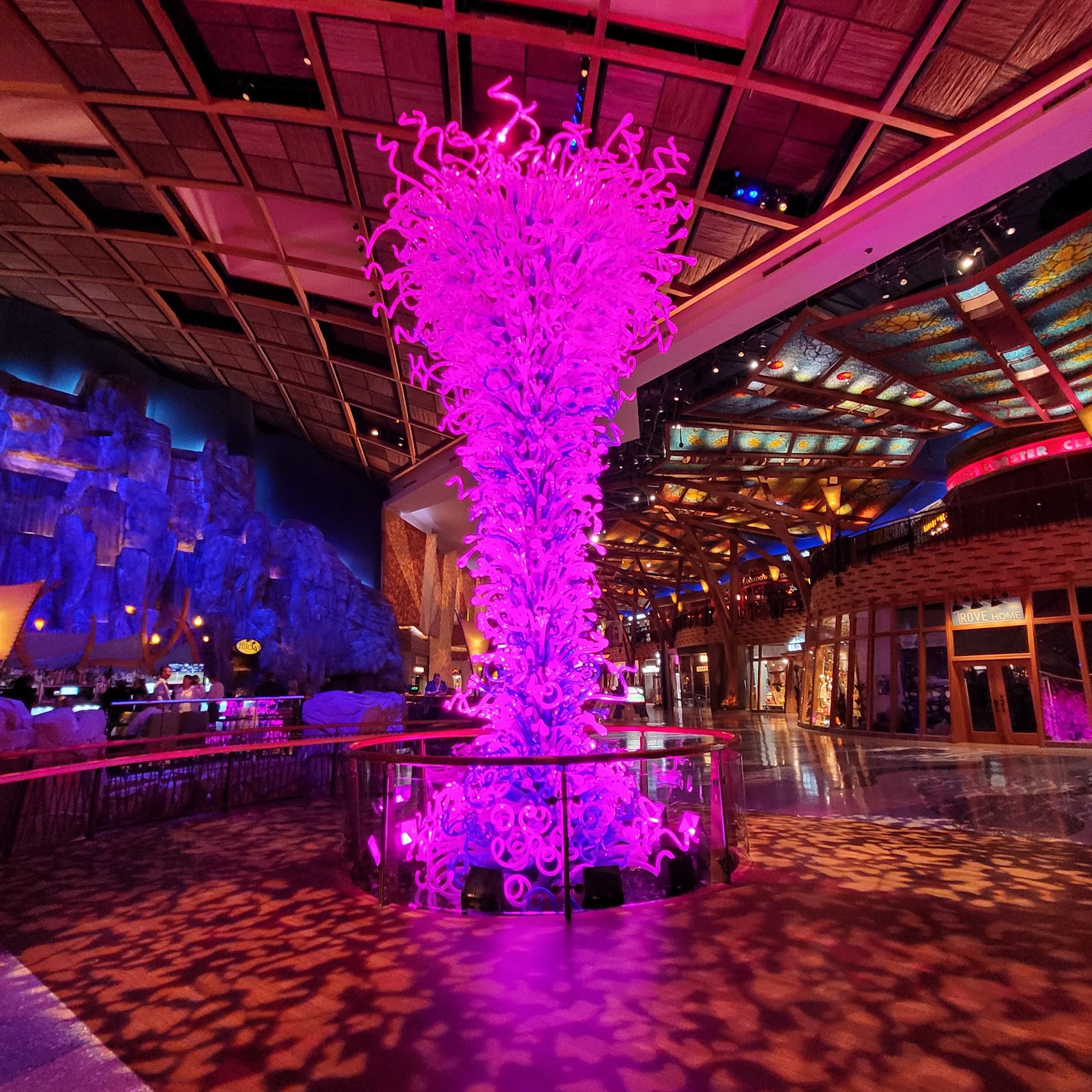
Either the day is worked with the building’s own light — mixed, coloured, artificial, designed for atmosphere and spectacle rather than for faces — and embraced as the look of the place. Or daylight is sought deliberately, in the small number of places it exists and in the landscape outside, and the schedule is arranged around it.
Both are legitimate and they produce entirely different sets of pictures. What fails is doing neither: drifting through the day taking whatever light happens to be in front of the camera, which in a building like this produces frames that are muddy, mixed in colour and inconsistent from room to room.
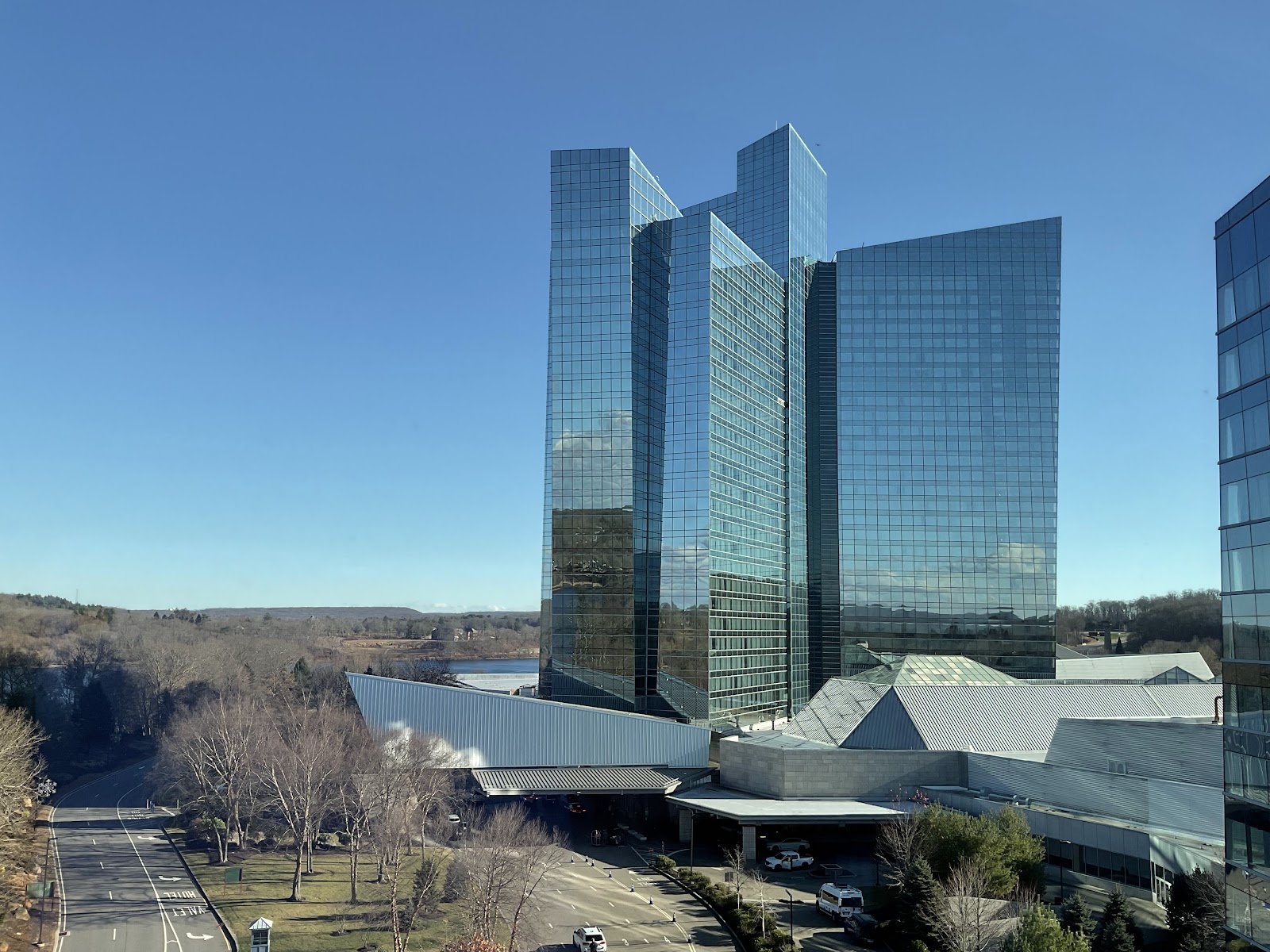
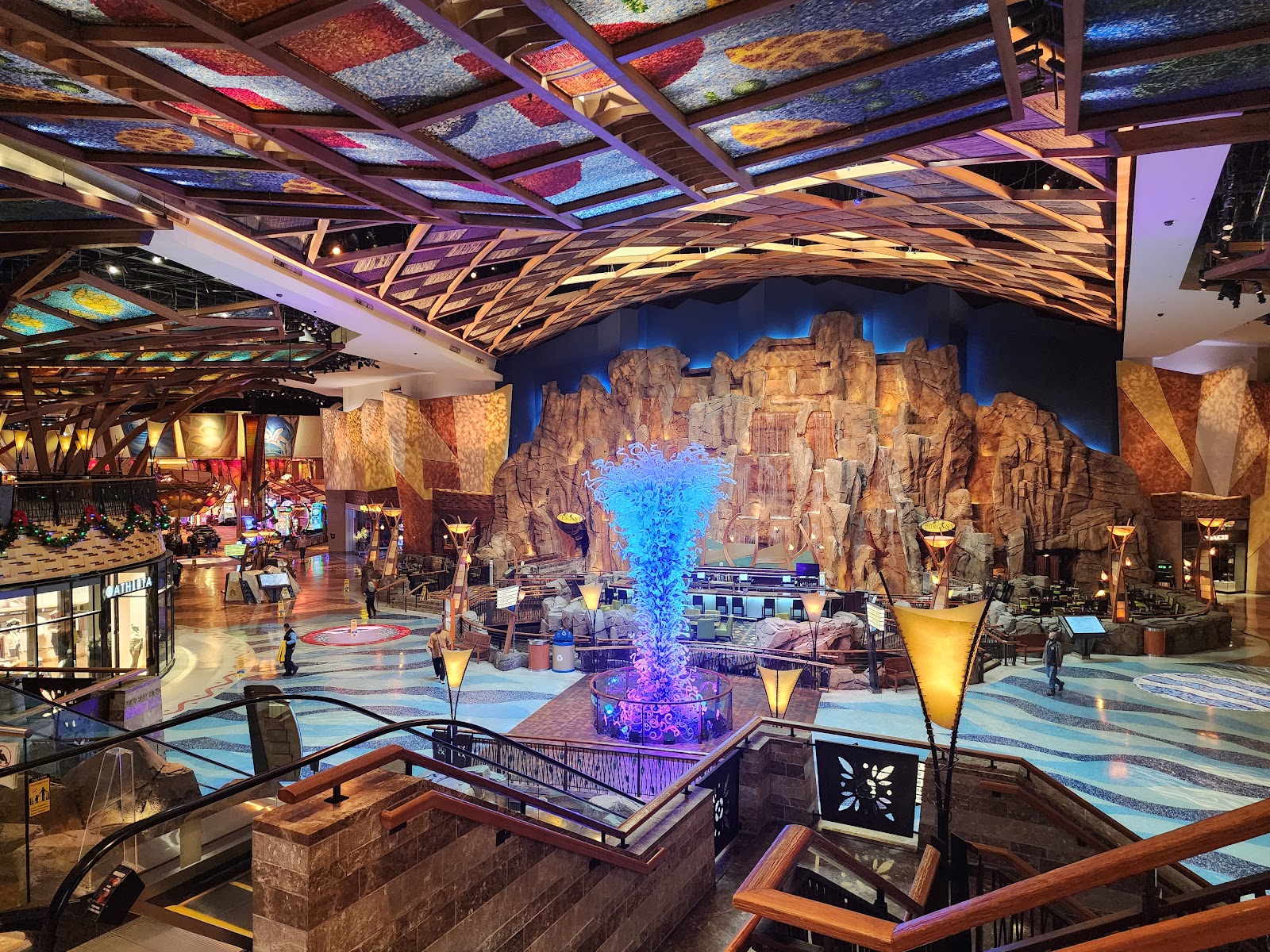
The reason the decision is so stark here is the building’s design. A complex on this scale is an interior world, largely without windows in its function and entertainment spaces, lit deliberately and theatrically, with long distances between areas and a scale that dwarfs a wedding party.
And the reason a real alternative exists is the location. The site sits above the Thames River in eastern Connecticut, in mixed deciduous woodland with genuine New England seasons — which means daylight, water and autumn colour are all within reach if the schedule allows for them.
We have not photographed a wedding at Mohegan Sun; very large resort complexes behave consistently. Which rooms are included, whether the lighting in them can be dimmed or adjusted, what outdoor and water-facing areas are available and how far they are, what daylight reaches the preparation rooms, and how long the internal transfers take are questions for their team — and those answers, rather than anything here, decide which side of this decision a wedding lands on.
Mohegan Sun at a glance
| Where | A very large resort above the Thames River, eastern Connecticut |
| The decision | Work the building’s own light, or go and find daylight |
| Building light | Mixed, coloured and theatrical — commit to it and it becomes a style |
| Daylight | A few interior positions, plus river and woodland outside |
| Ask first | Rooms and areas included, lighting control, transfer times, outdoor access |
If you work the building's light
Committing to the building’s own light is a real option and it produces a distinctive, contemporary set of pictures that a daylight approach cannot. It requires three things done consistently.
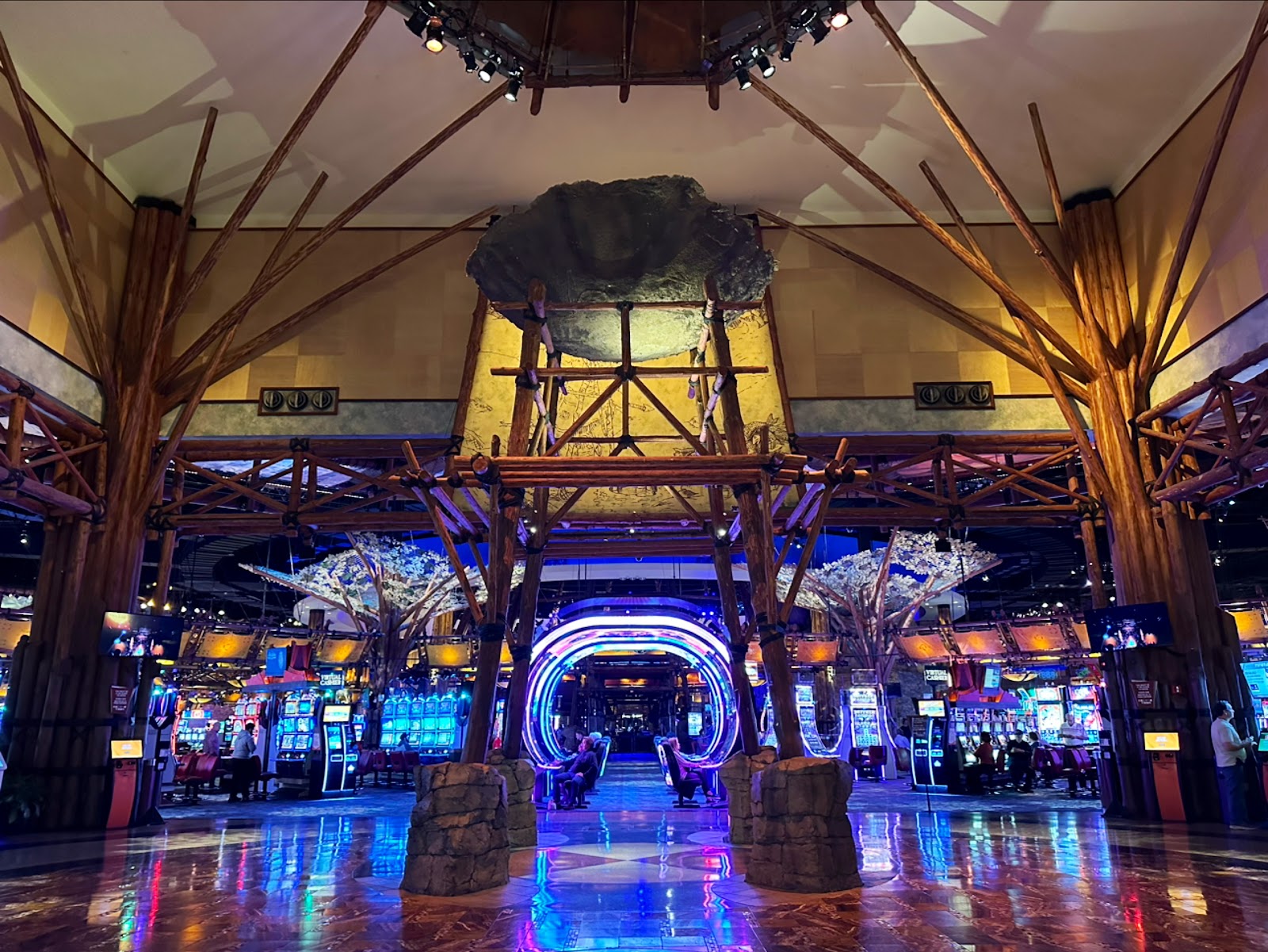
The first is to stop trying to correct the colour and start using it. The lighting in a complex like this is deliberately theatrical: saturated colour washes, coloured architectural lighting, video screens, warm downlights and cool accent light, frequently all in one space. No white balance is correct for that, and attempting to neutralise it produces a frame in which nothing looks right.
The working approach is to decide which light is landing on the face, set the white balance for that one, and let everything else fall where it falls. Skin correct and the room coloured is a picture. Skin wrong is not, regardless of how accurate the background is.
The second is to expose for the room rather than for the faces, then add light for faces only. A theatrically lit space has its character in the relationship between bright points and dark surroundings — and an exposure that makes faces correctly bright makes the room flat and washed out, which throws away the reason the space looks the way it does.
So: expose the ambient about a stop or a stop and a half under what skin needs, then add one source off the camera axis, gelled to whatever is dominant, set just above what the ambient gives the face, diffused so it does not read as flash. That keeps the room’s depth and colour and makes the faces readable.
The third is to use the coloured light as a compositional element rather than as a background accident. A wash of colour behind a subject, a lit architectural line, a reflection in polished floor or glass — those are graphic resources, and a frame built around one reads as intentional where the same light ignored reads as a mess.
Polished floors are the specific gift of these buildings. They double every source and every figure standing on them, which used deliberately gives frames with symmetry and depth that nothing else provides — and ignored, they reflect the photographer, the equipment and the service doors, which is why the angle matters.
Two technical notes on working this way. Tall ceilings mean the ceiling is not a usable bounce surface: a flash aimed five or six metres up returns almost nothing and what returns is coloured by whatever is up there. A pale nearby wall is the best bounce available, and where there is none, direct through a modifier is the answer.
And carpet helps. Heavily patterned carpet absorbs, which makes the fall-off from an added source steeper than it would be on hard flooring — so a background a few metres behind a subject drops away more than expected and the separation comes free.
The scale of the building is the last thing to handle and the honest answer is to work long and close for most of the day. A room built for a thousand dwarfs a wedding of a hundred and fifty, and a wide frame containing the volume shows an empty space with people in it. Closer framing with a longer lens puts the emphasis on the people, which is where it belongs.
Where the scale is used, it should be the subject: a very wide frame with a couple small and deliberate within an enormous space is a strong picture precisely because it is about scale. That is one picture in a set, not an approach to a whole day. And any upper level or balcony that lets the camera look down makes a large room legible as a shape rather than as an expanse, which wide framing at floor level cannot do.
If you go and find daylight
The daylight approach is the other side of the decision and it takes planning rather than equipment.
The first step is locating the daylight inside, which in a building like this means a small number of fixed places: an entrance or porte-cochère, a glazed atrium or connecting link, a high-floor guest room, and any restaurant or lounge with an external wall. Each of those behaves like a window in a dark room, which is the best portrait condition available anywhere.
The technique at each is identical. A metre from the glass, turned about forty-five degrees to it, gives horizontal light at head height with steep fall-off behind — real modelling, and a background two or three stops down for nothing. The catchlight confirms it: broad and low on the window side of each eye.
In a guest room, turn the room lights off. Warm bulbs against cool daylight put two colours on one face and no white balance renders both, and switching them off is free. A high floor is worth asking for, because a room above the treeline looks out over river and woodland rather than at a car park.
The scheduling consequence is the whole point of this approach: if the daylight positions are few and fixed, the portraits belong at those positions at whatever hour they work, and the running order has to be built around them rather than fitting them into a gap. A plan that leaves the couple’s portraits until after dark in a windowless building has thrown away the free resource in the place.
The second step is going outside, and in eastern Connecticut what is outside is genuinely good. Mixed deciduous woodland — sugar and red maple, oak, birch, hickory, with hemlock and white pine in the damp ground — and the Thames River, which is tidal this far up and therefore has boats, working waterfront and a changing water level.
The woodland rules are standard. Deciduous canopy filters as much as it blocks, so it dapples: look at the face rather than the ground, and a bright patch on skin means move a metre. Hemlock and white pine give the real full shade and the darkest backgrounds available, with the standard trap that a meter looking at them overexposes the face by a couple of stops.
The woodland edge is the single most reliable outdoor position: a metre or two inside the canopy at the margin of an opening gives soft directional light in front and darkness behind, which is a window in a dark room without a building around it.
The river adds a horizontal reflector, which doubles the sky and throws light upward into faces standing above it. Being tidal, its level changes by two or three feet through the day on a six-hour cycle — which changes the exposed margins and the height of anything moored, and is knowable in advance by checking the tide for the date.
Its colour is worth knowing: a tidal river carries sediment, so it is brown-green rather than blue, which means it does not brighten a frame the way an ocean does and it fills nearby faces with a muddy-coloured light. A custom white balance set on a face at the water’s edge fixes that.
The practical constraint on the whole daylight approach is distance and time, and it is the thing that decides whether it happens. If the nearest usable outdoor position is a ten-minute walk or a shuttle ride, then a twenty-minute portrait session is a forty-minute absence — which has to be in the running order explicitly rather than hoped for. Knowing the real distances in advance is what makes it possible.
The strongest argument for making the effort is seasonal. In this region, October gives two or three weeks of foliage that no interior can substitute for, and deep winter gives snow and a low sun raking horizontally through bare trunks. Twenty minutes outdoors on either of those dates is worth more than any amount of work inside, because it gives the whole set of pictures a place and a season that the building deliberately withholds.
- Commit to one approach: the building’s light, or daylight. Not neither
- Building light: set white balance for what lands on the face, ignore the rest
- Expose the room a stop under, then one gelled source just above skin
- Daylight: locate the few positions and build the running order around them
- Outside, the woodland edge and the river are twenty minutes and worth it
The eastern Connecticut year
Eastern Connecticut has four genuine seasons, moderated slightly by proximity to the Sound. Because the building itself is weather-independent, the calendar decides what the daylight half of the day gives rather than whether the wedding works.
Winter is cold with snow in most years, and for an indoor venue that is close to irrelevant — guests arrive under cover and nothing depends on the sky. That is the honest argument for a complex like this on a February date, and it is a real one.
Outdoors, winter is transformative and almost never used. Snow is the best natural fill available, lifting every shadow and throwing light upward into faces, and snow against dark bare trunks, dark hemlock or dark tidal water gives the widest brightness range available — expose for the snow and let the rest go black. Snow fools a meter by about two stops toward underexposure, so deliberate overexposure relative to the camera is the rule.
The December sun at this latitude reaches only about twenty-five degrees above the horizon, so the whole short day rakes rather than floods, and in leafless woodland it comes in almost horizontally through the trunks — the best light a New England wood receives, lasting most of the short day rather than an hour.
The practical costs are a short day, cold hands, batteries draining faster, and a cold camera fogging when brought back into a heated building. At a venue with a large temperature difference between inside and out that last one is a real consideration: spares in an inside pocket and bodies bagged until they warm.
Early spring is mud season and the weakest outdoor part of the year: bare trees, brown ground, wet footing and no colour anywhere. On an April date the building’s own light is the better decision, and that is a legitimate reason to make it.
Late spring is undervalued: new foliage transmits light beautifully, the woods are at their most luminous, temperatures are comfortable, and the river margins are green again. Late May is the first genuinely strong outdoor month.
Summer is warm and humid — mid to upper eighties Fahrenheit with high humidity — with afternoon thunderstorms a real feature from June into August. Indoors none of it matters. Outdoors it means the middle of the day belongs to conifer shade and canopy edges, and any outdoor trip in July should be scheduled for the last two hours.
The humidity has one compensating effect worth knowing: it warms and diffuses the light at the ends of the day more than dry air does, which flatters skin and suits transmitted light under leaves.
Autumn is the season and it is the strongest argument for the daylight decision. Colour in eastern Connecticut peaks in the second half of October in most years, and because the species turn at different rates — sugar maple scarlet, red maple crimson, birch and hickory yellow, oak russet — the window runs two or three weeks rather than one.
Reflected in a calm tidal river, that colour is doubled, and brown-green water is dark enough to hold a warm reflection without competing with it in the way blue water would. Scarlet and gold doubled in still water with boats in front of it is the single strongest frame available anywhere near this property.
Autumn also brings the clearest air, the most settled weather and the most comfortable temperatures of the year, which makes the trip outside easier as well as better worth taking.
Late autumn after leaf fall is spare and graphic rather than empty: bare structure, long sightlines through the trees, russet oak still holding, stone walls visible again, and the first snow on dark trunks. It is the most underrated fortnight of the year in this landscape.
More frames from Mohegan Sun
Mohegan Sun wedding photography: common questions
What is the governing decision?
Whether to work with the building’s own theatrical light or to go and find daylight. Both work; drifting between them produces muddy, inconsistent frames.
How do I handle mixed coloured lighting?
Decide which light is landing on the face, set the white balance for that one, and let the rest fall where it falls. Correct skin, coloured room, is a picture.
How should the function rooms be exposed?
About a stop under what faces need, so the room keeps its depth and colour, then add one gelled source just above skin level.
Where is the daylight inside?
A small number of fixed places — an entrance, a glazed link, a high-floor guest room, a restaurant with an external wall. Build the schedule around them.
Is it worth going outside?
Yes, and almost nobody does. Twenty minutes in eastern Connecticut woodland or by the river gives the pictures a place and a season the building withholds.
When is outside most worth it?
October, for two or three weeks of foliage doubled in the tidal river — and deep winter, for snow and a low sun raking through bare trunks.
More Connecticut venue guides
We are writing a photographer’s guide to every venue we would happily shoot in Connecticut. Here are three more, plus the full index:
- Pond House Cafe, West Hartford: One Frame, and How It Is Made
- Red Barn at Hampshire Hills, Milford: What It Suits and What It Does Not
- Riverhouse at Goodspeed Station, Haddam: A Walk Through the Site
Planning a wedding at Mohegan Sun?
Its light or the daylight — decide early. Tell us your date and we will plan it.