 Woodwinds, Branford: The Problem, and Four Ways Out
Pond House Cafe, West Hartford: One Frame, and How It Is Made
Roses in low sun, and a pond behind. The frame is simple; the timing is not.
There is one frame this kind of site gives better than anywhere else, and it is worth building properly because it depends almost entirely on decisions made before the camera comes out.
A couple stands among roses in bloom, in low sun, with a pond and mature parkland behind them. Three elements: flowers at close range, low raking light, and water as a background. Each of the three is straightforward on its own, and the frame needs all three at once — which is why the timing matters more than the technique.
The reason it works is that roses do something in low light that almost no other flower does. The petals are thin and layered, which means they transmit light as well as reflect it — so a backlit or side-lit rose glows from within rather than being lit from outside. A rose garden in the last hour is genuinely luminous, and no amount of added light reproduces it.
The reason it is difficult is the timing, and it has two parts. Roses in this climate have a main flush in June and a second, smaller one in late summer and early autumn — which means the frame exists for a few weeks rather than a season. And the low light exists for an hour, which in June means genuinely late.
The third element is the setting: a small venue within a public park, which brings its own considerations — other people, public access, permit questions, and a landscape maintained by someone other than the venue.
We have not photographed a wedding at the Pond House Cafe; small venues in public parks behave consistently. What areas are available and under what conditions, what permits apply to the park’s gardens, whether the rose garden can be used and when it is in bloom in a given year, the guest limit, and the covered alternative are questions for their team and for the park — and the bloom question in particular is worth asking rather than guessing.
Pond House Cafe at a glance
| Where | A pond and rose garden in a public park at West Hartford |
| The frame | Roses at close range, low raking light, and the pond behind |
| Why it works | Rose petals transmit light, so they glow rather than reflect |
| The timing | A main flush in June, a smaller one in late summer; an hour of light |
| Ask first | Areas and permits, bloom timing this year, guest limit, covered alternative |
How the frame is built
The light direction is the first decision and it is the one that makes the frame rather than merely lighting it. Roses want to be between the camera and the sun, or close to it — because transmitted light is what makes them glow, and transmitted light only happens when the light source is behind the subject.
So the working position has the sun low and behind or beside the flowers, with the camera looking toward it. Front-lit roses are simply flowers: correctly coloured, correctly exposed, and flat. Backlit roses are luminous.
The consequence for the couple is that they are backlit too, which means their faces are in their own shadow. That is the frame’s central technical problem and it has one good answer: expose for the roses and the background, and lift the faces with a close source gelled warm to match the light.
Close matters because a garden bounces very little — a source at two metres needs roughly a quarter of the output of the same source at four — and close is also softer relative to the subject. The gel matters because low sun at that hour is strongly warm, and an ungelled source produces faces that read cooler than everything around them, which the eye catches immediately.
The alternative answer is to place the couple in shade with the roses lit behind them, which is easier and gives a different picture: soft faces against a luminous background, with the flowers as the subject rather than the setting. Both are worth making.
The lens is the second decision and it decides whether the roses read as a mass or as individuals. A longer lens at a wider aperture compresses the bed into a field of soft colour behind the couple, which is the frame most people want — the flowers become texture and tone rather than identifiable blooms.
A closer position with a shorter lens gives individual flowers in focus and a tighter frame, which is a detail picture rather than a portrait. And a low camera, down at the level of the bed, puts flowers in the foreground as well as behind, which layers the frame and is the single most effective compositional move in any flower garden.
The pond is the third element and it does two things. It is a horizontal reflector, which throws light upward into faces standing beside it — helpful under a high sun, and at low sun it becomes a sheet of reflected colour. And it is a background that reads as depth: a mirror of trees and sky behind a bed of flowers gives three distinct planes in one frame.
A reflection runs about a stop darker than what it reflects, which is the thing to know when metering a frame containing both. And a pond in a park is likely to be still rather than choppy, because it is small and sheltered, which means it mirrors properly for most of the day.
Colour is the last build decision and it is the one that goes wrong most often. A rose garden contains reds, pinks, yellows and whites at high saturation, and a deep red rose is the first thing in any frame to lose its detail: it clips in one channel while the rest of the picture still looks correctly exposed.
The rule that follows is to expose for the reds. If the deep colours hold their texture, the frame works and skin can be lifted afterwards — the reverse is not recoverable. And a custom white balance set on a face in position handles the green cast bouncing off foliage and the warm light of the hour, both of which a daylight preset renders badly.
What breaks it, and what else the site gives
Midday sun breaks the frame completely and it is the commonest reason it fails. High sun on a rose bed gives no transmitted light at all — the flowers are lit from above, the petals do not glow, the colours clip, and the faces have vertical shadows and dark eye sockets with nothing overhead to help.
There is no technique for it. A rose garden in the middle of a bright day is a place to identify positions for later rather than to photograph in, and the honest answer is to schedule the frame for the last hour or the first.
Overcast changes it entirely and it is worth understanding as a different frame rather than a worse one. Under cloud the transmission effect is gone, because there is no directional light to transmit — but the colours saturate rather than clipping, the whole range collapses, faces need nothing added, and every part of the garden becomes usable at any hour.
So a grey day gives a rich, even, saturated rose garden and a bright one gives a luminous one, and neither is a failure. What does not work is a bright day photographed at noon.
The bloom is the second thing that breaks the frame and it is not a technical matter. Roses in this climate flower in a main flush from roughly early to mid June, with a second smaller flush in late summer into early autumn, and between and after those the beds are green rather than coloured. A date in late July may find a rose garden with very little on it.
That is a question with a real answer from whoever maintains the garden, and it is worth asking rather than assuming — because if the roses are not out, the frame described here does not exist and the day needs a different plan.
Being in a public park is the third consideration and it is practical rather than photographic. The garden is maintained for the public, which means other people in it, dogs, joggers, and the ordinary life of a park during a wedding — and it also means the planting, the mowing and any maintenance work are decided by the park rather than the venue.
That is workable and it argues for a longer lens and closer framing, both of which exclude the background anyway. And it argues for knowing in advance what permits or restrictions apply to a ceremony or a group in the garden, because that varies and it is not the venue’s decision to make.
What else the site gives is mature parkland, which is the fallback and a good one. A public park of any age has large specimen trees, and those give what a flower garden cannot: real shade, a dark background, and a position that works in the middle of the day.
The species here are the New England mix — sugar and red maple, oak, beech, with conifer where it has been planted — and the rules are standard. Deciduous canopy filters as much as it blocks, so it dapples: look at the face rather than the ground, and a bright patch on skin means move a metre. A dense conifer or beech canopy is the real full shade.
The canopy edge is the reliable position: a metre or two inside at the margin of an opening gives soft directional light in front and darkness behind, which is a window in a dark room without the building. It carries the standard trap — a meter looking at dark canopy overexposes the face by a couple of stops, while a bright pond frame a minute later fools it the other way — so manual exposure metered on skin throughout.
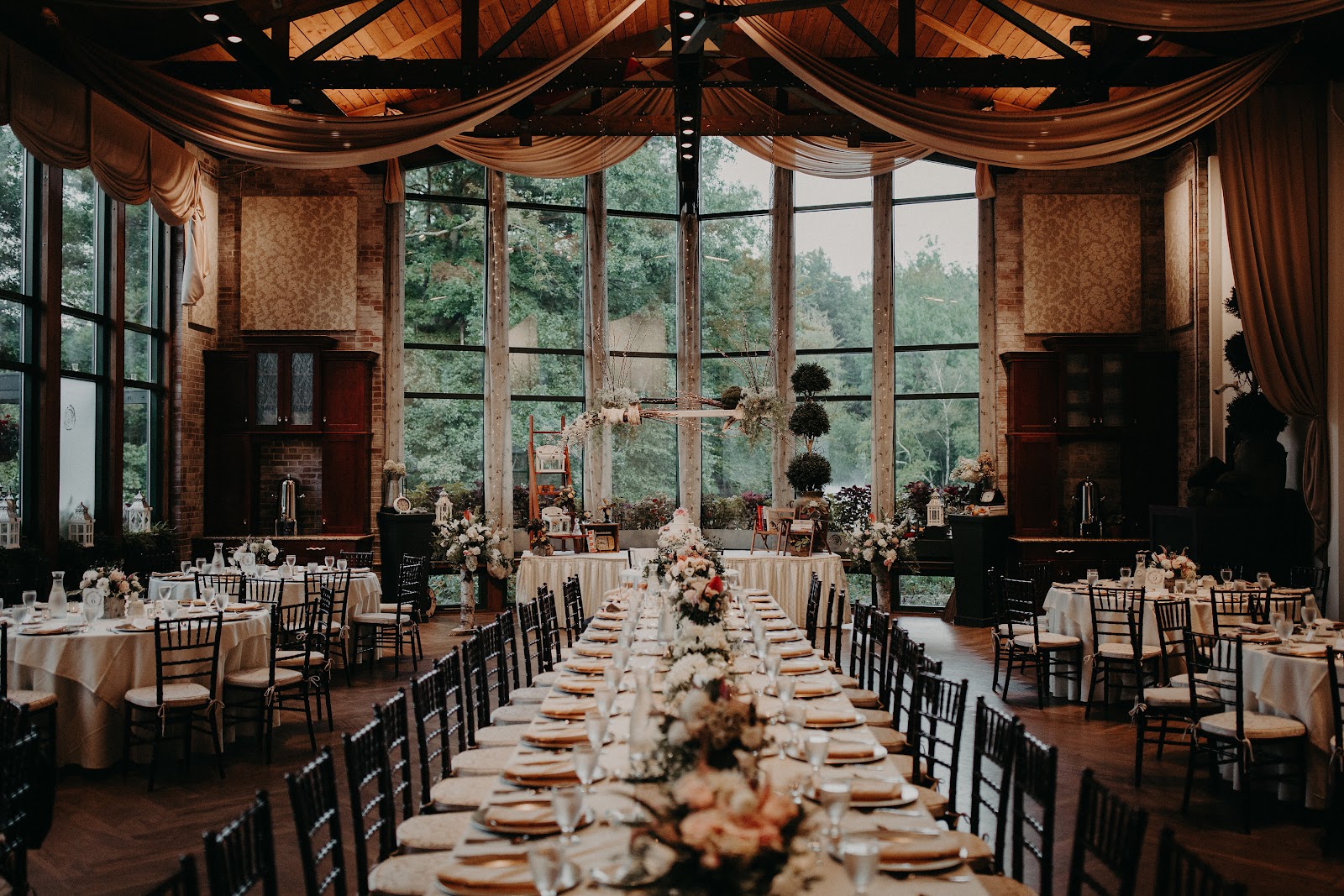
Indoors, a small venue of this kind has a limited number of rooms and the light is from windows, which is the best light it has. A subject a metre from the glass, turned about forty-five degrees to it, gets real modelling with steep fall-off behind — room lights off, and a custom white balance set on a face, because a window looking onto foliage delivers green light and one looking at the pond delivers cool.
For the evening, expose the ambient about a stop under what faces need so the room keeps its character, then add one warm-gelled source just above skin level with the white balance set to the gel. A small low-ceilinged room is a usable bounce surface, which is a real advantage.
- Sun low and behind the roses, camera looking toward it — that is the frame
- Expose for the roses and lift the faces close and gelled, or put them in shade
- Expose for the reds: a deep red clips before anything else in the frame
- Get low — flowers in the foreground as well as behind layers the picture
- Ask when the roses actually bloom this year; the frame depends on it
The central Connecticut year
Central Connecticut has four genuine seasons with little maritime moderation, and at a garden venue the calendar decides what exists to photograph more than at any other kind of site.
Winter is cold with snow in most years, and a rose garden in winter is bare pruned stubs — which is honest and not a picture. What winter gives instead is the parkland: bare structure, long sightlines, mature trunks, and snow.
Snow is the best natural fill available outdoors, lifting every shadow and throwing light upward into faces, and snow against dark bare trunks gives the widest brightness range available. Snow fools a meter by about two stops toward underexposure, so deliberate overexposure relative to the camera is the rule. And a frozen pond is a flat pale plane rather than a mirror — graphic rather than reflective, and genuinely striking.
The December sun at this latitude reaches only about twenty-five degrees above the horizon, so the whole short day rakes rather than floods, which in bare parkland means horizontal light through the trunks all day rather than for an hour. On the light alone, winter is the easiest season; on content, the thinnest.
Early spring is mud season and the weakest part of the year: bare beds, brown ground, wet footing and nothing in bloom. Late April brings the park’s early flowering — magnolia, cherry and the spring bulbs — which is a genuinely good fortnight and entirely different from the rose frame.
Late May is when the garden fills and the trees leaf out, and the light under new foliage is among the most flattering of the year: pale fresh green leaves transmit light beautifully.
June is the rose month and it is the reason to choose this site. The main flush in this climate runs from roughly early to mid June, which is when the frame described above is available at its fullest — and because the days are at their longest then, the low light arrives late, which means the portrait window is genuinely at eight in the evening rather than six.
That is a scheduling fact worth planning around rather than discovering: a June ceremony at four means the best light of the day comes several hours later, and the frame has to be placed there deliberately.
Midsummer is warm and humid — mid to upper eighties Fahrenheit with high humidity — with afternoon thunderstorms a real feature from June into August, which for a garden venue makes a named covered alternative a requirement. The roses between flushes are green, and the middle of the day belongs to the parkland canopy rather than the beds.
Late summer into early autumn brings the second rose flush, which is smaller but arrives with two advantages: the light is lower at a more civilised hour, and the air is clearer. A September rose frame is frequently easier to make than a June one, and it is worth mentioning to a couple with a flexible date.
Autumn is the park’s own season. New England foliage in central Connecticut peaks in the second half of October, and mature parkland trees — maple, oak, beech — give scarlet, gold and russet in a managed landscape where every specimen has room to spread. Reflected in a still pond, that colour is doubled, which is the strongest wide frame the site produces.
Autumn also brings the clearest air, the most settled weather and the most comfortable temperatures of the year. If the couple want the pond and the trees rather than the roses, October is unambiguously the answer.
More frames from Pond House Cafe
Pond House Cafe wedding photography: common questions
What is the frame?
A couple among roses in low raking light with the pond behind. Rose petals transmit light, so they glow from within rather than simply being lit.
Which way does the light have to come from?
From behind or beside the flowers, with the camera looking toward it. Front-lit roses are just flowers; backlit roses are luminous.
How do I expose it?
For the roses and the background, with the faces lifted by a close warm-gelled source — and above all for the reds, which clip before anything else.
When are the roses out?
A main flush from roughly early to mid June, and a smaller one in late summer into early autumn. It is worth asking rather than assuming.
Is an overcast day a problem?
No, just different — the glow is gone, but the colours saturate, the range collapses and the whole garden works at any hour.
What if the roses are not out?
Use the mature parkland instead: real shade, dark backgrounds and a still pond. In October that is the stronger frame anyway.
More Connecticut venue guides
We are writing a photographer’s guide to every venue we would happily shoot in Connecticut. Here are three more, plus the full index:
- Red Barn at Hampshire Hills, Milford: What It Suits and What It Does Not
- Riverhouse at Goodspeed Station, Haddam: A Walk Through the Site
- Saybrook Point Inn, Old Saybrook: The One Decision That Governs Everything
Planning a wedding at Pond House Cafe?
One frame, and it depends on the date. Tell us yours and we will check the bloom.