 The Henry Clay: Lighting a 1920s Lodge Building
Keeneland Racecourse, Lexington: The Problem, and Four Ways Out
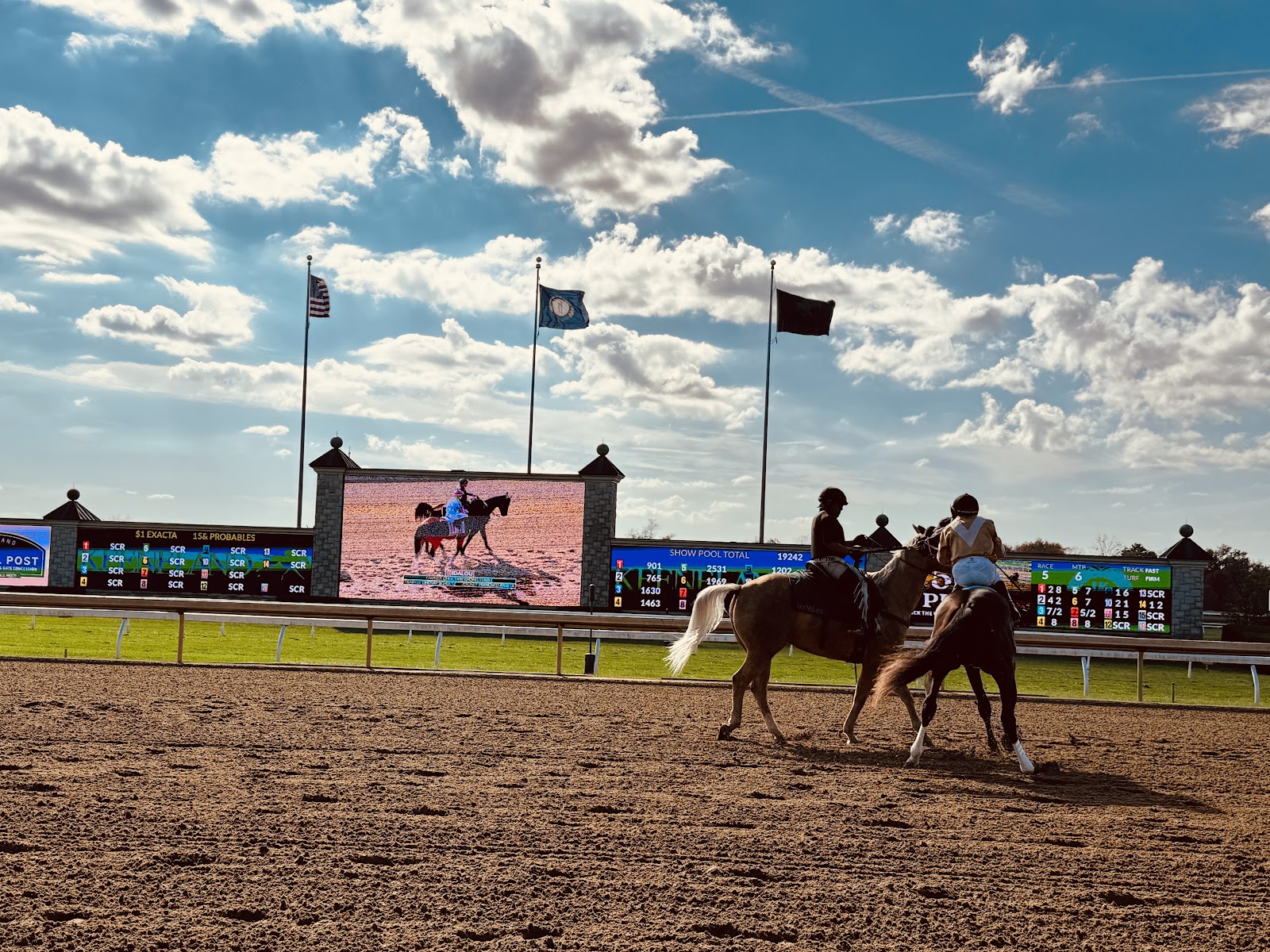
Acres of open turf and a stone grandstand. Neither of them gives you shade.
A racecourse is built around a large expanse of open ground with permanent structures along one edge, and that produces a specific pair of problems.
The open ground has no shade at all. Turf, rail and sand are the surfaces, and at this latitude — about thirty-eight degrees north, with a June midday sun around seventy-five degrees above the horizon — the middle of a summer day on open ground puts eye sockets in shadow and a hard line under every chin, with nowhere to escape to.
The buildings are stone, and here that is the regional material: limestone, which in this part of Kentucky is pale and warm. That makes them a reflector rather than a dark absorber, which is a genuine asset — but stone architecture built to hold crowds is also full of deep covered spaces that are several stops darker than the ground in front of them, which is a range problem rather than a lighting one.
There are four ways out and the Bluegrass landscape supplies one of them, which is the thing this region has that a racecourse elsewhere does not.
We have not photographed a wedding at Keeneland Racecourse; racecourses and Bluegrass country behave consistently. Which areas are available and when, what the covered alternative is, and whether the track and paddock areas may be used are questions for their team.
Keeneland Racecourse at a glance
| Where | Lexington, Kentucky, in the Bluegrass |
| The problem | Open ground with no shade, and deep covered stone spaces several stops down |
| Way one | Schedule it: the ends of the day, and shade in between |
| Way two | Use the limestone as a light. Way three: the covered spaces properly |
| Way four | The Bluegrass landscape — specimen trees in open pasture |
Ways one and two: the clock, and the limestone
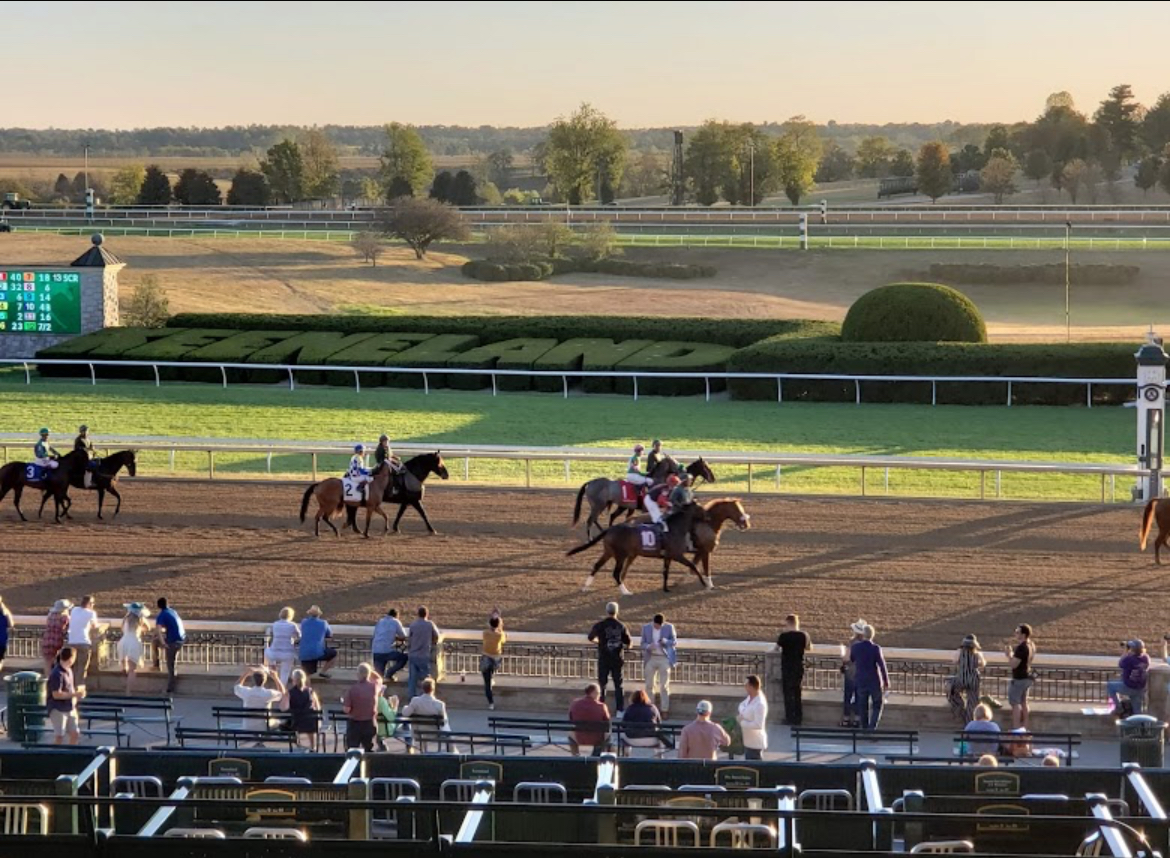
The first way out is scheduling and it is the honest one. Open ground is a morning-and-evening proposition: the first hour after sunrise, the last hour before sunset, and the twenty-five to forty minutes after it. Everything between is a shade exercise.
The last hour is where the value is, because that is when the open ground works properly. Low sun across mown turf gives texture that midday flattens entirely, the rail casts a long line, and the buildings’ stone reads as material. It is also when a wide frame — a couple small against an expanse of turf with a grandstand behind — becomes available, because at midday the same frame has no modelling in it anywhere.
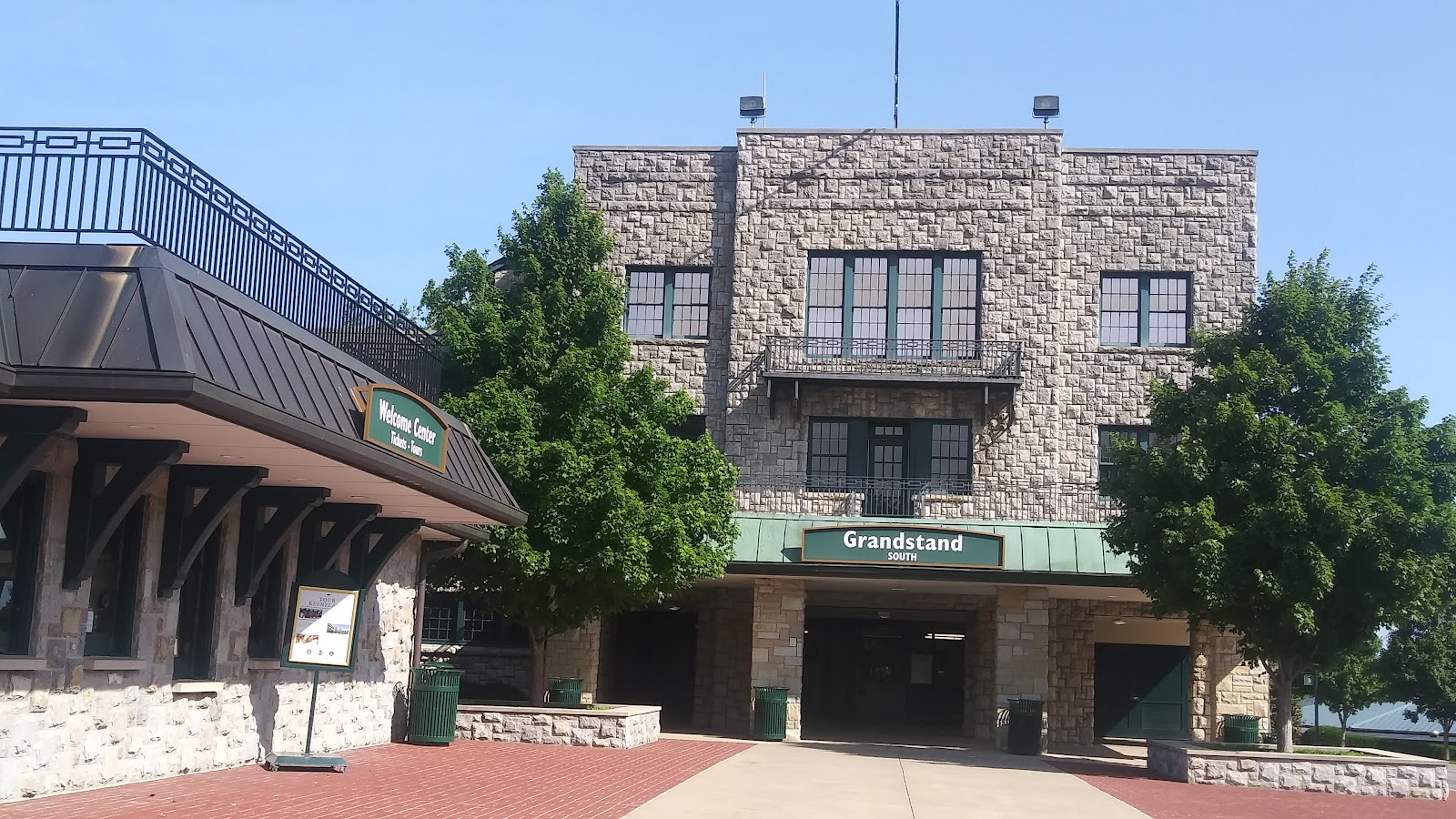
The second way out is to use the limestone as a light source, and in this region it is a stronger asset than most stone. Pale Kentucky limestone is warm and reflective, which means a sunlit stone elevation is a soft source at architectural scale — a couple standing in shade three or four metres out from one, turned towards it, is lit by a source the size of the wall.
The distance matters: closer than two metres and the fall-off across two faces becomes uneven; further than five and the open sky above takes over as the dominant source, which is flatter and cooler. Three to four metres out, facing the wall, with the camera positioned so the lit stone is behind the photographer rather than in the frame, because it will clip.
The colour has to be matched rather than corrected. Limestone bounce is markedly warmer than daylight, so a daylight setting renders it orange — and because the cast arrives from one side, a global correction neutralises the lit side and throws everything else cold. A custom white balance set on a face in the position being used is the fix, and any added source should be gelled warm with white balance set to that gel.
And the stone reads as stone only under raking light. Coarse limestone lifts every course and tool mark when light runs along it and flattens into a pale field when light faces it square, so the elevations the sun is skimming are the ones worth photographing — which on a building with a long frontage means a walk along it rather than a single position.
This is also the same rock that makes the region what it is: the limestone aquifer under the Bluegrass is why the pasture here supports the horses it does, and why the same stone appears in every wall and every building. It is worth knowing because it connects the architecture and the landscape rather than leaving them as two separate subjects.
Ways three and four: the covered spaces, and the Bluegrass
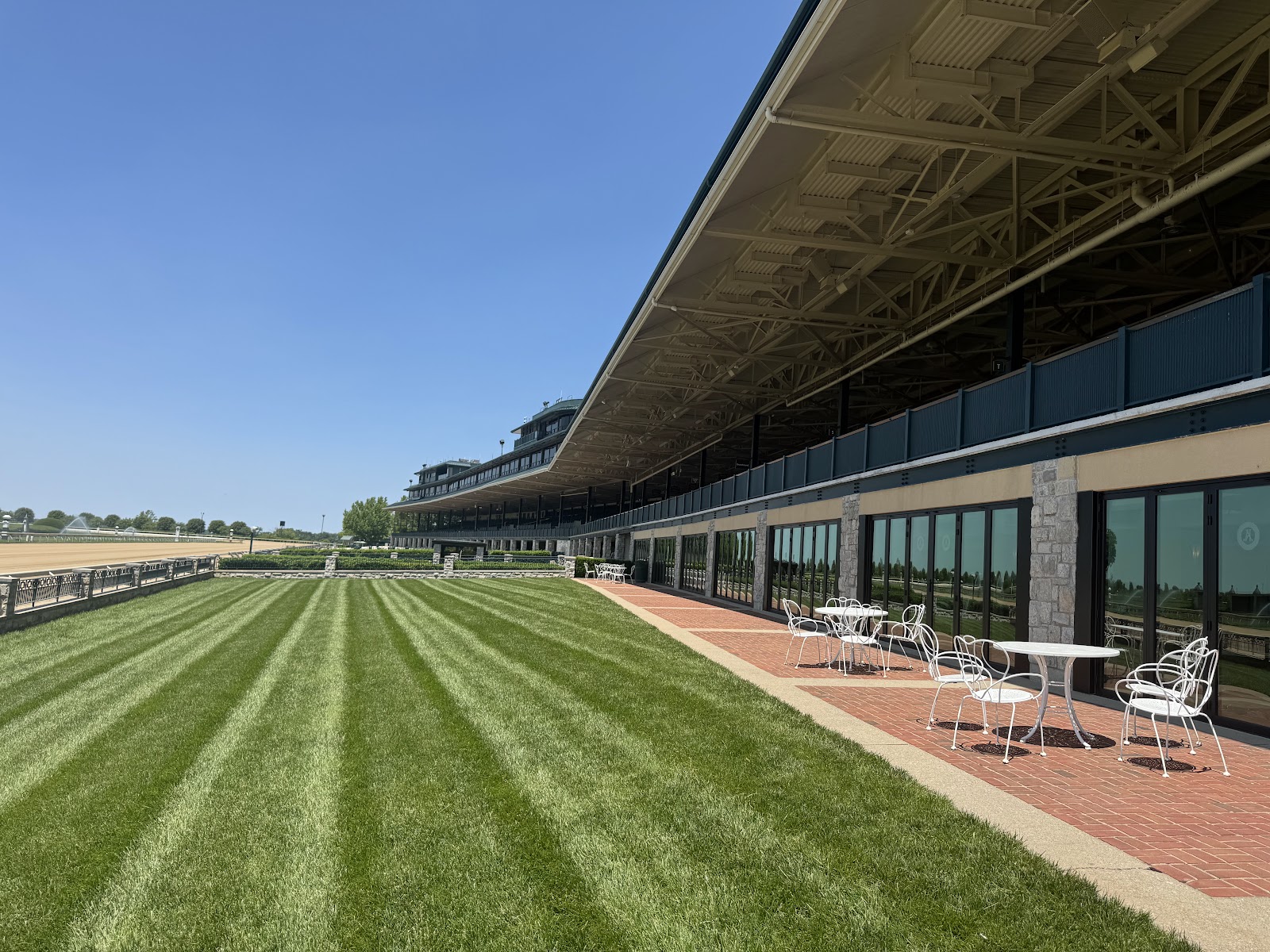
The third way out is the covered spaces, and a racecourse has them in quantity — grandstand undercrofts, colonnades, paddock shelters, verandas and covered walks.
Each does three things at once: the roof blocks the overhead component of the sun, which is what shadows eye sockets; the depth restricts the light to a horizontal band, which is direction; and the floor bounces it back to fill under the chin. That is a balanced three-source setup occurring naturally, available at any hour and in any weather, and it cannot dapple because the roof is solid.
The working position is about a third of the way in from the open edge, and one test frame at three depths settles it. Looking along a colonnade rather than out of it gives columns repeating into depth with the far end darkening by itself — the cheapest separation available anywhere.
The condition is the range. A covered space is several stops darker than the sunlit ground in front of it, which means a frame that includes both has to choose: expose for the interior and let the ground go white, expose for the ground and light the faces, or position the couple so the bright ground is not in the frame at all. The third is usually the right answer and it costs nothing but where the camera stands.
Deep stone spaces also return less than a painted veranda would, because stone is mid-toned rather than pale — so the fill from the floor is weaker, and a subject deeper in may need a modest source of its own.
The fourth way out is the Bluegrass landscape, and it is the thing this region has that a racecourse elsewhere does not.
The country here is rolling pasture with plank fencing and mature specimen trees standing alone in open ground — which is the specimen-tree condition at landscape scale. A tree grown alone in pasture has a broad crown, a clean trunk and space around it, which means it gives genuinely full shade over a large area and is a subject in its own right rather than part of a mass.
That matters because full shade is the whole game on a day with no cloud: dappled light through a thin crown puts bright patches and deep shadow on the same face at a ratio nothing holds, while a mature pasture oak gives complete shade a group can stand in. Ten minutes identifying which trees genuinely qualify is the most valuable ten minutes outdoors.
The plank fencing is the other landscape element and it is an unusually good one: long painted lines running with the contours, which give a frame structure, lead the eye, and rake beautifully in low sun. A couple at a fence line with pasture receding behind them is the region’s own frame and it needs nothing added.
And the pasture itself takes raking light the way mown turf does, with the added advantage that rolling ground means there are positions genuinely above and below a subject — a camera above a group sees faces rather than the backs of heads, and a position below puts sky behind a couple rather than ground.
- Treat the open ground as a morning-and-evening venue
- Three to four metres out from sunlit limestone, facing it, with a custom white balance
- A third of the way in from a covered edge; keep the bright ground out of frame
- Find the mature pasture trees — full shade a group can stand in
- Use the plank fencing: long painted lines that rake and lead
The Kentucky year
Spring is the region’s signature season and it is short and specific. The pasture greens intensely in April and May, the flowering trees come out, and the canopy has not yet closed — which means more light reaches the ground under the specimen trees and the dappling problem is at its mildest of the year.
It is also the period when the region looks most like itself, which matters if the landscape is part of what a couple chose.
Summer is hot and genuinely humid, and the humidity rather than the heat is the photographic fact: moist air scatters light, which softens shadows and slightly flattens the rolling distance. The pasture also dries and pales through a hot summer, which changes the ground colour from green to straw — a completely different background from the same position, and worth knowing rather than being surprised by.
Severe thunderstorms are a real possibility from spring through summer, and on open ground they are a genuine hazard rather than an inconvenience, which means a named covered alternative with a known capacity, agreed at booking. A racecourse has covered space in quantity, which makes that easy to arrange rather than difficult.
The fogging problem is severe in this climate: a body carried from an air-conditioned interior into July air fogs on every surface at once and does not clear quickly, so a bag opened twenty minutes before going out is the whole fix.
Autumn is the other strong window and for the buildings it is the stronger one. The humidity drops, the air clears, low sun arrives at a civilised hour, and the deciduous colour in this rolling wooded country usually peaks from late October into early November — with specimen trees in open pasture turning individually, which gives a single enormous crown in full colour above green ground, a frame uniform woodland cannot produce.
Morning fog is frequent here in autumn, because rolling country with moisture in it produces it readily. Fog is diffusion at landscape scale: it separates successive treelines and fence lines into grey layers and gives a frame no clear morning does. Over pasture with a plank fence running into it, that is the region’s most atmospheric picture and it burns off, so it is an early opportunity rather than something to schedule.
Winter is mild with frost rather than sustained freeze, and it is quietly excellent here for two reasons. The December midday sun at about thirty degrees above the horizon rakes limestone, turf and fence lines all day rather than lighting them from overhead — which means the whole short day is good light and the middle of it works outdoors for the only time in the year.
And the bare canopy opens the sightlines across rolling country, so the long views and the fence lines are at their most legible in January. Snow is occasional; when it comes it turns the ground into a reflector, lifting exactly the shadows a low sun carves while fooling a meter by about two stops — and snow against pale limestone and dark plank fencing is a strong, distinctly local contrast.
The winter constraint is the short day, which compresses the outdoor block into a couple of hours and means the positions should be decided in advance rather than explored.
More frames from Keeneland Racecourse
Keeneland Racecourse wedding photography: common questions
What is the central problem?
Open ground with no shade, plus deep covered stone spaces that are several stops darker than the sunlit ground in front of them.
What is the honest answer to midday?
Scheduling. Open ground is a morning-and-evening proposition, and the middle of the day is a shade exercise.
How do you use the limestone?
As a light. Stand the couple in shade three to four metres out from a sunlit elevation, facing it, with a custom white balance set on a face.
What is the covered-space difficulty?
Range. A covered space is several stops below the sunlit ground in front of it, so either choose an exposure or keep the bright ground out of the frame.
What does the Bluegrass supply?
Mature specimen trees standing alone in open pasture, which give genuinely full shade over a large area — and plank fencing that rakes and leads the eye.
When is the region at its best?
April and May for the intense pasture green and an open canopy, and late October into early November when individual crowns turn above green ground.
More Kentucky venue guides
We are writing a photographer’s guide to every venue we would happily shoot in Kentucky. Here are three more, plus the full index:
- The Kentucky Center, Louisville: A Walk Through a Glazed Arts Centre
- The Lexington Opera House: One Frame, and How It Is Made
- The Louisville Slugger Museum: A Working Factory Inside a Museum
Planning a wedding at Keeneland Racecourse?
Four ways out, and the Bluegrass gives one. Tell us your date.