 The Omaha Children’s Museum: A Photographer Answers Your Questions
The Capitol District Hotel, Omaha: What It Suits, and What It Does Not
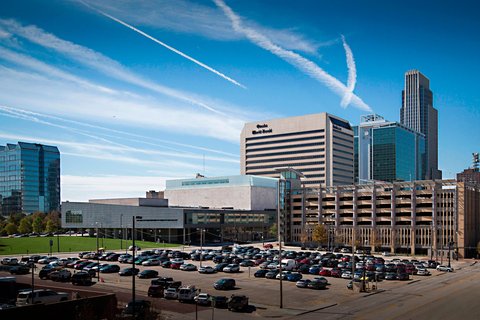
A modern hotel and a public square next to it. One is reliable and the other is not yours.
A contemporary city hotel with a public square beside it offers two very different propositions, and the difference is about control rather than about light.
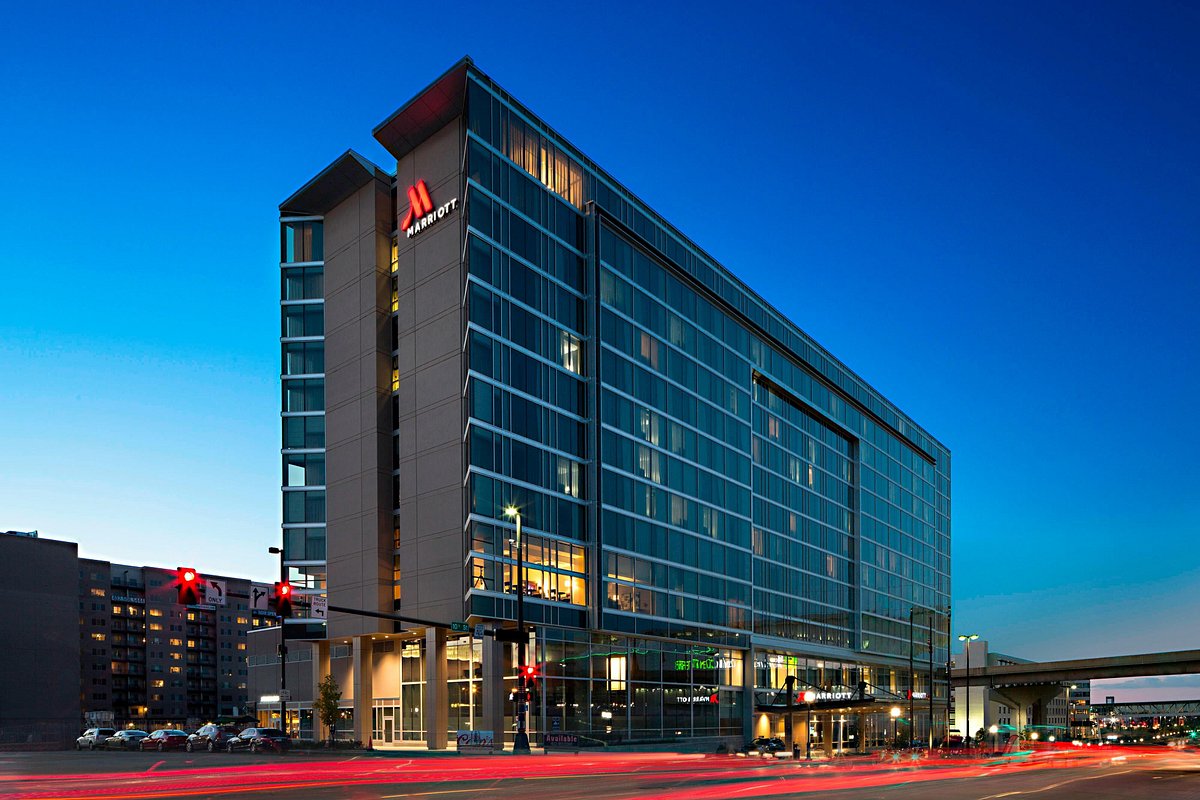
The hotel is entirely reliable. It is heated, sheltered, self-contained and used to running events, which means the day happens regardless of weather and the running order written in March survives into July. Its interiors are modern, which brings a familiar set of problems with known answers.
The square is not yours. A public space beside a hotel is an excellent exterior asset — room to stand back, hard landscaping that takes raking light, and frequently water or installed lighting — and it is also open to whoever else is in it, on any given day, at any hour. That is a different kind of planning from booking a garden.
Both halves are worth having and the day works best when each does what it is good at. We have not photographed a wedding at the Capitol District Hotel; modern city hotels and adjacent public squares behave consistently. Which spaces are included, whether the square is part of the offer or simply nearby, and whether the lighting is adjustable are questions for their team.
The Capitol District Hotel at a glance
| Where | Downtown Omaha, Nebraska |
| Suits | Reliability, a weatherproof plan, and a square with room to stand back |
| Resists | Separation in pale modern rooms, and a square you do not control |
| The main task | Building separation geometrically, because nothing else will |
| Ask first | Spaces included, square access, lighting control, room orientation |
What it suits
Reliability first, and it is worth more than it sounds in a climate with genuine weather. A self-contained heated building means the running order does not depend on the forecast, which on the edge of the plains — where severe thunderstorms are a real possibility from spring through summer and winter brings cold and snow — is a substantial advantage. Venues that depend on a garden or a terrace do not have it, and the difference shows up as calm rather than as a picture.
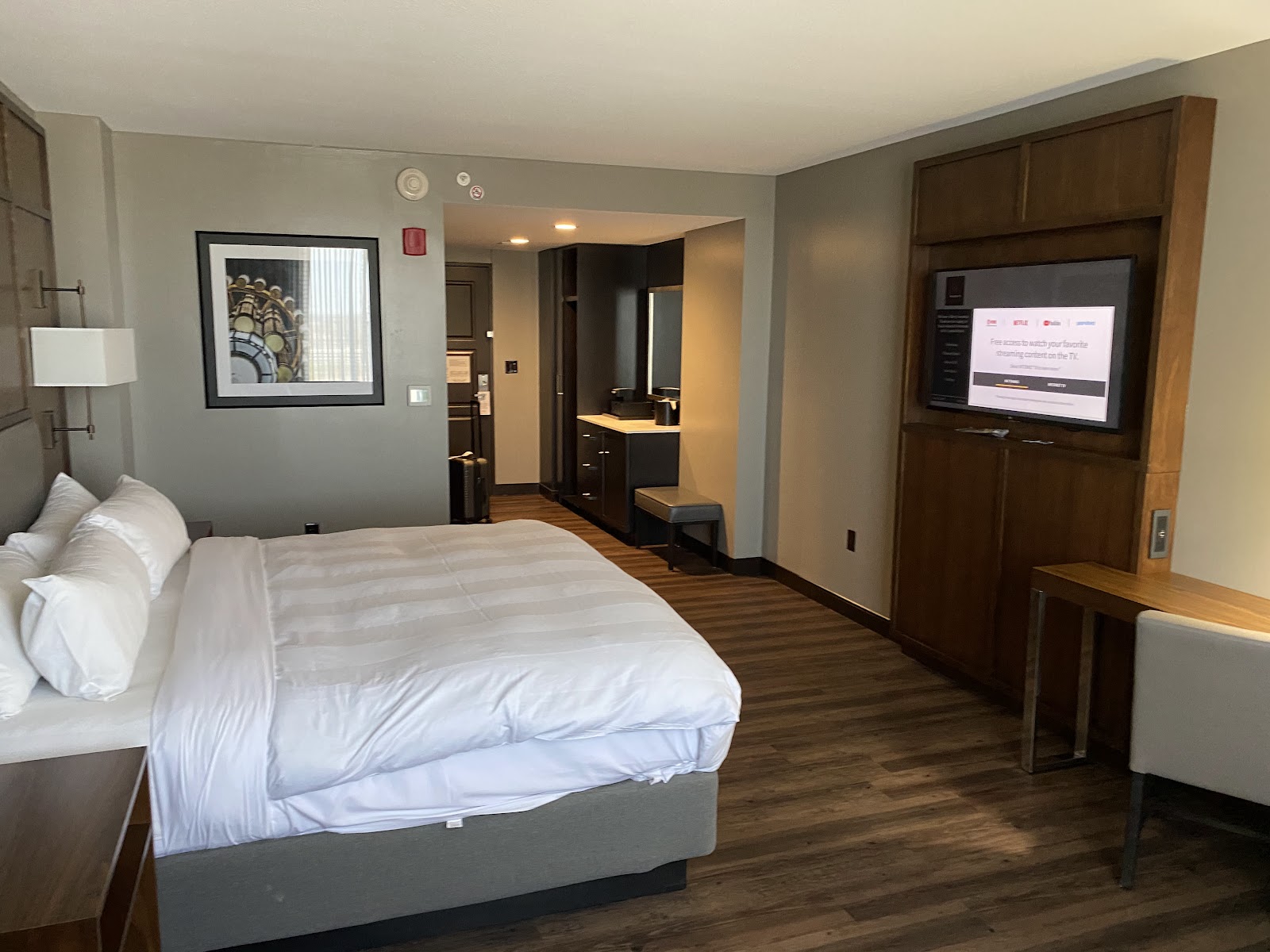
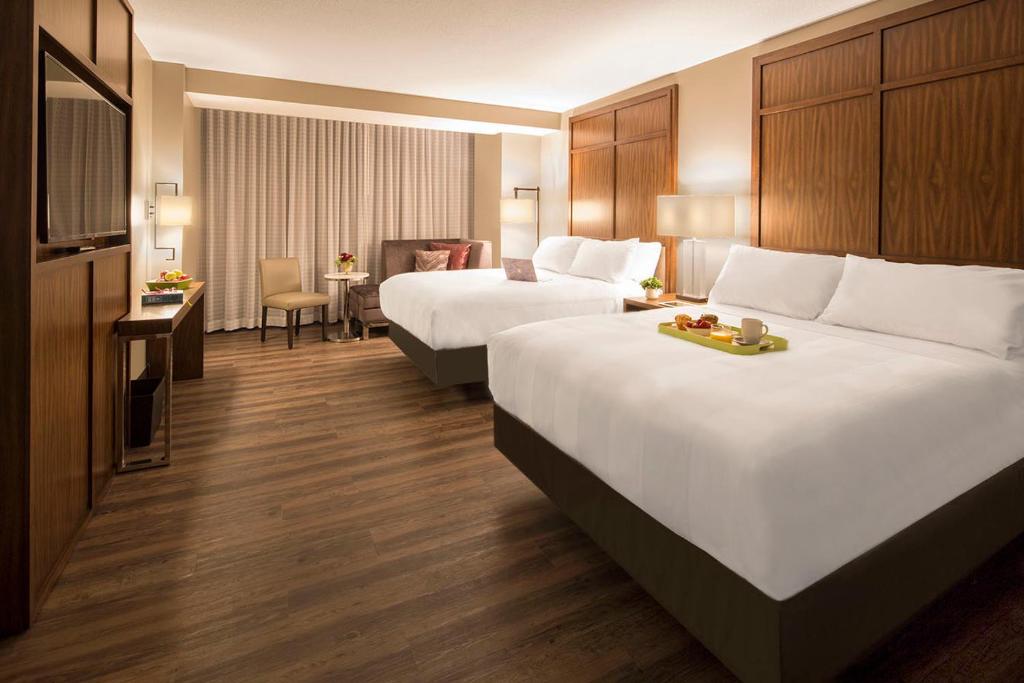
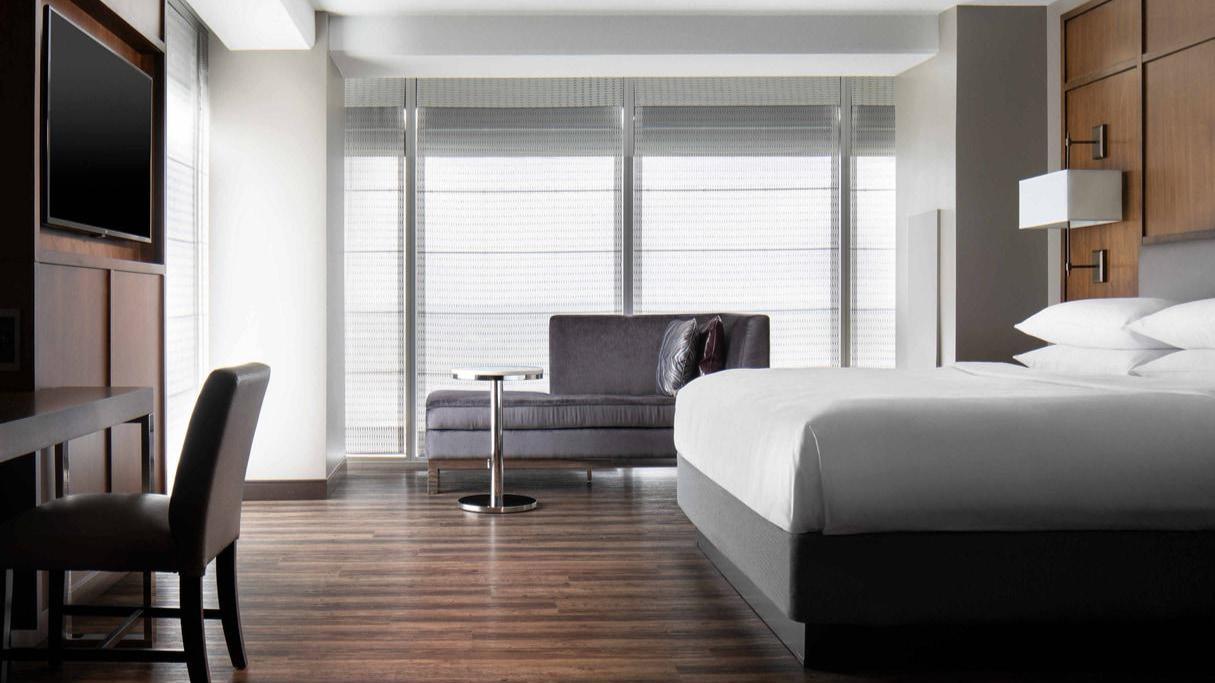
Guest rooms suit portraits and they are the best natural light in the building. Modern hotel glazing is frequently large, which means a window is a soft source big enough for two people at two or three metres, with near walls returning light into the shadow side and a ceiling low enough that a flash aimed upward returns something usable.
The requests are the familiar ones: largest window on the shaded side, every overhead fitting off so the room has one colour of light, lamps out of frame, two to three metres back. At Omaha’s latitude, about forty-one degrees north, a north-facing room is shaded all year and is the most reliable, while a south-facing one is a high source in summer and a low directional one through most of a winter afternoon.
One check: modern glazing is frequently coated for solar control, which throws a localised green or blue cast onto anything near it that global white balance cannot remove. One test frame rather than a discovery in editing.
The square suits what a hotel interior cannot: room to stand back. In a downtown setting that is genuinely rare — most city venues cannot be photographed whole because there is nowhere to stand — and a square is by definition an open space with sightlines across it. So the building is available as a whole, and so is the sky, which no interior gives.
Hard landscaping suits raking light. Paving, stone, steps, brick and installed metalwork all read only when light runs along them, and a square gives long uninterrupted lines that low sun rakes the length of. Steps in particular are the most useful feature: they give elevation, so a camera above a group sees faces rather than the backs of heads, and they give a way to arrange rows, which open paving does not.
Water, where there is any, suits doubling: it reflects anything lit and bounces light upward to fill facial shadows, with camera height deciding between a mirror and a view of the basin. Low is usually the answer.
And the transitions inside suit reportage. A corridor gives depth and repetition, with a subject at the far end sitting against a background that darkens by itself — the cheapest separation in any building; a stair gives elevation and rows of faces, wanting light from one side because overhead light on a stair shadows every eye socket at once.
What it does not suit
Separation is the first refusal and it is the main daily task in a modern hotel. Contemporary interiors are pale, hard-surfaced and evenly lit, which means the wall behind a subject is as bright as the face in front of it and the picture flattens. Nothing about that is fixable afterwards, because the information was never recorded.
The answers are geometric and they all work. Distance between subject and background, so fall-off does something — five metres rather than one. The darker end of the room, because every evenly lit space is in fact unevenly lit and one end is always half a stop to a stop down. A background that is depth rather than a near wall: a corridor, an open doorway, a further space. And a source brighter on the face than the room is on the wall, which is the only version that works regardless of geometry.
Ceiling height decides the bounce and it varies by space. Function rooms and ballrooms with ceilings over four metres return very little and colour what they do return; pre-function areas, corridors and guest rooms are lower, where a bounced source is a very large soft one. One test frame each is thirty seconds well spent and it changes what has to be carried.
Mixed colour is the second difficulty: neutral downlights, warmer decorative fittings, illuminated screens and any coloured uplighting installed for the event. Three temperatures on one face cannot be reconciled afterwards, so pick the one that should be correct, set white balance to it, and switch off or overpower whatever else lands on skin. Coloured uplighting off for ten minutes is usually all the portraits need.
Reflective surfaces are the third: polished stone, glass, metal and lacquer are the contemporary vocabulary and each shows a badly placed light at full brightness in a way nothing removes. Fifteen seconds of checking from the camera position prevents it.
The square is the fourth and the difficulty is not optical but social. A public space is open to whoever is in it, which means a wedding party is photographed among other people — on a warm evening a busy square is genuinely busy, and no amount of waiting empties it.
The tools are the usual ones and they work. A long lens compresses and blurs a crowd into unreadable tone; tight framing excludes it; and a low camera against sky or a high camera against paving both remove the horizon at which people stand. And earlier is quieter than later, which has to be weighed against the light being better at the other end of the day.
The other thing a public square does not suit is anything that needs to be set down or set up. Stands, props and arrangements in a space that is not the venue’s are a practical and sometimes a permissions problem — worth asking about, because a square adjacent to a hotel may or may not be within the hotel’s control, and the answer changes what is possible.
And on this edge of the plains, wind is a constant: a lightstand outdoors is a liability rather than a tool, a veil behaves unpredictably, and anything unweighted moves. A source in a hand or on a bracket is the working configuration.
- Build separation geometrically in the modern rooms; nothing else will
- Test bounce per space; guest rooms and corridors return, ballrooms do not
- Use the square’s steps for groups — open paving cannot arrange rows
- Long lenses and tight framing for the crowd; earlier is quieter than later
- Ask whether the square is the hotel’s to use, or simply nearby
Outside, and the Nebraska year
Omaha sits on the Missouri River, on the west bank looking east across the water, which has one consequence worth planning around: the river is frontlit in the morning and backlit by the afternoon. So the straightforwardly lit riverside frames belong to the first part of the day, and the silver, rim-lit version to the second.
The Old Market district is the other nearby asset and it is a specific kind of good. Heavy timber and brick warehouse buildings with cobbled streets give texture in every direction, and brick is a warm mid-toned reflector rather than a dark absorber — which means a sunlit brick elevation is a genuine soft source, and a couple three or four metres out from one, facing it, is well lit for nothing. It needs a custom white balance set on a face, because brick bounce is markedly warmer than daylight.
Cobbles and brick paving read only under raking light, and wet they read better still — so a shower is an opportunity delayed rather than a day lost, and wet paving reflecting lit shopfronts is a better frame than the dry version.
The timed frame is the crossing: twenty-five to forty minutes after sunset, when the sky still holds colour at about the brightness of the city’s lighting, so one exposure holds couple, buildings and sky. In a square with installed lighting that window is particularly good, because the ground and the fittings both read. Since the hotel interior does not change through the day, taking ten minutes for it costs nothing.
The seasons here are four emphatic ones with one of the larger annual temperature ranges in the country. Summer is hot and genuinely humid, and the humidity rather than the heat is the photographic fact: moist air scatters light, softening shadows and slightly flattening distance. Severe thunderstorms are a real possibility from spring through summer, which at an indoor venue costs a decision rather than a picture — and on the plains a storm is visible for a long time before it arrives, which is both a warning and the most dramatic sky the region gives.
The fogging problem is the equipment issue and a large hotel makes it worse, because the public rooms are cooled hard for occupancy: a body carried straight out into July air fogs on every surface at once and does not clear quickly, so a bag opened twenty minutes early is the whole fix.
Autumn is the best light of the year: humidity drops, the air clears, the cover along the river turns, and low sun arrives at a civilised hour, usually mid-to-late October.
Winter is cold and frequently overcast, which is less of a disadvantage than it sounds — overcast is the best soft source there is, and a grey January day gives even shadowless light that flatters faces and works through the hotel’s glazing without the direct-sun problem.
Snow does two things. Outdoors it is the best natural fill available, lifting exactly the shadows a low sun carves while fooling a meter by about two stops. And indoors it turns the ground into an enormous reflector, so the guest-room windows give softer, brighter and more even light in February than in June — with light arriving from below as well as above, so facial shadows nearly vanish.
The winter constraint is the short day: sunset falls in the middle of the afternoon at this latitude, which compresses the outdoor block into a couple of hours and means the square and the Old Market route should be decided in advance rather than explored.
More frames from The Capitol District Hotel
The Capitol District Hotel wedding photography: common questions
What does the hotel do best?
Reliability. A self-contained heated building means the running order does not depend on the forecast, which on the edge of the plains is a substantial advantage.
What is the main interior difficulty?
Separation. Pale, evenly lit modern rooms give a subject nothing to stand against, and the fixes are all geometric.
What does the square give?
Room to stand back, which in a downtown setting is rare — the building can be photographed whole, and so can the sky.
Where do the groups go?
The square’s steps. They give elevation and a way to arrange rows, which open paving cannot.
What is the square's difficulty?
It is not yours. A public space is open to whoever is in it, so long lenses, tight framing and an earlier hour are the tools.
When are the guest rooms at their best?
February. Snow turns the ground into an enormous reflector, so light arrives from below as well as above and facial shadows nearly vanish.
More Nebraska venue guides
We are writing a photographer’s guide to every venue we would happily shoot in Nebraska. Here are three more, plus the full index:
- The Cottonwood Hotel, Omaha: The One Decision That Governs Everything
- The Durham Museum, Omaha: One Frame, and How It Is Made
- The Peregrine Hotel, Omaha: A Walk Through a Converted Building
Planning a wedding at The Capitol District Hotel?
One reliable half, one public half. Tell us your date and we will use each properly.