 The Tlaquepaque Arts Village, Sedona: Field Notes on Courtyards
The Chapel of the Holy Cross, Sedona: One Frame, and How It Is Made
Red sandstone is the most strongly coloured reflector in the country. Here is the frame it makes, and the trap in it.
The defining photographic fact about Sedona is not the shape of the rock. It is the colour of the light coming off it.
Red sandstone here is stained with iron oxide, which makes it intensely warm and highly reflective — and a sunlit red rock face is therefore an enormous orange light source. Anything standing within a few metres of one is lit by it, whether or not anyone intended it, and at the ends of the day when the rock is fully lit the effect is powerful enough to turn skin visibly orange.
The frame that fact makes possible is this. A couple stands in shade, three or four metres out from a sunlit red rock face, turned towards it. They are lit by a source the size of a cliff: soft because it is enormous, directional because it comes from one side, and warm in a way no gel reproduces. Behind them the shaded rock is deep and dark. Nothing is added.
The trap in it is the same fact. That light is warm enough that a daylight white balance renders skin orange rather than golden, and a global correction neutralises the face and turns the rock grey — which destroys the only thing the place has.
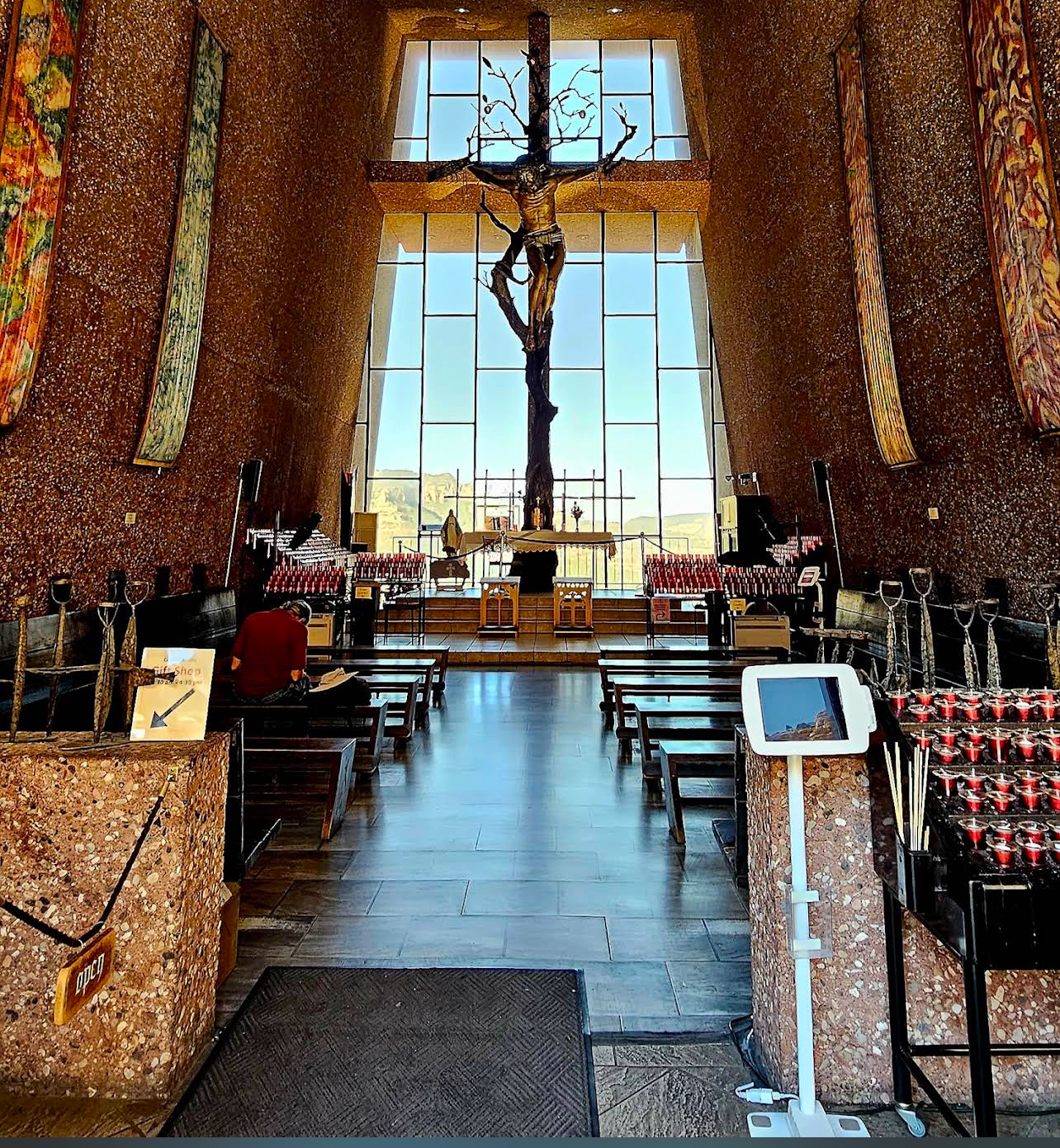
Six decisions make the frame and avoid the trap. We have not photographed a wedding at the Chapel of the Holy Cross; red sandstone and high desert light behave consistently. Permitted camera positions, whether photography is allowed during a service, group limits and access rules are questions for their team — and at a working chapel on a protected site those answers govern the day.
The Chapel of the Holy Cross at a glance
| Where | Sedona, Arizona, at about 4,500 feet |
| The frame | A couple lit by a sunlit red rock face, shaded rock behind |
| Why it works | Iron-stained sandstone is an enormous, intensely warm reflector |
| The trap | A daylight white balance renders that light orange rather than golden |
| Ask first | Permitted positions, photography during services, group limits |
Decisions one to three: the face, the distance, the colour
The first decision is which rock face, and it is settled by the sun rather than by the view. The frame needs a face in direct sun and a standing position in shade — which in Sedona means an east-facing wall in the morning and a west-facing one in the afternoon, and the geography of any particular site decides which is available.
The afternoon version is stronger, because the rock is warmest and the light on it longest in the last hour — and because the formations around this town are arranged so that the west-facing walls catch the end of the day. The last twenty minutes, when a red wall is fully lit and glowing, is when the bounce is at its most powerful.
The second decision is the distance, and it has a narrow working range with a wide consequence. Closer than about two metres and the fall-off across two faces is uneven and the colour is overwhelming; further than about six and the open sky takes over as the dominant source, which is blue and cool and flatter.
Three to four metres is the figure, facing the rock, with the camera positioned so the lit face is behind the photographer rather than in the frame. That last part matters: a fully lit red cliff in the same frame as a shaded face is several stops brighter and will clip.
The third decision is the colour and it is the one that separates a good version of this frame from an orange one. Red rock bounce is far warmer than daylight — warmer than golden hour sun, warmer than tungsten in its effect on skin — and there is no standard preset that renders it correctly.
The method is a custom white balance set on a face in the actual position being used, not on a grey card held in open sky. That gives correct skin while leaving the rock the colour it is, which is the whole point. What fails is a daylight setting, which makes skin orange; and a global correction in editing, which neutralises the face and turns the rock a dull grey-brown.
There is a subtler version of the same problem worth naming. Because the bounce arrives from one side only, a face can be warm on the lit side and neutral or blue on the other, lit by open sky. That is a split that no single white balance fixes — and the answer is either to turn the couple so the rock light is more frontal, or to accept it as a warm-to-cool gradient across the face, which in this landscape reads naturally rather than as an error.
Decisions four to six: the background, the sky, the added light
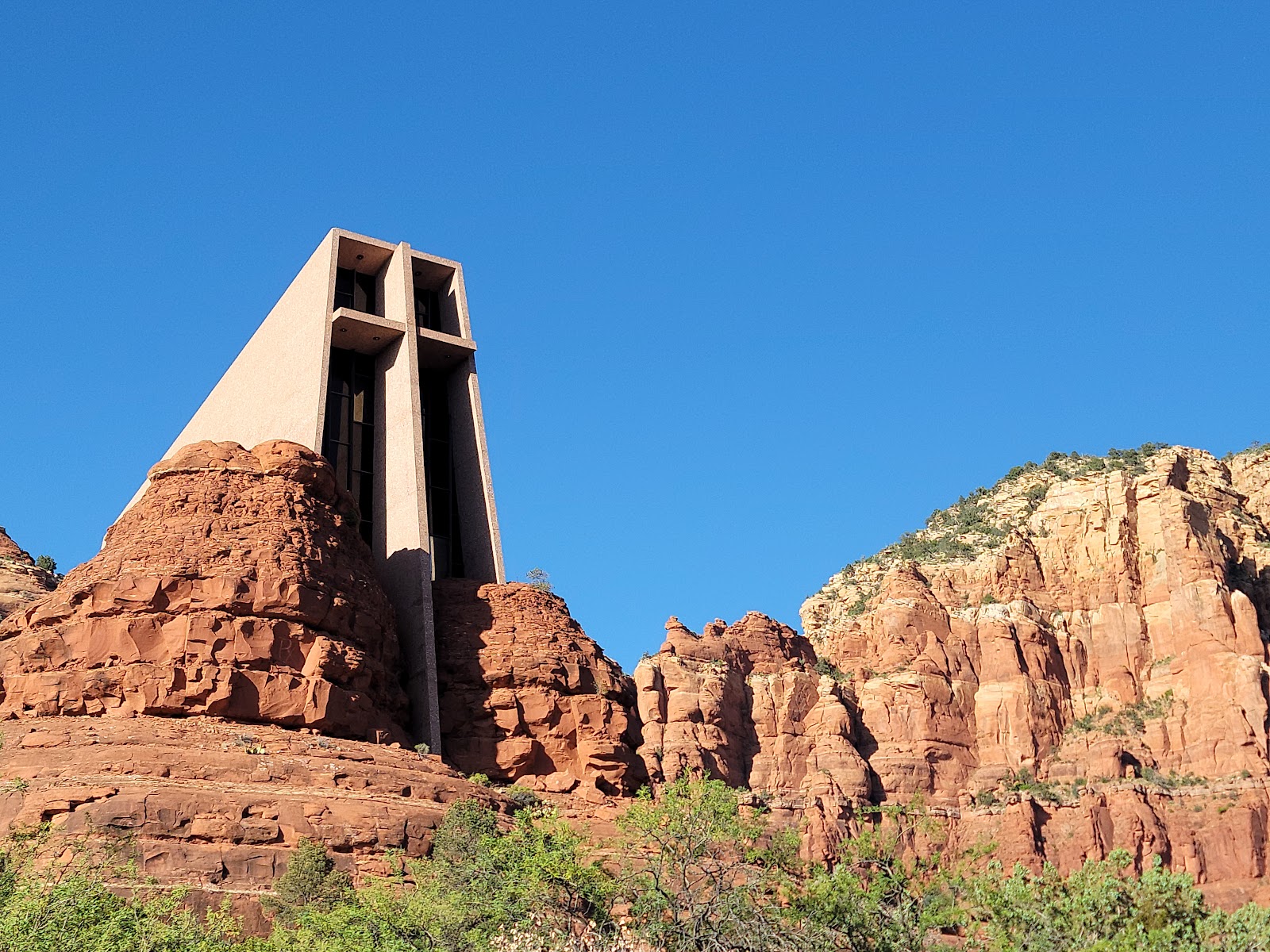
The fourth decision is the background, and the rock supplies the best one available. Shaded red sandstone is deep, mid-to-dark in tone and richly textured, which means a subject lit by bounce and standing in front of shaded rock is separated by two or three stops with no equipment at all.
That pairing — lit rock in front as the source, shaded rock behind as the background — is the geometry of the frame, and finding a position where both exist takes a short walk rather than an experiment. Looking along a wall rather than at it usually produces it, because a wall curving away has a lit part and a shaded part.
What fails as a background is sky, which at this altitude is a deep saturated blue but still several stops brighter than a shaded face. If sky is in the frame it should be a band rather than a field, with the exposure set for the faces.
The fifth decision is how much sky to include at all, and there is an argument for more of it than usual here. At about four and a half thousand feet there is meaningfully less atmosphere overhead to scatter sunlight, which makes the sky a markedly deeper blue than at sea level — and deep blue against red rock is the single most recognisable colour pairing in the American Southwest.
A polariser deepens it further and does more here than at sea level, because the sky is already less hazy. It also cuts glare off rock faces, which can be surprisingly specular when wet or when the surface is smooth.
The sixth decision is whether to add light, and in this frame the honest answer is usually no. The rock is already providing a very large warm source and the sky is providing fill from above; adding a third source is more likely to unbalance the frame than improve it, and an ungelled flash in this environment is conspicuously wrong because it is so much cooler than everything else.
Where a source earns its place is when the background must be darker than the subject — underexposing the ambient by a stop and lighting the faces back up, which deepens the sky and the shaded rock while the couple reads. It must be gelled strongly warm to sit anywhere near the rock bounce, with white balance set to that gel, and it must be close, because competing with a lit landscape needs proximity rather than power.
After dark there is a different opportunity that most venues cannot offer. Sedona is a designated dark sky community with lighting restrictions to protect the night sky, which means the darkness here is genuine — and a frame of a couple under stars with red rock silhouetted behind them is actually achievable rather than theoretical. It needs a fast lens, a high ISO, an exposure short enough that the stars do not trail, and a very modest amount of light on the couple from close range.
- Afternoon, west-facing wall, and the last twenty minutes are strongest
- Three to four metres out, facing the rock, with the lit face behind the camera
- Custom white balance on a face in position — a daylight setting gives orange skin
- Pair lit rock in front with shaded rock behind; sky is too bright to sit behind a face
- Add nothing unless deliberately darkening the ambient — and then gel it strongly warm
The shade problem, and the Arizona year
The condition that shapes everything outside the frame above is that Sedona has very little usable shade, and it is worth being specific about why.
The native trees here are juniper and pinyon pine — small, sparse and open-crowned, which means they filter light rather than blocking it. A juniper does not make full shade; it makes dappled shade, and dappled light puts bright patches and deep shadow on the same face at a ratio nothing holds. At this altitude, with a June midday sun around seventy-eight degrees above the horizon and thin dry air that scatters little, that ratio is severe.
So the usual woodland answer is unavailable. The shade that works here is made of rock and building rather than of leaves: the shadow side of a formation, a canyon wall, an overhang, an alcove, a building’s north side, or a covered structure with an open face. Those are the positions to find on arrival and there are fewer of them than at a wooded venue.
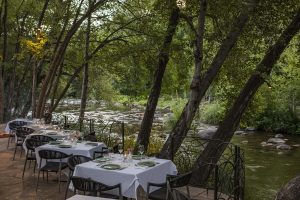
The one genuine exception is the creek corridor. Oak Creek runs through this landscape and it supports sycamore and cottonwood — large deciduous trees with dense crowns, which do make full shade. A riparian corridor in a red rock desert is a completely different environment a few minutes’ walk from the rock, with green canopy, moving water, and shade that actually works. It is the answer to midday and it is worth building into the plan rather than treating as scenery.
The creek also reflects and bounces light upward, which fills facial shadows — and camera height decides whether it reads as a mirror or as a stony bed, with low being the answer.
The monsoon is the region’s defining seasonal event and for a photographer it is a gift. From roughly July into September, afternoon moisture builds enormous cumulus towers over the high country, and those clouds are the only reliable diffusion this climate offers — soft directional light, saturated colour, and the most dramatic skies of the year over red rock. A monsoon afternoon is the best light Sedona produces.
The hazard is real: these storms produce lightning, and exposed rock is a genuinely dangerous place to be under one. A named indoor or covered alternative is a requirement and the decision to use it belongs to whoever is responsible for the party, not to whoever wants one more frame. Flash flooding in creek beds and canyons is the other serious risk and it can arrive from rain falling miles away.
Outside the monsoon the sky is usually cloudless, so waiting for diffusion is not a plan. The rock, the creek and the buildings are the plan.
Winter is mild in the day and cold at night, and the diurnal swing at altitude is large — twenty degrees Celsius between afternoon and evening is normal, so a party comfortable at four is cold by seven. The December midday sun at about thirty-one degrees above the horizon rakes the rock all day rather than lighting it from overhead, which means the red is at its best for the whole short day rather than for an hour at each end.
Snow on red rock is occasional and it is the most striking frame the region offers, because white against saturated red is a contrast nothing else in American landscape provides. It rarely lasts a day, which makes it luck rather than planning.
Ultraviolet is markedly higher at this altitude, which is a welfare point rather than a photographic one: a party outdoors for an hour burns faster than they expect, including under cloud.
More frames from The Chapel of the Holy Cross
The Chapel of the Holy Cross wedding photography: common questions
What is the defining fact about Sedona's light?
Iron-stained red sandstone is an enormous, intensely warm reflector. A sunlit rock face lights anything within a few metres of it, whether intended or not.
Where should the couple stand?
Three to four metres out from a sunlit face, in shade, turned towards it — with the lit rock behind the camera rather than in the frame, because it will clip.
What white balance does it need?
A custom one set on a face in the actual position. A daylight setting renders skin orange, and a global correction neutralises the face and turns the rock grey.
What background works?
Shaded red sandstone — deep, textured and two or three stops below a bounce-lit face. Sky is too bright to sit behind a face here.
Why is there so little shade?
Juniper and pinyon are small and open-crowned, so they dapple rather than block. The shade that works is rock and building — or the creek corridor’s sycamores.
Is the monsoon good or bad?
Photographically the best thing that happens here — the only reliable diffusion in the region. The lightning and flash flooding are genuine hazards needing a plan.
More Arizona venue guides
We are writing a photographer’s guide to every venue we would happily shoot in Arizona. Here are three more, plus the full index:
- The Enchantment Resort, Sedona: The One Decision That Governs Everything
- L’Auberge de Sedona: A Walk Through the Property
- The Red Rock Country Club, Sedona: The Problem, and Four Ways Out
Planning a wedding at The Chapel of the Holy Cross?
The rock is the light. Tell us your date and we will set the white balance on a face.