 The Blue Ball Barn, Wilmington: A Walk Through a Converted Barn
The Starboard, Dewey Beach: A Venue Built for the Season
A building designed to hold a crowd in July is designed for durability, not for daylight.
A resort-strip venue built to handle summer volume has a design logic that is entirely about capacity and weather, and that logic explains every photographic condition inside it.
It is built for numbers, which means wide open spaces, hard durable surfaces, and few of the domestic touches — soft furnishing, small windows, low ceilings — that make a room easy to light. It is built to open to the air, which means large door openings, decks and roll-up walls rather than glazing. And it is built for the evening, because that is when a resort venue does its business, which means the installed lighting is designed to create atmosphere at night rather than to flatter faces in the afternoon.
The consequences are consistent and predictable: a bright hard interior by day where the openings dominate, a dark warm one after sunset lit by fittings chosen for mood, and very little in between.
We have not photographed a wedding at the Starboard; resort-strip venues behave consistently. Which areas are included, whether both shorelines are accessible, whether the lighting is adjustable and what the covered alternative is are questions for their team.
The Starboard at a glance
| Where | Dewey Beach, Delaware, between ocean and bay |
| The logic | Built for summer volume, open to the air, lit for the evening |
| By day | Large openings dominate: bright outside, dark inside, a wide range |
| After dark | Warm atmospheric fittings that need one gelled source to work with |
| Ask first | Areas included, shoreline access, lighting control, covered space |
By day: the openings, and the range
The large opening is the defining daytime condition and it produces a brightness range wider than a window does. A door opening or a roll-up wall is not glazed, which means there is nothing to diffuse or attenuate what comes through it — so the exterior beyond is at full daylight brightness while the interior a few metres in is several stops down.
That gap has two honest resolutions and one that is not. Expose for the interior and let the opening go white, which is fine when the frame is about the room. Expose for the opening and light the faces, which is the frame when the view matters. And the one that fails is a compromise, which gives a grey exterior and dark faces and reads as a mistake.
The better answer is usually to work the threshold rather than either side of it. Standing two or three metres inside the opening, facing out, a subject is lit by an enormous soft source with darkness behind them — which is the best portrait position in any building of this design and needs no equipment at all. It is worth finding on arrival, with one test frame at two, three and four metres in to see where the light-to-background trade sits.
The hard surfaces are the second daytime condition and they behave in two ways. Painted timber, concrete and metal are all fairly reflective, which means the interior is brighter than a soft-furnished room would be and the light bounces around rather than being absorbed — that is genuinely helpful, and it means bounce flash may work even where the ceiling is high, because the walls contribute.
One test frame settles it. And the same surfaces show texture only under raking light: painted boards, corrugated metal and signage all read when light runs along them and flatten to one tone when it faces them, so the positions where existing light grazes a surface are the ones worth using.
Reflective metal is the third and it needs the standard discipline. Any polished or painted metal surface will show a badly placed light at full brightness in a way nothing removes afterwards, so the fifteen-second check from the camera position applies: look at every reflective surface in the frame and place the source where none of them sees it.
And the decks are the fourth and the best of the daytime conditions. A roof with an open face blocks the overhead component of the sun, restricts the light to a horizontal band, and the boards below bounce it back to fill under the chin — three things at once, occurring naturally. On a strip between two waters a deck also has a large low reflector in front of it, which adds more upward fill.
The one condition on a deck is direct sun coming in under the roof, which turns a soft source into a hard one with a hard edge. That is a matter of orientation and hour, and the venue will know which decks are shaded when.
After dark: fittings designed for mood
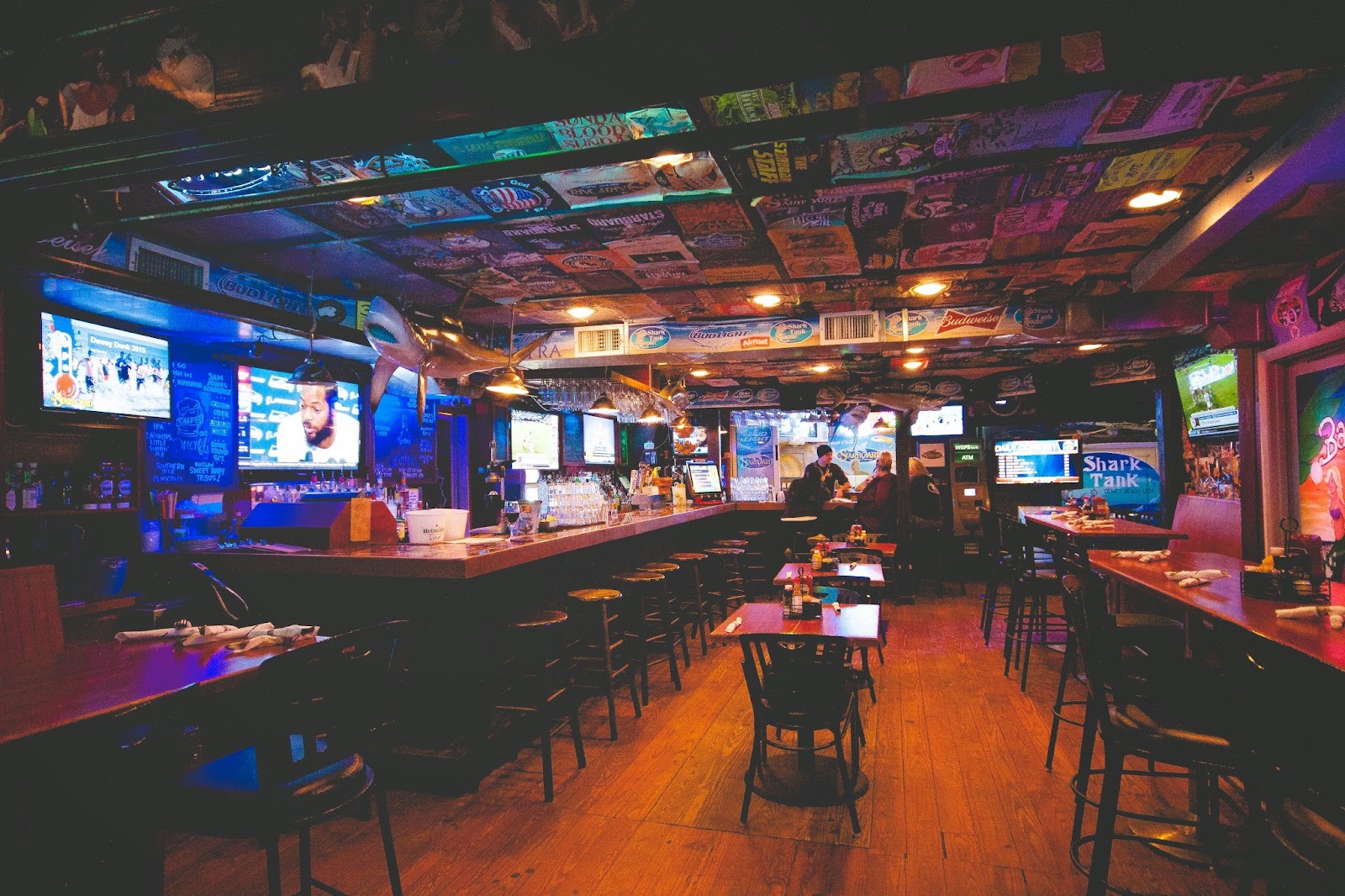
After sunset the building becomes what it was designed to be, and the lighting changes character completely. Resort venue lighting is chosen to create atmosphere: warm, low, decorative, and frequently coloured — string bulbs, festoons, painted fittings, neon or illuminated signage, and uplighting.
Three properties follow and each needs handling.
The ambient is low. Decorative fittings are dim by design, and even reflective surfaces cannot make much of very little — so measure it on arrival rather than estimating, because eyes adapt and meters do not. Expect to work at a high ISO and a wide aperture, and expect to add light.
The colour is warm and it is uneven. Warm decorative fittings, cooler recessed downlights added for practicality, illuminated signage and any coloured uplighting all land on the same face from different directions. Three temperatures cannot be reconciled afterwards, so pick the one that should be correct, set white balance to it, and switch off or overpower whatever else reaches skin. Coloured uplighting is usually the worst offender and frequently the easiest thing to have turned off for ten minutes.
And the fittings are background, not key. String bulbs and festoons look like a lighting solution and are not: they are small, dim, warm and high, which means a face lit by them is underexposed, top-lit and orange. The working rule is to let them be the background and to light faces with one source of your own, gelled warm to match them with white balance set to the gel — and an ungelled flash is the commonest failure, producing cool faces against warm bulbs.
Used as background they are the building’s signature frame. At a wide aperture, with real distance behind a subject, strings of bulbs become rows of warm points of light, which is exactly what this kind of venue gives and nothing else does. The condition is separation: a bulb immediately beside a head pulls the eye off the face every time, and moving the couple a step fixes it.
Steep fall-off is the compensation for the low ambient. A subject three metres in front of anything else in a dim space sits against natural darkness with no equipment at all, which is free separation — and it means positions with depth behind them beat positions against a wall.
The volume matters too. A venue built for numbers is full at a wedding, which means the frames are crowd frames rather than empty-room frames — and that suits the register. Long lenses to compress a busy background into unreadable tone, tight framing, and a willingness to work through the crowd rather than around it produce the gallery this venue is good at.
- Work the threshold: two or three metres inside a large opening, facing out
- Test bounce even under a high ceiling; hard reflective walls contribute
- String bulbs are background, never key — gel your own source to match
- Ask for coloured uplighting off for ten minutes
- Use fall-off: three metres of depth is free separation in a dim room

Two waters, and the Delaware year
The location’s real asset is outside the building and it is unusual: Dewey Beach sits on a narrow strip with the Atlantic on one side and Rehoboth Bay on the other, sometimes only a few hundred metres apart. That means two shorelines facing opposite directions within a five-minute walk.
The ocean faces east, so it is frontlit at sunrise — when the beach is also empty, which in a resort town is true at no other hour — and sidelit through the middle of the day, which is the best beach light: one side of a face lit and the other filled by the sand, which reflects strongly upward. Its cost is uplight under the chin, corrected by something solid on one side.
The bay faces west, so the sunset goes down over it, and because it is shallow and sheltered it goes genuinely calm as the land cools and the breeze drops. That makes the last hour and the twenty-five to forty minutes after sunset the bay’s own window, with a low camera across still water reflecting the sky — and camera height is the governing variable, because shallow water is transparent from above and a mirror from low down.
So the day divides cleanly: ocean early, bay late, interior in between and after dark. And in the ten minutes after sunset there is one frame that uses both, because the western sky over the bay is warm while the eastern sky over the ocean has gone deep blue.
The two waters run on different seasons. The ocean has a long thermal lag, which makes it coldest in spring and warmest in September — so late spring is the foggiest time on the ocean side, and September is the clearest and most comfortable month on the coast. The bay, being shallow, warms and cools quickly and is more reliably calm in the shoulder seasons, when the temperature difference driving the breeze is smaller.
Summer is the season this venue was built for: hot, humid, busy and long-evened. The crowds are the real photographic constraint rather than the light, and the humidity makes fogging severe — a body carried from an air-conditioned interior into July air fogs on every surface at once and does not clear quickly, so a bag opened twenty minutes early is the whole fix.
Autumn brings nor’easters, genuine coastal storms with sustained wind and heavy surf rather than mere rain. On a barrier strip that is a serious weather event, and a venue whose spaces open to the air needs a named enclosed alternative agreed at booking rather than a roll-up wall and optimism.
Salt and sand are what the location does to equipment. Airborne salt settles on a front element and on exposed metal and etches coatings over time, so a damp cloth at the end of the day is routine; sand is worse in the short term, because a grain in a zoom barrel or on a sensor is a repair rather than a clean.
Winter is cold, windy and empty, and for this venue’s signature frame it is quietly advantageous: darkness arrives in the middle of the afternoon, which means the string-light frames happen at a civilised hour rather than late at night, and both shorelines are unpopulated. The cost is comfort in a building designed to open to the air.
More frames from The Starboard

The Starboard wedding photography: common questions
What does the design logic explain?
Everything. Built for summer volume, open to the air and lit for the evening — which gives a bright hard interior by day and a dim warm one after dark.
Why is a large opening harder than a window?
Because there is no glass to diffuse or attenuate it, so the exterior is at full daylight brightness while the interior a few metres in is several stops down.
Where is the best portrait position?
Two or three metres inside a large opening, facing out — an enormous soft source in front and darkness behind, with no equipment needed.
Can string lighting light the faces?
No. Those bulbs are small, dim, warm and high, so a face lit by them is underexposed, top-lit and orange. They belong in the background.
What is unusual about the location?
Two shorelines facing opposite ways within a five-minute walk — the Atlantic east and Rehoboth Bay west, on a strip only a few hundred metres wide.
Is winter useful here?
For this venue’s signature frame, yes. Darkness arrives mid-afternoon, so the string-light pictures happen at a civilised hour and both shorelines are empty.
More Delaware venue guides
We are writing a photographer’s guide to every venue we would happily shoot in Delaware. Here are three more, plus the full index:
- Baywood Greens, Long Neck: The Venue’s Own Logic
- Bethany Beach Ocean Suites: What It Suits and What It Does Not
- Big Chill Beach Club, Bethany Beach: The Problem and Four Ways Out of It
Planning a wedding at The Starboard?
Built for July, usable in January. Tell us your date and we will plan for it.