 The Iowa Events Center: Four Ways Out of the Blank-Hall Problem
The Figge Art Museum, Davenport: A Building Meant to Be Seen Through
A translucent skin around opaque boxes. Every good frame in this building is in the gap between them.
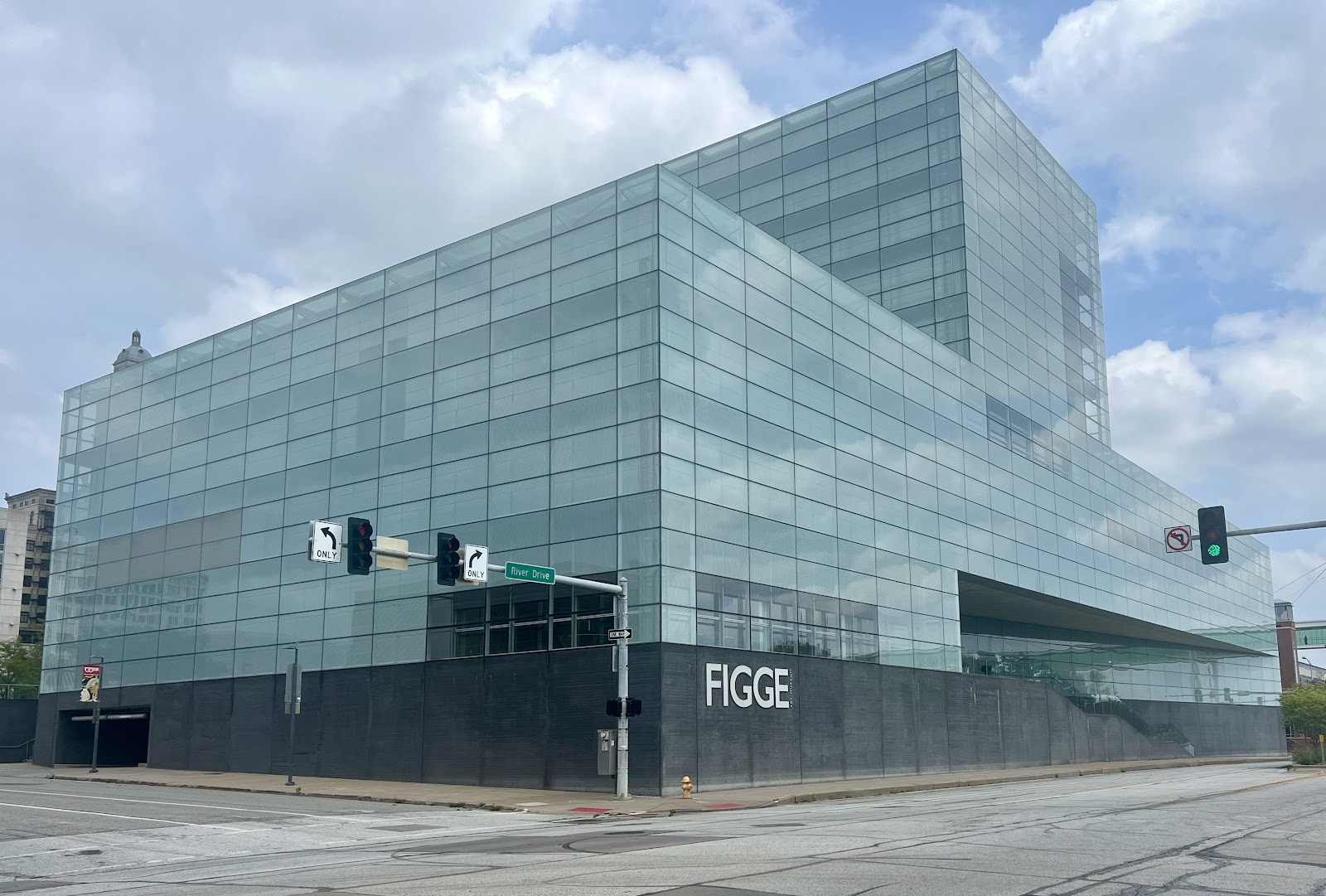
A contemporary glass-clad museum is built on a logic that sounds contradictory and is not: a translucent envelope wrapped around sealed interior boxes.
The galleries have to be sealed, because light damages work cumulatively and irreversibly and because a collection needs stable temperature and humidity. So they are windowless rooms lit at low levels by directional fittings aimed at walls.
The envelope has to be translucent, because that is the architecture — a glass or glazed-panel skin that admits daylight into the circulation, makes the building read as light rather than mass from outside, and glows at dusk when the interior lighting comes up.
Between those two is the circulation: the lobby, the stairs, the corridors and the landings that run between the envelope and the boxes. That gap is where all the daylight in the building is, and it is therefore where all the good frames are. A photographer who understands that walks past the galleries to work in the stairwell, which is the correct instinct here and an odd one everywhere else.
We have not photographed a wedding at the Figge Art Museum; glass-clad museums behave consistently. Which spaces are included, the rules on flash and proximity to work, and whether pieces may appear in published photographs are questions for their team.
The Figge Art Museum at a glance
| Where | The Mississippi riverfront, Davenport, Iowa |
| The logic | A translucent envelope wrapped around sealed gallery boxes |
| Where the light is | The circulation between the two — lobby, stairs, landings |
| The signature frame | The building glowing from outside at the crossing after sunset |
| Ask first | Spaces included, flash and proximity rules, publication of works |
The circulation, and what translucent glazing does
A translucent envelope is a different light source from clear glass and the difference is entirely in a photographer’s favour. Clear glazing gives a hard-edged beam and a view; translucent or fritted panels diffuse what passes through them, which turns the whole wall into a soft source with no hard edge anywhere.
That is the best light in the building and it behaves like an enormous softbox. The working distance is the usual one — two to three metres back for a couple, three metres for a row of people so the fall-off is even rather than dropping two stops across it — and the great advantage over a clear window is that it works at any hour, because there is no direct sun to avoid. A translucent wall in July at noon is the same soft source it is in October at four.
Two checks. Fritted and coated glazing shifts colour, usually towards green or blue, and in a museum the glazing may also be specified to cut ultraviolet for the collection’s sake — which shifts it further. A custom white balance set on a face in the position being used handles it; a global correction afterwards does not.
And translucent panels vary in brightness across a facade, because some are shaded by structure and some are not. Walking the circulation and looking at the wall rather than through it takes three minutes and identifies the brightest panels, which are the positions worth using.
The stair is the second circulation asset and in a building of this type it is the best architectural feature. It gives elevation, so a photographer above sees faces rather than the backs of heads; a natural line for a descent; and a vertical composition. It wants light from one side, which in a glass-clad building it usually has for free, because the envelope is beside it rather than above it — the opposite of a conventional stairwell lit from a rooflight, where every eye socket goes into shadow.
The landings are the third and they are the most overlooked. A landing between an envelope wall and a gallery entrance is a small space with a very large soft source on one side and a dark opening on the other, which is exactly the geometry a portrait wants: soft directional light, and a background two or three stops down. Those positions are worth finding on arrival and they need nothing added.
Hard modern surfaces are the condition running under all of it. Polished concrete, stone, steel and glass all reflect, which means the circulation is brighter than its glazing alone would suggest — genuinely helpful — and it means bounce flash may work even where the ceiling is high, because the walls contribute. One test frame settles it.
The galleries, and the frame from outside
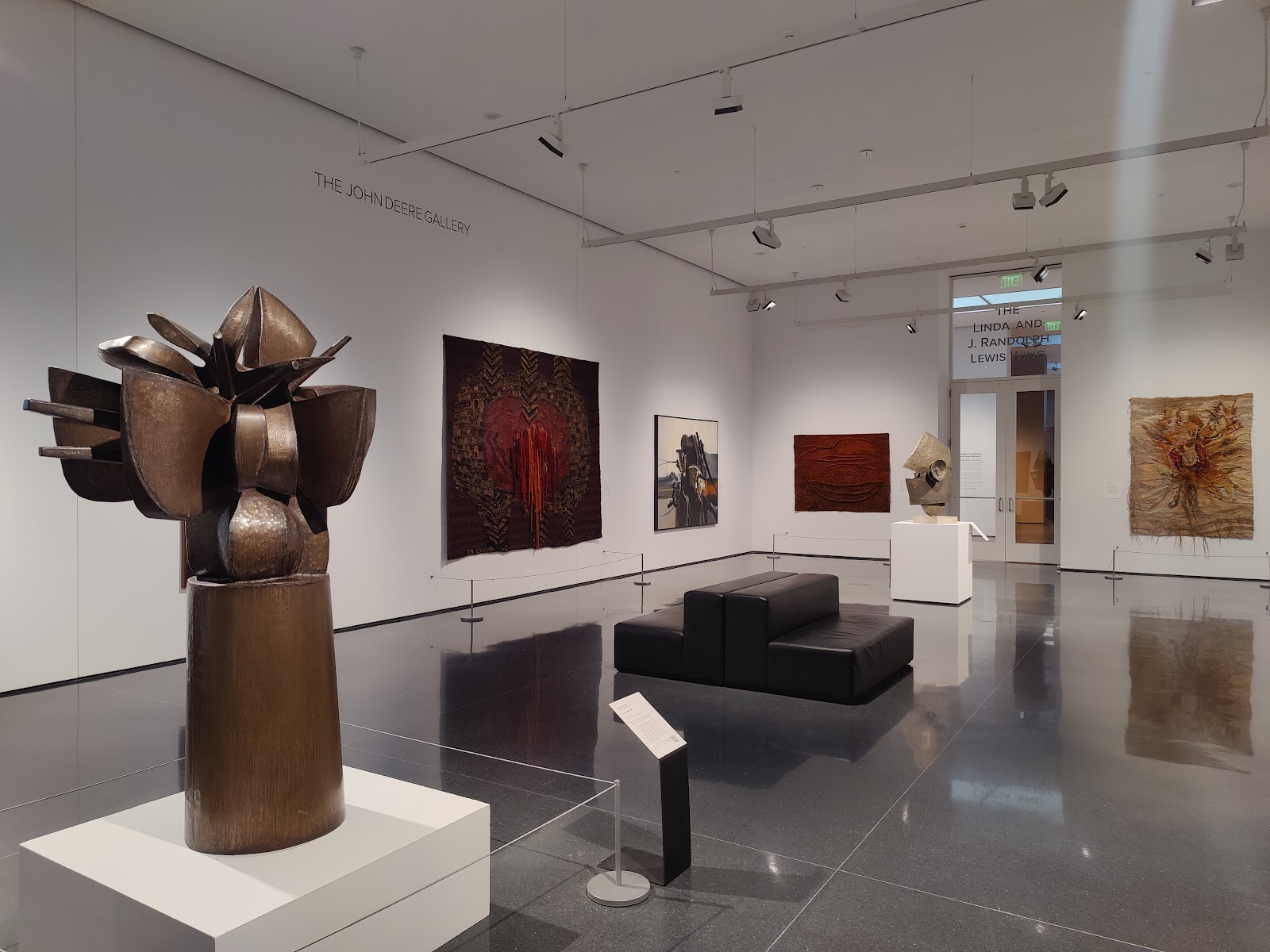
The galleries are sealed boxes and they have the standard museum conditions, which are worth knowing mainly so the time is spent in the right places.
The ambient is low, because fittings are low-output by design — measure it on arrival rather than estimating, since eyes adapt and meters do not. The light arrives in bright pools aimed at walls, with darkness between, which means a subject standing between two pools is unlit while the work beside them is perfectly exposed.
Used deliberately those pools are the best thing the galleries offer: a subject in a directed pool with an unlit gallery behind them is separated completely with no equipment at all, which is the steepest fall-off any venue type gives. Two minutes of walking to note where the pools fall is all the preparation it needs.
Display glass behaves like a mirror pointed wherever the camera is, so the fifteen-second check applies — look at every glazed work in the frame from the camera position and place any source where none of them shows it. And there is a rights question worth one ask rather than nervousness: artists hold rights in their work, a photograph reproducing a piece prominently and then published engages those rights, and museums will have a clear answer about which works may appear.
The threshold between a gallery and the circulation is the building’s other good interior frame. Standing two or three metres inside a gallery facing out towards the envelope gives a very large soft source in front and total darkness behind — and one test frame at two, three and four metres inside shows where the trade sits, watching the wall behind rather than the face.
The signature frame, though, is from outside, and it is the one the architecture exists to produce. A translucent-clad building glows when the interior lighting is on and the exterior light has dropped to match — which happens in the twenty-five to forty minutes after sunset, when the sky still holds colour at about the brightness of the lit envelope.
In that window one exposure holds the couple, the glowing building and the sky, and the building reads as a lantern rather than as a mass. It is the reason to schedule ten minutes outdoors, and since the galleries and circulation do not change through the day, taking it costs nothing indoors.
The position matters for that frame. A glass-clad building glows most from the side with the most interior lighting behind it, which is usually the circulation rather than the galleries — so the elevation that photographs best at dusk is the one the stairs and lobby sit behind. Worth establishing in daylight rather than discovering in the dark.
And by day the same building reads as mass rather than light, with the glazing reflecting sky and surroundings. That is a different and perfectly good frame, and it wants low sun raking across the facade so the panel grid reads as a texture rather than a flat sheet.
- Work the circulation, not the galleries — that is where the daylight is
- A translucent wall is a softbox with no hard edge, usable at any hour
- Set a custom white balance on a face; fritted and UV glazing shift colour
- Use the landings: a huge soft source one side, a dark opening the other
- Book ten minutes at the crossing; the building glows only then
The river, and the Iowa year
Davenport sits on the Mississippi, and the river here has an orientation that is unusual and useful to know: through the Quad Cities the Mississippi runs roughly east to west rather than north to south, which means Davenport is on the north bank looking south across the water.
That has two photographic consequences. The river is backlit for most of the day, because the sun is in the southern sky — which gives silver water, rim light on anyone standing at the edge, and a bright band behind a subject that needs the exposure set for the faces. And the sunset runs down the length of the river to the west rather than across it, which means the water carries the colour along its whole visible length rather than in a patch.
That second effect is the strongest exterior frame the location gives, and it coincides with the building’s own crossing — so the last hour and the twenty-five to forty minutes after sunset are the outdoor window, and they want a position where both the river and the building are available.
The riverfront here is open parkland rather than a walled embankment, which is unusual among large Mississippi cities and which means the water’s edge is genuinely accessible. It also means the ground is designed to flood: high water in spring is a normal event rather than a disaster, and a riverside position that exists in September may be underwater in April. That is worth checking rather than assuming.
Camera height is the governing variable at any water. Low across the surface sees a mirror reflecting sky and whatever stands beyond; high looking down sees the water’s own colour, which on the Mississippi is brown with sediment. Low is nearly always the answer here.
A polariser is worth carrying for the daytime frames, because backlit water produces specular highlights several stops above everything else which clip completely and fool any meter — though it should come off for the mirror frames, since a polariser also reduces reflections. Polarise to see into water; remove it to see the sky in water.
The seasons are four emphatic ones with one of the larger annual temperature ranges in the country. Summer is hot and genuinely humid, and the humidity rather than the heat is the photographic fact: moist air scatters light, softening shadows and slightly flattening the long river view. The fogging problem is severe and a museum makes it worse, because galleries are climate-controlled for the collection — a body carried straight out into July air fogs on every surface at once and does not clear quickly, so a bag opened twenty minutes early is the whole fix.
Autumn is the best exterior light of the year: humidity drops, the air clears, the cover along the river turns, and low sun arrives at a civilised hour, usually mid-to-late October. River fog is frequent on autumn mornings, and fog is diffusion at landscape scale — it separates the far bank into grey layers and gives a frame no clear morning does.
Winter is cold and frequently overcast, which for a translucent-clad building is genuinely good: overcast is the largest soft source there is, so the envelope gives even flattering light with nothing to avoid. Snow turns the ground into an enormous reflector, which brightens the circulation further, and the December midday sun at this latitude reaches only about twenty-five degrees above the horizon — so the whole short day rakes the panel grid and the brick of the surrounding streets.
More frames from The Figge Art Museum
The Figge Art Museum wedding photography: common questions
Where is the light in a building like this?
In the circulation — the lobby, stairs and landings between the translucent envelope and the sealed galleries. The galleries themselves have no daylight at all.
Why is translucent glazing better than clear?
Because it diffuses what passes through it, so the whole wall is a soft source with no hard edge — which means it works at any hour, with no direct sun to avoid.
What should be checked about the glazing?
Its colour. Fritted, coated and UV-cutting panels all shift the light, so a custom white balance set on a face in position beats a correction afterwards.
What is the building's signature frame?
From outside at the crossing, twenty-five to forty minutes after sunset, when the lit envelope glows at the same brightness as the remaining sky.
Which elevation glows best?
The one with the most interior lighting behind it, which is usually the circulation rather than the galleries. Worth establishing in daylight.
What is unusual about the river here?
Through the Quad Cities the Mississippi runs east to west, so Davenport looks south across it — the water is backlit most of the day and the sunset runs down its length.
More Davenport, IA venue guides
We are writing a photographer’s guide to every venue we would happily shoot in Davenport, IA. Here are three more, plus the full index:
- The German American Heritage Center, Davenport: Field Notes on a Brick Building
- The RiverCenter, Davenport: The Problem, and Four Ways Out
- The Davenport Hotel, Iowa: The Light Through a Day
Planning a wedding at The Figge Art Museum?
The frames are in the gaps. Tell us your date and we will work them.