 The Rio, Las Vegas: A Walk Through an Off-Strip Resort
The Downtown Grand, Las Vegas: The One Decision That Governs Everything
A roof in a desert city has exactly two good hours. Which two, and whether you are on it, is the whole plan.
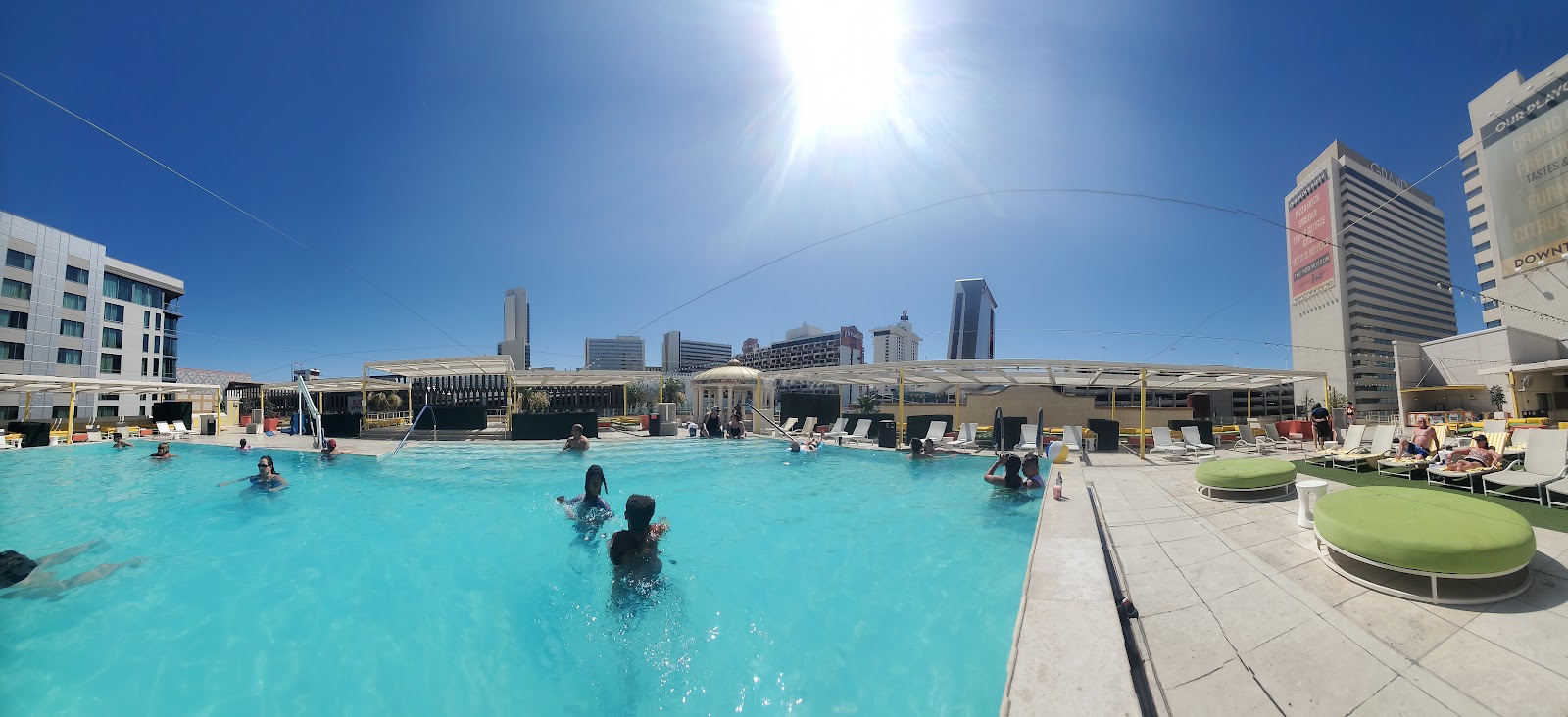
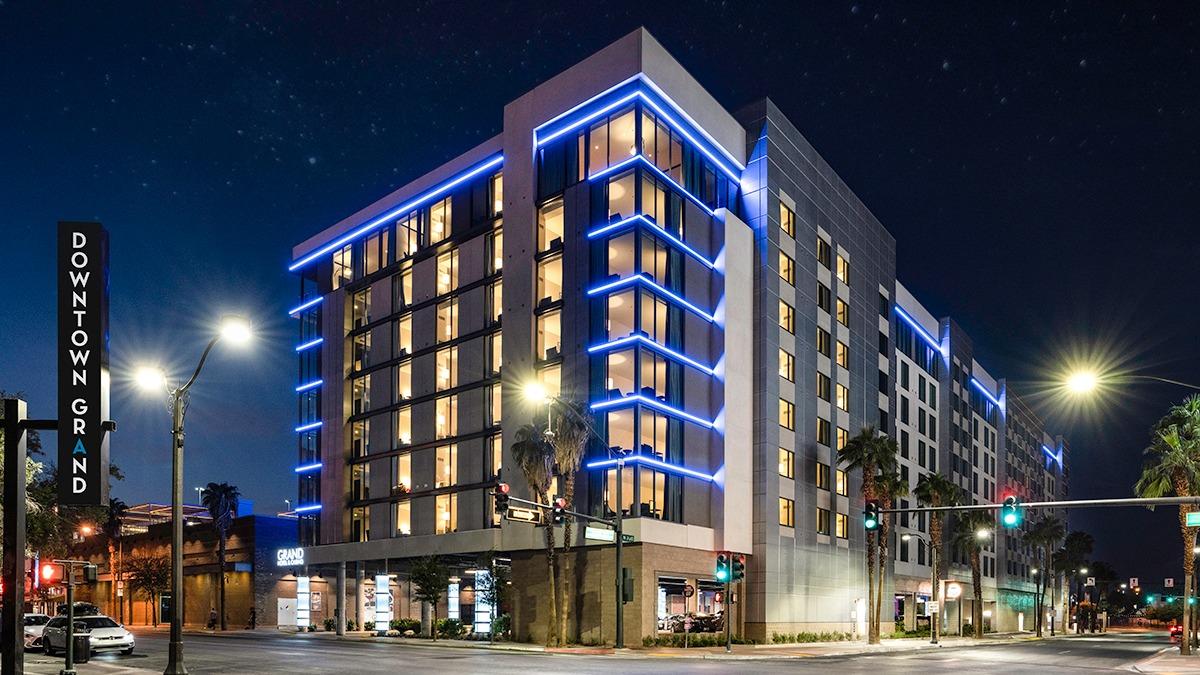
At a downtown hotel with a rooftop pool deck, the governing decision is when the party goes up. Everything else follows, because the interior does not change through the day and the roof changes completely.
A roof in the Mojave is not a place with a view; it is a place with no shade, no shelter and no walls, exposed to the full vertical force of a desert sun for most of the day and to the best light in the city for about two hours of it. Those two hours are the entire photographic value of the space.
Get the time right and the rooftop gives frames no interior can. Get it wrong and it is a hot deck with hard shadows on everyone’s face and a washed-out sky.
We have not photographed a wedding at the Downtown Grand; rooftop pool decks in desert cities behave predictably. Which spaces are included, whether rooftop access is part of the offer and what the pool rules are are questions for their team.
The Downtown Grand at a glance
| Where | Downtown Las Vegas, Nevada |
| The governing decision | When the party goes up to the roof |
| The two hours | The last hour of daylight, and twenty-five minutes after sunset |
| Why | No shade, no shelter, no walls — the sun is unfiltered up there |
| Ask first | Rooftop access, pool rules, spaces included, lighting control |
Why the timing governs, and what each hour gives
A roof has no shade, and in this climate that is the whole story. At about thirty-six degrees north the June midday sun sits roughly seventy-seven degrees above the horizon, and the very dry air scatters almost nothing — so on an open deck in the middle of the day the light comes down hard and straight, black eye sockets and a hard shadow under every chin, with a range between lit and unlit that exceeds what a sensor holds.
There is no technique for that on a roof, because the two usual escapes are unavailable: there is no structure to stand behind and no canopy to stand under. A held diffusion panel works and needs a person to hold it, and it fails in wind, which at roof level is stronger than at street level.
So the middle of the day up there is not a photographic slot. It is a slot for people to enjoy the pool while the photographer works indoors.
Mid-morning and mid-afternoon are marginal. The sun is lower, which helps, but it is still high enough to be unflattering, and the deck is still hot. The exception is the hour or so when the sun is low enough that a parapet, a structure or the building itself casts real shade across part of the deck — and that shade, with pale paving bouncing light up into it and water alongside doing the same, is genuinely good directional light. It is worth asking which part of the deck shades first and when.
The last hour before sunset is the first real window and the more useful of the two, because people are dressed and gathered. Low sun comes across faces rather than down onto them, the pale deck and the water fill the shadows from below, and the light rakes everything it touches. A roof has one advantage here that street level does not: above the surrounding buildings the sun stays visible after it has set for anyone below, which means the usable light lasts perhaps twenty to thirty minutes longer up there.
The roughly twenty-five minutes after sunset is the second window and it is the frame the space exists to give. The sky still holds deep colour, downtown’s signage comes up, the pool holds a reflection of both, and one exposure carries the couple, the sky, the lit city and its double in the water. Nothing indoors compares.
It is short here, because the very dry desert air gives less afterglow than a humid sky, so the colour drains quickly. Twenty-five minutes is generous, and this needs to be a scheduled ten minutes with the couple already up there rather than something drifted into.
What follows from it
Once the two rooftop windows are fixed, the rest of the schedule arranges itself, because everything else is movable.
The interior has no daylight in its public spaces, which means it is identical at nine in the morning and nine at night. Every indoor frame can therefore go anywhere the couple prefers, and nothing is lost by leaving the reception for ten minutes at the right time. That is worth saying to a couple explicitly, because the request to interrupt dinner sounds larger than it is.
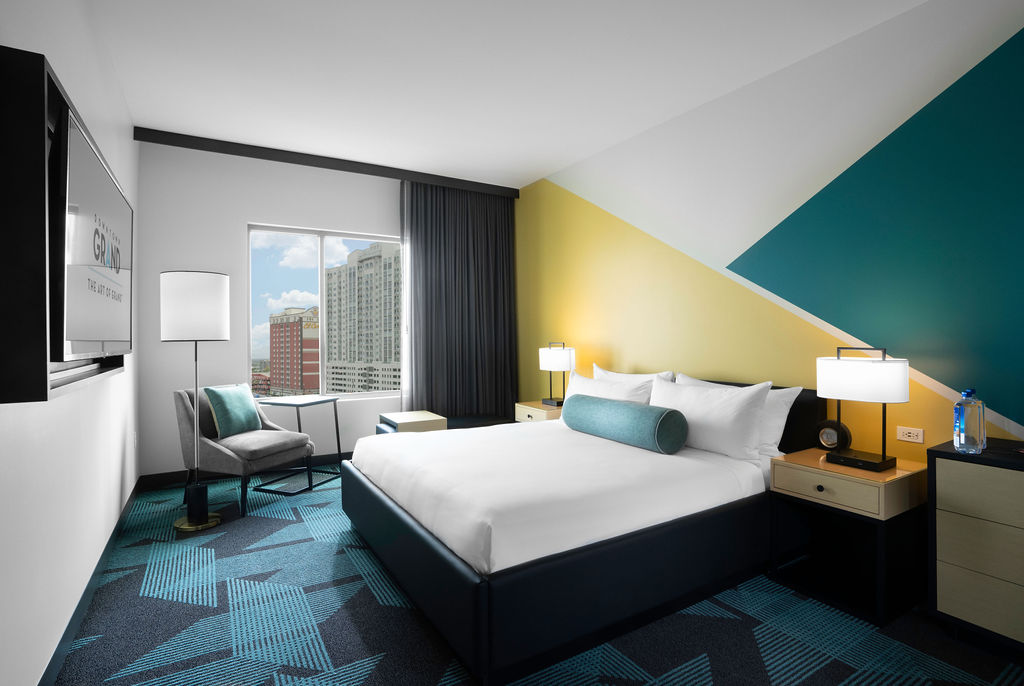
The guest rooms are the exception and they have their own soft deadline: their light is best in the middle of the day and gone by late afternoon in December. Largest window on the shaded side, every overhead fitting off so the room has one colour of light, lamps out of frame, two to three metres back from the glass. In this climate direct sun through glass is unusually hard, so the shaded side is the whole difference; and floor height matters less than in a dense city — downtown, with lower buildings, less again — so orientation is the question worth asking.
The water on the deck is worth using properly rather than merely being near. Camera height decides everything: a low camera looking across the surface sees a mirror that reflects the sky and whatever is standing beyond it, while a high camera looking down sees through to the bottom. Half a metre of camera height changes the whole character of a water frame, and the low position is usually the good one.
A polariser is the one filter genuinely worth carrying here, because direct sun on water produces specular highlights several stops above everything else that clip completely and fool any meter. Its one-and-a-half to two stop cost is irrelevant in this much light.
And the physical risk deserves plain treatment: a pool deck is wet, tiled and slippery, a long dress on that surface is a hazard, and a camera near a water edge is at real risk. Compose so that nobody needs to stand on the edge.
Indoors, the standard conditions apply. Dense overhead lighting that shadows eye sockets, fixed by direction rather than brightness: one source off the camera axis at face height, half a stop to a stop above the ambient, gelled to match the dominant fitting colour with white balance set to the gel. Lower ceilings than a Strip resort, which means bounce flash usually works — worth one test frame. Patterned carpet competing with faces, solved by camera height or distance. Reflective surfaces showing a badly placed light, solved by fifteen seconds of checking from the camera position. And mixed colour everywhere, solved by picking one temperature and killing or overpowering the rest.
- Fix the two rooftop windows first; everything indoors is movable
- Ask which part of the deck shades first, and when
- Camera low across the water for the mirror; camera high sees the bottom
- Carry a polariser — the two-stop cost is irrelevant in this light
- Compose so nobody has to stand on a wet edge
Downtown below, and the desert year
Down at street level, downtown Las Vegas has one property the Strip does not: it is at pedestrian scale. Lower buildings, narrower streets, more sky reaching the pavement, and signage close overhead rather than across a boulevard — which makes the street light brighter and less directional than in a canyon of towers, and lets low sun get over the rooflines so the last hour of daylight actually reaches the pavement.
It also means signage lights people, which is a mixed blessing: saturated coloured signage is narrow-spectrum, so a face lit by it has almost no information in two of its three colour channels and no editing recovers what was never recorded. Signage goes behind or above; one gelled source of your own lights the faces, gelled warm to roughly match the dominant colour nearby.
A workable street plan is three positions within a five-minute walk — close signage, architectural texture on a lower building, and one enclosed position such as a doorway or arcade that works in any weather. Whether the street is used at all depends on whether the roof has taken both windows, which is a genuine choice rather than an oversight: there is only one last hour of daylight.
The year decides how much of the roof is usable. Summer, June into September, has daytime highs regularly above forty degrees Celsius, which on an open deck with no shade is a welfare limit rather than a comfort one — the rooftop session should be short, at the very edge of the day, and with water available. The compensation is that sunset in July is late enough that the deck has cooled a little by the time the light is right.
The monsoon from July into September brings occasional afternoon thunderstorms and blowing dust. On a roof that is a real interruption and needs a named indoor alternative, and any open deck will close in a storm — though a desert thunderstorm at dusk seen from a roof is the most dramatic frame the city can produce, and wet decking reflecting lit signage beats the dry version.
Winter is the good season for the light and the awkward one for the deck: mild days, cool mornings, the clearest air of the year, sunset in mid-afternoon so both windows fall at civilised hours — but a rooftop pool in January is a background rather than a place to linger. That is a fair trade, because the reflection and the crossing frame work regardless of temperature, and a coat solves the rest.
Spring is windy, and wind is the specific enemy here: a rippled pool reflects nothing, so the mirror frame is simply unavailable on a windy afternoon, and a lightstand on a roof in desert wind is a liability rather than a tool. The still-water frames happen at the calmest times of day, which in the desert are usually early morning and the hour around sunset.
Wind also means blowing dust, which flattens anything distant and gets into everything, so bodies stay bagged between positions. And fogging runs one way only in this climate: a cold body from air conditioning taken up onto a hot deck fogs instantly and does not clear inside twenty-five minutes. Twenty minutes of warming before going up is the difference between having the crossing frame and missing it.
More frames from The Downtown Grand
The Downtown Grand wedding photography: common questions
What is the one governing decision?
When the party goes up to the roof. The interior never changes through the day and the roof changes completely.
Which two hours matter?
The last hour before sunset and roughly twenty-five minutes after it. A roof also gains twenty to thirty minutes of late light over street level.
Why is the middle of the day unusable up there?
Because a roof has no shade and no shelter, and the desert midday sun comes down hard and straight with a range that exceeds what a sensor holds.
How do you use the pool water?
Camera height decides. Low across the surface gives a mirror reflecting sky and signage; high looking down sees the bottom. Half a metre changes everything.
Does wind matter?
Substantially. A rippled pool reflects nothing, so the mirror frames only exist at the calmest times — early morning and the hour around sunset.
Will interrupting the reception cost anything?
No. Nothing indoors changes through the day, so ten minutes at the right time costs nothing and gains the best frame of the day.
More Las Vegas, NV venue guides
We are writing a photographer’s guide to every venue we would happily shoot in Las Vegas, NV. Here are three more, plus the full index:
- The Excalibur, Las Vegas: What It Suits, and What It Does Not
- The Fremont Hotel, Las Vegas: The One Decision That Governs Everything
- The Golden Nugget, Las Vegas: The One Decision That Governs Everything
Planning a wedding at The Downtown Grand?
Two hours decide the gallery. Tell us your date and we will book them.