 The Rio, Las Vegas: A Walk Through an Off-Strip Resort
The Cosmopolitan, Las Vegas: The Light Through a Day
A building lit partly by moving images has a problem no other venue has. It also has terraces, which solve another one.
Two features distinguish some newer Strip resorts from the classic windowless model, and both change the shape of a wedding day.
The first is terraces: guest rooms and public spaces with genuine outdoor space attached, which in a desert city is worth a great deal, because it gives access to real sky without a walk to the street.
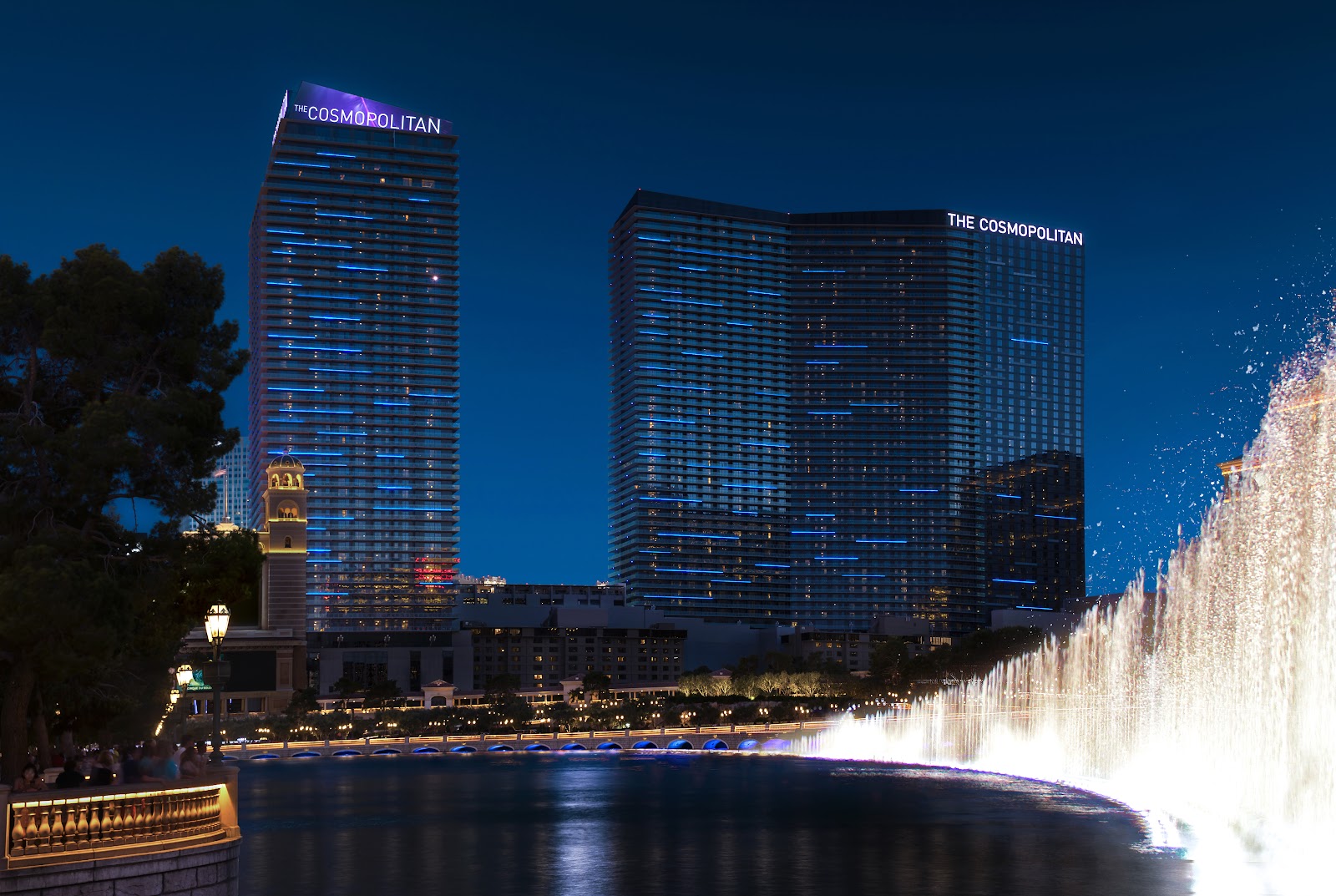
The second is screens — large illuminated displays used as architecture, with moving images on them. That is a photographic condition no conventional venue has, and it is a genuine problem rather than a novelty: the light on a face changes brightness and colour several times a second, which means consecutive frames do not match.
This is the day in order, with both handled as they arrive. We have not photographed a wedding at the Cosmopolitan; newer Strip resorts behave consistently and desert light is predictable. Which spaces are included, whether terrace access is part of the offer and whether the lighting is adjustable are questions for their team.
The Cosmopolitan at a glance
| Where | Las Vegas Strip, Nevada |
| Morning | The hour after sunrise, then terraces and guest rooms |
| Midday | Interior, or terrace in shade — the open desert sun is unusable |
| Evening | The last hour of daylight, twenty-five minutes of dusk, then neon |
| Ask first | Terrace access, spaces included, lighting control, screen control |
Morning: the hour after sunrise, then the terraces
The hour after sunrise is the best outdoor light of a Las Vegas day and it is almost always unused. Low sun across faces rather than down onto them, the clearest air of the day before the heat builds haze, and a Strip that is genuinely quiet. It takes twenty minutes and a destination chosen the night before, because the light changes fast enough that there is no time to explore.
Mid-morning belongs to the terraces, and in this climate a terrace has a specific property worth understanding: it is outdoor space with a wall behind it and usually a soffit above, which makes it directional rather than open. Sky provides the source, the wall bounces into the shadow side, and the soffit blocks the overhead component that ruins faces in the open. It is the best of both conditions and it exists at very few Las Vegas venues.
The one condition is direct sun. When the sun is low enough or the terrace oriented so that it comes in under the soffit, the space becomes a hard-light trap with brilliant floor and deep shade a metre away. That is a matter of orientation and hour, and it is worth establishing which terraces are shaded when before the schedule is written.
The pale desert ground, and pale terrace paving, bounce light up strongly — which fills the shadows a high sun carves, and is the one desert effect working in a photographer’s favour. The cost is uplight under chins and into nostrils, so a position with a wall to one side beats the open middle of a terrace.
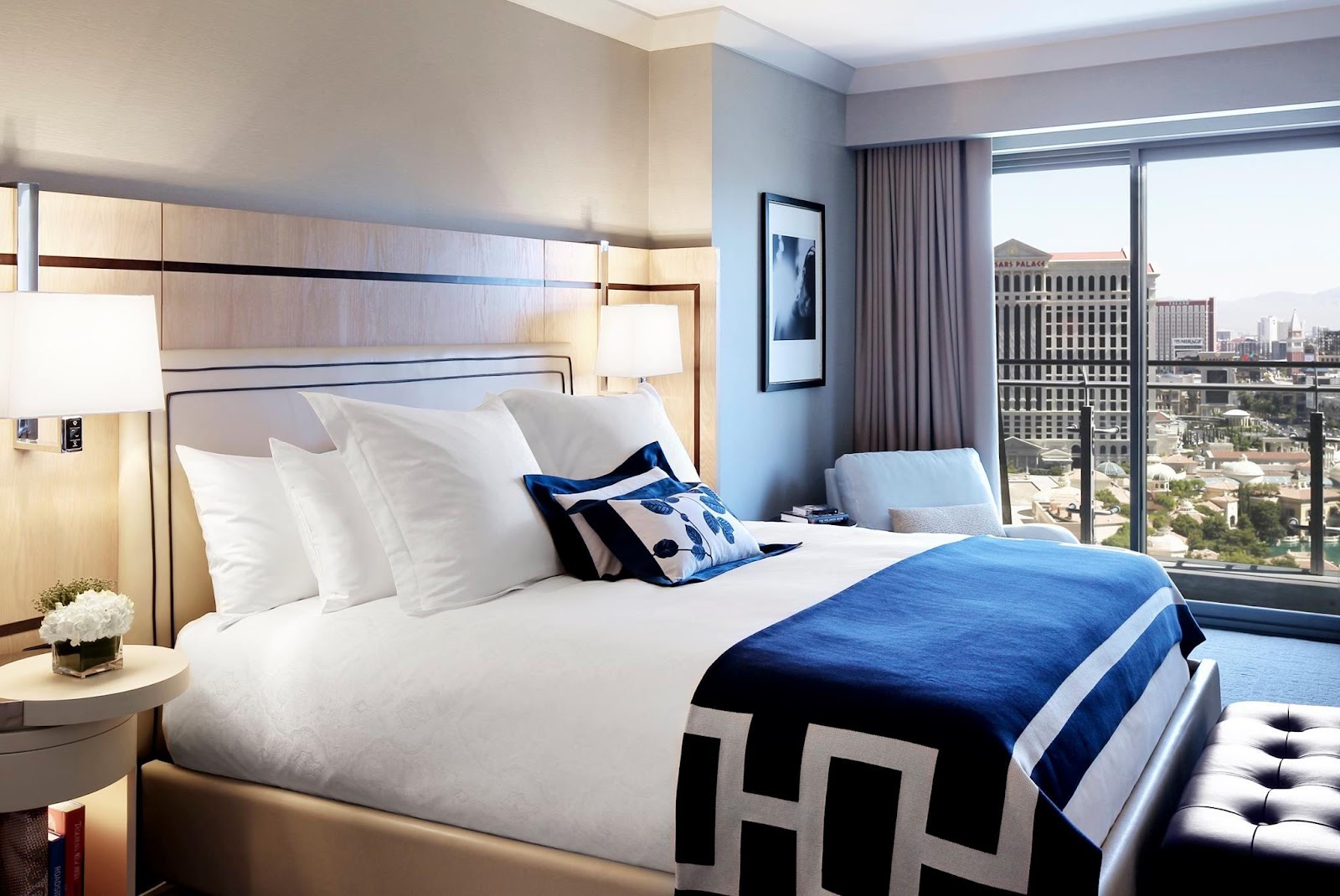
The guest rooms carry the rest of the morning and are the interior daylight. Largest window on the shaded side, every overhead fitting off so the room has one colour of light, lamps out of frame, two to three metres back from the glass.
Two local specifics. Direct sun through glass in this climate is among the harder sources a photographer meets, because the sun is high and the air is dry, so the shaded side is the whole difference rather than a refinement. And a modern resort’s glass is often tinted, which throws a localised green or blue cast onto anything near it — check it with one frame on arrival rather than finding it in editing.
Floor height matters less here than in a dense city, because the towers are far apart and the sky is not blocked. Orientation is the question to ask.
Midday and afternoon: inside, and the screens
The middle of a Las Vegas day is not usable in the open and that is a fact about the desert, not the venue. At about thirty-six degrees north the June midday sun sits roughly seventy-seven degrees above the horizon, near enough to straight down that eye sockets go black and every chin gets a hard shadow; and the very dry air means nothing scatters the light, so the contrast exceeds what a sensor holds. With close to three hundred sunny days a year, waiting for cloud is not a plan.
So the middle of the day is interior, or terrace-in-shade, and the interior brings the screens.
A large illuminated display used as architecture is a source, and it is a source with three properties that matter. It changes brightness, sometimes by several stops, as the content changes. It changes colour completely, from white to saturated red to blue within a few seconds. And it is large and close, which makes it a soft source — genuinely flattering when it happens to be white and bright, and unusable when it happens to be magenta.
The consequence is that consecutive frames do not match, and a sequence shot under screen light needs individual correction rather than a batch setting. That is a real editing cost and it is worth knowing before it arrives.
There are three working methods. Overpower it: one gelled source bright enough that the screen becomes background rather than key, which makes the faces consistent and the screen a colourful field behind them. Time it: watch the content cycle, learn its rhythm, and take the frames during the white or neutral passages — content loops, so this is more practical than it sounds. Or use it deliberately as the subject, accepting the colour as an effect rather than a problem, which for a couple who chose this venue is frequently the right answer.
What does not work is metering once and shooting a series. Auto exposure will chase the content and produce a sequence that flickers; manual exposure set for one passage will be two stops off during another.
The rest of the interior follows the modern resort pattern: dense overhead lighting that shadows eye sockets and needs direction rather than brightness; pale hard surfaces that give no natural separation, fixed geometrically by distance, the darker end of the room, depth behind, and a source brighter on the face than the room is on the wall; reflective stone, glass and metal that will show a badly placed light, fixed by fifteen seconds of checking from the camera position; and ceilings over the largest floors low enough that bounce flash returns something usable, which is worth testing with one frame.
- Book the sunrise hour; it is the best light and the quietest Strip
- Establish which terraces are shaded at which hour before scheduling
- Under screens, overpower with one gelled source or time the content loop
- Never auto-expose a sequence lit by a moving display
- Check modern glass for tint before it appears on skin
Evening: the last hour, the crossing, and the year
The last hour before sunset is the day’s most useful window, because people are dressed and gathered by then. Low sun crosses faces instead of falling onto them, the pale ground fills from below, and the long light rakes every surface — which is what makes desert architecture read at all.
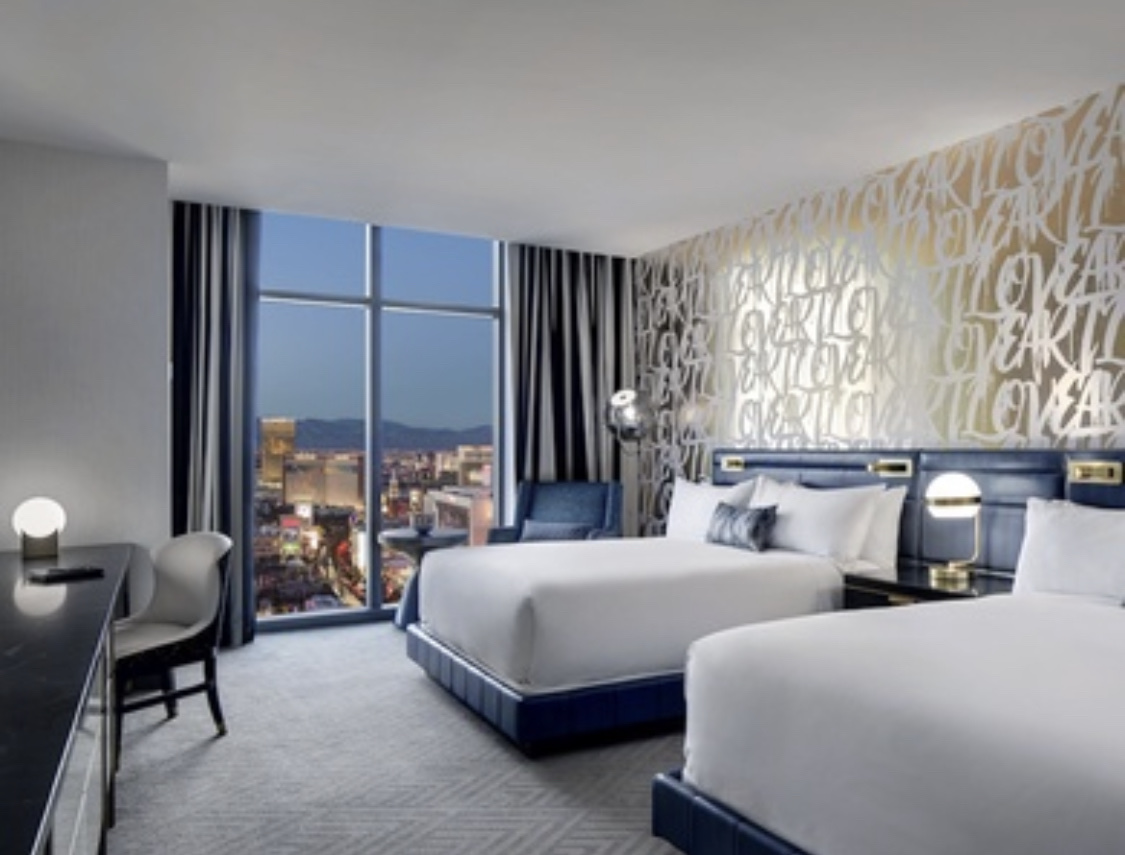
The final twenty-five minutes are the crossing and they are the frame this city exists to give: the sky still holds light while the Strip’s illumination comes up, and for a short period the two sit at about the same brightness, so one exposure holds couple, sky and lit city. On a terrace, above the surrounding ground level, it is better than at street level and arrives slightly earlier.
It is short here. Dry clear air gives less afterglow than a humid sky, so the colour drains quickly, and twenty-five minutes is generous. It needs to be a scheduled ten-minute excursion rather than something drifted into — in a summer wedding it falls well into the reception; in December, with sunset in mid-afternoon, it may precede the ceremony.
After it goes, the Strip after dark is one of the brightest exterior environments in the world, and outdoor night portraits here need nothing added. That makes the late evening a genuine option rather than a write-off.
The caveat is spectral. Saturated signage and neon put a great deal of energy into a narrow part of the spectrum and very little elsewhere, which means they do not render skin the way broad-spectrum light does, and one colour channel clips well before the others. Let them be the background; light faces with one gelled source of your own.
The year is two and a half seasons rather than four. Summer, June into September, has daytime highs regularly above forty degrees Celsius, which makes an outdoor or terrace block a matter of minutes at the edges of the day rather than an hour in the middle — and makes the sunrise window more attractive than it first sounds.
The monsoon period from July into September brings occasional afternoon thunderstorms and blowing dust. For a terrace-dependent plan that is a real risk needing a named indoor alternative, though wet paving photographs better than dry and a desert thunderstorm at dusk is the most dramatic sky the city gives.
Winter is the good season: mild, the clearest air of the year, sunset in mid-afternoon so both windows fall at civilised hours, and terraces usable through the middle of the day because the sun never climbs high enough to get under a soffit. Spring is windy, and wind here means dust — haze that flattens distance, grit everywhere, bodies bagged between positions.
And in a climate this dry, fogging runs one way only: a cold body from air conditioning taken into forty-degree air fogs immediately. Twenty minutes of warming before stepping out is the entire fix, and it is the difference between having the dusk frame and missing it.
More frames from The Cosmopolitan
The Cosmopolitan wedding photography: common questions
What is unusual about the light here?
Large illuminated screens used as architecture. They change brightness and colour several times a second, so consecutive frames do not match.
How do you photograph under a screen?
Overpower it with one gelled source so it becomes background, or learn the content loop and shoot during the neutral passages. Never auto-expose a sequence.
Why are terraces valuable in Las Vegas?
Because a terrace has a wall behind and usually a soffit above, which blocks the overhead light that ruins faces in the open while keeping the sky as a source.
Is the middle of the day usable outdoors?
Not in the open. The sun is nearly overhead, the dry air does not soften it, and the contrast exceeds what a sensor holds. Shade or indoors.
How long is the dusk crossing?
About twenty-five minutes, and shorter than in a humid climate. Schedule it as a ten-minute excursion rather than drifting into it.
What is the one desert equipment problem?
A cold body from air conditioning fogs instantly in forty-degree air. Twenty minutes of warming beforehand is the whole fix.
More Las Vegas, NV venue guides
We are writing a photographer’s guide to every venue we would happily shoot in Las Vegas, NV. Here are three more, plus the full index:
- The Downtown Grand, Las Vegas: The One Decision That Governs Everything
- The Excalibur, Las Vegas: What It Suits, and What It Does Not
- The Fremont Hotel, Las Vegas: The One Decision That Governs Everything
Planning a wedding at The Cosmopolitan?
Screens, terraces and twenty-five minutes. Tell us your date and we will time all three.