 The Rio, Las Vegas: A Walk Through an Off-Strip Resort
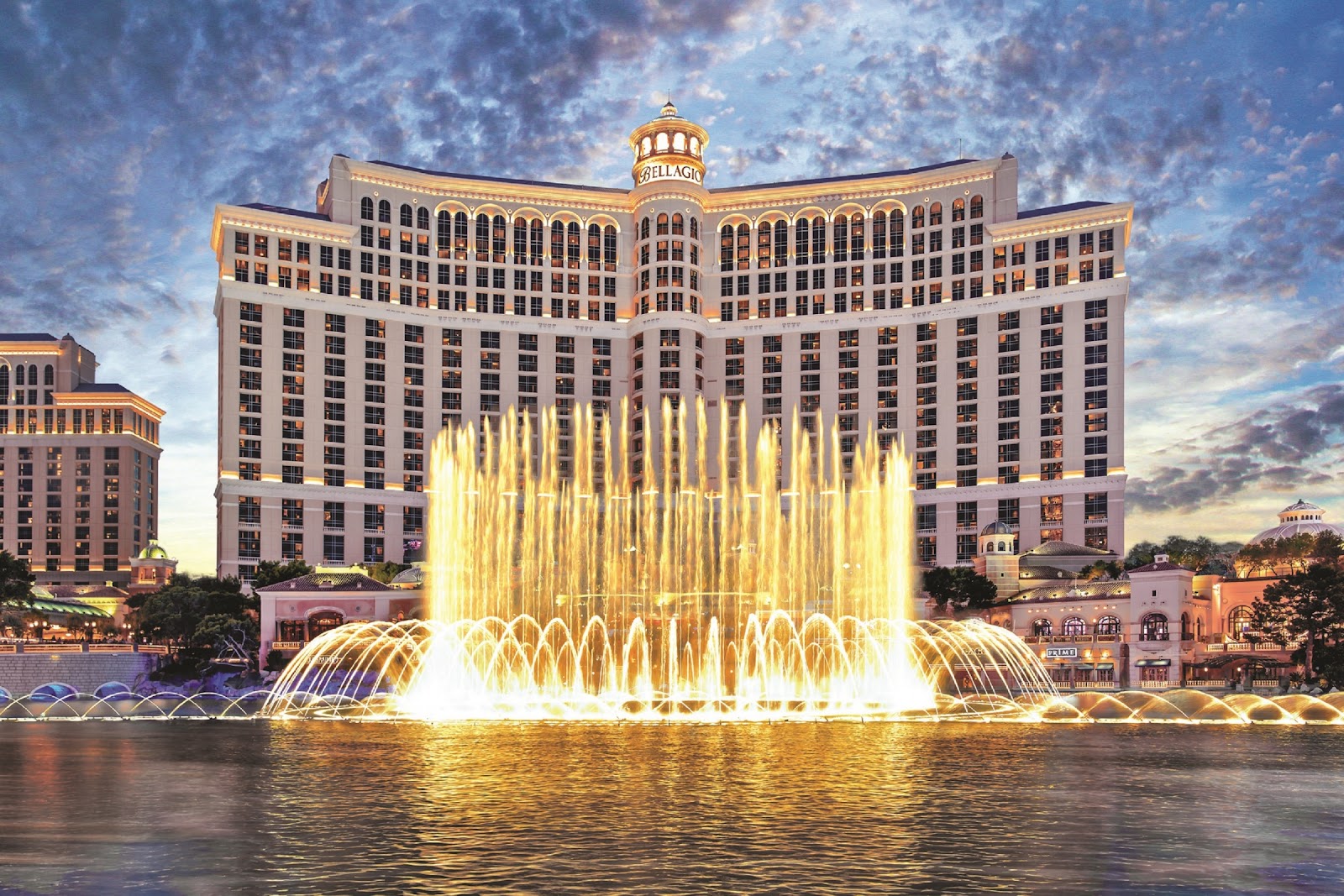
The Bellagio, Las Vegas: A Resort Built to Have No Outside
The building was designed so that nobody inside it can tell what time it is. That single decision explains every lighting problem in it.
A Las Vegas Strip resort is the most deliberately designed interior a wedding is likely to happen in, and the design has one governing objective: to remove any sense of outside. No windows on the gaming floor, no clocks, no views, no daylight, no way of telling eleven in the morning from eleven at night.
That is not incidental and it is not a criticism. It is the building’s logic, and a photographer who understands it can predict almost everything about the light before arriving — because every consequence follows from the same decision.
There is no daylight in the public areas. The artificial lighting is dense, warm and installed to be flattering to spending rather than to faces. The ceilings over the largest floors are low, which is unusual and turns out to be a gift. The carpet is patterned, the surfaces are reflective, and coloured sources are everywhere. And outside is the Mojave Desert, which for four months of the year is not usable at all.
We have not photographed a wedding at the Bellagio; large Strip resorts are built to a consistent logic and their light follows from it. Which spaces are included, whether the lighting is adjustable and what may be attached are questions for their team.
The Bellagio at a glance
| Where | Las Vegas Strip, Nevada |
| The design logic | Remove any sense of outside: no windows, no daylight, no clocks |
| The gift | Low ceilings over vast floors, so bounce flash actually works |
| The problems | Patterned ground, coloured sources, no natural light except guest rooms |
| Ask first | Spaces included, lighting control, fixings, guest-room orientation |
What the windowless logic does to the light
The first consequence is that the interior does not change through the day, which is unusual and genuinely useful. In a venue with windows a photographer is negotiating with the sun; here the ballroom at nine in the morning is identical to the ballroom at nine at night, which means the running order can be built around the couple’s preferences rather than around the light. That is a freedom most venues do not offer.
The second consequence is that all the light is installed light, which means it is numerous, warm and coming from directly overhead. Dense downlighting is the standard fitting pattern in these buildings, and overhead light does the one thing a photographer never wants: it puts eye sockets in shadow and the nose in relief on every face at once. It is why unlit casino-floor portraits look tired even when the exposure is correct.
The fix is not brightness, it is direction. One source off the camera axis at face height changes the whole character of the frame, because it replaces overhead with sideways — and the amount needed is small, half a stop to a stop above the ambient, because the ambient is already doing the work of filling.
The third consequence is the gift, and it is specific to these buildings: the ceilings over the largest floors are low. A casino floor a hundred metres across has a ceiling three or four metres up, which is remarkable for a space of that size and it means a flash aimed upward returns something usable. In a hotel ballroom with a five-metre ceiling, bounce is a waste of a battery; here it works, and a bounced source is a very large soft one.
It is worth testing with one frame on arrival rather than assuming, because ceilings vary space to space and the finish matters — a dark or strongly coloured ceiling absorbs, and a gold one tints. But in most of these buildings the answer is yes, and it changes the equipment decision for the whole day.
The fourth consequence is colour, and it is the hard one. Installed lighting in a resort is a mixture: warm decorative fittings, cooler recessed downlights, coloured accent lighting, illuminated signage and screens, and any coloured uplighting installed for the event. Three temperatures on one face cannot be resolved afterwards, so the working method is to pick the one that should be correct, set white balance to it, and switch off or overpower whatever else lands on skin.
Coloured accent lighting is the usual worst offender and it is frequently the easiest thing to have turned off for the ten minutes the portraits need — which is a request worth making rather than a compromise worth accepting.
The ground, the surfaces, and where the daylight is
The patterned carpet is the least discussed problem in these buildings and it matters more than it sounds. A figured carpet carries detail at roughly the same spatial frequency as a face, which means a wide frame taken from close range puts face and pattern in competition and the eye cannot separate them. It also fills the bottom third of every standing portrait.
The three answers are the ordinary ones and they all work. Distance and aperture, so the pattern reduces to tone while the face stays sharp. Framing that excludes the floor, which is a matter of camera height and lens choice rather than of anything difficult. And brightness on the subject, because a face a stop above its surroundings holds the eye regardless of what the surroundings are doing.
Reflective surfaces are the other structural feature: polished stone, glass, mirror, lacquer and metal are the resort vocabulary, and every one of them will show a badly placed light at full brightness. The discipline is to stand where the camera will stand, look at each reflective surface in the frame, and place the source where none of them sees it — usually forward of the reflecting plane and outside the frame edge on the far side.
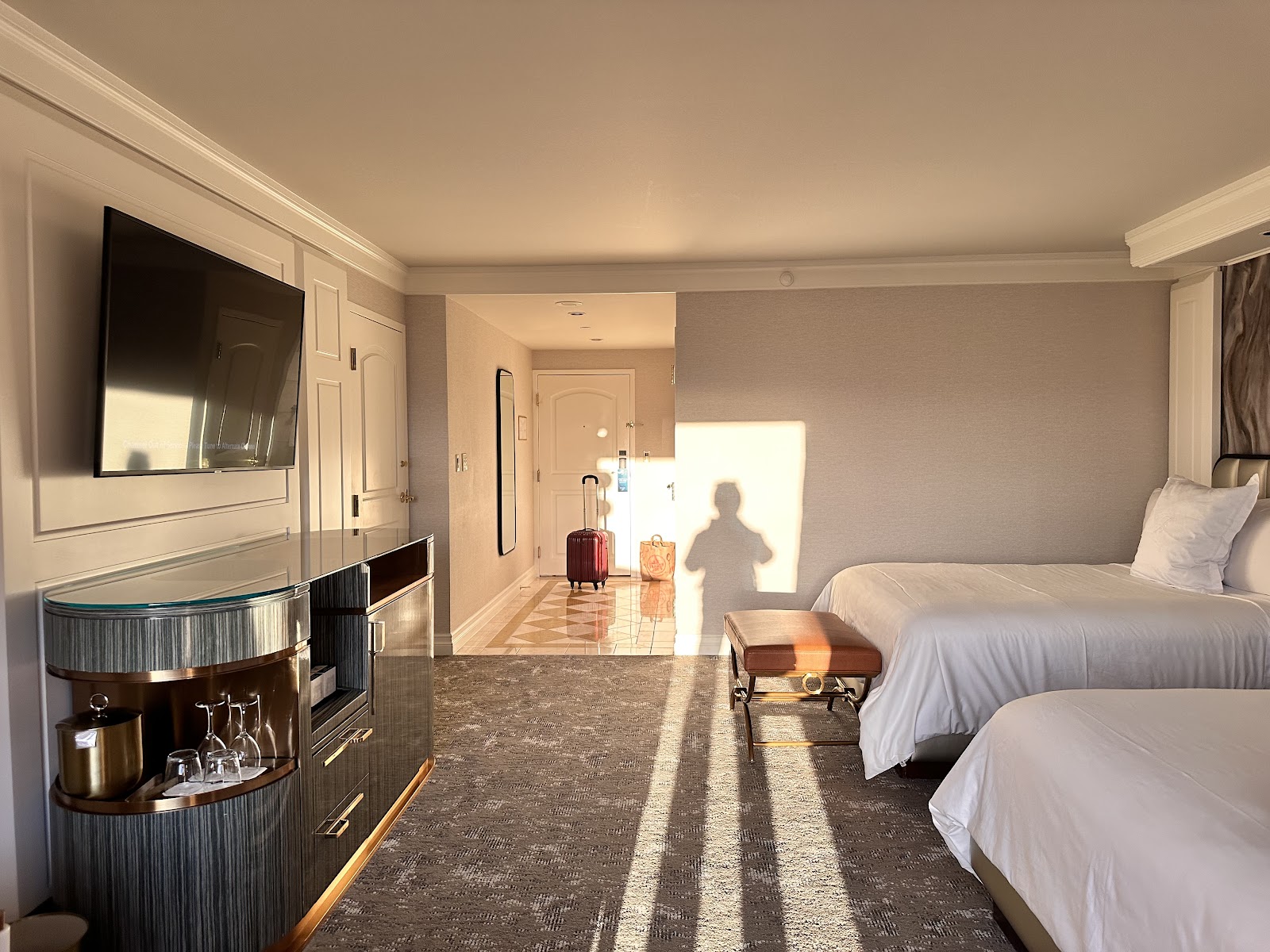
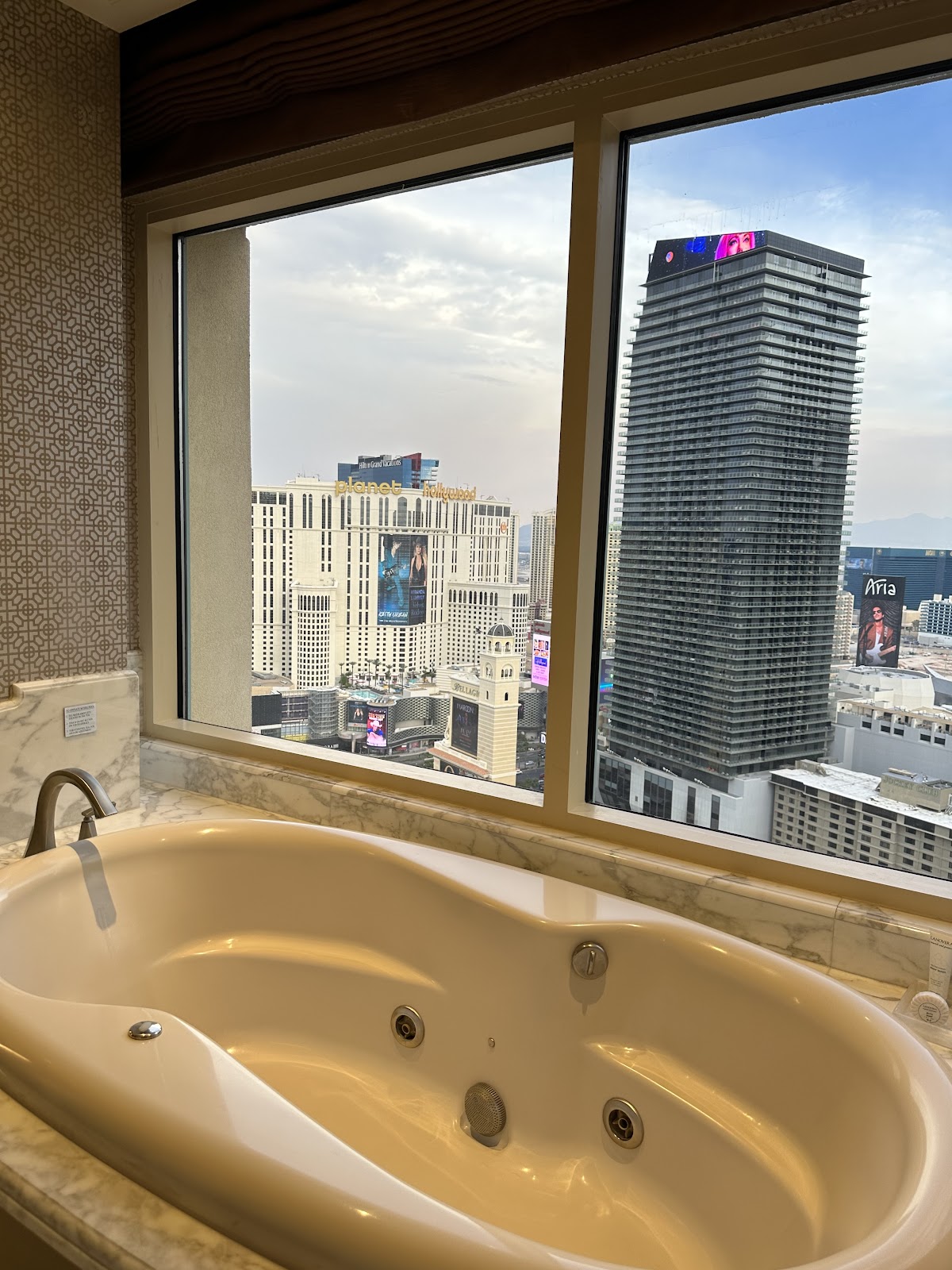
The guest rooms are where the daylight is, and in a building designed to have no outside they are the only place a naturally lit frame is possible. That makes them more valuable here than at an ordinary hotel, not less.
The requests are the familiar ones with one desert-specific addition. Largest window on the shaded side, every overhead fitting off so the room has one colour of light, lamps out of frame, two to three metres back from the glass. The addition is that in Las Vegas the sun is brutally strong and the air is very dry, which means direct sun through a window is a harder source here than almost anywhere — the shaded side is not a refinement, it is the difference between a soft source and a hard one.
The corollary is that a high floor matters less here than in a dense city, because the buildings are further apart and the sky is not blocked. What matters instead is orientation, and it is worth asking which way the room faces rather than how high it is.
One more consequence of the windowless logic: the building has no dusk frame. In a hotel with tall windows there is a twenty-minute crossing when the interior and the city match in brightness, and it is usually the best picture of the evening. Here that frame exists only in the guest rooms and outside, which makes the outdoor plan more important rather than less.
- Test bounce on arrival; low casino ceilings make it work
- One source off-axis replaces overhead light and fixes every face
- Exclude the carpet by camera height, or dissolve it by distance
- Ask for coloured accent lighting off for ten minutes
- In the guest rooms, ask about orientation rather than floor height
Outside, and the desert year
Outside is the Mojave Desert and its light is the most extreme of any major American city, for two reasons that compound each other.
The first is the sun’s height. Las Vegas sits at about thirty-six degrees north, which puts the midday sun in June roughly seventy-seven degrees above the horizon — almost directly overhead. Light from that angle carves eye sockets into black holes and puts a hard shadow under every chin, and there is no technique that makes it flattering.
The second is the dryness. Very low humidity means almost nothing in the air to scatter the light, so the shadows are harder here than in a humid climate at the same sun angle, and the contrast between lit and unlit is greater. The city also averages something close to three hundred sunny days a year, which means the usual photographer’s hope — that cloud will arrive and soften everything — is not a plan. It happens rarely enough to be a bonus rather than a strategy.
The consequence is that outdoor photography here has two windows and no middle. The first hour after sunrise and the last hour before sunset, when the sun is low enough to come across faces rather than down onto them; and roughly twenty-five minutes after sunset, when the sky still holds light and the Strip’s own illumination comes up. Everything between is either shade or a compromise.
Open shade in the desert is better than it sounds, because the pale desert ground is a reflector. Light bounces up off it strongly, which fills the shadows a top-down sun creates — the one effect working in a photographer’s favour here. The cost is that it can put light under the chin and into the nostrils, so shade with a wall on one side beats shade in the open.
The seasons are not four here, they are two and a half. Summer, roughly June into September, has daytime highs regularly above forty degrees Celsius, which makes an outdoor block in formal clothes genuinely unwise rather than merely uncomfortable — it should be short, shaded, and scheduled at the edges of the day. The monsoon period from July into September adds occasional afternoon thunderstorms and blowing dust, which is the one time cloud is likely.
Winter is the good season and it is properly good: mild days, cool mornings, clear air and sunset in the middle of the afternoon in December, which puts the golden window at a civilised hour instead of after nine in the evening. Spring is windy, which means blowing dust and, on the worst days, visible haze that flattens anything distant.
And the one practical note about desert dusk: it is shorter than people expect. Clear dry air gives less afterglow than a humid sky, so the colour goes quickly — which is exactly why the twenty-five minutes after sunset needs to be scheduled rather than wandered into.
More frames from The Bellagio
The Bellagio wedding photography: common questions
Why is there no daylight in the public spaces?
Because the building is designed to remove any sense of outside — no windows, no clocks, no views. Every lighting consequence follows from that one decision.
Does the interior light change through the day?
No, which is a real advantage: the running order can follow the couple’s preferences rather than the sun. The trade-off is that the building has no dusk frame.
Why does bounce flash work here?
Because the ceilings over very large floors are unusually low — three or four metres. That is high enough to be out of the way and low enough to return usable light.
What is the main problem with the installed lighting?
It comes from directly overhead, which puts eye sockets in shadow on every face. The fix is direction, not brightness: one source off-axis at face height.
When can you photograph outside?
The first hour after sunrise, the last hour before sunset, and about twenty-five minutes after it. In a Las Vegas summer the middle of the day is not usable.
Is waiting for cloud a plan?
No. The city averages close to three hundred sunny days a year, so overcast is a bonus rather than something to schedule around.
More Las Vegas, NV venue guides
We are writing a photographer’s guide to every venue we would happily shoot in Las Vegas, NV. Here are three more, plus the full index:
- Caesars Palace, Las Vegas: The Problem, and Four Ways Out
- The Cosmopolitan, Las Vegas: The Light Through a Day
- The Downtown Grand, Las Vegas: The One Decision That Governs Everything
Planning a wedding at The Bellagio?
One design decision explains the whole day. Tell us your date and we will plan to it.