 The Whitby, New York: A Walk Through a Midtown Hotel
The Ritz-Carlton Central Park, New York: The One Decision That Governs Everything
The park is the reason to be here. What time you enter it decides what you come back with.
At a hotel on the southern edge of Central Park, the interior is competent and the park is the reason. That asymmetry produces one decision that governs every other, and it is a scheduling decision rather than a technical one.
The decision is when the wedding party goes into the park. Not whether, not where exactly, not for how long — when. Because the interior does not change through the day and the park changes completely, and a park entered at the wrong hour gives harsh overhead light through thin foliage, while the same park an hour before sunset gives the best portrait light available anywhere in Manhattan.
Everything else follows: the ceremony time, the length of the reception gap, whether the formals happen before or after, and how much of the day’s best light the gallery contains.
We have not photographed a wedding at the Ritz-Carlton Central Park; the park’s light behaves the way large deciduous parks do and the hotel behaves the way large modern hotels do. Which spaces are included, whether the park-facing rooms are available and whether the lighting is adjustable are questions for their team.
The Ritz-Carlton Central Park at a glance
| Where | Central Park South, New York |
| The governing decision | When the party goes into the park |
| The target | The last ninety minutes of daylight, ideally the last forty |
| Why | The interior does not change through the day and the park changes completely |
| Ask first | Spaces included, park-facing rooms, lighting control, permit rules |
Why the timing governs, and what each hour gives
A large deciduous park is a set of different venues depending on the hour, and the differences are larger than most people expect.
Midday under full sun is the worst of them. Overhead light through a canopy produces dappling — bright patches and deep shade across the same face within a few centimetres — and dappling cannot be fixed, because the ratio between the patches exceeds what any sensor holds and any fill bright enough to close the gap kills the picture. The only workable midday answer is full open shade with no canopy above at all: the shadow side of a large structure, a bridge underpass, a dense evergreen. Those positions exist in Central Park and they need to be known in advance rather than searched for.
Midday under overcast is completely different and genuinely good. Cloud turns the whole sky into one soft source, the dappling disappears, and the canopy becomes an even filter rather than a stencil. The colours saturate too, which for green foliage matters. An overcast midday is a better park slot than a sunny one and that is worth knowing when the weather turns and everyone starts apologising.
Late afternoon is where it becomes reliably good. As the sun drops, light starts arriving through the trees sideways rather than from above, which means it comes across faces instead of down onto them, and the canopy stops being a stencil. This is the window in which a park photographs the way people imagine parks photographing.
The last forty minutes before sunset is the target and it is worth building the day around. Low sun through foliage is warm, directional and backlit-capable; rim light through leaves, long shadows across grass, and the one condition that makes a park look like more than a green background. Foliage is also partly translucent, so a couple placed with the sun behind the trees gets a warm glow rather than a silhouette.
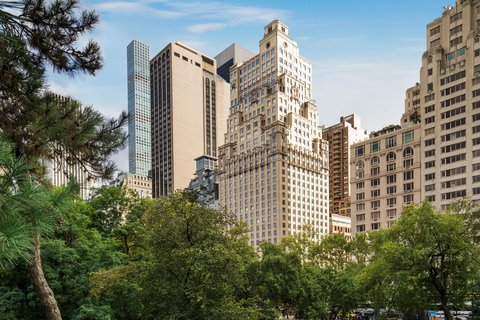
Roughly twenty minutes after sunset is the second window and in this specific location it is the best frame the site offers: from inside the park looking south, the buildings along Central Park South come up lit while the sky still holds colour, and for about twenty minutes they sit at the same brightness. One exposure holds trees, couple, skyline and sky. It happens once.
Which is why the timing is the governing decision. A ceremony at five in June leaves both windows available; a ceremony at five in December means the second window has already passed.
What follows from it
Once the park slot is fixed, the rest of the schedule arranges itself around it and the hotel becomes the filler rather than the frame.
The interior does not change, so the getting-ready coverage, the first look, the details and the reception can all go anywhere that suits the couple. The guest rooms are the exception: their light is best in the middle of the day and gone by mid-afternoon in winter, which means the getting-ready coverage has its own soft deadline.
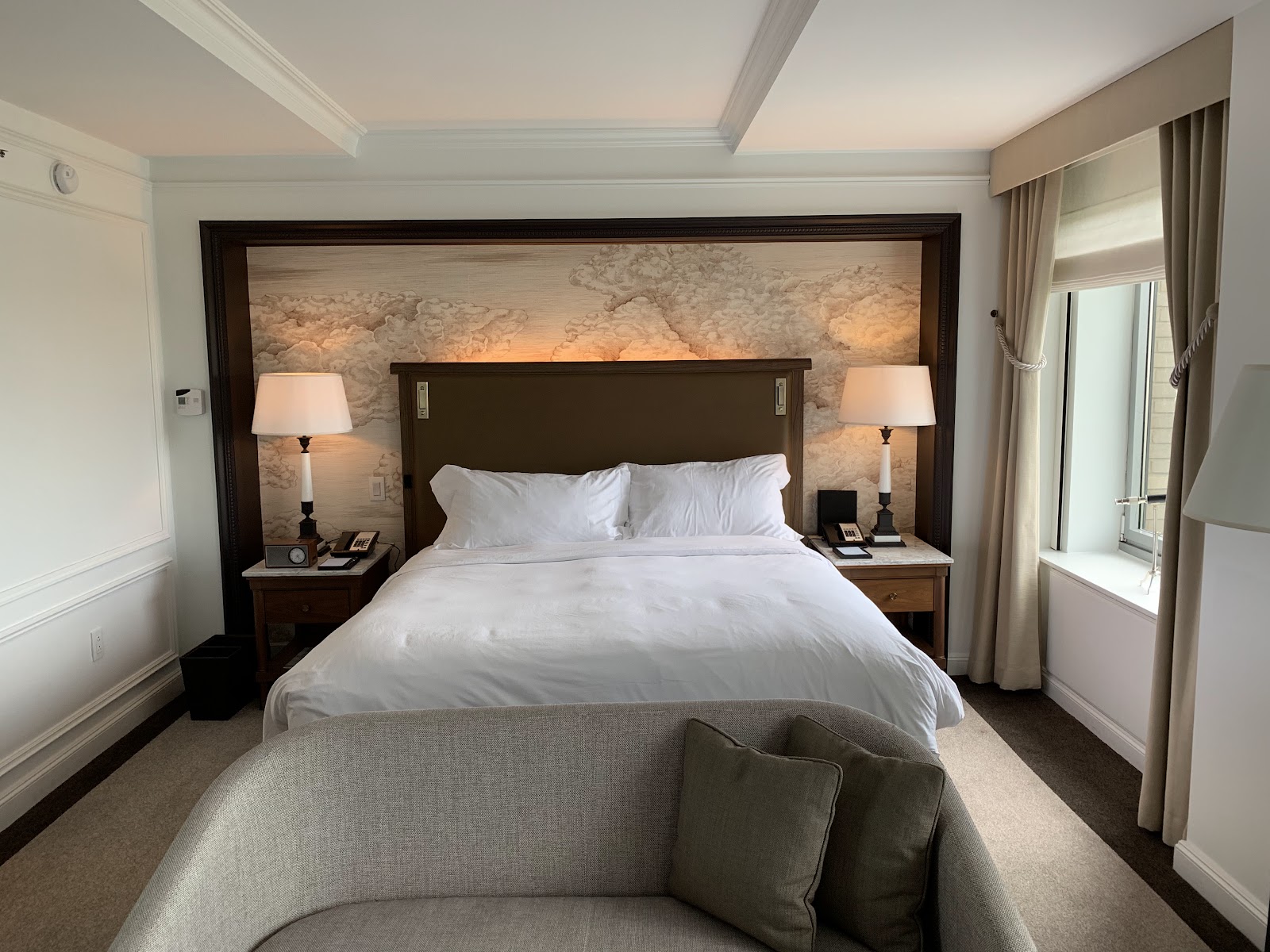
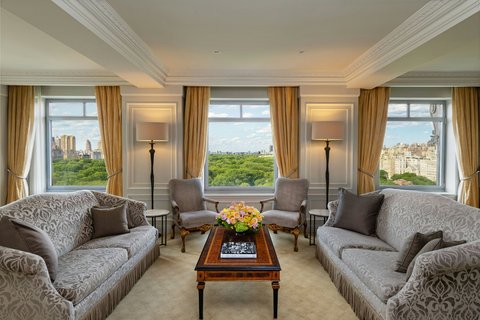
Park-facing rooms are worth asking for specifically, and for a reason beyond the view. A room facing the park has no tall building immediately opposite, which means far more sky reaching its window than a side-street room gets — in Manhattan that is unusual and it is worth more than a stop of light, with softer and more even quality as well. The best daylight portrait in this hotel is beside a park-facing window with every overhead fitting switched off.
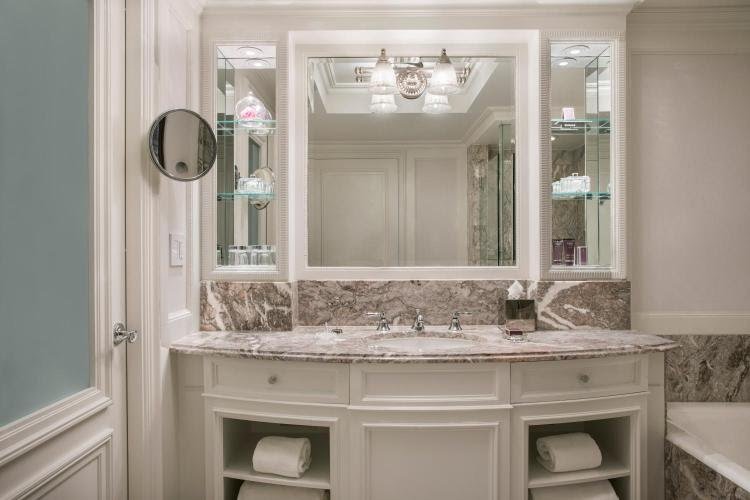
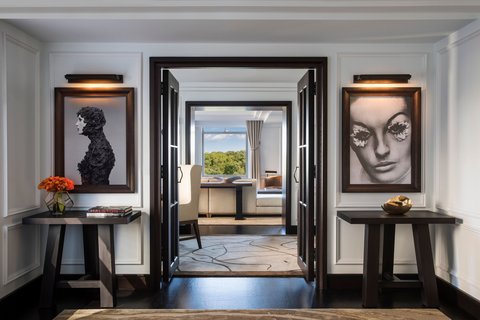
In the function rooms, expect the modern-hotel conditions: pale even surfaces giving no natural separation, mixed colour temperatures from warm decorative and cooler recessed fittings plus any coloured uplighting, and ceilings too high for bounce to return anything useful. The answers are geometric and familiar — distance between subject and background, the darker end of the room rather than the bright end, depth behind rather than a near wall, and one source brighter on the face than the room is on the wall.
Coloured uplighting is worth a specific request: ten minutes off is usually all the portraits need, and it removes a colour cast that cannot be corrected afterwards.
Inside the park there are practical rules that need checking rather than assuming. Central Park is a public park with its own rules about photography groups, equipment and access, and a wedding party of any size is a different proposition from a couple with one camera — the hotel’s events team will know the current position and it should be established in advance rather than negotiated with a park officer on the day.
And distances matter. The park’s southern edge is immediately across the street, which means the good positions within a five-minute walk are the practical set: the pond at the south-east corner, the paths just inside the wall, the open lawns a little further in. Anything deeper is a fifteen-minute walk each way in formal shoes, which costs more of the light than it gains.
- Build the day around the last forty minutes of daylight in the park
- Avoid sunny midday under canopy; dappling cannot be fixed
- Overcast midday is a good park slot, not a compromise
- Ask for a park-facing room: more sky, softer light, more of it
- Confirm the park’s current rules for a wedding group in advance
The park through the year, and the street
A deciduous park is four different venues across the year and the differences are larger than the hotel’s are.
Spring, from the middle of April into May, gives new foliage — thin, bright, translucent and the best green of the year — plus flowering trees. The canopy is not yet dense, so more light reaches the ground and the dappling problem is milder than in summer.
Summer gives the densest canopy, which means the deepest shade and the strongest dappling, and also the most reliable open-shade positions. It is hot and humid with afternoon thunderstorms a real possibility, so the park slot needs an indoor alternative named rather than assumed.
Autumn is the season this location was made for. Peak colour in the park usually falls in the second half of October into early November, the air is at its clearest, and low sun through turning foliage is the single best light the site gives. It is also the shortest window — a week or two either side of peak — and it is worth asking the hotel what their recent years looked like.
Winter strips the canopy entirely, which changes the park from green to graphic: bare branches, open sightlines, the skyline visible through the trees rather than hidden behind them. That is a genuinely good picture and a different one, and it is the season in which the park and the city appear in the same frame most easily. Sunset in the middle of the afternoon in December compresses everything, so the park slot may precede the ceremony.
Snow is the strongest version of the site. It is the best natural fill there is, lifting exactly the shadows a low sun carves while fooling a meter by about two stops, and a snow-covered park with a lit skyline behind it at dusk is the frame this location exists to give. Indoors it turns the street into a large reflector, so the park-facing windows are at their best in February.
At street level Central Park South offers what the rest of Manhattan does not: room to stand back on the park side, which means the hotel facade can actually be photographed. That is rare enough in this city to be worth using. Most street light here is bounced down from lit facades above rather than direct — soft, directional, good, and not golden-hour light.
And the fogging risk applies in both directions, so let a body come towards the temperature of where it is going before it gets there; a lens taken from a warm ballroom into the February park fogs, and it does not clear inside the twenty minutes the dusk frame lasts.
More frames from The Ritz-Carlton Central Park
The Ritz-Carlton Central Park wedding photography: common questions
What is the one governing decision?
When the wedding party goes into the park. The interior does not change through the day and the park changes completely.
What is the target slot?
The last forty minutes before sunset, with roughly twenty minutes after sunset for the frame that holds trees, couple, skyline and sky together.
Why avoid sunny midday in the park?
Dappling. Overhead light through a canopy puts bright patches and deep shade on the same face, and the ratio exceeds what any sensor holds.
Is overcast bad for the park?
No — it is better than sunny midday. Cloud turns the sky into one soft source, removes the dappling and saturates the greens.
Which guest room should you ask for?
A park-facing one. With no tall building opposite it gets far more sky than a side-street room, which is unusual in Manhattan and worth more than a stop.
Does the park need permission?
It has its own rules for photography groups and equipment, and a wedding party is a different case from a couple with one camera. Establish the current position through the hotel in advance.
More New York venue guides
We are writing a photographer’s guide to every venue we would happily shoot in New York. Here are three more, plus the full index:
- The St. Regis New York: One Frame, and How It Is Made
- The Whitby, New York: A Walk Through a Midtown Hotel
- The William Vale, New York: How the Light Moves
Planning a wedding at The Ritz-Carlton Central Park?
One decision, and the light follows. Tell us your date and we will set the time.