 The Whitby, New York: A Walk Through a Midtown Hotel
The Crosby Street Hotel, New York: A Walk Through a SoHo Hotel
Strong colour, a dark room and a garden in one building. Each one is a different photographic problem.
A hotel in SoHo with deliberately bold interiors presents an unusual sequence, because its spaces do not share a register the way a grand hotel’s do. A vividly coloured drawing room, a windowless screening room and an outdoor courtyard are three different problems in one building, and the day moves between them.
Read as a walk rather than a list, that becomes manageable: each space asks for one specific thing, and knowing which thing before arriving is most of the work.
Outside, SoHo’s cast-iron streets are the other half of the offer, and they behave differently from the rest of Manhattan in one respect worth knowing in advance.
We have not photographed a wedding at the Crosby Street Hotel; strongly coloured contemporary interiors, screening rooms and enclosed courtyards each behave consistently. Which spaces are included, whether the courtyard is available and whether the lighting is adjustable are questions for their team.
The Crosby Street Hotel at a glance
| Where | Crosby Street, SoHo, New York |
| The sequence | Street and entrance, drawing rooms, screening room, courtyard, guest floors |
| The distinctive problem | Strong colour, which bounces onto skin and cannot be corrected globally |
| The best light | The courtyard by day, the guest floors, and any large window |
| Ask first | Spaces included, courtyard access, lighting control, fixings |
The street, the entrance and the coloured rooms
SoHo’s streets are the first space and they differ from the rest of Manhattan in a useful way: the buildings are lower. Five and six storeys of cast iron rather than thirty of steel means more sky reaches the pavement, which makes the light brighter and less directional than it is in Midtown — closer to ordinary open shade than to the deep canyon bounce further uptown.
It also means the low-sun effect is stronger here, because a low sun can actually get over the rooflines. The grid in SoHo is less regular than uptown Manhattan’s roughly twenty-nine-degree rotation, so a short walk with the sun in mind beats a calculation, but the reward is real: late light running down a cast-iron street is one of the best frames the city gives.
Cast iron itself is a raking-light material. The columns, cornices and repeated bays read as architecture only when light runs along them; face-on they flatten into a grey field. The positions worth having are those where the sun skims a facade rather than striking it square.
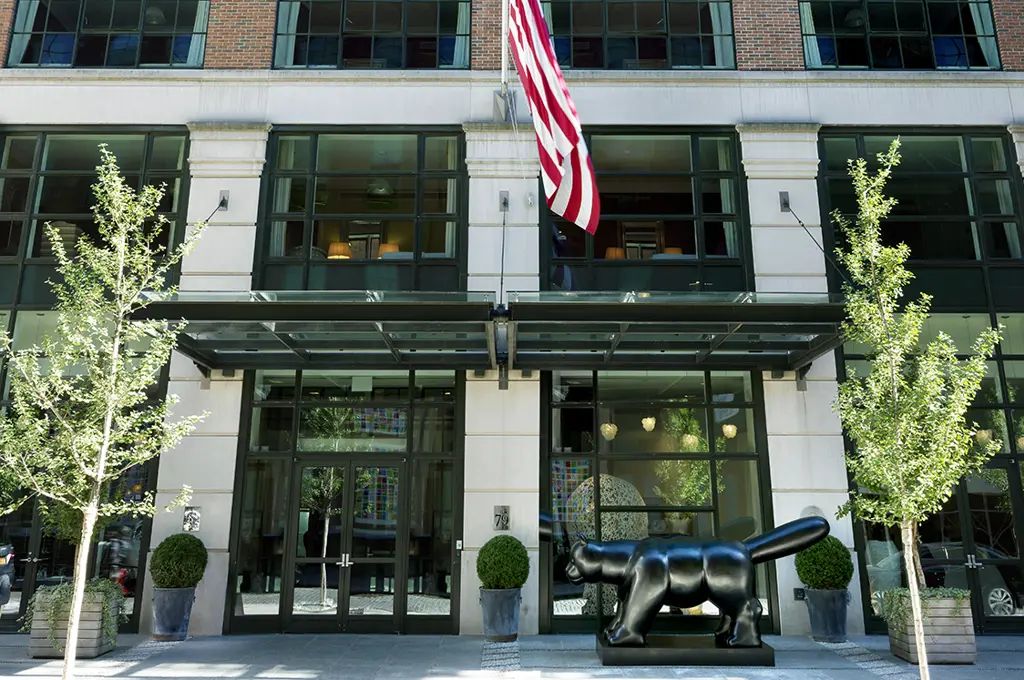
Still, no facade here fits in a frame whole, so the entrance picture is a fragment — the door, the canopy if there is one, the step, looking up. A canopy is a roof with an open face, which makes a directional soft source at the right size for two people and is the one reliably weatherproof position at any hotel.
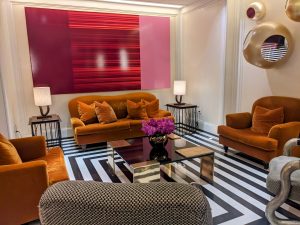
Inside, the coloured rooms are the building’s signature and its main technical problem. Strong colour on walls and furnishings does two things: it competes with anything in front of it, and it bounces its own hue onto skin from whichever direction it sits.
The competition is a compositional decision and it has two valid answers. Commit — place the couple so both they and the colour read, treating the room as a subject. Or subordinate — long lens, wide aperture, so the colour becomes a field behind them. Half-in is the failure, and in a strongly patterned room half-in happens easily.
The cast is a technical decision and it has one answer. A saturated wall throws its colour onto a nearby face, localised, on one side only, and global white balance cannot separate it from the subject. The working method is to let one gelled source own the faces, with white balance set to that source — or, where no flash is being used, to set a custom white balance on a face in the actual position rather than on a grey card in the middle of the room.
And distance helps more than anything: a metre further from a coloured wall roughly halves what it throws.
The screening room, the courtyard and the guest floors
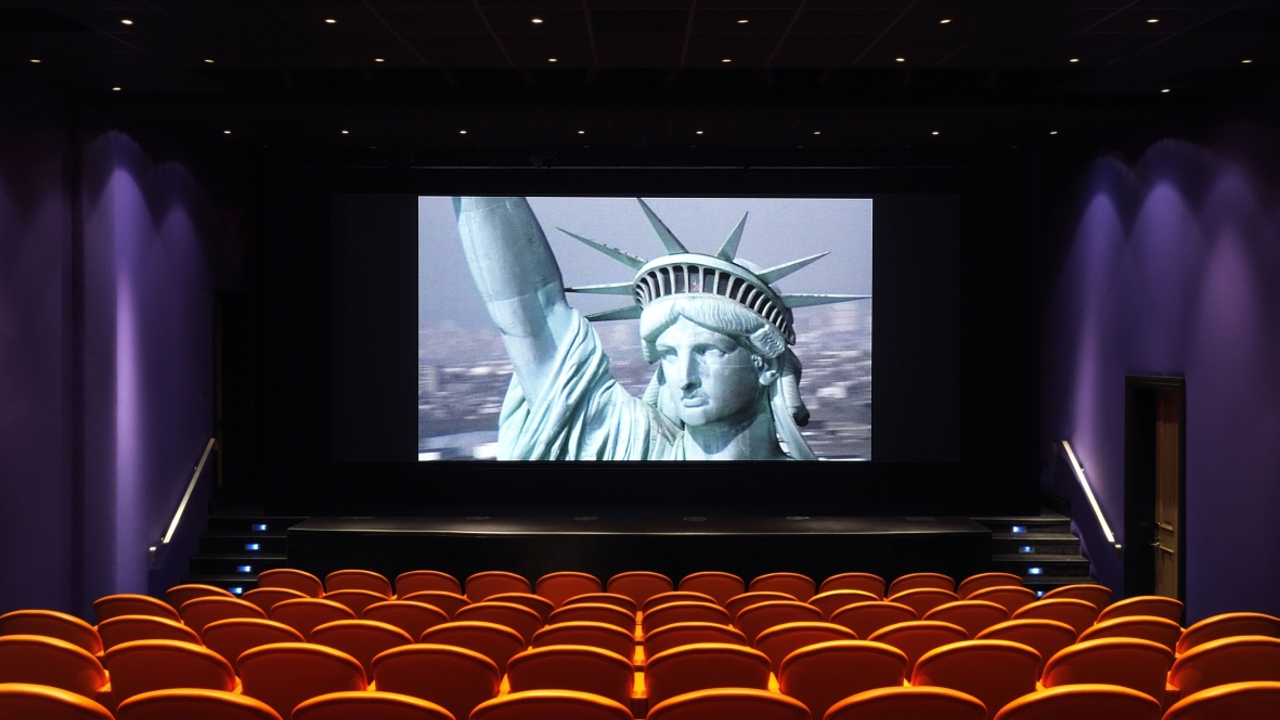
A screening room is the darkest space in any hotel and it is a genuine technical corner. There is no daylight, the walls and seating are dark and absorbent, and the fittings are dim by design — which means the ambient can be three or four stops below a normal interior, and bounce returns essentially nothing.
The compensation is that fall-off is absolute: a subject lit by one source in a dark room sits against pure black with no equipment beyond that source. That is the most dramatic separation available anywhere in a building and it is worth using deliberately rather than treating the room as a problem.
The method is one source, close, in a modifier, off the camera axis, with the exposure set for the face and the room allowed to go dark — which is the opposite of the advice for a warm furnished room, and correct here because a screening room is genuinely dark rather than dimly warm. Where the screen itself is lit, it becomes a large soft source and a couple in front of it is backlit by it, which is a frame worth making once.
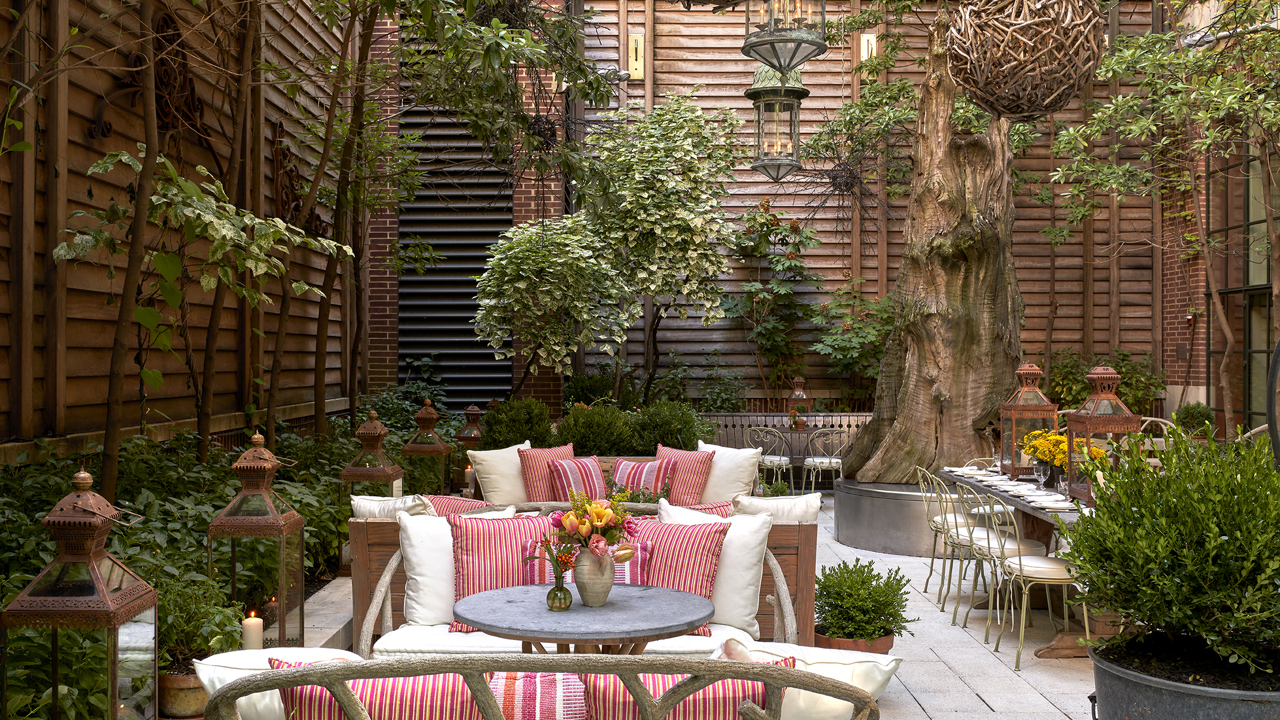
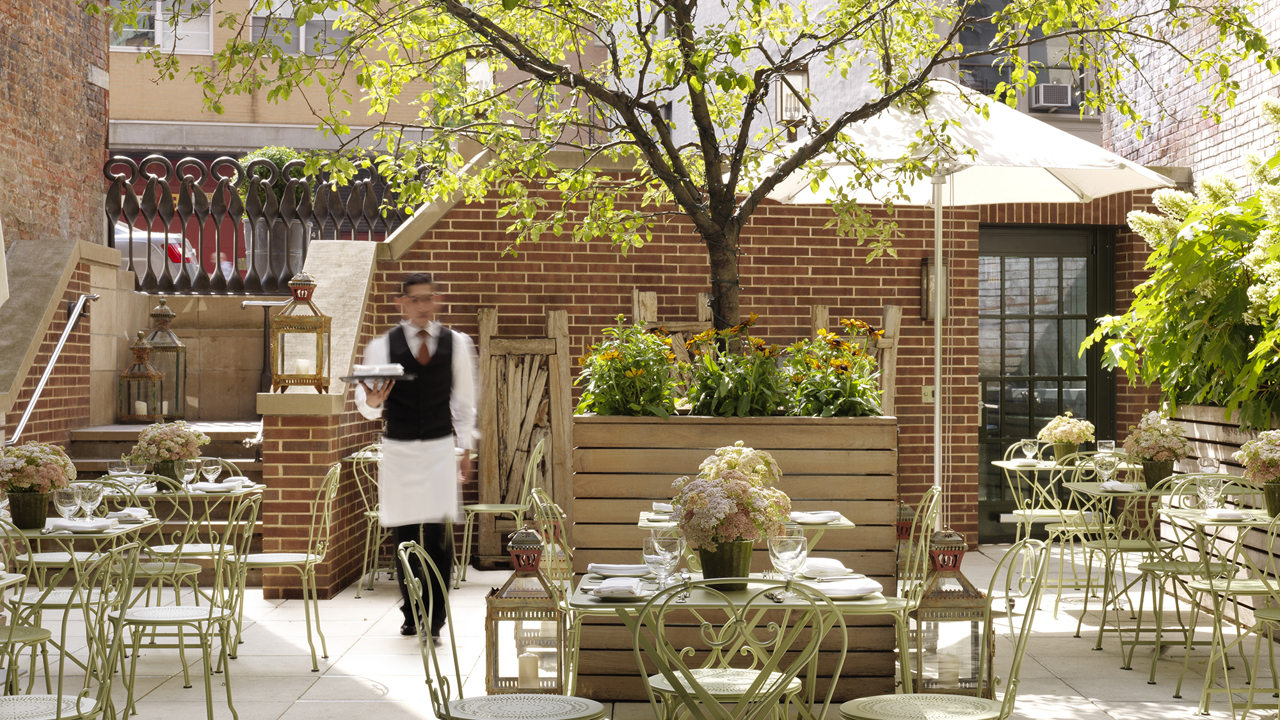
The courtyard is the other extreme and it is the best light in the building by day. An enclosed outdoor space with walls around it is a softbox at architectural scale: sky above for the source, walls around to bounce into the shadows, and no direct sun for most of the day because the surrounding building blocks it. In a city of towers an enclosed courtyard is rare and it should carry the formals.
Two conditions apply. Wall colour transfers — a courtyard with strongly coloured or heavily planted walls throws that hue onto faces, and the fix is the same custom white balance or gelled source as inside. And a courtyard has a light ceiling in the literal sense: when the sun is high enough to come over the parapet directly, the space stops being a softbox and becomes a hard-edged trap, which is a matter of an hour either side rather than the whole day.
After dark a courtyard follows outdoor rules entirely: nothing bounces, ambient is near zero, and the frames are decorative-light-plus-one-source. Roughly twenty minutes after sunset the sky still holds colour at about the brightness of the lit walls, and one exposure holds both — that is the courtyard’s timed frame and it happens once.
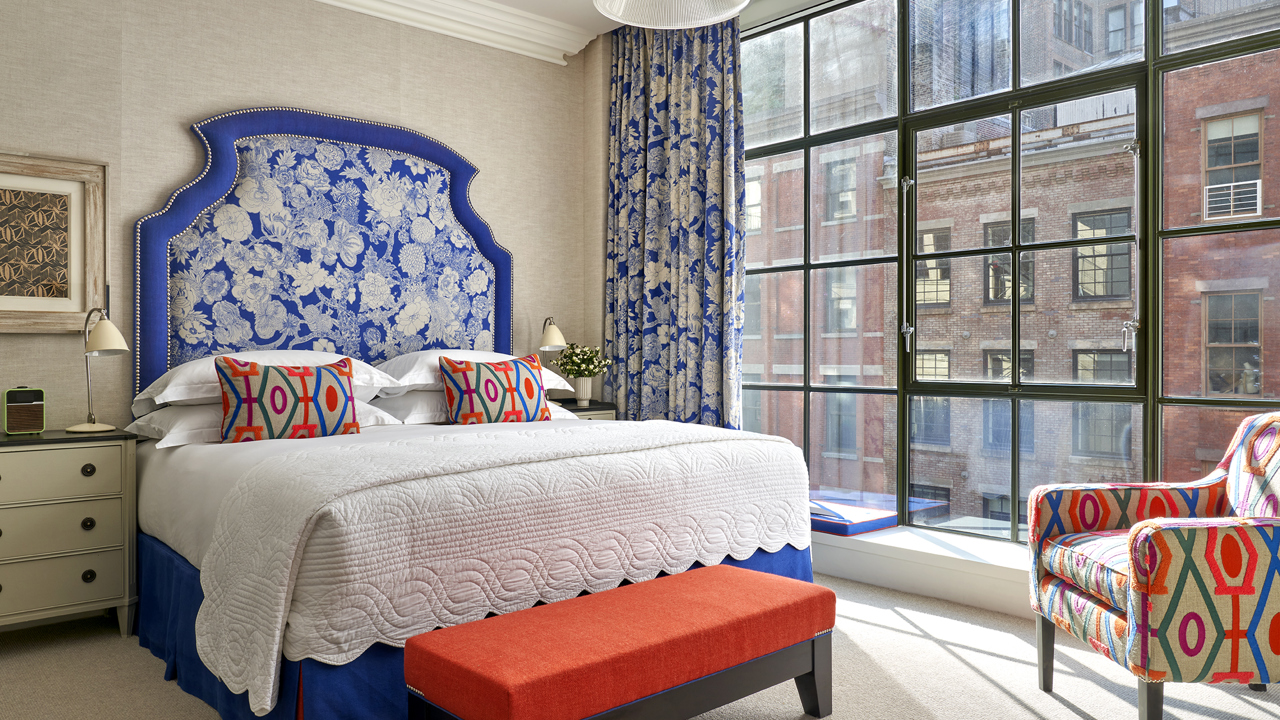
The guest floors are the reliable natural light, as in any hotel: largest window on the shaded side, every overhead fitting off so the room has one colour, lamps out of frame, two to three metres back from the glass. In SoHo the buildings opposite are lower than uptown, which means more sky reaching the window on any floor — one of the few respects in which a downtown hotel beats a Midtown one photographically.
- Rake the cast iron; face-on it flattens to grey
- Commit to strong colour or dissolve it — half-in is the failure
- A metre further from a coloured wall halves what it throws
- In the screening room, expose for the face and let the room go black
- Put the formals in the courtyard, an hour clear of high sun
The running order, and New York's year
The schedule follows from which spaces change. The coloured rooms and the screening room do not change through the day, so they can happen at any hour. The courtyard, the guest floors and the street all do, so they set the running order.
The courtyard is best when the sun is not over the parapet, which in summer means morning and later afternoon rather than the middle of the day. The guest floors are best in the middle of the day and gone by late afternoon in December. And the street is best in the last hour of daylight, when low sun can actually get over SoHo’s low rooflines.
The one non-movable point is the twenty minutes after sunset in the courtyard, if the courtyard is included. It falls well into the reception in a New York summer, which means agreeing it in advance as a short deliberate excursion; in December it falls in the middle of the afternoon and may precede the ceremony entirely.
New York’s seasons are four real ones, and a venue with a courtyard feels them more than a fully indoor one.
Summer is hot and humid with afternoon thunderstorms a real possibility. For the courtyard that is a genuine risk and needs a named indoor alternative — which this building has in abundance, so the cost is a decision rather than a loss. Wet stone in a courtyard also reads better than dry, and wet cast-iron pavement returning reflections of lit shopfronts is one of SoHo’s better frames.
Autumn gives the clearest air and the best raking light of the year on cast iron, plus the most comfortable conditions for a courtyard.
Winter is cold with short days and a courtyard that is usable rather than pleasant; a brief planned excursion works and a leisurely one does not. Sunset in the middle of the afternoon in December compresses everything outdoor into a couple of hours.
Snow is the compensation and it does three things here. Outdoors it is the best natural fill there is, lifting exactly the shadows a low sun carves while fooling a meter by about two stops. In the courtyard it turns the floor into a reflector, so the light arrives from below as well as above and the shadows nearly vanish — which is the softest this space ever is. And indoors it turns the street into a large reflector, so the guest-floor windows are at their best in February.
The fogging risk applies in both directions, so let a body come towards the temperature of where it is going before it gets there — which at a venue with a courtyard used repeatedly through the evening needs more thought than at a fully indoor one. Leaving a body in the courtyard between visits, rather than carrying it in and out, is the practical answer.
More frames from The Crosby Street Hotel
The Crosby Street Hotel wedding photography: common questions
What is the distinctive problem here?
Strong colour. Saturated walls and furnishings compete compositionally and bounce their hue onto skin from one side, which global white balance cannot correct.
How do you handle it?
Commit to the colour or subordinate it with a long lens; and let one gelled source own the faces, or set a custom white balance on a face in the actual position.
Is the screening room usable?
Yes, and it gives the most dramatic separation in the building. One source close and off-axis, exposed for the face, with the room allowed to go black.
Why is the courtyard the best light?
Because an enclosed outdoor space is a softbox at architectural scale — sky above, walls bouncing into the shadows, and the building blocking direct sun for most of the day.
How does SoHo differ from Midtown outside?
The buildings are lower, so more sky reaches the pavement and low sun can actually get over the rooflines. Late light down a cast-iron street is one of the city’s best frames.
What is the one timed frame?
Roughly twenty minutes after sunset in the courtyard, when the sky still holds colour at the brightness of the lit walls and one exposure holds both.
More New York venue guides
We are writing a photographer’s guide to every venue we would happily shoot in New York. Here are three more, plus the full index:
- The Four Seasons New York: What It Suits, and What It Does Not
- The Greenwich Hotel, New York: How the Light Moves
- The Lowell, New York: One Frame, and How It Is Made
Planning a wedding at The Crosby Street Hotel?
Three registers in one building. Tell us your date and we will plan each one.