 The Westin Book Cadillac, Detroit: A Walk Up Through a Restored 1924 Hotel
The Fillmore Detroit: The One Decision That Governs Everything
A grand lobby and a working music hall are two rooms. Only one of them can be photographed properly.
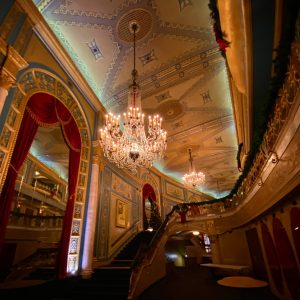
The grand lobby, with its soaring ceilings, ornate chandeliers and intricate mouldings, offers a dramatic first impression, as the venue’s own description has it.
That sentence identifies the room that should lead the day, and the decision is worth making explicitly because the alternative is tempting. A historic theatre working as a music venue has two great spaces: the lobby, which retains its period architecture and — crucially — usually has street-facing glazing, and the hall, which has been blacked out and rigged so that a lit stage reads against it.
The lobby can be photographed properly. The hall gives two or three strong frames and nothing else, because black paint absorbs everything, the volume is beyond any flash, and the rig is coloured and overhead. Deciding in advance that the lobby leads and the hall supplies a small number of deliberate pictures produces a far better gallery than treating them as equals — which is what happens by default, because the hall is where the party is.
This is written around that decision. We have not photographed a wedding at the Fillmore; historic theatres working as music venues behave consistently. What the house lighting can be set to and who operates it, whether the lights can be brought up plain for a few minutes, and whether the stage rig is available are the questions for their team.
The Fillmore Detroit at a glance
| Where | Downtown Detroit, Michigan |
| Character | A historic theatre with a grand lobby, now working as a music venue |
| The decision | Let the lobby lead; the hall gives two or three frames |
| Why | The lobby has period architecture and daylight; the hall absorbs everything |
| Ask first | Lighting control and operator, plain house lights, stage rig |
Why the lobby leads
A theatre lobby of this period was designed to be walked through and looked at before a performance, and that gives it four properties a blacked-out hall does not have.
It has daylight, or at least the possibility of it: theatre fronts of this era were built with tall street-facing glazing to draw people in, and that glazing is frequently the only daylight in the building. A subject two or three metres inside a tall window on the shaded elevation has architectural-scale lighting requiring no permission, no stand and no cable — and in a building whose main hall has no windows at all, that is the difference between a flattering frame and a lit one.
It has ornament, and the ornament is intact. Mouldings, cornices, columns and decorative ceilings are three-dimensional, which means they read as ornament only when light crosses them at an angle and casts a small shadow beside every element. Under a flat overhead wash they flatten into a dark field — so one source placed to one side, close to parallel with a surface, brings all of it back. It is a one-light problem, not a big-kit one.
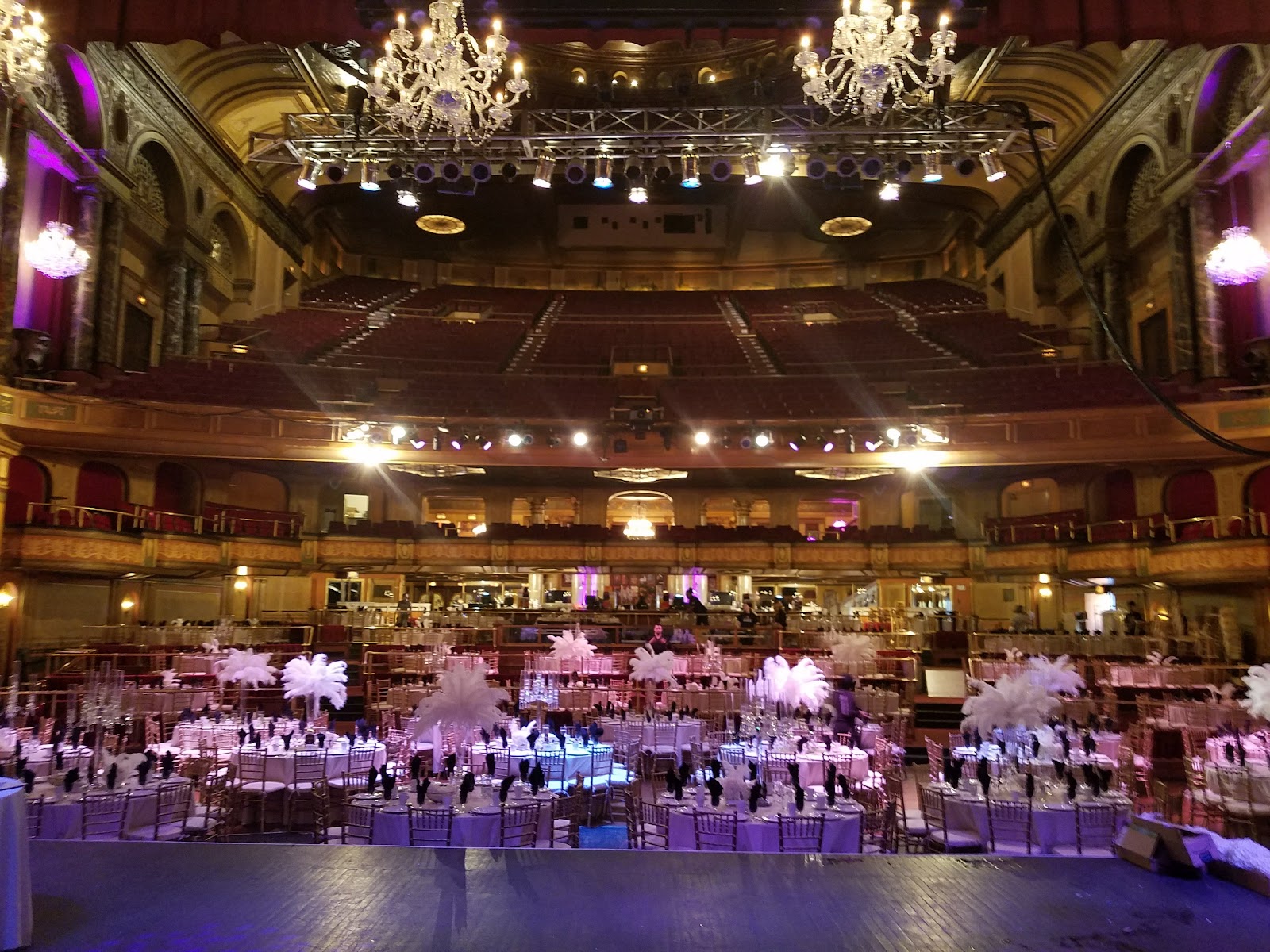
It has chandeliers, and those are more useful as subject and background than as light. A chandelier is a cluster of small bright points hung high in a volume: the light reaching a face arrives almost vertically, the level at floor height is far lower than the fitting’s apparent brightness suggests, and the fittings themselves are the brightest things in frame. At a wide aperture behind a subject they become warm points of light, which is the most attractive thing this kind of lobby does — and a bright one beside a head pulls the eye off the face every time.
And it usually has a stair, which solves the group problem that theatres otherwise handle badly. Steps make rows automatically, so thirty people arrange themselves with everybody visible where no aisle or flat floor will — and the frame from the top looking down, with the couple small inside the sweep, is the one most often missed because it requires climbing.
Soaring ceilings mean bounce returns nothing, so test it once and plan for a pale wall or direct modified light — with the steep fall-off in a tall dim volume used as free separation rather than filled in.
The most valuable single request in the building is whether the lobby lights can be brought up plain — white, undimmed, no colour — for a few minutes before guests arrive. That is the only chance to photograph the room as a room rather than as a dim atmospheric volume, and it costs a conversation rather than equipment.
What the hall gives, in two or three frames
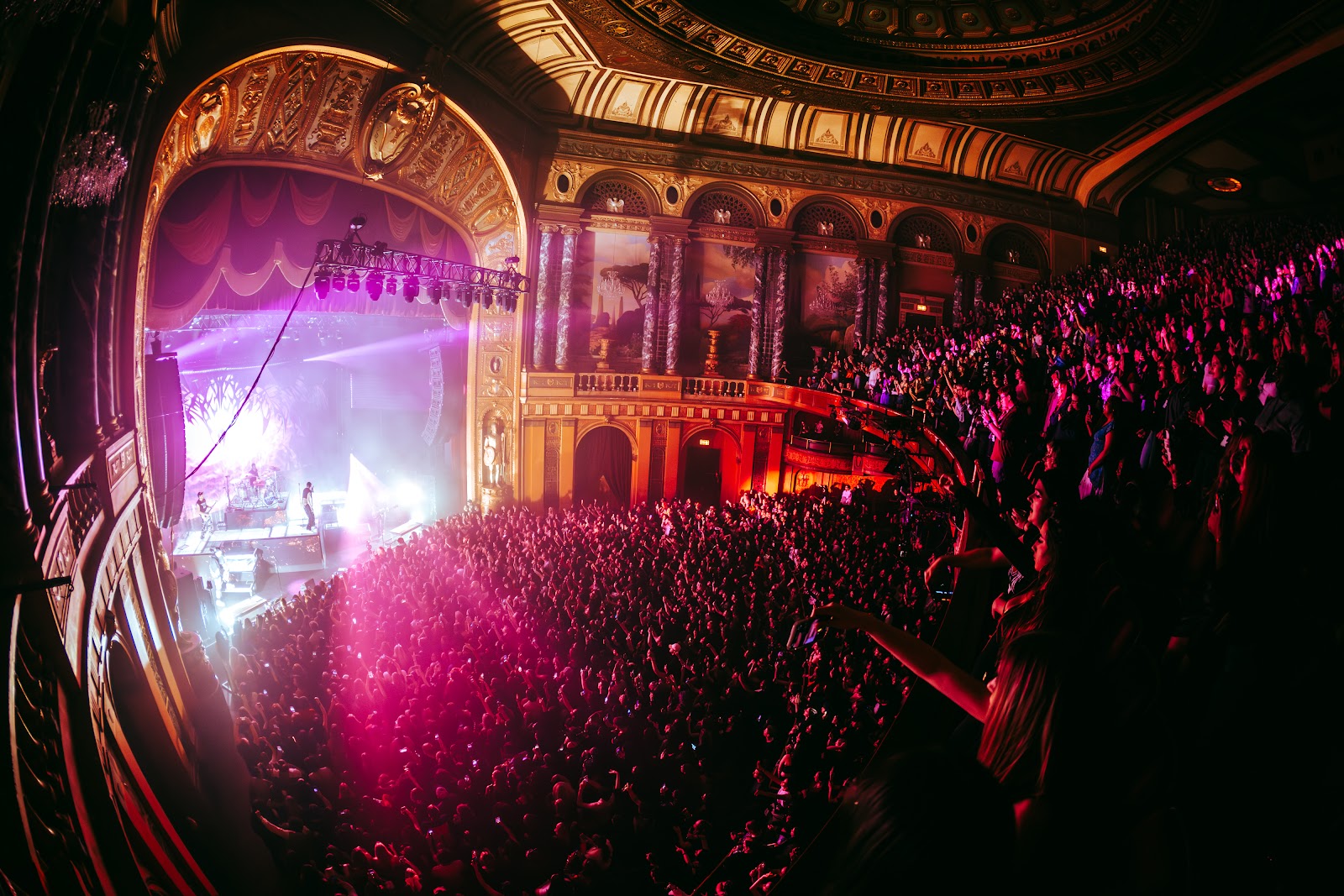
The hall is not unusable; it gives a small number of very strong frames. Knowing which in advance is what makes twenty minutes there worthwhile rather than wasted.
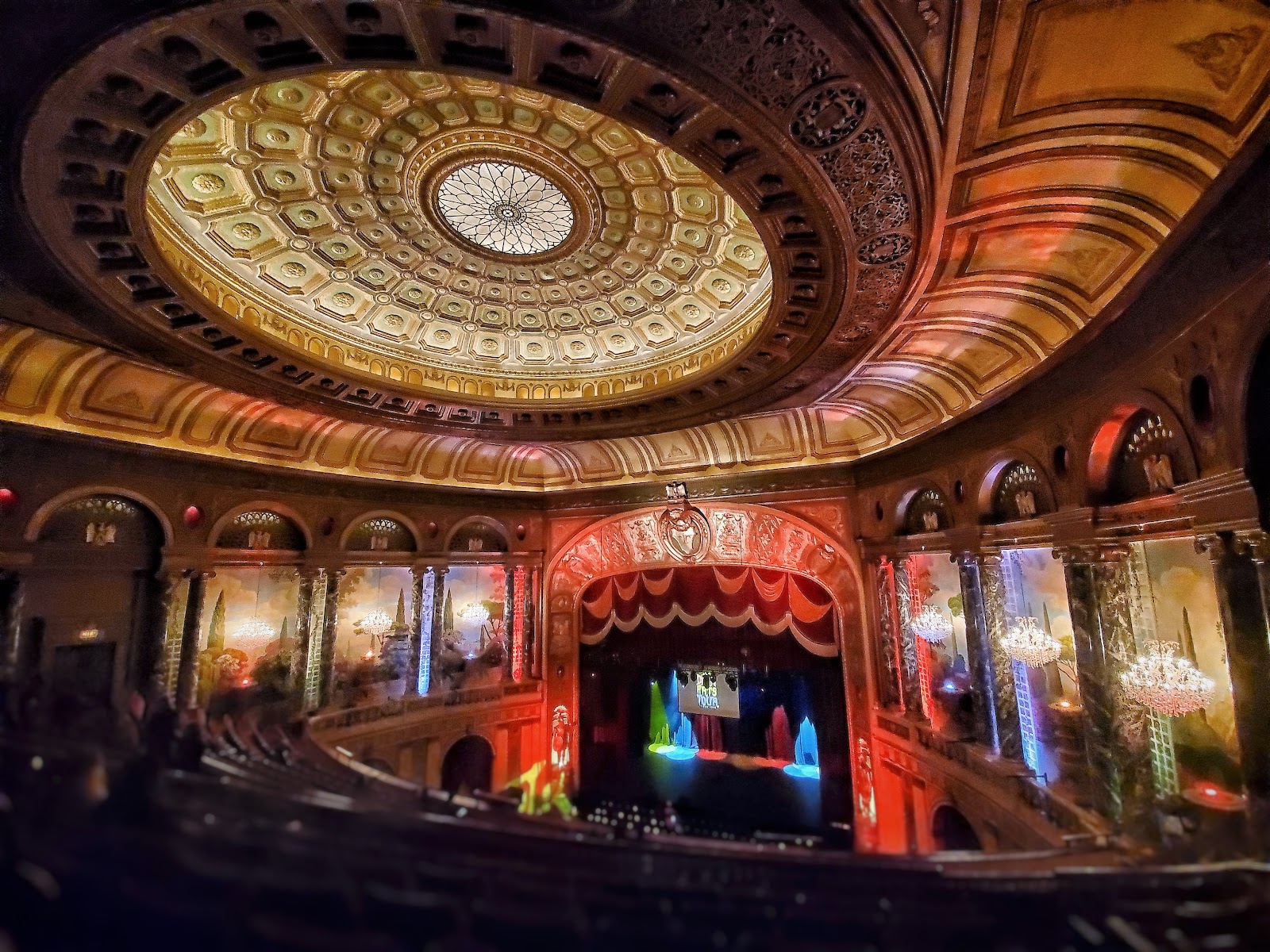
The first is the long view down the room, or from the stage towards it. A former theatre’s floor and balcony receding into darkness is pure repetition and reads immediately as what it is — and because the geometry is symmetrical, it rewards precision: off the centre line or a degree out of level and the convergence goes crooked.
The second is a couple in a single pool of light on an otherwise dark stage, in front of an empty room — one of the strongest frames any venue type produces, needing a board operator rather than equipment, which is why the stage rig belongs in the contract rather than a conversation on the night.
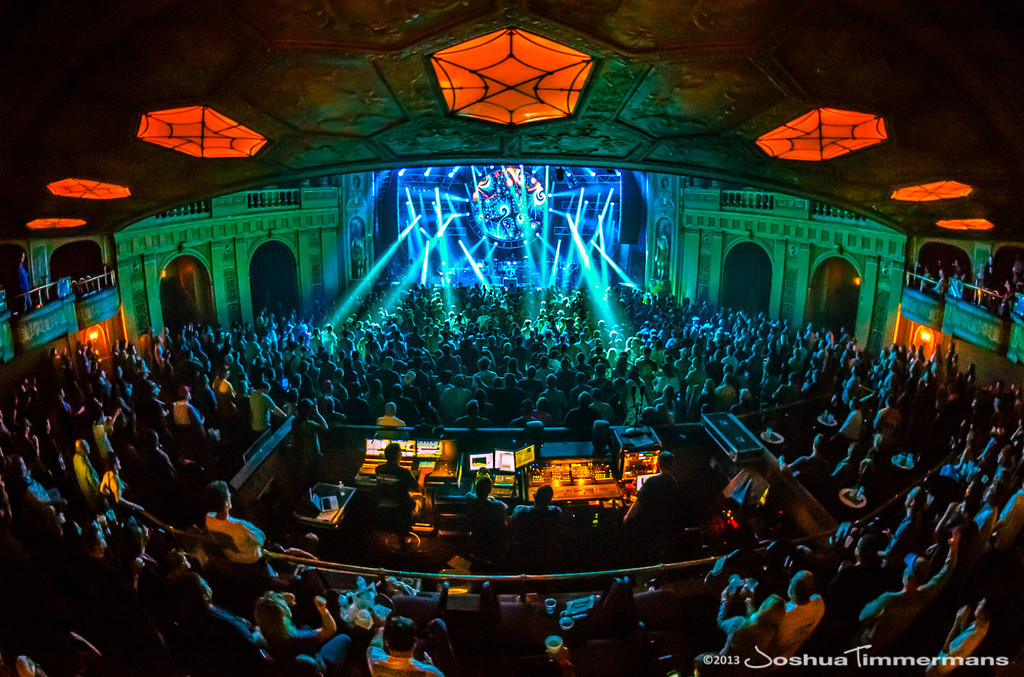
Coloured washes are a separate matter and need treating as an effect. A saturated wash renders skin unrecoverably in its own colour, and a face lit by two coloured sources has two casts at once with no single correction — so commit to shape and silhouette deliberately, or add a neutral source on the faces and let the wash light the set behind.
The third is a balcony, where one survives and is accessible: from its front the camera is above the floor, the whole volume reads, and the proscenium sits at eye level rather than above it. Two minutes of walking, and it is the frame that shows what the building was.
Beyond those, the hall resists for reasons worth naming once. Black paint absorbs rather than returns light, so the ambient is far below what the rig suggests and bounce returns nothing at all. The volume is beyond the reach of any flash, so every source is direct and the distances have to be assumed in each power decision. And the rig is coloured, moving and overhead, which changes brightness and hue between consecutive frames — so where a program cycles, wait for the phase you want rather than shooting through it.
For anything that must be legible, one gelled source at face height, off the camera axis, set bright enough to dominate what the rig puts on skin, with white balance set to the gel: the room stays as coloured as it is and the faces stay consistent. And the aim is to dominate the skin rather than the room, because overpowering everything gives a brightly lit couple against a black void.
The compensation is absolute separation: a couple lit three metres in front of anything in a black room reads against nothing at all, which is free and dramatic.
- Let the lobby lead; its street glazing is the only daylight in the building
- Ask for the lobby lights up plain for five minutes before guests arrive
- Graze the ornament from one side, or it photographs as a dark field
- Put the group on the lobby stair, and take the frame from the top
- In the hall, one gelled source dominating skin — not the room
The marquee, the street, and Detroit's year
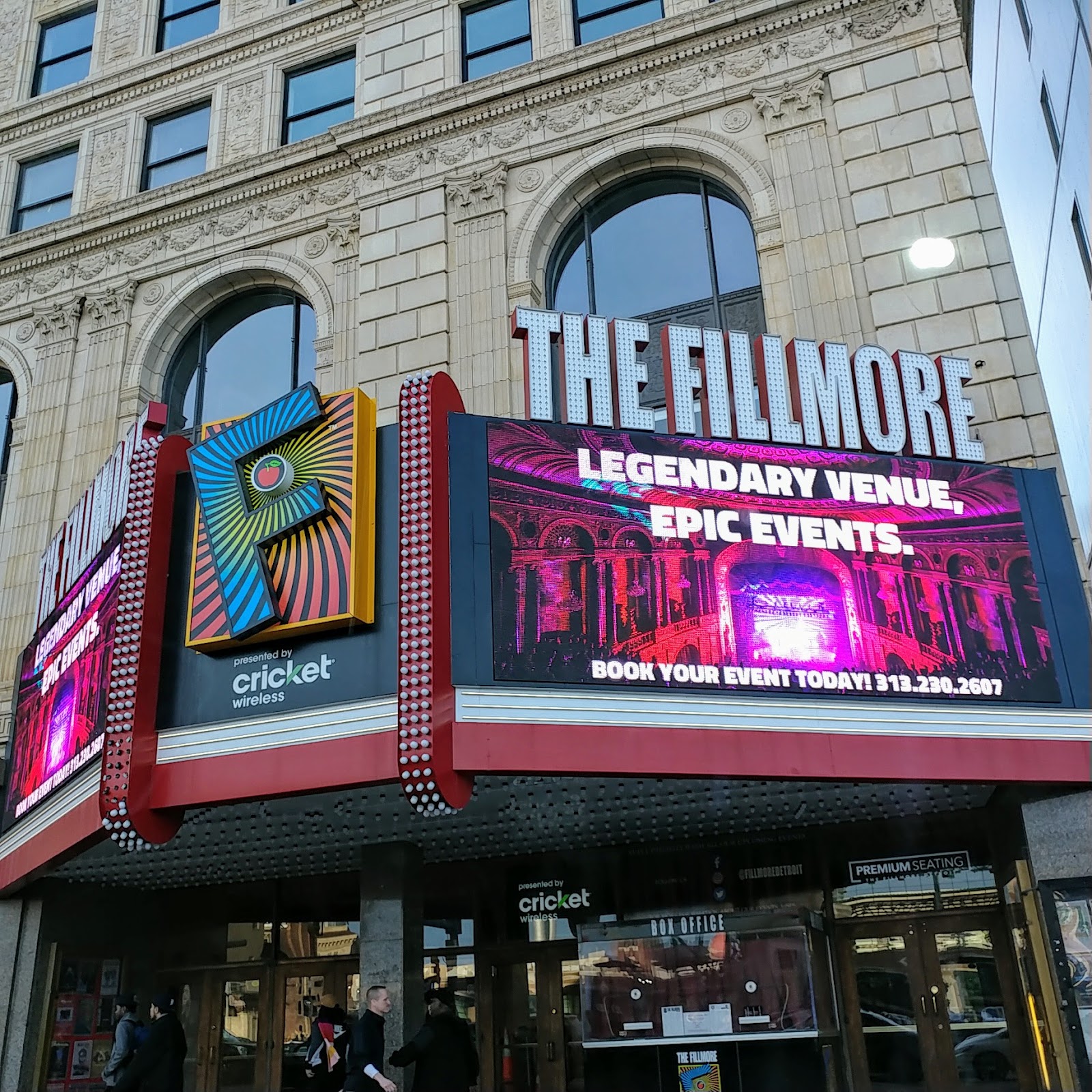
A theatre of this era has one exterior frame nothing else offers and it is time-critical: a lit marquee against a sky that still holds colour exists only in the twenty to thirty minutes after sunset, because before that the sign is invisible against a bright sky and after it the sky is black and the frame becomes a sign floating in nothing. Take the sunset time, add fifteen minutes, be in the street with the couple already there, and bracket as the sky falls.
It also needs confirming that the marquee will be lit, which outside performance hours is a request rather than a given — and it is the single question that determines whether the frame exists at all.
Detroit gives that frame an advantage almost no other American city does: there is room to stand back. Substantial open ground and surface parking mean a whole theatre facade and its marquee can be photographed entire rather than in fragments, which for an ornate 1920s building is exactly what it was designed for. In a denser city the same frame is impossible.
That openness also means low sun reaches street level across a wider area than in a canyon city, so the last ninety minutes give raking light on masonry from more positions. Stone, brick and terracotta show their texture only when light runs along them, so a short walk to find which side is being raked is worth more than any accessory. And Detroit’s radiating boulevards mean some streets run diagonally and take low sun at angles the grid streets do not.
Michigan’s seasons are four real ones. Summer is warm and humid with afternoon thunderstorms a real possibility, which for a sealed theatre is entirely irrelevant indoors — the only casualty is the marquee frame, which needs a sky, so on an unsettled evening it is worth taking early and taking twice.
Autumn gives the clearest air and the best raking light of the year on masonry, which is the season the facade is at its best in.
Winter is cold and snowy with short days, sunset falling in the middle of the afternoon in December, which moves the marquee window early — possibly before the ceremony rather than after it. Snow is the compensation and it is the best natural fill there is, lifting exactly the shadows a low sun carves while fooling a meter by about two stops — and snow falling through the light of a lit marquee is one of the best frames a theatre can give.
Indoors, snow turns the street into a very large reflector, so the lobby’s tall glazing gives softer, brighter and more even light in February than at any other time of year, which makes the room that leads the day easier in winter than in summer.
And the fogging risk is severe in both directions: a camera taken from a heated lobby into subzero air and brought back will fog comprehensively and can take a long time to clear, which in a twenty-minute marquee window is a real risk. Get a body to ambient before it rather than carrying it out cold.
More frames from The Fillmore Detroit
The Fillmore Detroit wedding photography: common questions
Why should the lobby lead?
Because it has period architecture, intact ornament, a stair, and — most importantly — street-facing glazing, which is frequently the only daylight in a building whose hall has been blacked out.
What does the hall actually give?
Two or three strong frames: the long view down the room, a couple in a pool of stage light before an empty hall, and a balcony vantage. Nothing else.
What is the most valuable request?
That the lobby lights be brought up plain — white, undimmed, no colour — for a few minutes before guests arrive. It is the only chance to photograph the room as a room.
How should chandeliers be used?
As background and subject rather than as light. At a wide aperture they become warm points behind a couple; as a source they arrive almost vertically and give less level than they appear to.
How do you work under a coloured rig?
One gelled source dominating what the rig puts on skin, with white balance set to it — so the room stays coloured and the faces stay consistent. Dominate the skin, not the room.
Why is the lobby easier in February?
Because snow turns the street into a very large reflector, so the tall glazing gives softer, brighter and more even light than at any other time of year.
More Detroit, MI venue guides
We are writing a photographer’s guide to every venue we would happily shoot in Detroit, MI. Here are three more, plus the full index:
- The Foundation Hotel, Detroit: Field Notes on a Civic Conversion
- The Fox Theatre, Detroit: One Frame and How It Is Made
- The Gem Theatre, Detroit: The One Decision That Governs Everything
All Detroit, MI Wedding Venues →
Planning a wedding at The Fillmore Detroit?
Let the lobby lead, and ask for five minutes of plain light. Tell us your date.