 The Sheraton Portsmouth: What a Conventional Hotel Actually Buys You
Portsmouth Harbor Events: What a Very Bright Room Actually Gives
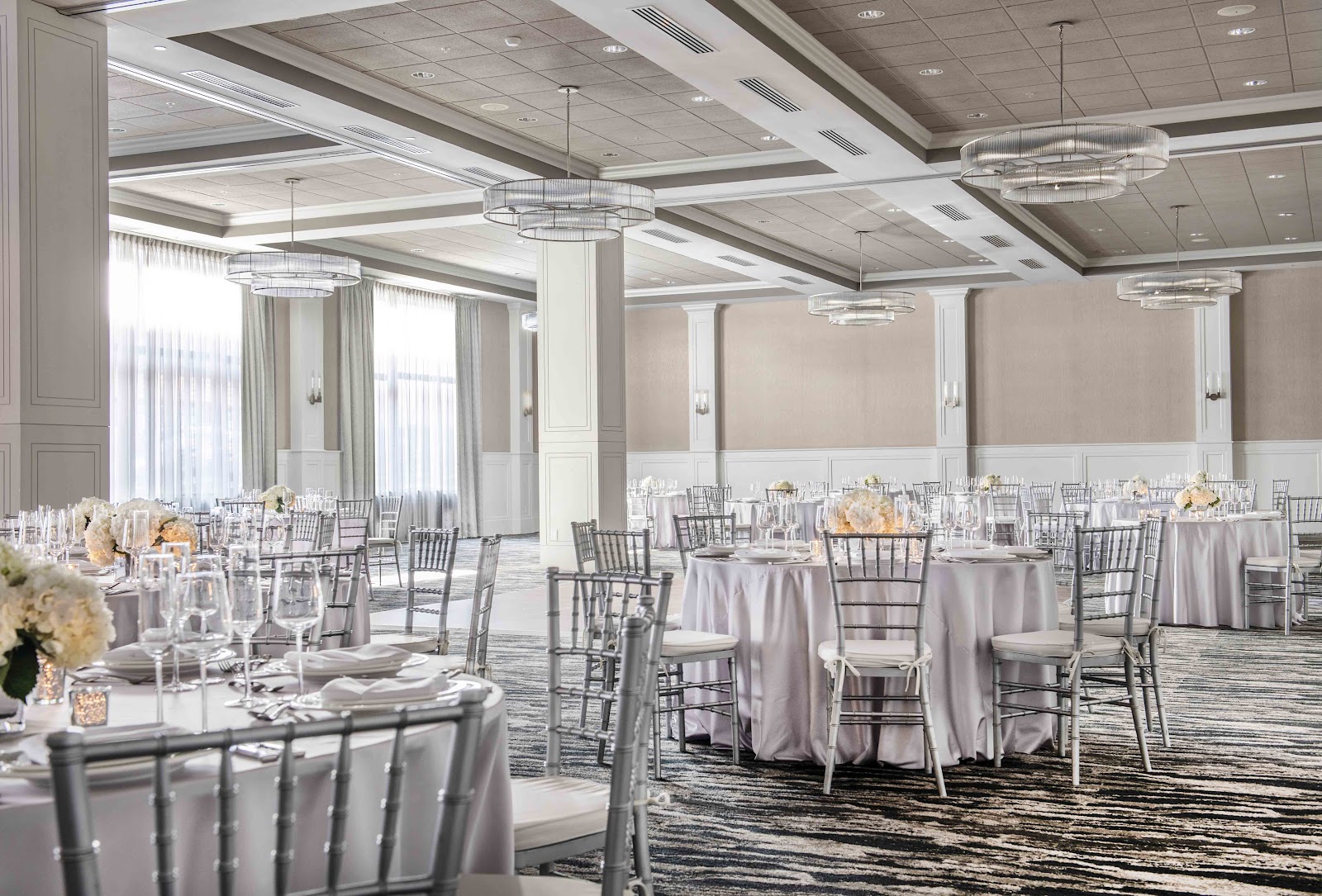
A room with this much glass is the easiest venue in daylight and one of the hardest after dark.
Portsmouth Harbor Events occupies a waterfront position in Portsmouth, New Hampshire, with extensive glazing and event space looking out across the harbour and the Piscataqua River.
A heavily glazed waterfront room is a specific venue type with a very particular profile: exceptionally good in daylight and unexpectedly demanding once the daylight goes. In daylight the glass delivers abundant soft directional light from a large area of sky and water, and the water bounces a second source upward — which means faces are lit from front and below and almost nothing needs to be carried. After dark, every one of those windows becomes a mirror showing the lit room and everything in it, including your lights.
This is an honest account of who that suits and who it works against. We have not photographed a wedding here; heavily glazed waterfront rooms behave the same wherever they are built. Which spaces are available, which way the glazing faces and what the outdoor access allows are questions for their events team — and orientation is the useful one.
Portsmouth Harbor Events at a glance
| Where | Waterfront, Portsmouth, New Hampshire |
| Character | Event space with extensive glazing over the harbour and river |
| In daylight | Abundant soft light, plus a second source bouncing off the water |
| After dark | Every window is a mirror showing the room and your lights |
| Ask first | Which way the glazing faces, and the tide on the date |
Why a glazed waterfront room is such good daylight
Two things combine. A large glazed area facing open water collects a very large area of sky with nothing obstructing it — no buildings opposite shadowing the light or bouncing colour into it — which makes the light cleaner and more directional than an equivalent window in a built-up street. And the water surface itself reflects light upward, so a second, softer source arrives from below.
Front-and-below is an unusually flattering combination. The main light from the glazing models the face; the upward bounce from the water fills the eye sockets and the shadow under the chin, which is exactly what a high source would otherwise carve. Photographers pay for that combination with a reflector; here the harbour does it for free.
The practical instruction is simply to use it: place people facing the glass, a metre or two back, and let the room behind them fall away. The fall-off gives separation without equipment, and the light is consistent enough that groups can be arranged for composition rather than for light.
Orientation decides how long it lasts. Glazing facing away from the sun gives that soft condition all day. Glazing facing into the sun gives a hard bright patch, extreme contrast and, if the frames are close together, hard shadow bars across faces — which is the same problem a gridded façade creates and cannot be corrected afterwards. Asking which way the glass faces is a one-line question that changes the whole plan.
Who this venue suits
The profile fits a clear set of briefs:
- Daytime and early-evening weddings, which get the venue at its considerable best
- Couples wanting a light, bright, airy gallery without a dark interior in it
- Anyone who wants the water and boats visible in the frame rather than a walk away
- Briefs needing weather independence — the view survives rain, unlike an outdoor site
- Photographers happy to work almost entirely on available light through the day
Who should look elsewhere
And some intentions run into the room’s limits:
- Late, dark, atmospheric receptions, where the glass turns into a wall of mirrors
- Couples drawn to period texture and architectural character, which a glazed room lacks
- Anyone wanting deep shadow and moody contrast; the room is emphatically high-key
- Briefs where the venue must be recognisable, since a glazed event room could be anywhere
- Low-tide dates, if the water is the point — the harbour looks very different then
The water as a light source, not just a view
The harbour is doing more than sitting in the background, and it is worth being explicit about the mechanism. A water surface reflects light upward, so a room facing open water receives a second source from below — weaker than the sky but arriving from exactly the direction nothing else does. That is why faces in a waterfront room look better than the same faces in a room with a wall outside the window.
Upward fill matters because every other source in a photographer’s life comes from above. Sky, ceiling fixtures, a softbox on a stand: all of them shadow the eye sockets and mark the line under the nose and chin. Light arriving from below fills exactly those shadows, which is precisely what a reflector held low is for. At this venue the harbour does it for free, continuously, for as long as there is daylight.
Its strength varies with two things worth knowing. A calm surface reflects more coherently than a choppy one, so a still morning gives a stronger and cleaner upward fill than a windy afternoon. And the tide changes the geometry: at high water the reflecting surface is closer and larger relative to the window, so the effect is stronger than at low water when mud replaces much of it. Mud reflects very little, and it is a dull brown rather than a sky tone.
The practical use is simply to place people facing the water rather than facing into the room. Facing out, they get the glazing as a key and the harbour as a fill, which is a two-source setup arriving at no cost. Facing in, they get the key on the back of the head and the room’s own lighting on the face, which is the worst available arrangement and the one people default to because it feels more natural to look at the camera.
After dark, the tide, and the window that matters
Once the sun is down, a heavily glazed room becomes the hardest version of itself. Every pane shows the lit interior, so the view disappears and is replaced by a reflection of the room, the guests and your lighting. Wide frames that were beautiful at six are cluttered at nine.
Three controls. Keep your lights well off the camera axis and, where possible, behind the plane of the subject, so the reflected cone misses the lens. Shoot obliquely to the glass rather than square on. And frame tighter, using the room’s interior rather than its view, because the view is no longer there.
Used deliberately, the reflection is a genuine asset — a couple and their reflection in a dark window with harbour lights beyond is a frame that only a glazed waterfront room produces. But it has to be composed rather than tolerated.
The window that matters is the convergence at dusk. For roughly twenty minutes, the brightness of the sky outside drops to about the level of the room’s interior lighting, and for that period a single exposure holds the lit room, the couple and the harbour with colour still in the sky. That is the frame the venue exists to give, it is dictated by sunset rather than by the running order, and it is unavailable ten minutes late. Take the clock time from sunset on the date and treat it as an appointment.
The tide is the other variable and it is easy to overlook. The Piscataqua has a substantial range, so high water gives a full harbour with floating boats and reflections while low water gives exposed mud, weedy pilings and hulls on the bottom. Both are usable; only one is what most couples picture. Tide times are published and checking them takes two minutes.
Outside, downtown Portsmouth is close by — narrow brick and clapboard streets that behave like soft boxes, low-rise enough that evening sun reaches street level. That is the counterweight a glazed room needs, because a gallery made entirely of bright interiors lacks texture and shadow, and the old town supplies both.
Portsmouth Harbor Events wedding photography: common questions
Why is the daylight here so good?
Because glazing facing open water collects a large unobstructed area of sky with no buildings shadowing it, and the water reflects a second softer source upward. Front-and-below is unusually flattering — the harbour does what a reflector would otherwise do.
What should be asked about the glazing?
Which way it faces. Away from the sun it gives soft light all day; into the sun it gives a hard bright patch, extreme contrast and hard shadow bars from the frames — which cannot be corrected afterwards.
What happens after dark?
Every pane becomes a mirror showing the lit room, the guests and your lights, so the view disappears. Keep lights off the camera axis and ideally behind the subject, shoot obliquely to the glass, and frame tighter using the interior rather than the view.
Is there one frame to plan the evening around?
Yes — the dusk convergence, roughly twenty minutes when the sky outside drops to the brightness of the room’s lighting, so one exposure holds the lit room, the couple and the harbour with colour still in it. Take the time from sunset and treat it as fixed.
Does the tide matter?
More than people expect. The Piscataqua has a substantial range, so high water gives a full harbour with floating boats and reflections while low water gives mud, weedy pilings and hulls on the bottom. Tide times are published; checking takes two minutes.
What does the gallery need that this room cannot give?
Texture and shadow. A set made entirely of bright glazed interiors is uniformly high-key, so a block in the old town — narrow brick and clapboard streets, low-rise enough for street-level evening sun — is the counterweight.
More New Hampshire venue guides
We are writing a photographer’s guide to every venue we would happily shoot in New Hampshire. Here are three more, plus the full index:
- AMC Pinkham Notch, New Hampshire: The Problem and Four Ways Out of It
- Bedford Village Inn, Bedford: A Walk Through the Site
- Capitol Center for the Arts, Concord: One Frame and How It Is Made
Planning a wedding at Portsmouth Harbor Events?
Easiest venue there is in daylight, hardest after dark. Tell us your date and we will time the twenty minutes between.