 Venue at Willow Creek, Huntsville: The Problem, and Four Ways Out
Venue at High Falls, Guntersville: One Frame, and How It Is Made
The frame is the water. Whether there is any is a question about last week’s rain.
There is one frame this kind of site exists to give and it is worth building properly, because almost every decision in it is a deliberate one rather than an automatic one.
A couple stands below or beside falling water, with the fall behind them, the wet rock around it and the pool beneath. It is a frame about motion — the one subject in this guide that changes depending on the shutter speed rather than the aperture — and it is also the most conditional frame here, because a southern waterfall depends entirely on recent rain.
That is the first thing to establish and it cannot be assumed. Waterfalls in the Alabama hill country are fed by rainfall rather than by snowmelt or a glacier, which means they run hard after a wet spell and reduce to a trickle after a dry one. A fall that is spectacular in March may be a damp rock face in September.
Asking the venue what the water is actually doing in the week before the date is the single most useful piece of preparation available, and it decides whether the frame described here is available at all.
The second decision is what the water should look like, and it is a genuine aesthetic choice rather than a technical default. A fast shutter freezes the fall into individual droplets and threads, which reads as energy and detail. A slow shutter blurs it into a smooth continuous veil, which reads as calm and is the familiar look. Neither is correct and they are completely different pictures.
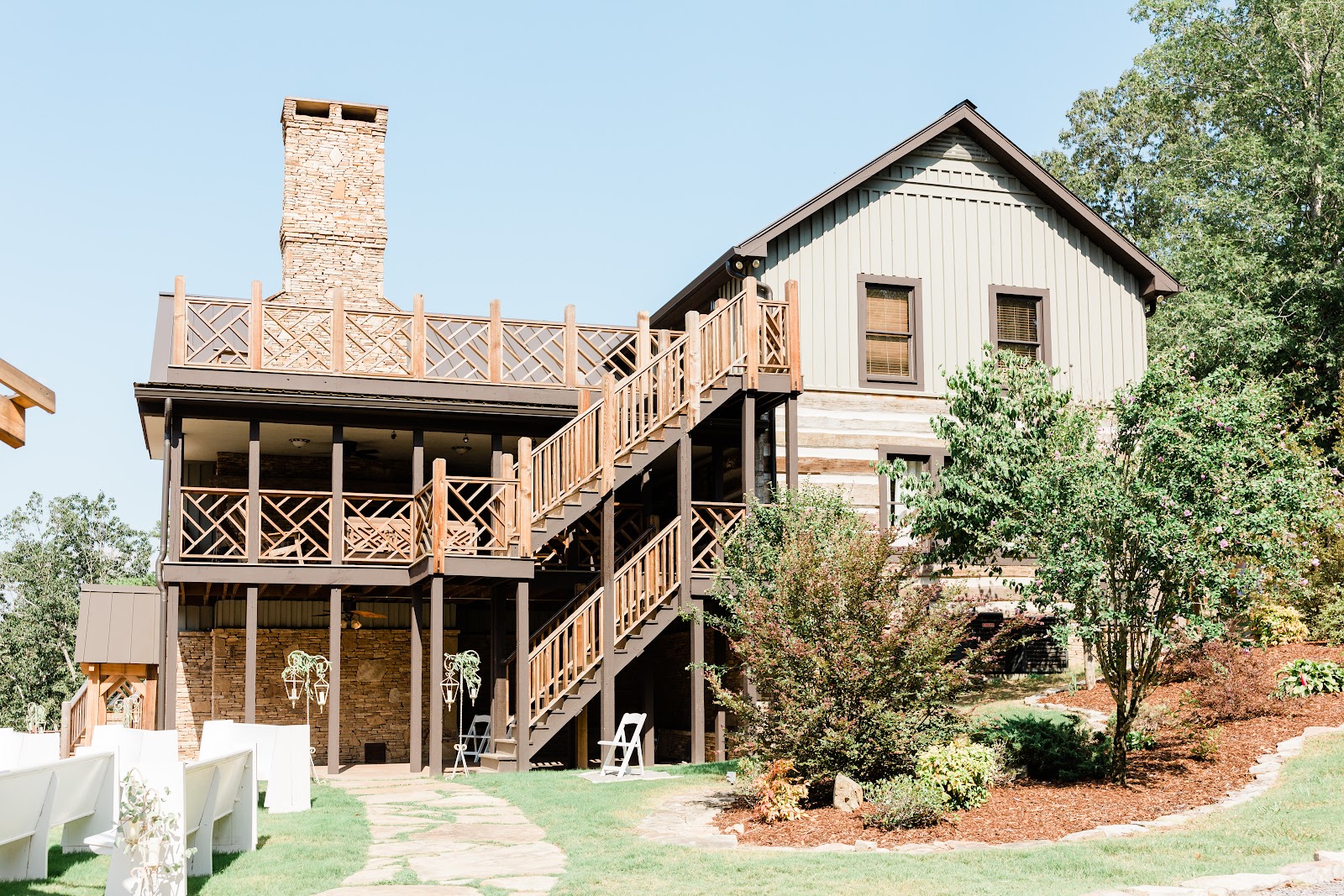
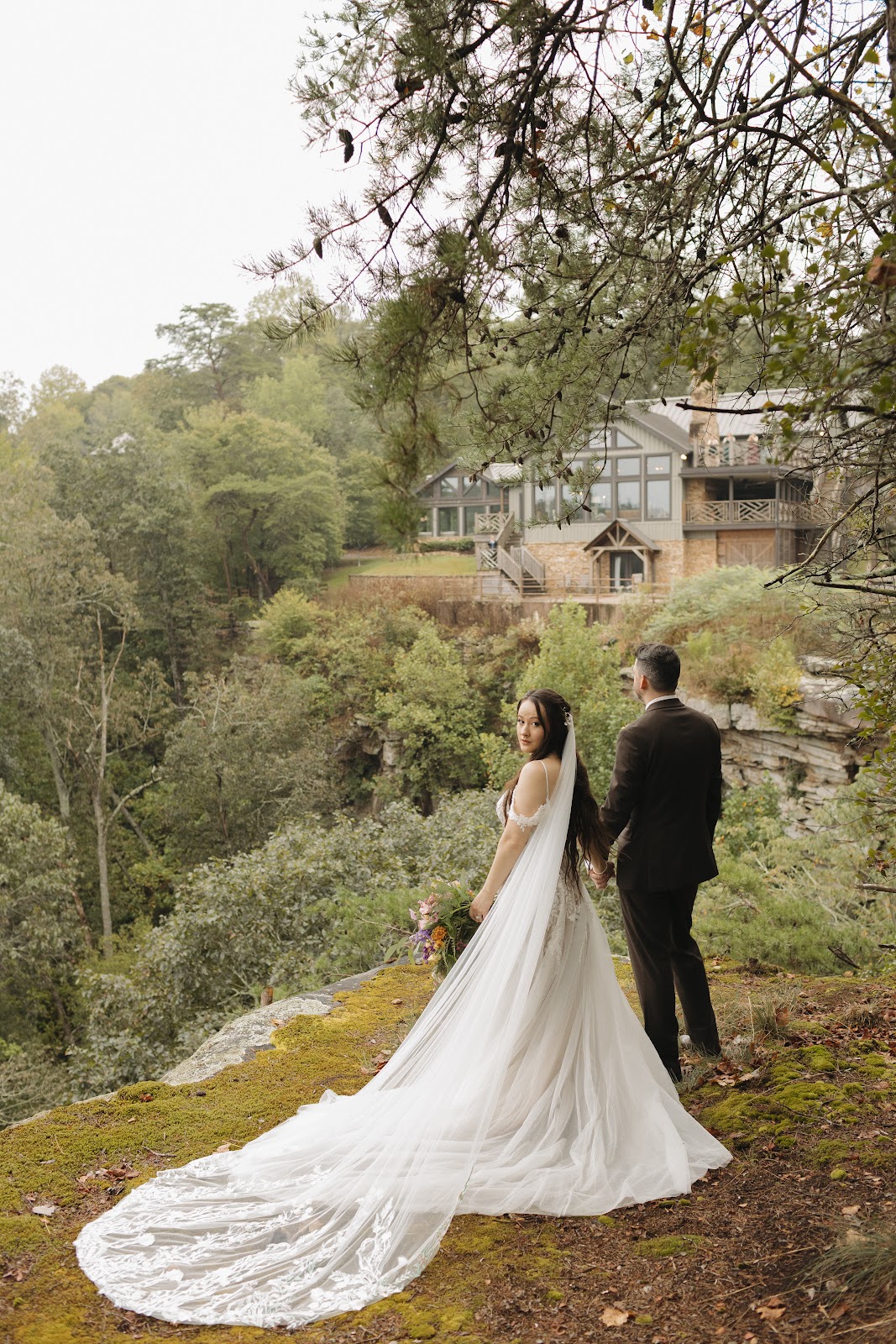
The third element is the setting: north Alabama hill country, mixed hardwood and pine over sandstone, with humid air, red clay and a genuine autumn.
We have not photographed a wedding at the Venue at High Falls; waterfall venues in this region behave consistently. What access there is to the water and where the safe limits are, what the flow is doing, the covered alternative, and what the ground is like underfoot are questions for their team — and access is a safety matter rather than a photographic one, because wet rock beside falling water is genuinely dangerous.
Venue at High Falls at a glance
| Where | Beside a waterfall in the north Alabama hill country at Guntersville |
| The condition | Rainfall-fed: the flow depends on the last week, not the season alone |
| The choice | Fast shutter freezes the water; slow shutter blurs it. Two different pictures |
| The hazard | Wet rock beside falling water. Follow the venue’s limits |
| Ask first | Flow on the date, access and safe limits, covered alternative, footing |
How the frame is made
The shutter speed is the first decision and it is worth making deliberately rather than accepting whatever the exposure lands on.
To freeze the water, a shutter of about a five-hundredth of a second or faster will hold individual droplets and threads — which reads as energy, shows the structure of the fall, and suits a frame where the water is dramatic and the couple are close to it.
To blur it into a smooth veil takes something around a quarter of a second or slower, and the familiar milky look needs a second or more. That requires a tripod for the camera and, more awkwardly, stillness from the couple — because at those speeds any movement from them blurs too.
The practical resolution for a wedding is the middle ground and it is the one most people miss: something around a thirtieth to a fifteenth of a second gives the water enough motion to read as flowing without turning it to featureless white, and it is slow enough to be hand-holdable with care while fast enough that a couple standing still stays sharp. That is the working setting for the frame described here.
Where the milky version is wanted, the answer is two frames: one of the couple at a normal shutter speed, and one of the fall alone on a tripod at a long exposure. Attempting both in one frame usually produces a soft couple and a lovely waterfall.
The exposure is the second decision and falling water misleads every meter in the same direction. White turbulent water is bright, which means a meter pulls it toward mid-grey and the whole frame comes out dark — and it also clips easily, losing all the structure in the fall.
The correction is to meter on skin and then check the water: it should read white or near-white with texture and thread visible in it, not a featureless blank. Where the range between the lit water and a shaded couple is too wide, the answer is a close source on the faces gelled to the ambient, which lets the water be exposed correctly.
Close matters because a wet rock gorge bounces very little: a source at two metres needs roughly a quarter of the output of the same source at four.
The third decision is the light on the fall, and it is the one that makes the difference between a good waterfall frame and a poor one. Direct sun on falling water is the worst condition: it clips the white to nothing, throws hard specular highlights off every wet surface, and produces a brightness range far beyond what one exposure holds.
Overcast is the best condition for a waterfall, and it is worth saying plainly. Under cloud the whole range collapses, the water holds detail, wet rock saturates to a deep rich tone rather than glaring, the surrounding foliage greens up, and the frame works at any hour. A grey day at a waterfall is not a compromise — it is the condition the subject wants.
Where the sun is out, the practical answer is the time of day when the fall is in shade. A gorge is a steep-sided place, which means the water is shaded for most of the day and lit only when the sun is high enough to reach it — so the shaded hours are the usable ones, which is the reverse of most outdoor advice.
The fourth element is the wet rock and it is the frame’s other subject. Rock beside a fall is permanently damp, which darkens it and saturates its colour — and it is frequently mossed, which gives green as well. That dark wet surround is what gives a waterfall frame its separation: a lit face against dark wet rock needs nothing added.
A custom white balance set on a face is worth the thirty seconds, because a wet gorge under canopy bounces green from moss and foliage while the water itself is neutral.
And spray is the practical constraint. A working fall throws mist that reaches further than it appears to, which means a front element picks it up within seconds — a cloth in a pocket, a rain cover for the body, and lens changes well back from the water. Sealed equipment matters more here than at most venues.
What breaks it, and what the site gives otherwise
Low flow breaks the frame completely and it is the likeliest failure. A rainfall-fed southern waterfall in a dry spell is a damp sandstone face with a thread of water down it — which is honest and is not the picture anyone planned.
The response is to know in advance, and then to change the frame rather than persist with it. A low fall is better photographed close: the detail of water over rock, the pool below, the wet moss and the individual threads, rather than the wide view that needs volume to work.
Direct sun breaks it, as above, and the fix is the hour rather than any technique.
Safety breaks it, and this belongs in a planning conversation rather than a footnote. Wet rock beside falling water is among the most hazardous ground at any venue in this guide: it is slick, frequently mossed, and the consequences of a slip are serious. Whatever the venue’s limits are, they are followed rather than judged — and a wedding party in formal shoes should not be anywhere a photographer would hesitate.
The related caution is that a rainfall-fed fall can rise quickly. A heavy storm upstream raises the flow within hours, which in a gorge means water where there was rock — so the position that was safe in the morning may not be in the evening after a thunderstorm. That is a question for the venue on the day.
The rest of the site is the north Alabama hill country and it gives a good deal.
The gorge itself is a shaded, humid, enclosed environment and the canopy edge is the reliable position: a metre or two inside at the margin of an opening gives soft directional light in front and darkness behind, three or four stops of free separation. The species mix here is mixed hardwood and pine — oak, hickory, maple, sweetgum and tulip poplar with loblolly pine through it — and deciduous canopy filters as much as it blocks, so it dapples. Look at the face rather than the ground.
Magnolia and hemlock, where they occur, are the real blockers and the darkest backgrounds — with the caution that magnolia’s large glossy leaves throw hard specular highlights in direct sun.
The metering trap is severe at a waterfall site: dark wet rock and dark canopy make a meter overexpose a face by a couple of stops, and bright falling water fools it hard the other way within a single frame. Manual, metered on skin, and check the water.
The open ground and the building are the weather-independent parts. A building’s shaded wall is the reliable outdoor position at any hour; a covered structure with a solid roof restricts light to a horizontal band and cannot dapple; and indoors, a window with a subject a metre from it turned forty-five degrees gives horizontal light with steep fall-off, room lights off, custom white balance on a face.
The humidity is the condition running under everything and at a waterfall it is at its highest. It softens contrast, which helps the fall’s extreme range; it reduces clarity at distance, which argues against the wide ridge views except in the clearest months; and it warms and diffuses the light at the ends of the day.
It also produces morning fog in the gorge, and fog with falling water in it is the most atmospheric condition this site offers — worth the early start in the cooler months when it is most frequent.
And the practical notes are the region’s: summer heat and humidity that make an outdoor ceremony between June and September a welfare matter first, near-daily afternoon thunderstorms in July and August, a genuine spring severe-weather season that makes a named covered alternative a requirement, and biting insects in a humid gorge that are worth raising in planning.
- Ask what the water is doing in the week before the date
- Choose the shutter deliberately: a thirtieth is the working compromise
- Meter on skin, then check the water holds thread and texture
- Overcast is the best condition for a waterfall, not a compromise
- Wet rock beside falling water is dangerous ground. Follow the limits
The north Alabama year
North Alabama has a humid subtropical climate with a genuine four-season feel, and at a rainfall-fed waterfall the season matters twice: once for the light and once for the flow.
Winter and early spring are when the water is at its strongest. Rainfall in this region is highest in the cooler months and the trees are not drawing water, which means the falls run hardest between roughly December and April — and a fall in March after a wet week is the most dramatic it will be all year.
Winter also gives the light the subject wants. The December sun at this latitude reaches about thirty-four degrees above the horizon, which in a steep gorge means the water is in shade for most or all of the day — which is exactly the condition a waterfall needs. And the deciduous canopy is down, which opens views of the fall that summer foliage hides.
Hard freezes occur here, and a partly frozen waterfall with ice formations on the rock is a genuinely spectacular and uncommon condition worth being ready for. Snow is occasional and rarely lies, but snow on dark wet rock beside falling water is the widest brightness range the site offers.
Morning fog in the gorge is most frequent in the cooler months, and fog with falling water in it is the site’s most atmospheric frame.
Late winter into spring brings the flowering — redbud and dogwood through March and April, with mountain laurel a little later on the slopes — and the canopy leafing out through April, which encloses the gorge again.
The honest spring caveat is severe weather. Alabama sits in one of the most tornado-prone regions in the country, with a pronounced peak from March through May, and severe thunderstorms are a real feature of that period. A named covered alternative with real capacity is a requirement — and at a gorge site the additional consideration is that heavy rain raises the water quickly.
Spring proper is the best combination of flow and comfort: warm, green, long-lit, and the falls still running well from the winter rain.
Summer is the hardest season here and it is hard in both ways. The heat and humidity make an outdoor ceremony a welfare matter first — the low nineties Fahrenheit with high humidity pushes the heat index considerably higher — and it is also when the falls are at their weakest, because rainfall drops and the trees are transpiring hard.
The compensation is that a gorge is the coolest place on the property by a noticeable margin, and that afternoon thunderstorms are near-daily in July and August, which can put water back into a fall within hours. A storm-fed fall in August is a real possibility rather than a rarity.
Autumn is the best season overall for everything except flow. The heat breaks in October, the humidity drops, the air clears, and the hardwood colour arrives late — typically from the last week of October into mid-November, weeks later than New England.
Oak russet, maple scarlet, hickory and tulip poplar yellow and sweetgum’s mixed red and purple arrive over two or three weeks, and against dark wet gorge rock that colour reads at full saturation. A fall running well in early November with full colour around it is the strongest frame this site produces — and whether it runs well depends on the autumn rain.
Late October and early November are the easiest and most beautiful dates of the year here, with the caveats that November is the state’s second severe-weather peak and that autumn is frequently the driest part of the year for the water.
More frames from Venue at High Falls
Venue at High Falls wedding photography: common questions
What decides whether the frame exists?
Recent rain. These falls are rainfall-fed, so a fall that is spectacular in March may be a damp rock face in September. Ask what the flow is doing.
What shutter speed should I use?
A deliberate one. About a thirtieth to a fifteenth of a second gives motion without turning the water white, and keeps a still couple sharp.
How do I expose the water?
Meter on skin, then check the fall holds thread and texture rather than clipping. Where the range is too wide, lift the faces with a close gelled source.
Is sun good for a waterfall?
No — it clips the white, throws specular highlights off wet rock, and blows the range. Overcast is the condition the subject wants.
What about the spray?
It reaches further than it looks. Rain cover, a cloth in a pocket, and lens changes well back from the water.
When is the water strongest?
Roughly December to April, when rainfall is highest and the trees are not drawing water. Autumn is often the driest.
More Alabama venue guides
We are writing a photographer’s guide to every venue we would happily shoot in Alabama. Here are three more, plus the full index:
- Venue at The Depot, Rainsville: The One Decision That Governs Everything
- Venue at Willow Creek, Huntsville: The Problem, and Four Ways Out
- Westin Huntsville: The Light Through the Day
Planning a wedding at Venue at High Falls?
One frame, and it depends on the rain. Tell us your date and we will ask.