 The Thunderbird Inn: Field Notes on a 1964 Motor Inn
The St. Regis Atlanta: How the Light Moves
A grand staircase and a pool terrace are two different venues with two different clocks.
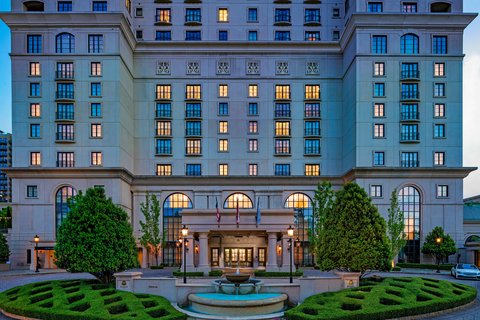
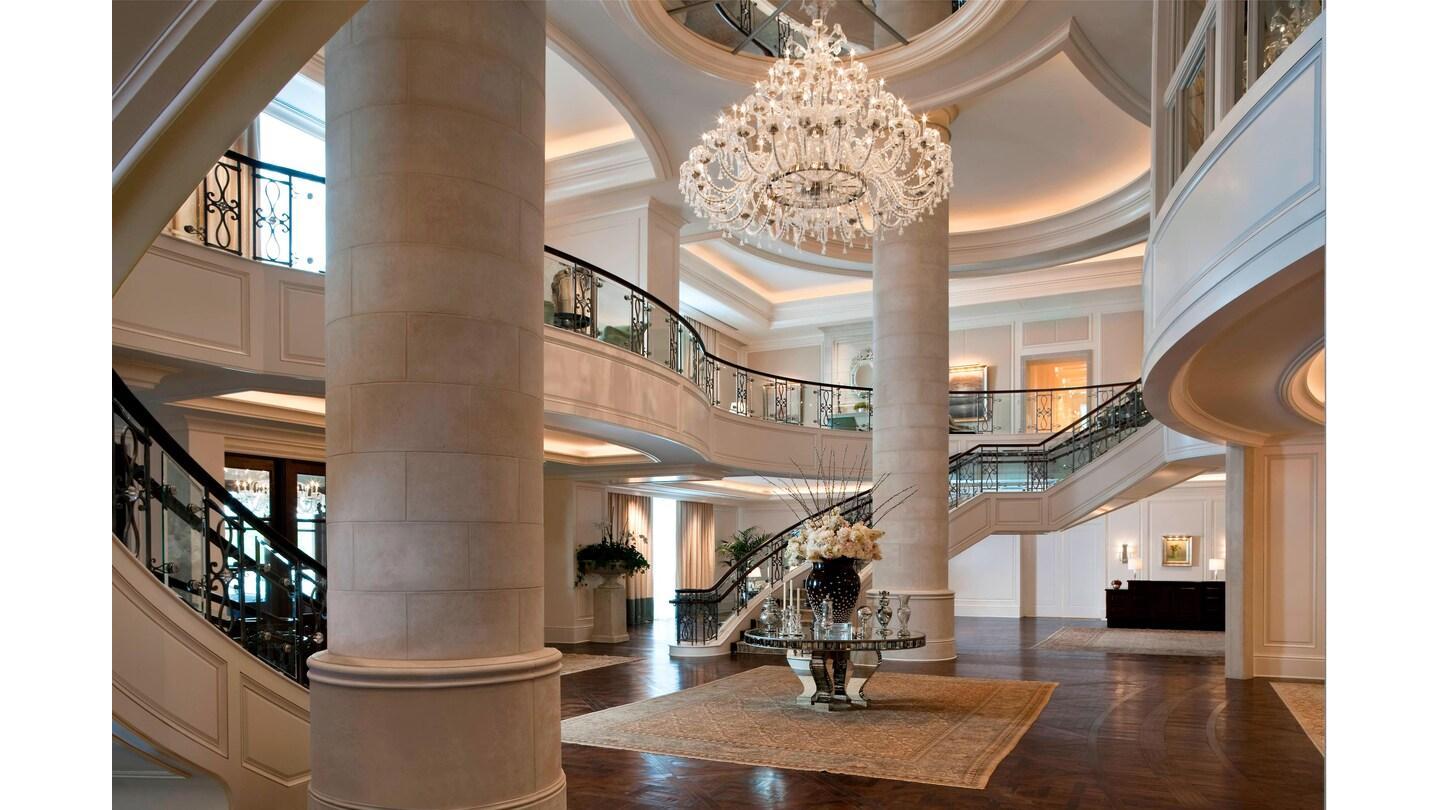
The St. Regis Atlanta offers, by its own description, a grand staircase and a tranquil pool area — each providing a distinct narrative element to a wedding album.
That pairing is the thing to plan around, because the two spaces run on different clocks. A grand staircase is an interior feature lit by the hotel’s own scheme, which means it is identical at two in the afternoon and ten at night. A landscaped pool terrace is outdoors, which means it swings through four or five stops and changes character completely between noon and dusk.
So the day divides cleanly: the staircase can go anywhere in the schedule and the terrace cannot. That sounds obvious and it is the thing most often got wrong, because a terrace is easy to visit at a convenient moment and almost never good at one.
This is written as a day. We have not photographed a wedding at the St. Regis; luxury hotels with outdoor terraces behave consistently. Which spaces are included, whether the terrace is exclusive, and whether the ballroom lighting is adjustable are the questions for their team.
The St. Regis Atlanta at a glance
| Where | Atlanta, Georgia |
| Character | A luxury hotel with a grand staircase and a landscaped pool terrace |
| Two clocks | The staircase never changes; the terrace changes hourly |
| The consequence | The terrace decides the schedule; the interior fits around it |
| Ask first | Spaces included, terrace exclusivity, ballroom lighting control |
Morning and midday: the staircase and the rooms
The staircase is the building’s strongest single feature and it is worth photographing properly rather than in passing. Steps make rows automatically, so a group of thirty arranges itself with everybody visible, which no ballroom floor will do — and almost every group photograph in a hotel of this kind belongs there.
It also gives elevation without architecture: standing above a subject or below them changes the whole relationship of figure to space, and both are available within a few paces. And a curve or a sweep gives a leading line that a straight flight does not, which is worth walking around to find.
A staircase frame rewards precision and punishes near-misses. Symmetry is usually built into it, and the eye detects a two-degree error in a symmetrical composition instantly while forgiving a large one in an asymmetrical composition entirely. Level, and either centre exactly or step clearly to one side.
Lighting it is the part that needs deciding. Grand staircases are usually lit from above by a chandelier or downlights, which darkens eye sockets and marks the line under the nose on everybody in the group. The fixes are cheap and should be ready: a low reflector, a lifted chin, or one source at face height. For a large group, one source placed at the camera position but raised slightly is usually more practical than trying to light from the side.
Guest rooms are the best portrait light in the building and the place the morning belongs. Domestic-sized windows with close walls that bounce and ceilings low enough that a flash aimed upward returns something usable — three moves set it up: largest window on the shaded side, every overhead fitting off so the room has one colour of light, lamps moved out of frame.
Public floors present the luxury problem: light that is deliberately even, which erases the gradient across a face that reads as shape, and pale surfaces, which erase the tonal difference between subject and background. One directional source at close to ambient level fixes the first; depth, aperture, dark placement and negative fill fix the second. In a pale room, subtracting light with something dark on the shadow side beats adding another source.
The terrace: when, and how
A pool terrace at midday in an Atlanta summer is the least usable space on the property. Open sky overhead gives hard downward light; water raises light from below onto the underside of the chin, which is an unfamiliar and unflattering direction; there is rarely much shade; and the heat and humidity make formal clothes genuinely uncomfortable. Anything scheduled there before late afternoon is a welfare decision as much as a photographic one.
From about two hours before sunset it becomes the best space the hotel has. The sun drops low enough that the water stops glaring and starts holding colour, light begins raking along paving and planting rather than falling straight down, and the heat breaks.
Still water is a mirror and it is the terrace’s distinctive asset. A pool reflects the sky, the planting and any lit architecture around it, which doubles the information in a frame and fills what would otherwise be dead ground at the bottom of the picture. It depends entirely on the surface being undisturbed, so it is a frame to take early in the block rather than late, and it is worth asking whether any water features can be switched off.
A low camera is the technique that makes a reflection work: how much of the reflection appears depends on viewing angle, so dropping close to the water’s edge can be the difference between a full mirrored image and a flat plane of surface. It costs nothing but kneeling.
Planting around a terrace behaves like any planting — it bounces green onto nearby skin, so set a custom white balance on a face in the position being used, and use pale paving as a neutral bounce surface.
The last twenty minutes are the best version of the terrace. With the sun down, the water holds the whole sky’s colour and becomes luminous rather than reflective, and if the terrace lighting is on, the two balance for a short while. A couple against a luminous pool will silhouette unless lit — one warm-gelled source at face height about a stop under the sky holds both.
That same window is the interior’s one timed frame, at any large window: one exposure holding the lit room, the couple and the outside together. The two cannot both be had, so choose in advance which matters more.
- Put the group on the staircase, and fix the overhead light on their faces
- Nothing on the terrace before late afternoon in summer
- Take the still-water reflection early in the block, before the surface moves
- Get low at the water’s edge; angle decides how much reflection you see
- Choose in advance between the terrace crossing and the window crossing
Evening, Atlanta outside, and the year
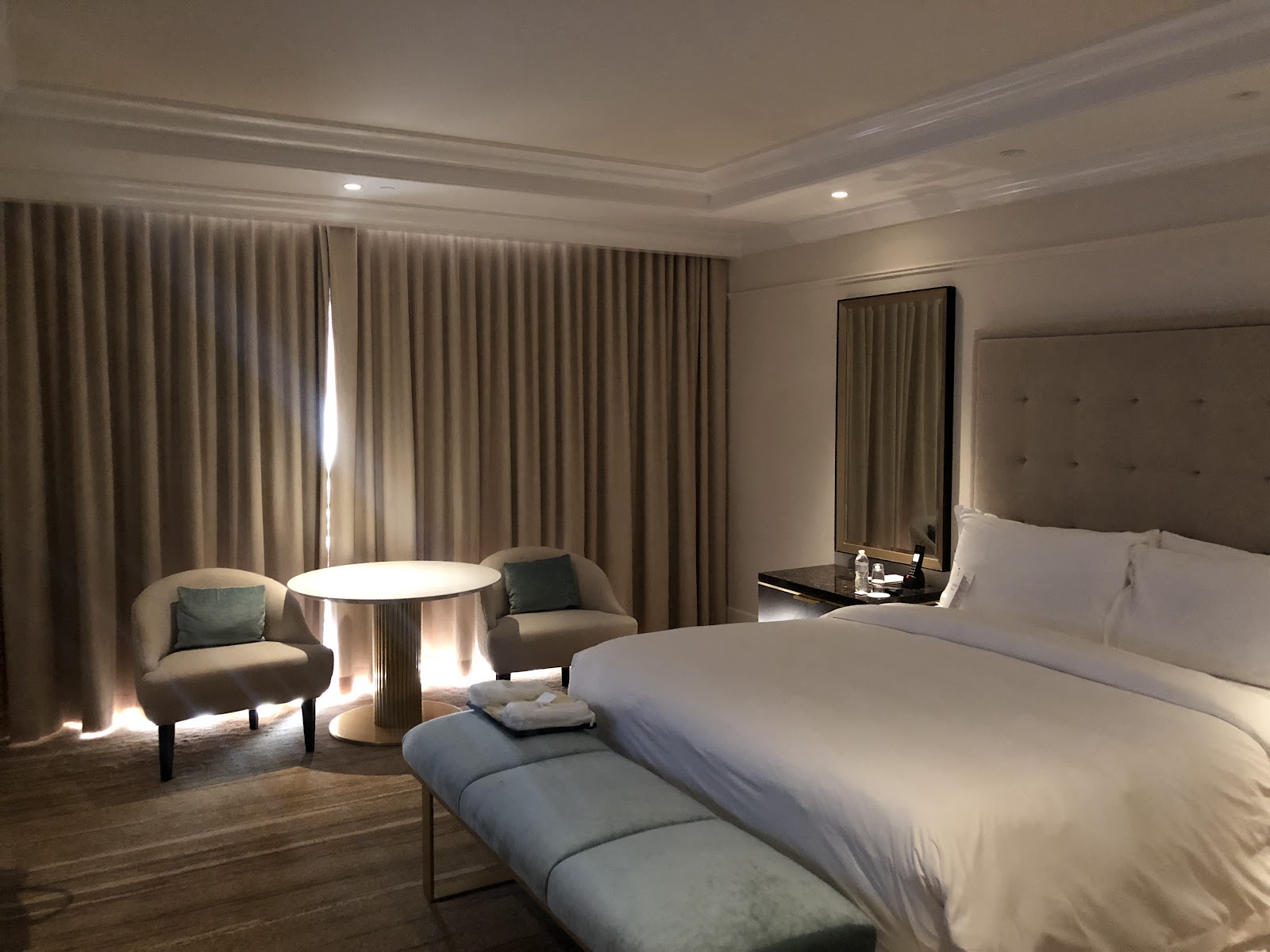
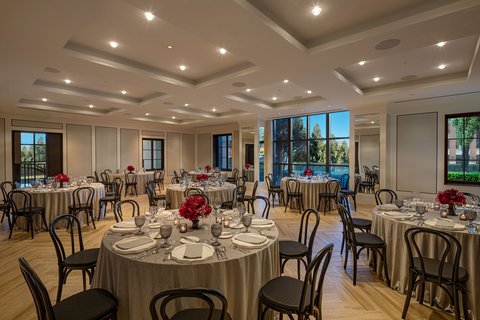
The ballroom is the evening and it is a known quantity: a high ceiling with no usable bounce, warm decorative fittings, overhead sources and a house scheme dimmed low. Expose for the room so it stays warm and dim, add one warm-gelled source at face height where legibility matters, set white balance to the gel and hold it, and use the steep fall-off as free separation. Ask whether the lighting can be dimmed to pools rather than set evenly; it usually can, and the difference exceeds any equipment decision.
Outside, Atlanta’s geography is worth understanding rather than assuming. The towers are clustered rather than continuous, which produces deep shaded canyons between them where direct low sun rarely reaches street level — good soft bounced light for much of the day, but not a golden-hour environment. The lower-rise fabric nearby is where raking light is, and reaching it is usually a short walk.
Atlanta’s tree canopy is the other local fact and it is abundant: this is one of the most heavily wooded major cities in the country, so mature shade is rarely far away. That is the midday resource everywhere outdoors, with dapple as its hazard — hot spots several stops above the surrounding shadow, shifting with any breeze, so full shade, open light, or wait.
Summer heat and humidity make long outdoor blocks genuinely difficult, and afternoon thunderstorms are close to a daily feature rather than an occasional event. For a hotel that is almost entirely an advantage — the day continues indoors without a decision — but a terrace ceremony needs a stated fallback with a capacity and a decision time.
Humidity also produces the region’s equipment problem, and a luxury hotel is where it bites hardest because the air conditioning is most effective: a camera chilled indoors fogs comprehensively on reaching the outside air and can take many minutes to clear. Warm the kit twenty or thirty minutes before the outdoor block and plan one excursion rather than three.
Spring brings pine pollen in late March and April, which coats surfaces in a visible yellow film, hangs in the air, and shows as a yellow cast on pale surfaces — a terrace and a pool surround are exactly the sort of pale surfaces it lands on. A cloth and an awareness of which surfaces have been wiped is the whole of the answer.
Winter is mild enough that a terrace remains usable much of the year, which is a real advantage over most venues in this series. A clear winter afternoon gives low raking light for hours rather than for ninety minutes, which on a terrace with still water is the best condition it will ever have.
More frames from The St. Regis Atlanta
The St. Regis Atlanta wedding photography: common questions
Why do the staircase and the terrace need different planning?
Because they run on different clocks. The staircase is lit by the hotel’s own scheme and is identical at two or at ten; the terrace swings four or five stops and changes character completely.
When is the terrace unusable?
Midday in summer. Hard downward light, water raising light onto the underside of the chin, little shade, and heat and humidity in formal clothes — a welfare decision as much as a photographic one.
What is the terrace's distinctive asset?
Still water as a mirror. It doubles the information in a frame and fills what would be dead ground — but it needs an undisturbed surface, so take it early in the block.
Why get low at the water's edge?
Because how much reflection appears depends entirely on viewing angle. Dropping close to the water can be the difference between a full mirrored image and a flat plane of surface.
How do you light a grand staircase group?
Fix the overhead direction. Chandeliers and downlights darken eye sockets on everybody, so one source at face height near the camera position, or a low reflector, does more than anything else.
What should be chosen in advance?
Whether the dusk crossing happens on the terrace or at an interior window. They are the same twenty minutes and you cannot have both.
More Atlanta, GA venue guides
We are writing a photographer’s guide to every venue we would happily shoot in Atlanta, GA. Here are three more, plus the full index:
- The Swan House, Atlanta: One Frame and How It Is Made
- The Trolley Barn, Atlanta: What It Suits and What It Does Not
- The Westside Cultural Arts Center, Atlanta: Four Ways Out of the Blank Box Problem
All Atlanta, GA Wedding Venues →
Planning a wedding at The St. Regis Atlanta?
The terrace sets the clock and the interior fits around it. Tell us your date.