 Park Hyatt Aviara, Carlsbad: The One Decision That Governs Everything
Rosewood Sand Hill, Menlo Park: The One Decision That Governs Everything
Indoors or outdoors. Not a preference — the two halves of this property are lit by different rules.
At a low modern hotel in the Peninsula foothills there is one decision that governs the photographic day, and it is simply whether the wedding happens indoors or out.
That sounds obvious and it is not, because at most venues the two are variations of a single character. Here they are genuinely different environments with opposite rules, and a plan that suits one actively misfires in the other.
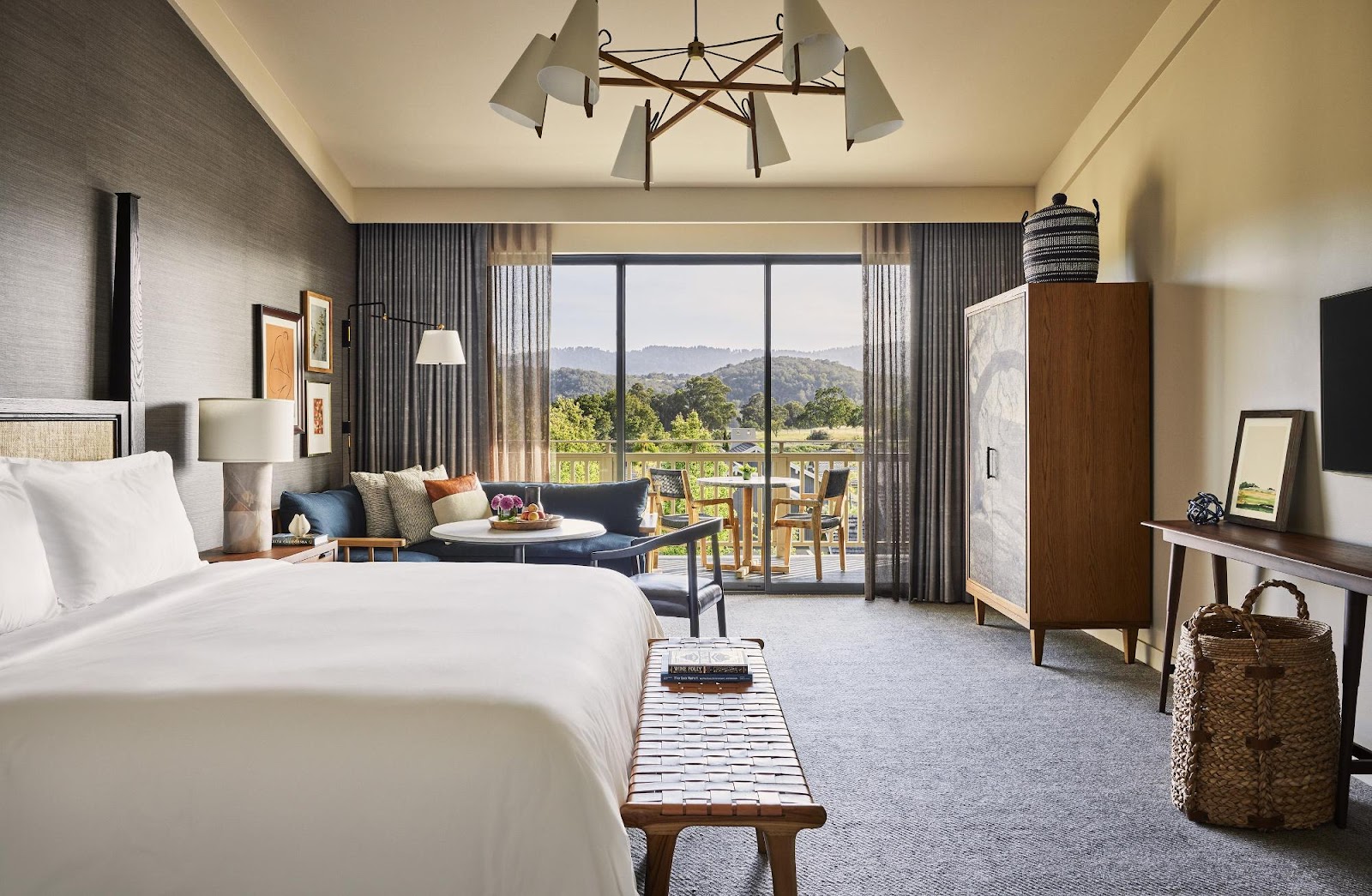
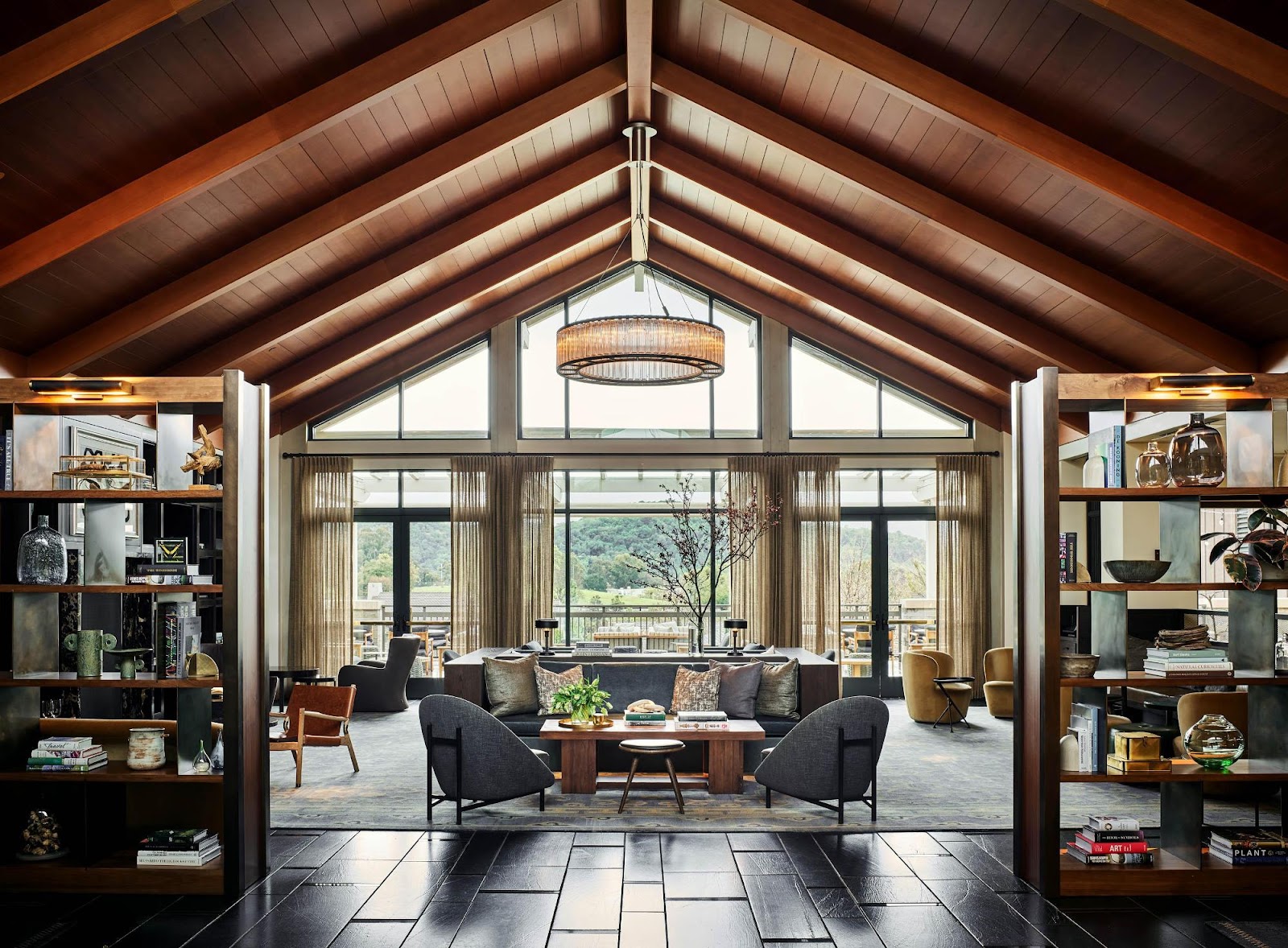
Indoors, a hotel of this kind is modern, controlled, warm-toned and low-ceilinged, with large glazing and pale surfaces. Everything bounces, nothing falls off steeply, the artificial light is designed to flatter, and the photographic problem is separation rather than quantity.
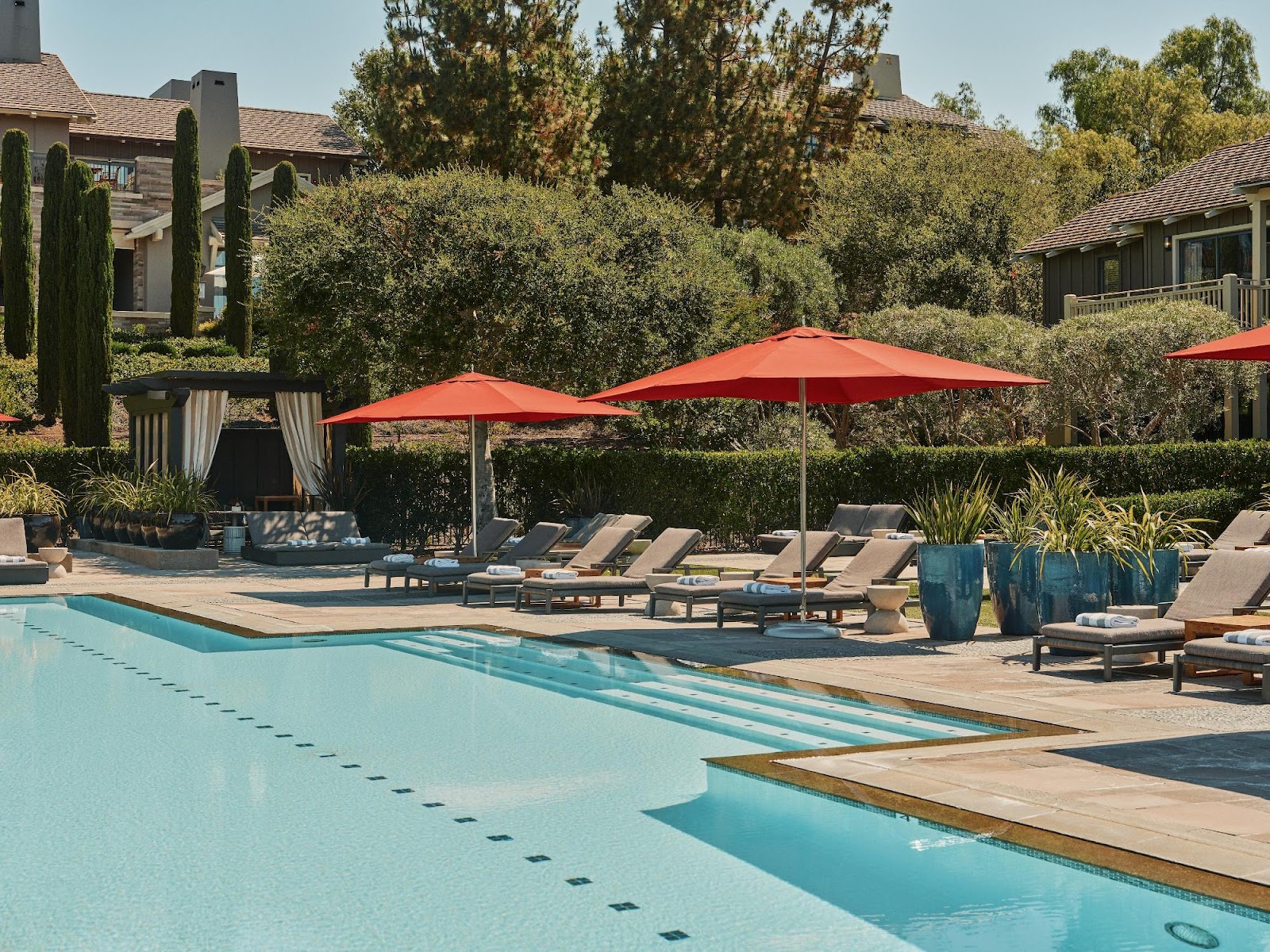
Outdoors, it is oak country: mature coast live oak over dry grass, open ground between the buildings, strong Peninsula sun and hills close on the western side. Everything is contrast, dappling and timing, and the photographic problem is the opposite one — too much light in the wrong places.
Which of those two the wedding leans toward decides the schedule, the equipment, the portrait plan and the risk. Decided early it makes everything straightforward; decided late it produces a day that works in one half and struggles in the other.
We have not photographed a wedding at Rosewood Sand Hill; low modern hotels in this landscape behave consistently. Which rooms and outdoor areas are included, whether the function-room lighting can be dimmed or adjusted, what the covered alternative is, and what the turnaround between spaces takes are questions for their team.
Rosewood Sand Hill at a glance
| Where | The Peninsula foothills at Menlo Park, in oak country |
| The decision | Indoors under control, or outdoors under oaks |
| Indoors | Pale, warm, low-ceilinged, everything bounces — separation is the problem |
| Outdoors | Oaks, dry grass, hard sun — contrast and dappling are the problem |
| Ask first | Rooms and areas included, lighting control, covered alternative, turnaround |
If it is indoors
A modern hotel interior is the easiest place in this guide to get an acceptable photograph and one of the harder places to get a distinctive one, and knowing which problem you have changes the approach.
The light is abundant and it is soft. Large glazing, pale walls and pale ceilings mean daylight enters and then bounces from every surface, which fills the shadows under eyes and chins, lowers the contrast, and produces even flattering illumination almost anywhere in the room. Nothing needs adding for a face to be well lit.
What that costs is separation. A subject in soft bounced light against a pale wall has nothing distinguishing them from the background — no fall-off, because the light does not fall off; no shadow, because it has been filled; no tonal difference, because everything is pale. The frame reads flat, and it reads the same wherever it is made.
So the work indoors is building separation, and there are three ways to do it. Find the dark: a doorway, a dark panel, a recessed area, a corridor receding away — anything two stops below the subject. Modern interiors have fewer of those than historic ones, which is why finding them is a deliberate search rather than an accident.
Use the glazing as a source rather than a background. A subject a metre from a large window, turned so the light crosses the face at about forty-five degrees, gets real modelling even in a pale room, because the window is still much brighter than the bounce. That is the one position in a modern interior that gives direction for free.
Or build it with a source. One light off the camera axis, set a stop or so above the ambient, restores the shadow side that the room’s bounce has filled — which is the reverse of the usual reason for adding light. In a dark venue a source supplies light; here it supplies contrast.
Colour is the other indoor consideration. Warm-toned modern interiors — timber, brass, warm stone, warm LED — bounce warm light onto skin, while daylight from large glazing comes in cool. Two colours on one face is the standard problem, and the answer is the same as anywhere: switch off what can be switched off, and set a custom white balance on a face in position rather than trusting a preset.
Low ceilings are the one genuine advantage a modern room has over a historic one, and it is worth exploiting. A ceiling two and a half or three metres up is an enormous usable bounce surface: a flash aimed into it returns a soft overhead-forward light across the whole room, which in a high-ceilinged ballroom is simply not available. For a reception, that single fact makes a modern room considerably easier to light than a grand one.
The caution is colour again — a warm-painted or timber ceiling colours the bounce, and the white balance has to follow it.
And the large glazing needs one technical note: it reflects. Any frame pointed toward a window at a shallow angle picks up the room, the camera and the photographer, and the fix is a few degrees off perpendicular rather than any equipment. Finding that angle is the first thing to do in a glass-walled room.
The evening reception follows the standard approach: expose the ambient for the room about a stop under what faces need, then add one warm-gelled source just above skin level with the white balance set to the gel. In a low pale room, bounce rather than direct, and the room lights itself.
If it is outdoors
Outdoors the rules invert completely, and the governing element is the oaks.
Coast live oak is the characteristic tree of this landscape and it is an unusually good shade tree: a dense, broad, low-spreading evergreen crown of small stiff leaves that blocks rather than filters, giving genuinely full shade under a mature specimen and the same shade in February as in August.
The working position is a few metres inside the canopy on the side facing open sky, which gives soft directional light in front and a background three or four stops down behind. That is the best free frame on the property and it needs no equipment at all.
It carries the exposure trap that is the exact opposite of the indoor problem. A meter looking at dark oak canopy tries to lift it toward mid-grey, which overexposes the face by a couple of stops — where indoors the pale surfaces make the same meter underexpose. So a day that moves between the two requires the metering corrected in both directions, which is precisely what automatic exposure cannot do. Manual, metered on skin, in both environments.
Dappling is the outdoor hazard and the check never changes: look at the face rather than the ground, and a bright patch on skin means move a metre. Peninsula sun is strong and dry, so a single hard patch on a cheek is unrecoverable rather than merely awkward.
The ground between the oaks is dry pale grass for most of the year, and it is a reflector. It throws light upward into faces, filling the shadows a high sun carves, at the cost of uplight under the chin — which something solid on one side corrects, and the diagnosis is simply to look at the chin in the first frame.
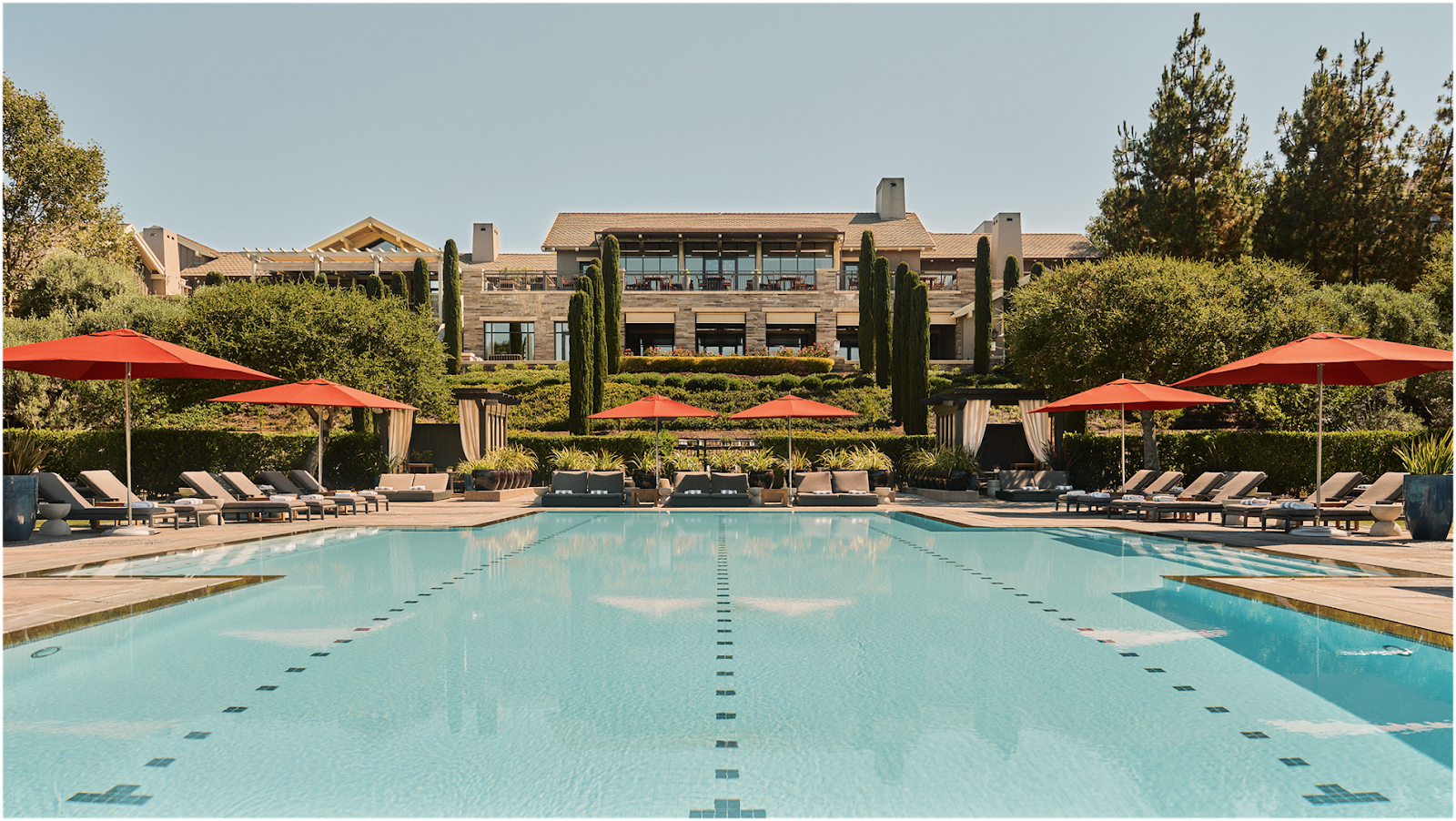
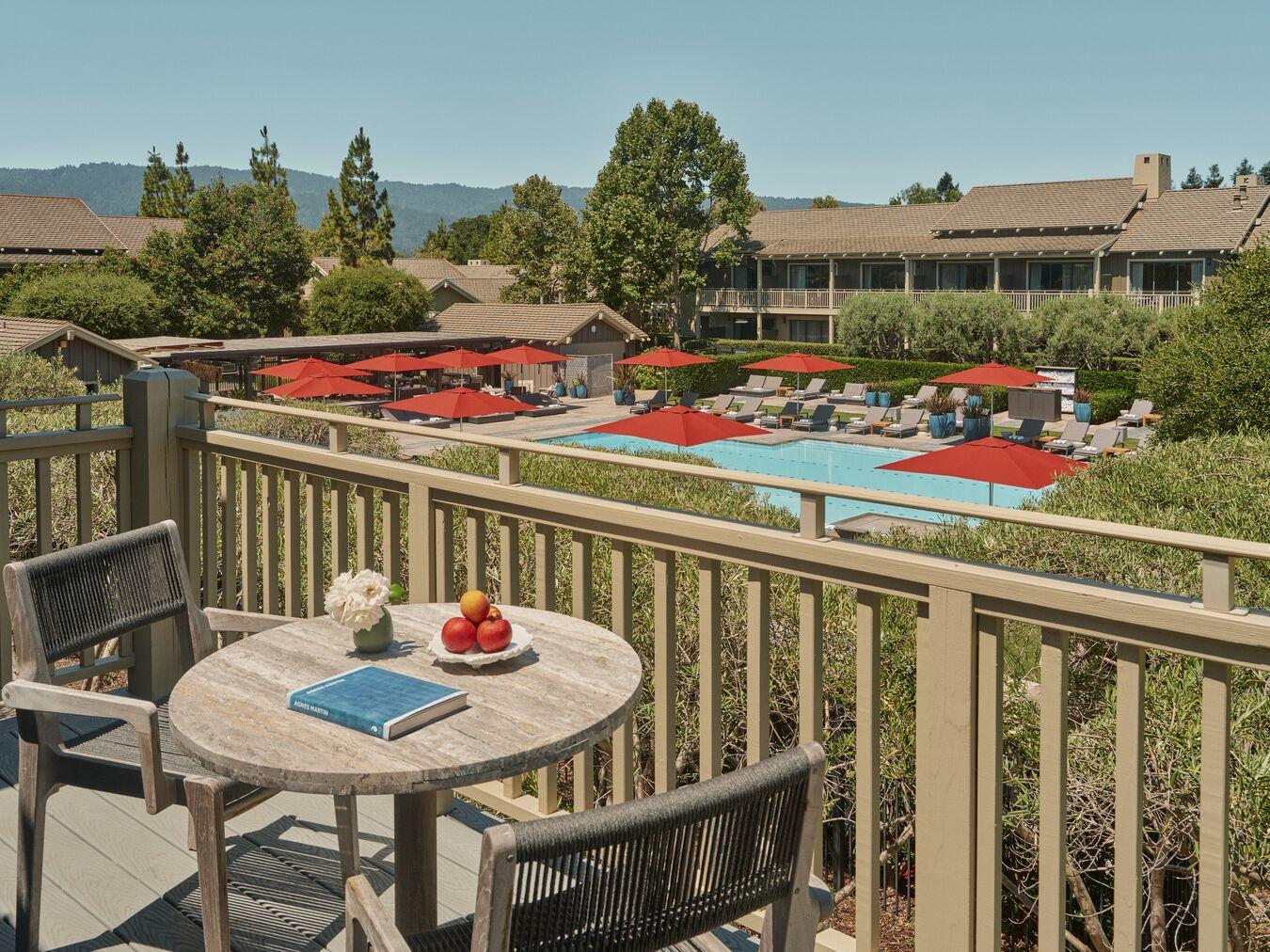
Open ground between low buildings is the other outdoor environment and it has no shade in it at all. Low modern architecture throws short shadows, which means the shade available is whatever a roofline, a pergola or a colonnade gives — and a slatted pergola is not shade, it is a striped dappling machine. A solid roof is, and two or three metres in from its open edge is the working position, at any hour, with no dappling possible.
Timing outdoors is set by the hills on the western side, which take the sun earlier than a sunset table says. That brings the last hour forward and shortens it, and it produces the interval frame: the ground in soft even shade while the hills and the oak crowns above are still lit, which puts a couple in flattering light with a brilliantly lit background for twenty or thirty minutes.
That frame is made by lifting the faces with a close warm-gelled source rather than by underexposing the background to match them. Close, because dry open ground bounces some light but not much, and a source at two metres needs roughly a quarter of the output it needs at four.
Heat is a practical constraint on this side of the decision. The Peninsula foothills are warm and dry in summer — commonly in the high eighties Fahrenheit through July and August, with far less marine cooling than the coast — and a party in formal clothes on open ground at three in the afternoon is uncomfortable in a way that shows. Oak shade is markedly cooler and it is the answer.
And the indoor-outdoor transition is the one thing that catches photographers on a day that uses both. Moving from a pale bright interior into oak shade is a four-stop change and a colour change at the same time, in the space of ten steps. Resetting exposure and white balance at each transition, rather than once at the start, is the whole discipline of working this kind of property.
- Indoors the problem is separation, not light — find the dark or build it
- Use large glazing as a source at forty-five degrees, not as a background
- Outdoors, oak canopy is the shade; meter on skin and let it go dark
- Slatted pergolas are not shade; solid roofs are, at any hour
- Reset exposure and white balance at every indoor-outdoor transition
The Peninsula year
This part of the Peninsula sits inland of the coastal hills, which makes it warmer, sunnier and much less foggy than the ocean side — and the year is a mild Mediterranean one with a distinctly dry summer.
The wet season runs roughly November through March. For the indoor half of the property that barely matters, which is the strongest argument for the indoor side of the decision on a winter date. For the outdoor half a covered alternative is not optional in those months.
What rain gives is a set of conditions that solve the outdoor problems entirely: soft even light, no dappling under any oak, saturated colour, wet paving that mirrors the buildings, and green grass instead of straw. A grey winter day outdoors here is technically easier than a bright summer one.
Late winter and spring are the green season, and the contrast is the point: green grass under dark evergreen oaks is the strongest thing the outdoor landscape does, and it is only available from roughly January into April.
By June the grass has turned gold and dry and it stays that way until the rains. That is the landscape’s true colour for half the year and it suits low sun beautifully, but it is not what a spring photograph shows — worth setting a couple’s expectation in advance.
Summer is reliable, warm and dry, with rain genuinely unlikely from roughly May to October. Morning fog reaches over the coastal hills some mornings and burns off early, which makes an early ceremony softer and easier than a midday one. The diurnal swing is moderate here — cooler than the inland valleys, warmer than the coast — so evenings are comfortable rather than cold.
The practical shape of a summer day outdoors is: a workable morning, a middle handled by oak shade and solid rooflines, and an excellent last hour brought forward by the western hills. Weight the schedule accordingly and the site is straightforward.
Autumn is the best season for the outdoor half by a clear margin. The heat eases, the air is at its clearest of the year, the fog retreats, and the light is long at a civilised hour. Autumn colour is modest, because the dominant trees are evergreen, but any deciduous planting turns through November here and yellow foliage against dark oak is a strong contrast.
Fire risk is the honest note for the Peninsula’s dry months and it belongs in a planning conversation rather than a footnote. Smoke rather than flame is the likelier photographic reality: a layer of it turns the sun orange, flattens contrast and shifts everything warm in a way no white balance fully resolves. It cannot be planned for, only acknowledged.
Winter light is the technical bonus on both sides of the decision, and it is substantial. The December sun at this latitude reaches only about thirty degrees above the horizon, so outdoors the whole short day rakes rather than floods — which removes the dappling problem entirely and makes even open ground usable from morning to evening.
Indoors the same low sun enters large glazing almost horizontally and travels much further into a room than a summer sun does, which strengthens exactly the one position a modern interior gives for free. So for a property whose two halves are lit by opposite rules, December is the month in which both of them are at their easiest — which is not something that can be said of most venues.
More frames from Rosewood Sand Hill
Rosewood Sand Hill wedding photography: common questions
What is the governing decision here?
Whether the wedding leans indoors or outdoors. The two halves of the property are lit by opposite rules, and a plan that suits one misfires in the other.
What is the problem with a modern interior?
Not light — there is plenty. It is separation: pale bounced light against pale walls gives no fall-off, no shadow and no tonal difference.
How do I fix that?
Find something dark, use a large window as a source at forty-five degrees, or add a source to restore the shadow side the room’s bounce filled in.
What is the shade outdoors?
Coast live oak, which blocks rather than filters and is evergreen. A slatted pergola is not shade; a solid roof is.
What catches people out on a day using both?
The transition. Pale interior to oak shade is a four-stop and a colour change in ten steps, and it has to be reset each time rather than once.
Which month is best?
December — a low sun rakes outdoors all day and reaches deep inside through the glazing, so both halves of the property are at their easiest at once.
More California venue guides
We are writing a photographer’s guide to every venue we would happily shoot in California. Here are three more, plus the full index:
- Solage Calistoga: What It Suits and What It Does Not
- Sunstone Winery, Santa Ynez: Field Notes
- University of California Botanical Garden, Berkeley: A Walk Through the Site
Planning a wedding at Rosewood Sand Hill?
Indoors or out — decide it early. Tell us your date and we will plan the rest.