 The Venetian, Garfield: The Building’s Own Logic
Morristown Hyatt: The Problem, and Four Ways Out
The rooms could be in any city. The town outside could not.
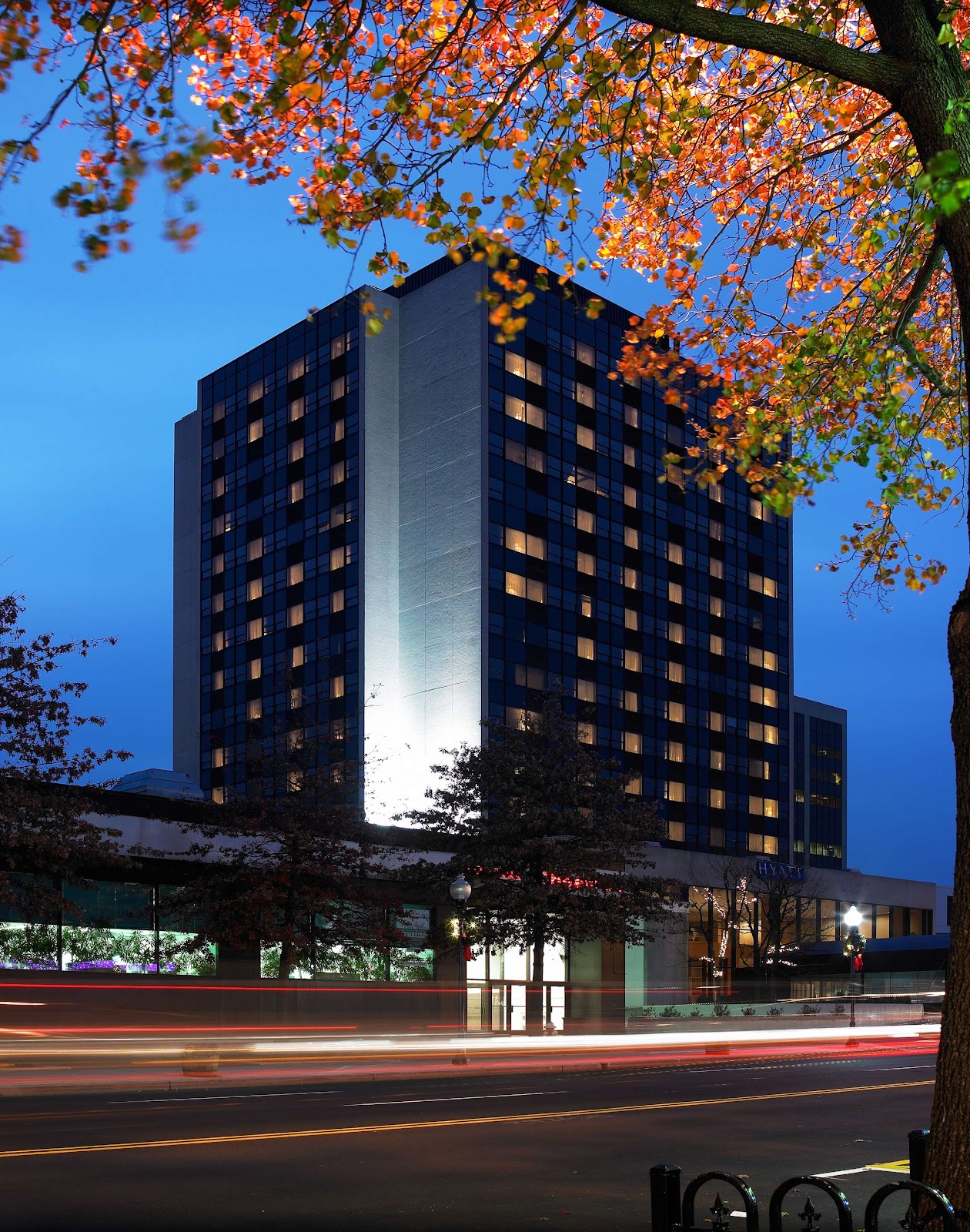
The problem at a modern chain hotel is not light and it is not capability. It is that the interiors could be anywhere.
That is by design and it is not a criticism. A hotel of this kind is built to a specification that works reliably in any city: neutral finishes, even lighting, flexible function rooms, comfortable guest rooms with good windows, and nothing that dates or distracts. It is an excellent place to hold a wedding and a difficult place to make photographs that belong to a particular day in a particular place.
Three consequences follow. The wide frames are interchangeable — a function room in a hotel like this looks like a function room in a hotel like this, wherever it is. The light is even and pale, which means separation rather than illumination is the technical problem. And there is very little texture or incident anywhere, which puts all the weight on the people and the composition.
The counterpart, and it is a large one, is the location. Morristown is a historic northern New Jersey town with a green, brick and clapboard architecture, mature street trees and real seasons — which means everything the building withholds is available within a short walk.
So the problem has a straightforward shape: the hotel supplies capability and comfort, and the place supplies identity. A set of pictures made entirely inside is competent; a set that uses both is of somewhere.
There are four ways out. We have not photographed a wedding at the Morristown Hyatt; modern hotels of this class behave consistently. Which rooms are included, whether the ballroom lighting can be dimmed, what the guest room outlook and floor level are, what the actual timings are, and whether stepping out during the evening is possible are questions for their team.
Morristown Hyatt at a glance
| Where | A modern hotel in Morristown, northern New Jersey |
| The problem | Neutral, even, anonymous interiors that could be in any city |
| Way one | The guest room window, which is the best light in the building |
| Way two | Find the dark. Way three: work close and precisely |
| Way four | Go outside — the town is the thing the building cannot supply |
Ways one and two: the window, and the dark
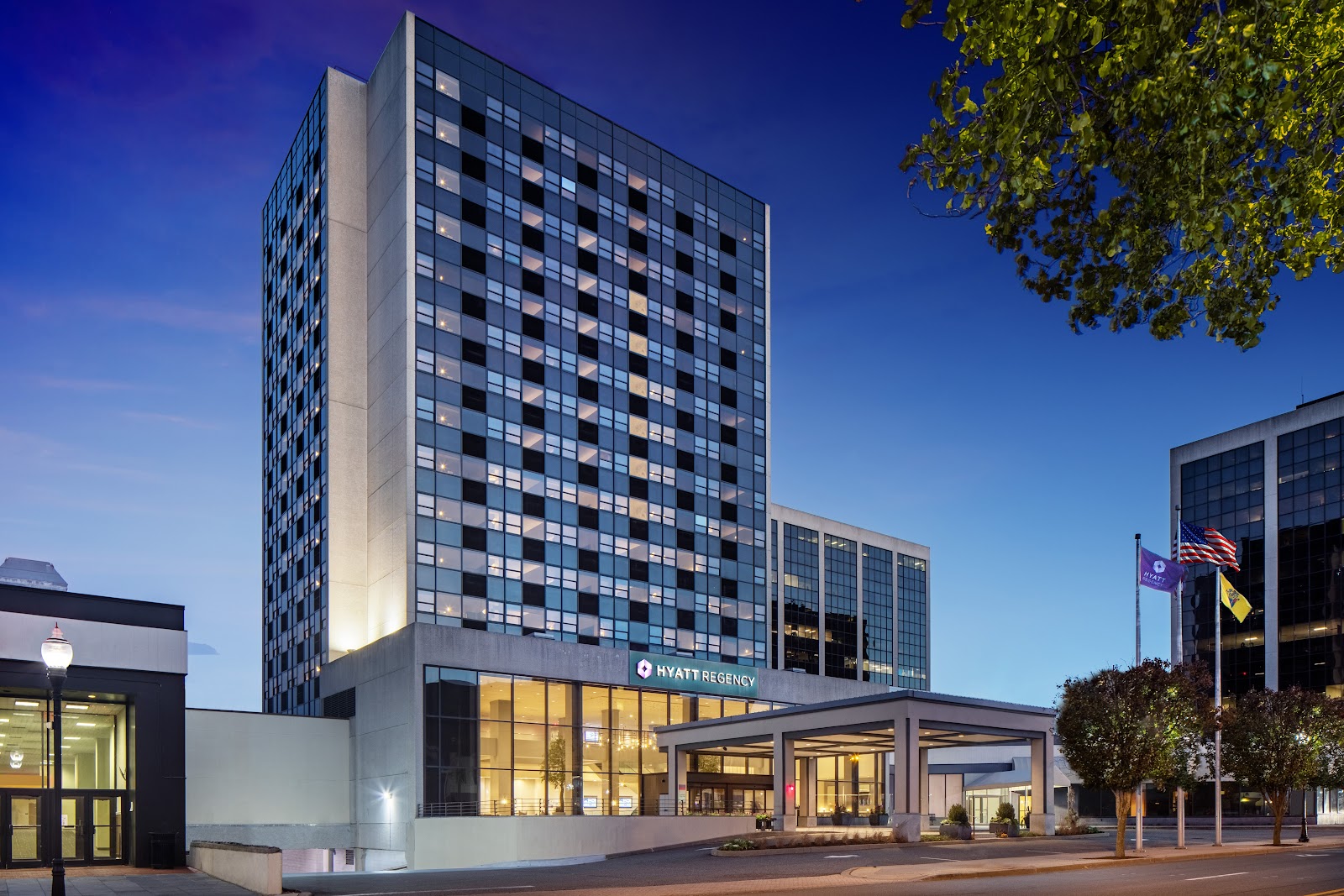
The first way out is the guest room window, and at a modern hotel it is the single best light available in the building.
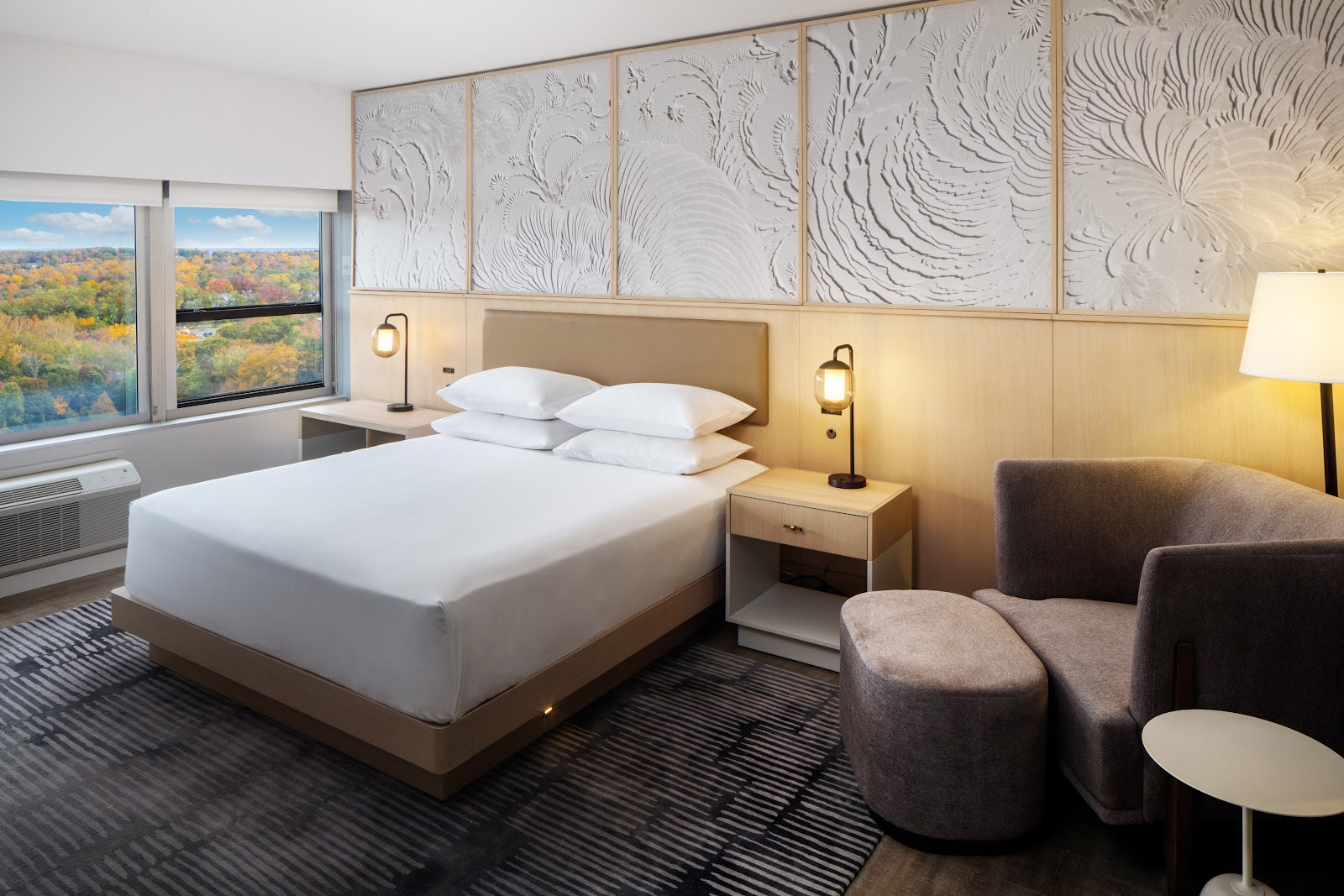
Modern guest rooms have generously glazed windows, often floor to ceiling or close to it, in rooms of modest depth with pale walls. That gives abundant soft light — and the important part is that the window is still much brighter than anything bouncing around the room, which means it is directional even in a space that fills every shadow.
A subject a metre from the glass, turned about forty-five degrees to it, gets a lit side, a shadowed side and a gradient between them. That is real modelling, and it is available in every guest room on every floor at any time of day. The catchlight confirms it: broad and low on the window side of each eye.
Two free rules and both matter here. Turn the room lights off, because warm bulbs against cool daylight put two colours on one face and no white balance renders both. And set a custom white balance on a face in position, because window light is the colour of whatever is outside — sky is cool, a sunlit brick building opposite is warm, and a street tree in leaf is green.
The floor level is worth asking about, because it changes what is behind the subject as well as what lights them. A high floor looks over rooftops and tree canopy; a low one looks at the building opposite or a car park. And a room on the side of the building away from direct sun gives soft even light all day, which for preparations is better than one that gets a hard shaft through it at eleven.
A pale room is also a large soft reflector, which means a subject can be lit from the window on one side and filled by the wall on the other with nothing added. The cost is that the fill removes contrast, which is the next problem.
The second way out is to find the dark, and in a pale modern hotel that is a deliberate search rather than something that happens by itself.
The reason it matters is that soft bounced light against pale walls gives no fall-off, no shadow side and no tonal separation — so a frame reads flat and, worse, it reads the same wherever in the building it was made. Contrast is what makes a picture have structure, and in a building like this it has to be found or built.
What qualifies is anything two or more stops below the subject’s own light. A doorway with an unlit room behind it. A corridor receding away from a window. A lift lobby, a stairwell, a service passage. A dark panel, a dark-framed mirror, a dark piece of furniture. Drapery pulled across part of a window, which turns a bright wall into a dark one.
Walking the building once and listing three or four of those is ten minutes of work and it is the difference between a varied set of pictures and a uniform one.
The exposure follows: metering on skin, in manual, and letting the dark background stay dark. The correction is the opposite of the one that applies in the rest of the building, where large pale surfaces make a meter underexpose — which means a day here needs the metering corrected in both directions depending on where the camera is pointing.
And where nothing dark exists, it can be built: one source at a stop above the ambient, off the camera axis, restores the shadow side the room’s bounce has filled in. That is adding light in order to add contrast rather than illumination, which is the reverse of the usual reason and the right one here.
Ways three and four: precision, and the town
The third way out is precision, because a building without texture punishes approximation and rewards deliberate composition.
Modern interiors give long straight lines, flat planes, repeated elements — mullions, light fittings, chairs, columns, paving joints — and large plain surfaces. Those are compositional resources if they are used exactly: a subject placed against a large plain wall with deliberate negative space reads as intentional, and repetition used as a rhythm behind a subject reads as design.
The requirement is that the frame be square and level and the subject placed on purpose. A frame a degree off level against a long horizontal, or a subject positioned almost-but-not-quite deliberately, looks like a mistake — where the same imprecision would hide entirely in woodland or in an ornate room.
Height is the other precision tool and modern hotels have it: an upper-level walkway, a mezzanine, a stair, a landing looking down over a lobby. A position above floor level makes a large volume legible as a shape rather than as an expanse, which is the one frame wide-angle work at floor level cannot produce.
Working close is the other half of this. A longer lens at a wider aperture dissolves the anonymous background into tone, which means the frame becomes about a face rather than about a room — and at conversational distance the pictures are of the wedding rather than of the hotel. That is not avoidance; it is where the interest actually is.
The fourth way out is to go outside, and in Morristown that is a short walk rather than an expedition.
A historic New Jersey town centre gives four things the hotel cannot. Architecture with texture: brick, clapboard, stone and period detail, which takes raking light at the ends of the day and gives relief that a flat modern plane does not. A town green or park with mature specimen trees, which supply real canopy and a canopy edge — the single most reliable outdoor position anywhere, giving soft directional light in front and darkness behind.
Street geometry: a street is a canyon, so the light on the pavement depends on which way it runs and how high the buildings are, and an east-west street is lit along its length at the ends of the day while a north-south one is lit only around the middle. Two minutes with a map tells you which, and it is the difference between a strong exterior and a flat one.
And seasons. Northern New Jersey has four genuine ones, and a town’s street and park planting is deliberate and concentrated, which means October colour is present in quantity rather than scattered. That is the thing a neutral interior withholds absolutely.
The practical constraints are the ordinary urban ones. Doorways, recessed entrances, arcades and solid awnings are the midday shade and a town has them in quantity — a recessed doorway restricts daylight to a horizontal band that models a face properly, gives a dark surround, and cannot dapple. Public space has other people in it, which a longer lens and closer framing handles. And the walk has to be in the running order explicitly rather than hoped for.
The strongest argument for taking it is seasonal rather than aesthetic: twenty minutes outdoors in mid-October or after snowfall gives the whole set of pictures a place and a time that the building deliberately does not have. That is worth more than any amount of work in the lobby.
The ballroom, meanwhile, follows the standard method. Expose the ambient about a stop under what faces need so the room keeps depth, then add one warm-gelled source just above skin level with the white balance set to the gel. A modern hotel’s lower ceiling is a genuine advantage — it is a usable bounce surface, which a tall historic ballroom’s is not.
- The guest room window is the best light in the building; lights off
- Find three or four genuinely dark backgrounds before the day
- Square, level and placed on purpose — plain surfaces punish approximation
- Go outside: the town has texture, canopy, street light and seasons
- Bounce off the low ballroom ceiling; expose the room a stop under
The Morristown year
Northern New Jersey has four genuine seasons with hot humid summers and cold winters, and at a weather-independent hotel the calendar decides what the walk outside gives rather than whether anything works.
Winter is cold with snow in most years, and for the building it barely matters — the honest argument for a February date.
Where winter helps indoors is the guest room window. The December sun at this latitude reaches only about twenty-six degrees above the horizon, which means it enters almost horizontally and travels much further into a room than a high summer sun does — so the usable band beside the glass is much wider and the light arrives at exactly the head height a portrait wants. The best light in the building is better in January than in June.
Outside, snow transforms a town. It covers the ordinary clutter of a street, simplifies every background, turns the pavement into a reflector that lifts the shadowed side of every façade, and gives the widest brightness range available against dark brick or bare street trees. Snow fools a meter by about two stops toward underexposure, so deliberate overexposure relative to the camera is the rule.
And winter puts the after-dark street frames — lit windows, shopfronts, wet pavement doubling everything in reflection — inside a normal running order, because the light goes by half past four rather than after eight.
The costs are a short day, cold hands, batteries draining faster, and a cold camera fogging when carried from a winter street into a heated hotel. Spares in an inside pocket and bodies bagged until they warm.
Early spring is the weakest part of the year outdoors: bare street trees, grey ground and wet footing. Indoors it makes no difference, which is a legitimate reason to weight an April wedding inward.
Late spring is when the town’s street and park trees leaf out, which softens every urban frame considerably and gives real canopy on the green. New foliage transmits light beautifully — and it needs a custom white balance, because a preset renders transmitted green light badly.
Summer is hot and humid — commonly upper eighties Fahrenheit and above with high humidity — with afternoon thunderstorms a real feature from June into August. Indoors none of that matters; outdoors the middle of the day belongs to doorways and awnings rather than open pavement, and the mature canopy on a town green is genuinely cooler than the street.
The long summer days are the scheduling complication: the good low light arrives after eight in the evening, hours after a reception has started, which makes asking in advance about stepping out later the difference between getting it and not.
Autumn is the best season and it is the strongest argument for the walk. The humidity breaks in September, the air reaches its clearest of the year, and street and park trees in northern New Jersey turn from the middle of October into early November — oak russet, maple scarlet, beech bronze and tulip poplar yellow, over two or three weeks because the species turn at different rates.
Town planting is chosen deliberately and present in quantity, which means the colour is concentrated rather than scattered — and against brick, stone and clapboard it reads at full saturation. For a hotel whose interiors could be in any city, twenty minutes in October is what makes the pictures of Morristown.
More frames from Morristown Hyatt
Morristown Hyatt wedding photography: common questions
What is the problem with a modern chain hotel?
The interiors are neutral and even by design, which means the wide frames are interchangeable and there is no texture or incident to build on.
What is the best light in the building?
A guest room window. A metre from the glass at forty-five degrees gives real modelling, with the room lights off and a custom white balance on the face.
Why is contrast the technical problem?
Pale bounced light against pale walls gives no fall-off and no shadow side, so frames read flat and identical wherever they are made.
How do I fix that?
Find three or four genuinely dark backgrounds — a doorway, a corridor, a stairwell — or add a source to create the shadow side the room’s bounce filled in.
Why does precision matter more here?
Plain flat surfaces punish approximation. A frame a degree off level or a subject placed almost deliberately looks like a mistake.
Is the walk outside worth it?
Yes, and it is short. The town has brick and clapboard texture, mature canopy, street geometry and real seasons — everything the building withholds.
More New Jersey venue guides
We are writing a photographer’s guide to every venue we would happily shoot in New Jersey. Here are three more, plus the full index:
- Morven Museum, Princeton: A Walk Through the Site
- New Jersey Performing Arts Center, Newark: The Building’s Own Logic
- Newark Museum of Art: A Walk Through the Site
Planning a wedding at Morristown Hyatt?
A capable building and a town outside it. Tell us your date and we will use both.