 The Hilton Garden Inn Fargo: Field Notes on a Standardised Hotel
The Medora Musical: The Light Through the Day
A west-facing bowl in eroded rock. The day builds to one thing.
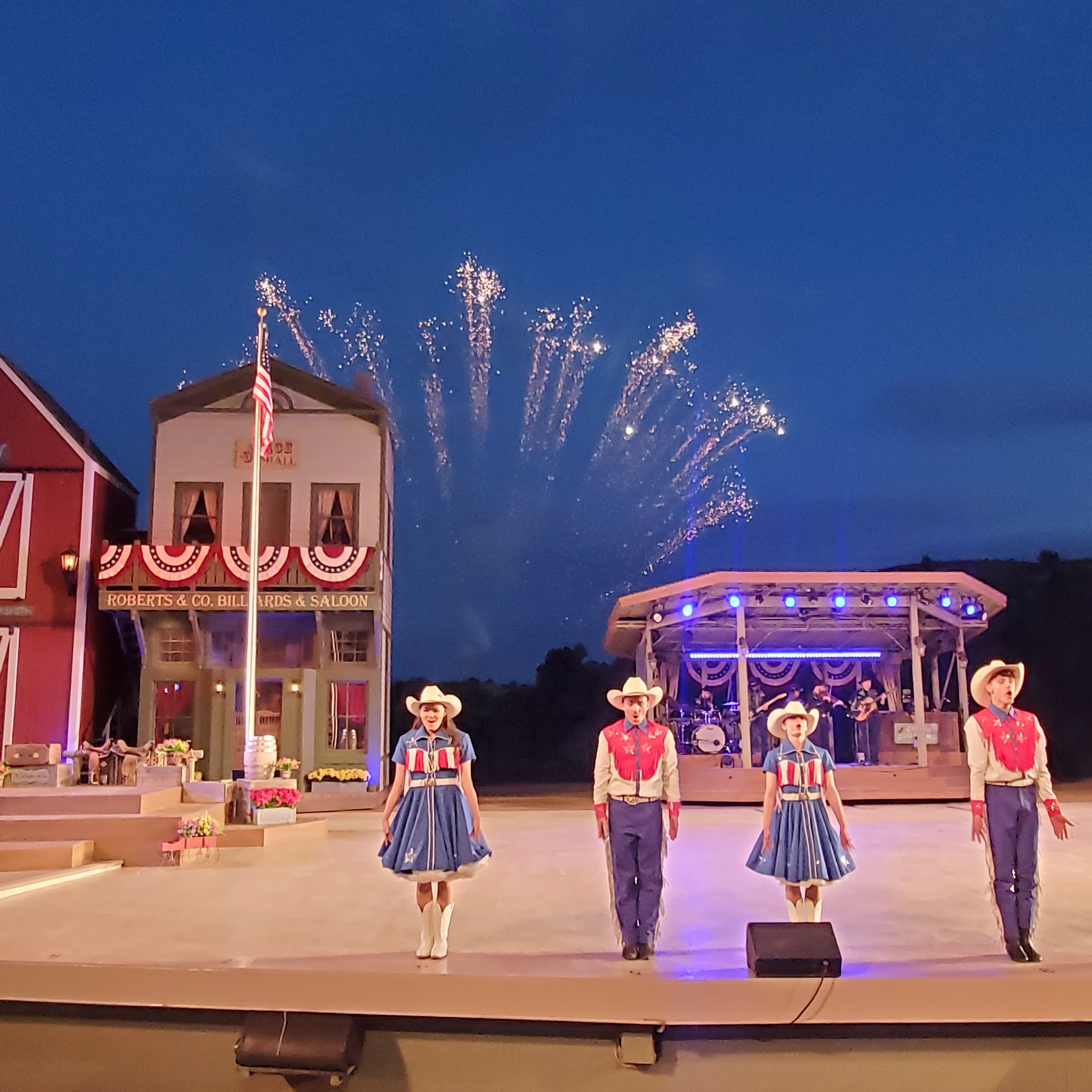
An outdoor amphitheatre built into a hillside is a bowl, and a bowl facing west is a specific photographic instrument.
The seating is cut into the slope, the stage sits at the bottom, and the whole thing opens toward the view — which here is the Little Missouri badlands, eroded into buttes and gullies and banded in genuinely different colours.
That orientation decides the entire day. A west-facing bowl is in its own shadow through the morning, lit across through the afternoon, and looking directly into the sunset at the end — which means the light goes from soft and flat, to raking and dramatic, to back-lit and extreme, in a predictable sequence.
The venue was built for an evening show and that is the clue: everything about it is arranged so that an audience sitting in the seats at eight in the evening is looking west at the badlands with the sun going down behind them. A photographer should work with that rather than against it.
The second thing to understand is the rock. The Little Missouri badlands expose soft sedimentary layers in horizontal bands — grey-blue bentonite clay, tan and buff sandstone, black seams of lignite coal, and red scoria where a coal seam burned underground and baked the clay above it.
Those bands read only in raking light. Under a high sun the buttes flatten into pale washed masses with the colour drained out; at low sun they separate, the reds saturate, and the whole landscape acquires relief. So the badlands and the amphitheatre want the same hours, which is convenient.
And the third is the exposure. This is open country at about forty-seven degrees north and roughly two thousand three hundred feet, with almost no shade and a great deal of wind. Days run from about eight hours twenty to fifteen hours fifty-five, the June noon sun reaches around sixty-six and a half degrees, the December noon sun about nineteen and a half, and civil twilight is roughly thirty-eight minutes — long.
What follows is the day in order. We have not photographed a wedding here; what the seating and stage access permit, the seasonal operating dates and the permitted hours are questions for the venue — and the show schedule is the one that matters most.
The Medora Musical at a glance
| Where | An outdoor amphitheatre cut into a badlands hillside near Medora |
| The orientation | West-facing: shadowed morning, raked afternoon, back-lit sunset |
| The rock | Banded sedimentary layers that read only in raking light |
| The design intent | Built so an evening audience looks west at the badlands |
| Ask first | The show schedule, seating and stage access, seasonal dates |
Morning into afternoon
The morning is the bowl’s quietest condition and it is more useful than it sounds.
A west-facing amphitheatre has the hillside behind it and the sun behind that, which means through the first hours the seating and stage are in their own shadow while the badlands beyond are front-lit. That gives a specific and rather good combination: a subject in soft even shade with a brightly lit banded landscape behind them.
The ratio needs managing — lit rock against shaded foreground is a three or four stop frame — but it is bridgeable with a modest source, and the shade on faces is genuinely flattering.
It is also the calmest part of the day. Overnight the ground cools and the air stabilises, so wind is at its daily minimum at dawn and builds through the morning. On a site where wind is the normal condition, that matters: anything needing stillness belongs in the first two hours.
The badlands are at their best in that window too, because the morning sun rakes them from the east. Buttes facing the amphitheatre are front-lit and their bands separate, the red scoria saturates, and the whole view has relief.
That is worth knowing because it reverses the usual advice. At most venues the landscape frames belong at the end of the day; here the view is lit in the morning and back-lit in the evening, so the two ends give completely different pictures rather than variations on one.
Through mid-morning the sun climbs and the bowl begins to catch light. By ten or eleven the upper seating is lit while the stage is still shaded, which produces a visible gradient down the slope — a condition worth using, because a subject positioned on the line between lit and shaded seating has a natural split.
Structure is the other morning subject. An amphitheatre’s seating is a repeating geometry of curved rows, and in raking morning light each row casts a shadow onto the one below — which turns the bowl into a pattern of concentric bands. A camera high on the slope looking down renders that as pure geometry, and it is the frame that shows what the venue is.
That wants the camera on the bowl’s axis and the light low. By midday the row shadows disappear and the seating flattens to a grey mass.
By the middle of the day the site is at its worst, which is the honest position. At sixty-six and a half degrees of noon sun elevation the badlands wash out, the seating flattens, and an open bowl with no shade is a difficult place for a portrait.
The redeeming detail is that a sixty-six-degree sun is meaningfully lower than the seventy-five to eighty-three degrees of the southern venues in this library, so even midday light here retains some angle. Faces are modelled rather than flattened, which makes the middle of a northern summer day workable in a way it is not further south.
Where shade is needed, it is the built structures — whatever roofed provision the venue has — or a carried diffuser with a braced assistant, because the wind will take anything on a stand. The only natural shade in this landscape is the cottonwoods along the Little Missouri, which are a walk away.
Afternoon to dark
The afternoon is when the bowl becomes what it was built for, and the sequence is worth planning precisely.
From about three o’clock the sun crosses to the west and begins to light the bowl across rather than from behind. The seating rows regain their shadows, the stage is lit, and the badlands beyond shift from front-lit to side-lit — which is arguably their best condition, because side light gives the buttes both colour and modelling.
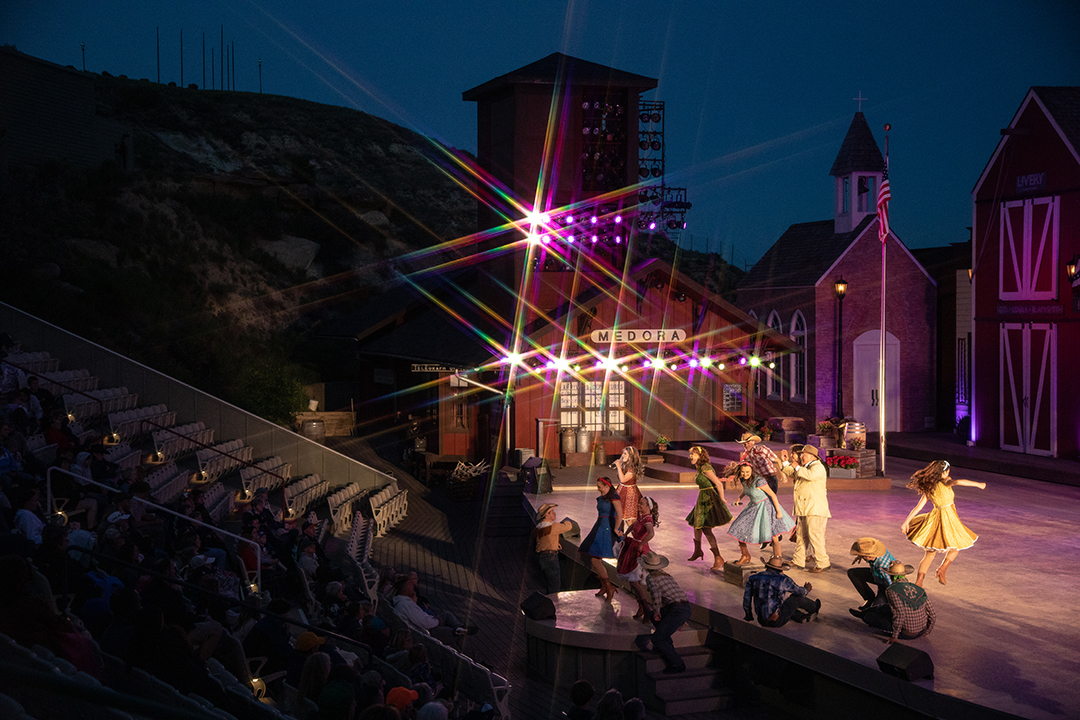
The last two hours are the venue’s peak. The sun is low and in front of the bowl, which means the seating and stage are lit from the audience’s side and everything is warm.
Then the geometry becomes extreme, and this is the part to decide about in advance. As the sun drops toward the horizon it is directly in the bowl’s view — so a camera on the slope looking down at the stage is shooting into it.
That gives three frames and they are all deliberate choices. A silhouette: subjects on the stage as shapes against a blazing sky and backlit badlands, which is technically trivial and graphically strong. A rim: subjects lit from behind with a fill on their faces at about a stop and a half under the sky, which needs real output because the sky is very bright. Or turn around and shoot up the slope, with the couple front-lit by the low sun and the seating rising behind them, which is the easiest good frame of the day.
The third is the one most people miss and it is the most reliable, because it puts the difficult light behind the camera.
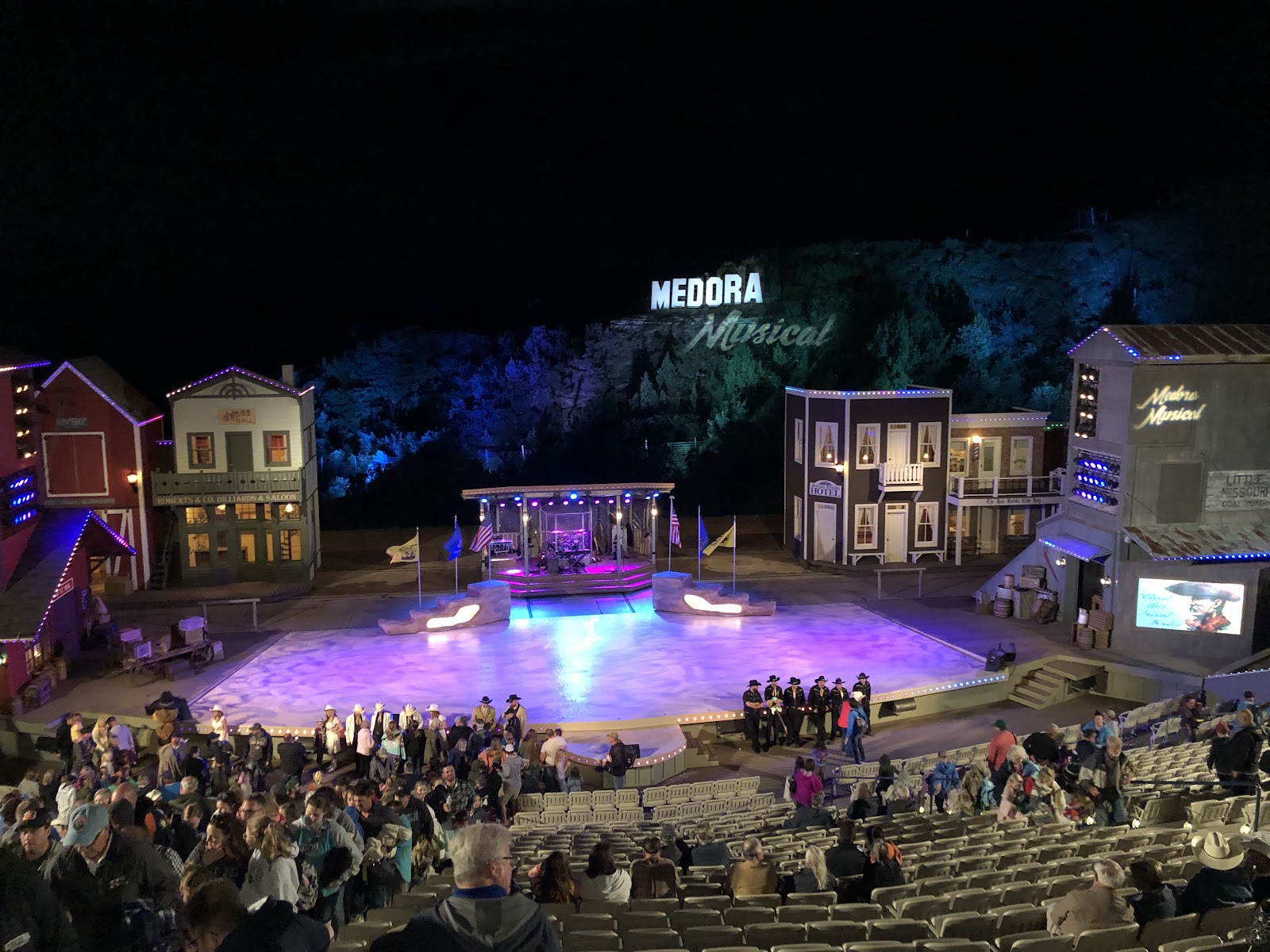
What follows is the reason to be here. Once the sun is down, the badlands go into shadow while the sky above them holds colour — and because the rock is banded and the sky is a northern one, the frame separates into layers: colour sky, dark banded buttes, and the bowl in shadow.
Civil twilight here runs about thirty-eight minutes, among the longest figures in this library, which turns that into a genuine working session rather than a scramble. Three or four distinct setups fit comfortably.
In June the sequence lands very late — sunset near nine-thirty and the blue hour after ten — which puts it well after dinner and makes it an easy ask of a party who have already relaxed. In late September it comes around seven-thirty, which is more conveniently placed.
The wind is the constant throughout. North Dakota is among the windiest states and an open bowl on a hillside offers nothing to interrupt the flow, which means a five-hundredth of a second for anything with hair or fabric and no modifier on an unweighted stand at any point.
A veil will be moving. Read the direction and rotate the couple so it carries across or away from the camera rather than into their faces — on a west-facing slope in an evening breeze that is usually straightforward, because the flow tends to come up the slope.
After dark the site’s remoteness becomes its best asset. The northern plains are among the darkest inhabited regions in the continental United States, and an amphitheatre cut into a hillside with no city within a long drive has a genuinely dark sky.
The Milky Way is plainly visible on any clear moonless night, and at forty-seven degrees north the aurora borealis is a real possibility several times a year, most likely near the equinoxes. A banded butte or a lit stage under a sky full of stars is a thirty-second tripod frame almost nowhere else in this library can offer, and a date near a new moon is worth more than any equipment.
- Morning: subject in bowl shade, badlands front-lit behind — a bridgeable ratio
- Shoot the seating geometry from high on the axis when the rows cast shadows
- In the last hour, turn around and shoot up the slope — the frame most people miss
- Thirty-eight minutes of twilight: three or four setups, and in June it is after ten
- No unweighted stands, ever; the wind is the normal state of the air
The show, the season and the rock
Two practical matters govern a wedding at a working outdoor venue and both are about the show.
An amphitheatre that runs a nightly production through the season has a schedule, and it is not flexible. Rehearsals, technical calls, cast arrival and an evening performance all occupy the site — which means a wedding either happens outside that window or in a space the production is not using.
That is the question to ask first, because it decides whether the venue is available at the hour when its light is best. An amphitheatre whose best frames are at eight in the evening and whose stage is occupied at eight in the evening is a scheduling problem rather than a photographic one.
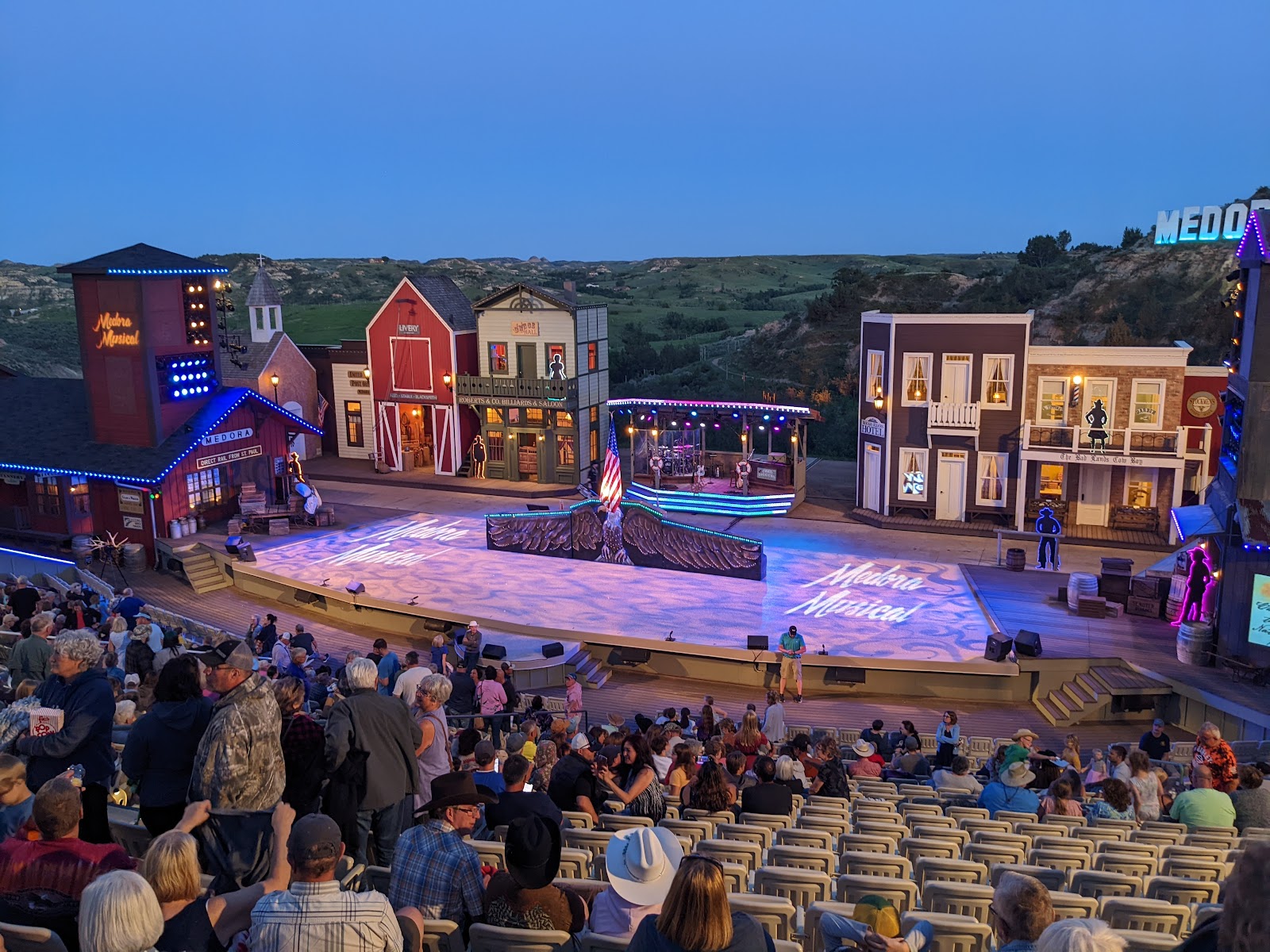
If the rig is available, it is a genuine asset. A working outdoor stage has lighting designed to be seen at dusk and after dark, which means there is already substantial output aimed at where people will stand — and asking for a neutral wash for five minutes of portraits is worth doing, because theatrical fixtures are heavily gelled and a magenta or amber face is unrecoverable toward neutral.
The season is the second matter and it is short. A remote outdoor venue in North Dakota operates through the summer and closes for the winter, and the dates are worth establishing precisely rather than assumed — the town’s whole economy is seasonal, and much of it shuts.
Ranking what remains: late August into September is the best window. The heat has broken, the air is clearing, the prairie grasses begin to turn russet, the days are still long enough to be comfortable, and the show is usually still running.
Late September into early October is better photographically and worse operationally. The cottonwoods along the Little Missouri turn clear yellow, the little bluestem goes full russet, the air reaches its clearest of the year, and the low sun rakes the banded buttes for most of a shortening day — but the season is ending and much of the town is closing.
That trade is real and it is worth resolving with the venue rather than hoping.
Summer is the operating season: long-lit at almost sixteen hours, with the badlands hazier and the heat reaching the nineties on open ground with almost no shade. It is also the busiest.
Spring is the weakest season and largely unavailable — cold into May, the prairie brown and dead before it greens, the cottonwoods bare, and bentonite slopes treacherous with melt.
Winter is severe and the site will be closed. Temperatures reaching twenty or thirty below, real blizzards, and about eight hours twenty of December daylight. What it gives, for anyone who could access it, is snow on banded badlands — the white filling gullies and ledges while exposed faces stay red and grey, which exaggerates the banding rather than hiding it.
One practical note about the rock that applies whenever anyone walks off a path. Bentonite clay becomes genuinely slick when wet and stays that way for a day or more after rain — not merely soft but greasy, in a way that matters for anyone in wedding shoes on a slope. That is a safety point rather than a fussy one.
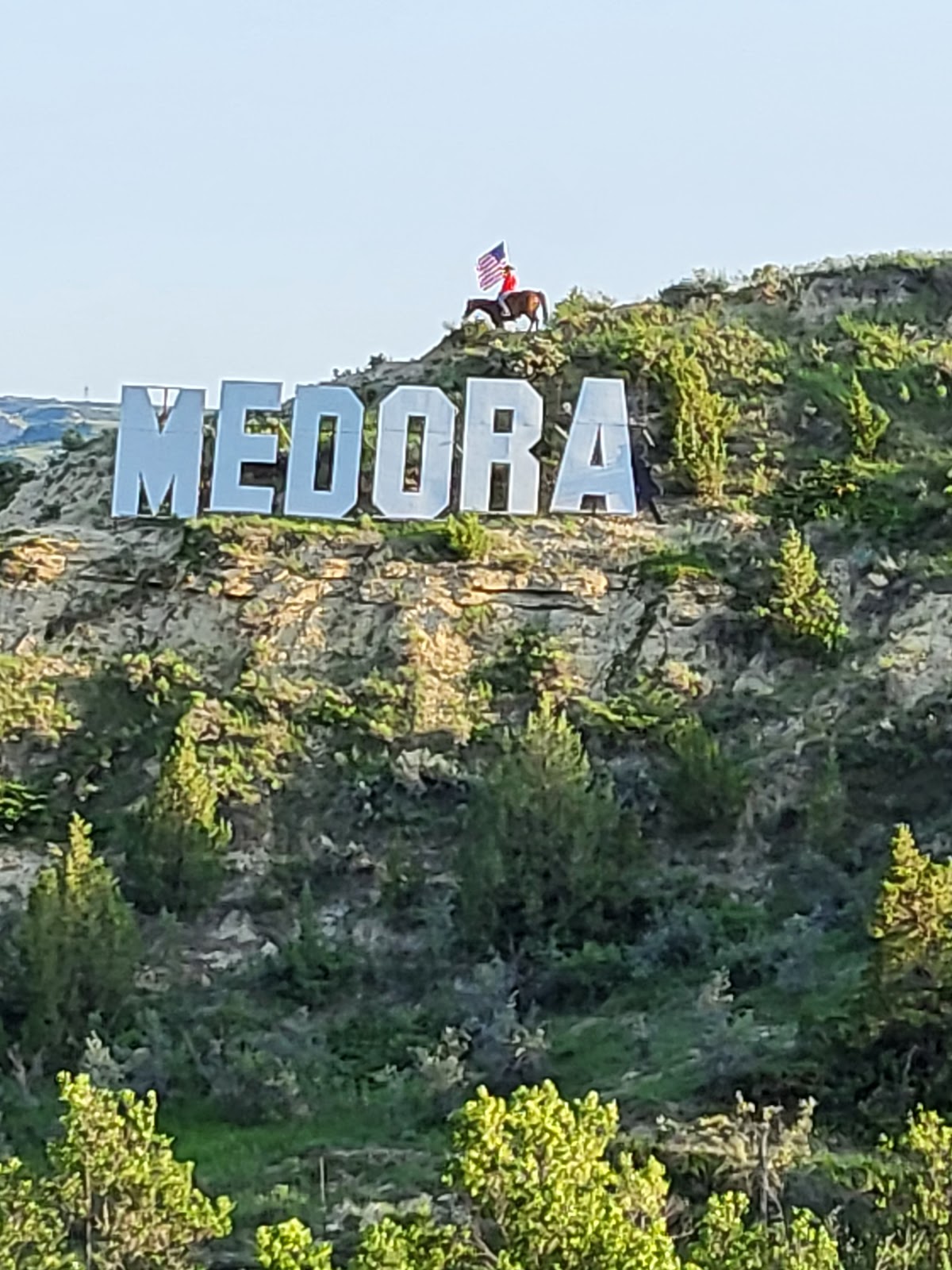
And the red scoria is worth seeking deliberately at low sun. Clay baked hard where a coal seam burned underground is a genuine brick red, and in late light it goes close to orange — which against blue-grey bentonite below and a deep northern sky above is the most saturated combination this landscape produces, and the single most specifically North Dakotan thing in any frame.
More frames from The Medora Musical
The Medora Musical wedding photography: common questions
How does the orientation shape the day?
A west-facing bowl is shadowed in the morning, raked in the afternoon and shooting into the sun at the end. The sequence is predictable and worth planning around.
What is the morning good for?
A subject in the bowl’s own shade with the badlands front-lit behind them — flattering light on faces with a lit landscape, at a bridgeable three or four stops.
What is the frame most people miss?
In the last hour, turn around and shoot up the slope. It puts the difficult sun behind the camera and gives front-lit faces with the seating rising behind.
When do the rock bands show?
Only in raking light. A high sun flattens the buttes into pale washed masses with the colour drained out.
What should I ask about first?
The show schedule. An amphitheatre whose best light is at eight in the evening and whose stage is occupied then is a scheduling problem.
Is there a safety issue underfoot?
Yes. Bentonite clay becomes genuinely slick after rain and stays greasy for a day or more — a real consideration on a slope in wedding shoes.
More North Dakota venue guides
We are writing a photographer’s guide to every venue we would happily shoot in North Dakota. Here are three more, plus the full index:
- The Rough Riders Hotel, Medora: The Venue’s Own Logic
- The Bonanzaville, West Fargo: The One Decision That Governs Everything
- The Chateau de Mores, Medora: A Walk Through the Building
Planning a wedding at The Medora Musical?
A bowl facing west over banded rock. Tell us your date.