 The Thunderbird Inn: Field Notes on a 1964 Motor Inn
The Fox Theatre, Atlanta: Four Ways Out of the Atmospheric Theatre Problem
A picture palace was designed to make a room disappear when the lights went down. That is the problem.
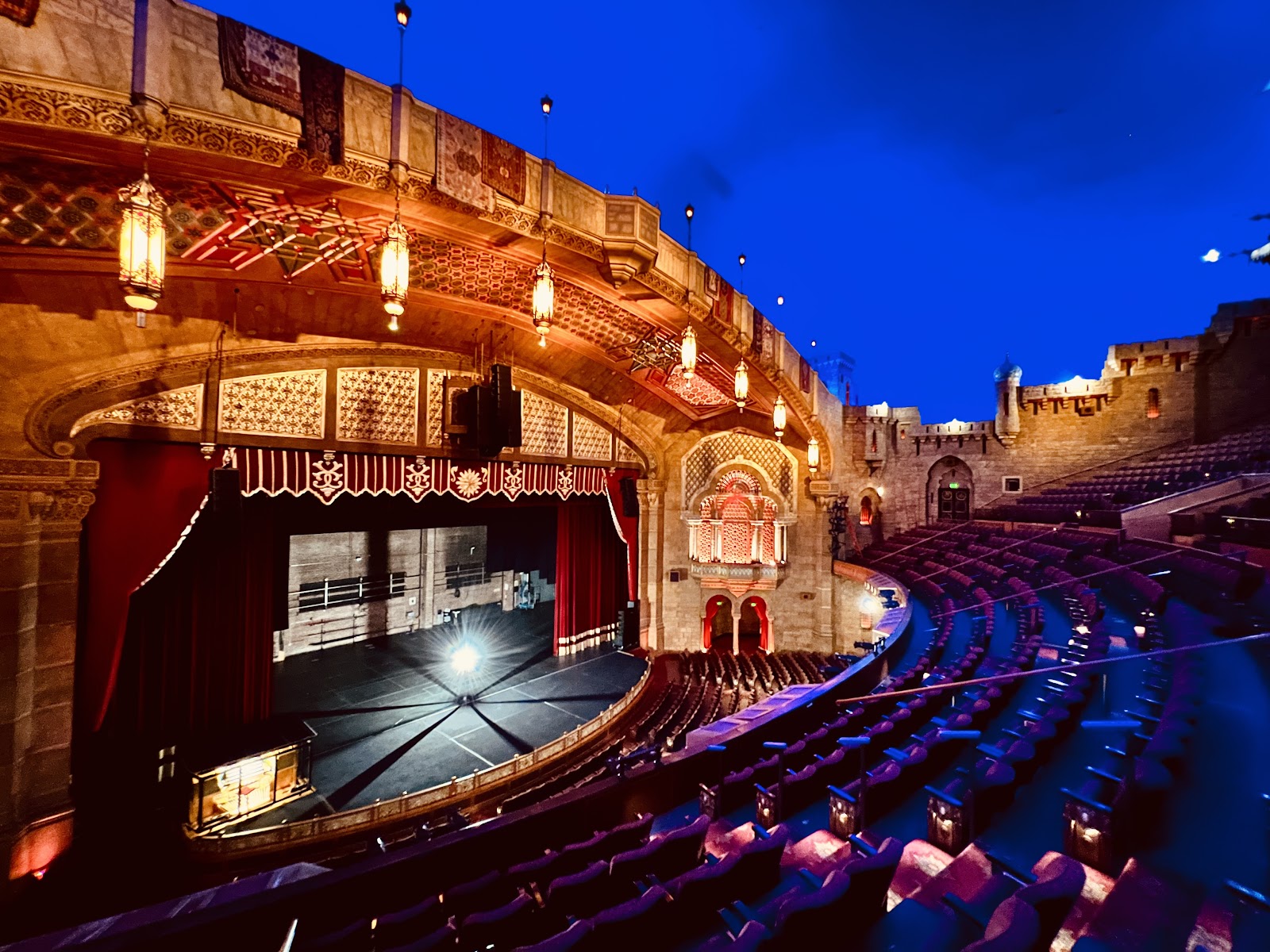
The Fox Theatre’s rich colours, intricate architectural detail and grand stage combine, as its own description has it, into a setting that is both spectacular and deeply historic.
All of that is true and all of it sits inside a building designed for the opposite of photography. An atmospheric picture palace of this era was engineered so that when the house lights dimmed, the architecture would recede and the audience’s attention would go to a lit screen or stage — which meant deep colours that absorb light, elaborate three-dimensional ornament in shadow, and an enormous volume with no reflective surfaces in it at all. Everything that makes the room spectacular to stand in makes it difficult to photograph in.
That is not a reason to avoid it. It is a reason to arrive with a decided approach rather than a general one. This is written as the problem and four ways out of it. We have not photographed a wedding at the Fox; atmospheric theatres of this period behave consistently. What the house lighting can be set to, whether the stage rig is available, who operates it, and where a photographer may stand are the questions for their team.
The Fox Theatre at a glance
| Where | Atlanta, Georgia |
| Character | A historic atmospheric picture palace with elaborate ornament and a stage |
| The problem | Deep colours, huge volume and no reflective surfaces — it eats light |
| The payoff | Frames no other venue in the city can produce |
| Ask first | House lighting control, stage rig availability and operator, positions |
Why an atmospheric auditorium eats light
Four things are happening at once and it is worth separating them, because only one of them is solved by ISO.
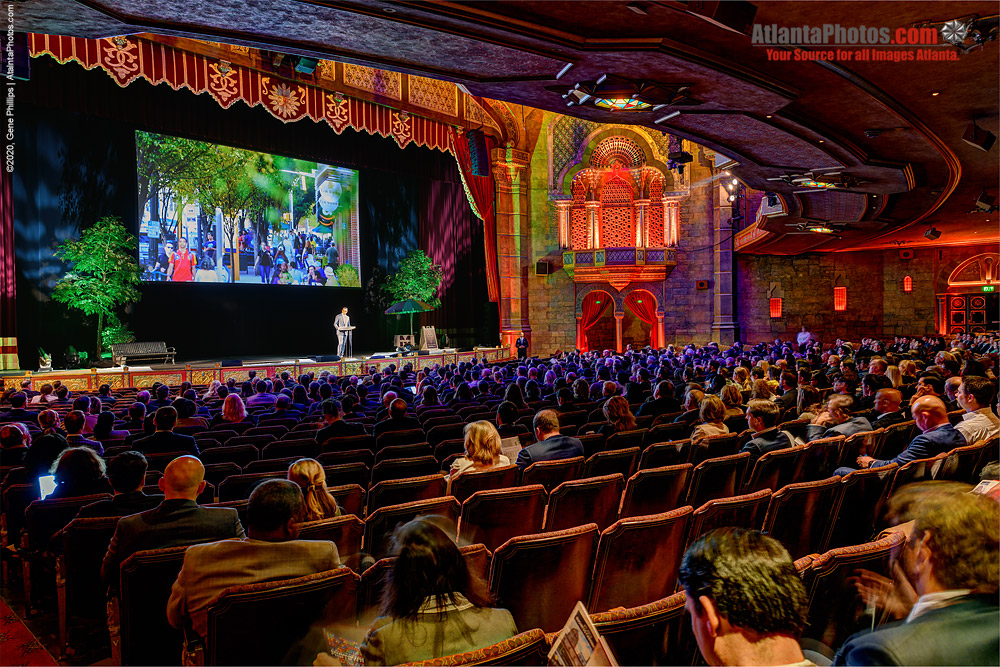
The first is absorption. Deep-toned paint, heavy textiles, carpet and upholstery are chosen to reduce reflection so that a lit stage reads brightly against them — and usable room light is mostly bounced light, so a room where everything absorbs has far less of it than its fittings suggest. Two rooms with identical lamp counts, one pale and one deep-toned, differ by two stops or more.
The second is volume. An auditorium ceiling is far beyond the reach of any flash, which removes bounce entirely, and the distances are real — a source adequate in a hotel ballroom simply will not carry. Power and modifier choices have to assume real working distance.
The third is direction. House lighting exists so an audience can find a seat, which means it is low-level, warm, and mounted overhead. That is the classic problem in its strongest form: eye sockets in shadow, a hard line down from the nose, an unlit chin — and at a level low enough to force a high ISO on top of it.
The fourth is the ornament itself. Elaborate architectural detail is three-dimensional, and three-dimensional things read only when light crosses them at an angle and casts small shadows. Under the flat downward wash of house lighting, the most spectacular ceiling in the state photographs as a brown field.
The compensation is steep fall-off, and it is genuinely useful: in a large dark room a subject three metres in front of anything else sits against natural darkness with no equipment at all. That is free separation and it is the opposite of the pale-hotel problem.
Four ways out
The first way out is a single source at face height, gelled warm to match the house tungsten, off the camera axis, exposed so the room still reads as the dim ornate space it is. Set white balance to the gel and hold it for the whole block. The aim is not to light the theatre — it cannot be lit — but to put a catchlight in the eyes and an edge on a shoulder while everything else stays as dark as it actually is. A theatre lit to an even brightness stops being a theatre.
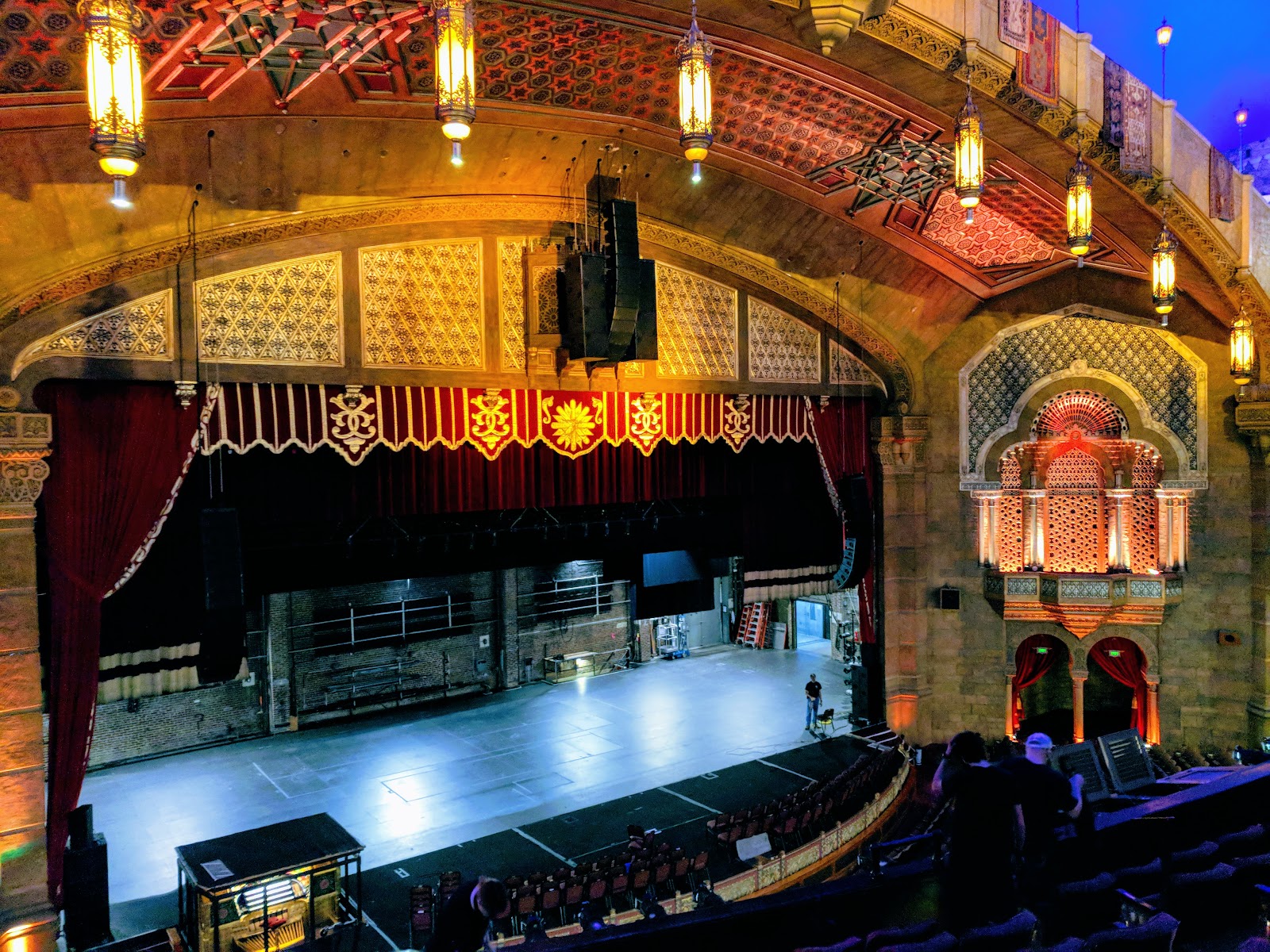
The second way out is the stage rig, and it is the biggest single question in the building. A theatrical rig gives a hard key from a defined angle, a warm wash, and the option of a single pool of light on an otherwise dark stage — and a couple standing in that pool in front of an empty house is one of the strongest frames any venue can produce. It needs no equipment of yours; it needs a board operator, which is why it belongs in the contract rather than in a conversation on the night.
Coloured washes are a separate matter and need treating as an effect rather than a portrait source: a saturated wash renders skin unrecoverably in its own colour, and two coloured sources on one face have no single correction. Under one, either commit to shape and silhouette deliberately or put your own neutral source on the faces and let the wash light the set behind.
The third way out is to graze the ornament rather than facing it. One source placed to one side of a proscenium arch, a column or a balcony front puts a small shadow beside every moulding and the detail returns — a one-light problem rather than a big-kit one. And if the house lights can be brought up plain for a few minutes before guests arrive, that is when the room can be photographed as a room rather than as a dark volume.
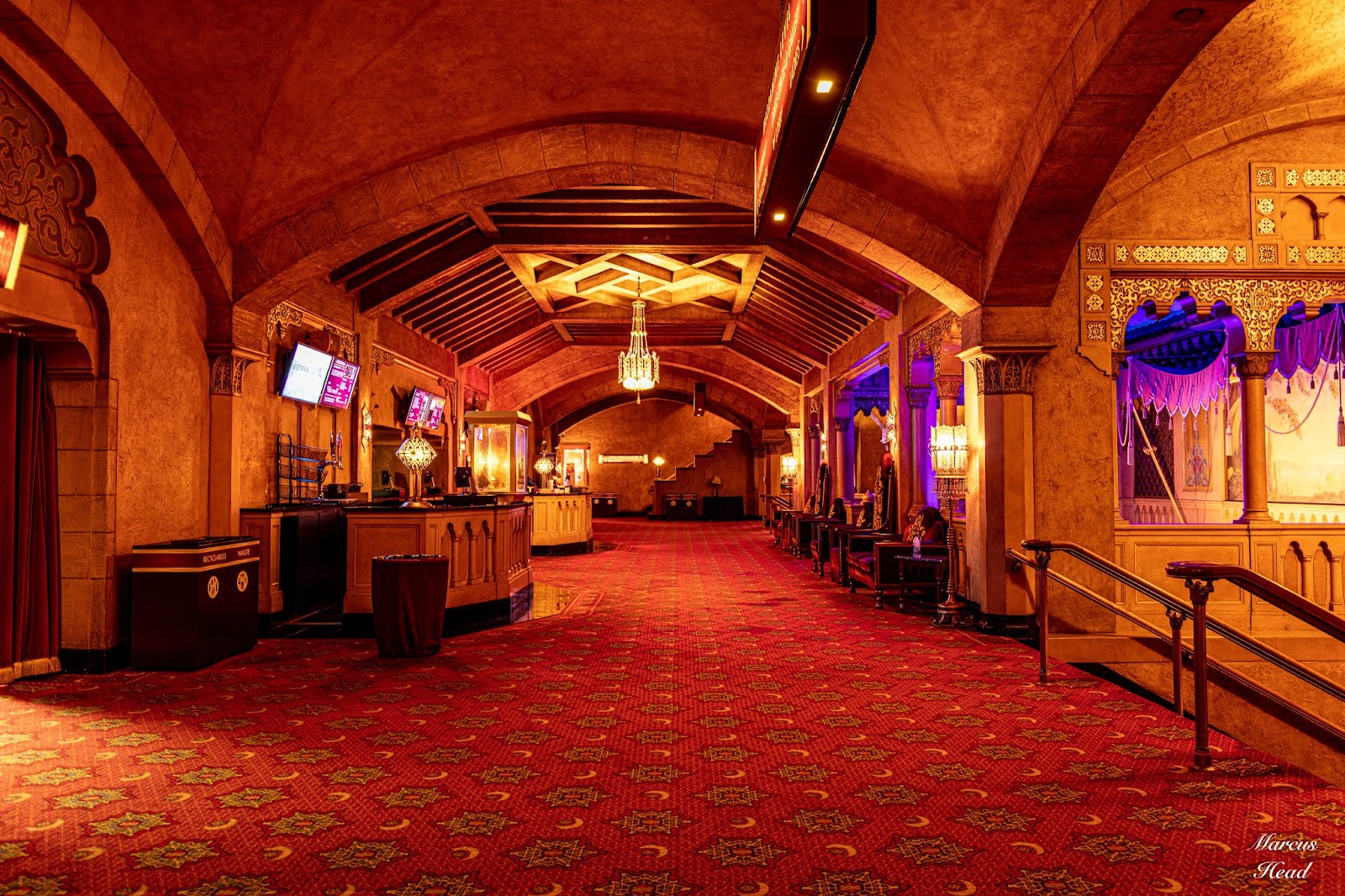
The fourth way out is the lobby and the front of house, which is where a picture palace keeps its daylight. Foyers of this era have tall street-facing glazing, generous stair halls and often a first-floor lobby with windows — and those are the best-lit rooms in the building by a wide margin. Anything that needs to be flattering belongs there, and the lobby’s own ornament is usually as elaborate as the auditorium’s while being several stops brighter.
The view from the stage towards the house is the frame most people miss: rows of seating receding into darkness make a background of pure repetition, and standing on a stage is a place almost nobody is ever photographed.
- One warm-gelled source at face height, a stop under the room
- If the stage rig is available it beats anything you can carry
- Under a coloured wash: commit to shape, or add neutral light on faces
- Graze the ornament with one source, or the ceiling photographs as brown
- Do the flattering work in the lobby; it is several stops brighter
The marquee, the street, and Atlanta's weather
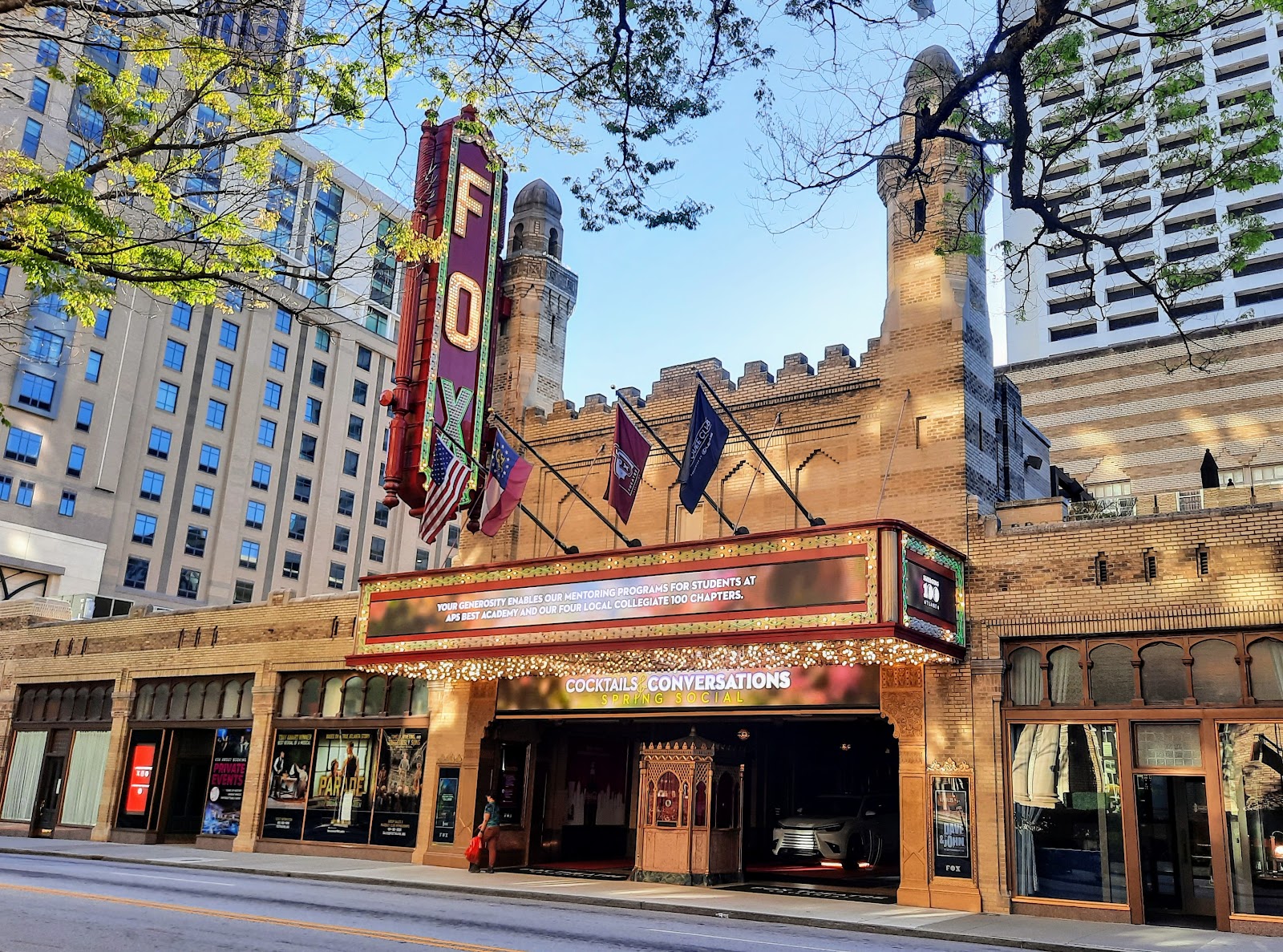
A picture palace has one exterior frame that no other venue type offers, and it is time-critical. A lit marquee against a sky that still holds colour is the image the building type is known for, and it exists only in the twenty to thirty minutes after sunset — before that the sign is invisible against a bright sky, and after it the sky is black and the frame becomes a lit sign floating in nothing.
The reason is a brightness comparison: a marquee is several stops dimmer than a daylit sky and brighter than a night street, so only during the crossing do both sit inside one exposure. Take the sunset time, add fifteen minutes, be standing in the street with the couple already there, and bracket a sequence as the sky falls.
It also needs confirming that the marquee will be lit, which outside performance hours is a request rather than a given — and it is the single question that determines whether this frame exists at all.
At street level, Atlanta’s geography matters. The city’s towers are clustered rather than continuous, which produces deep canyons where direct low sun rarely reaches the ground; the lower-rise fabric nearby is where raking light is, and it is usually a short walk. Canyon light itself is soft, even and bounced down from lit facades, which is good portrait light available for much of the day even though it is not golden-hour light.
Atlanta’s tree canopy is abundant — this is one of the most heavily wooded major cities in the country — so mature shade is rarely far away and it is the midday resource outdoors. Dapple is its hazard: hot spots several stops above the surrounding shadow, shifting with any breeze, so full shade, open light, or wait.
Summer heat and humidity make long outdoor blocks genuinely difficult, and afternoon thunderstorms are close to a daily feature rather than an occasional event. A sealed theatre is, for once, the ideal weather plan — the interior day is completely unaffected by the sky. The only casualty is the marquee frame, which needs the sky, so on an unsettled evening it is worth taking early and taking twice.
Humidity produces the region’s equipment problem: a camera chilled by a strongly air-conditioned theatre fogs comprehensively the moment it reaches the outside air and can take many minutes to clear — which in a twenty-minute marquee window is a real risk. Put a body out into ambient air well before that window rather than carrying it out cold. And in spring, pine pollen in late March and April coats surfaces in a visible yellow film and hangs in the air, which affects guests as much as equipment.
More frames from The Fox Theatre
The Fox Theatre wedding photography: common questions
Why does the auditorium eat light?
Four reasons at once: deep-toned surfaces absorb rather than bounce, the volume is too large for any flash, house lighting is low and overhead, and the ornament is three-dimensional so flat light flattens it.
How should the interior be lit?
One warm-gelled source at face height, off the camera axis, exposed so the room still reads as dim and ornate. The aim is a catchlight and a shoulder edge — a theatre lit evenly stops being a theatre.
Is the stage rig worth asking for?
It is the biggest question in the building. A single pool of light on a dark stage with a couple in it is one of the strongest frames any venue can produce, and it needs a board operator rather than equipment.
What about coloured washes?
Treat them as an effect. A saturated wash renders skin unrecoverably in its own colour, and two coloured sources on one face have no single fix. Commit to shape, or add neutral light on the faces.
Where is the flattering light?
The lobby and front of house. Foyers of this era have tall street glazing and stair hall windows, so they are several stops brighter than the auditorium — and just as ornate.
When can the marquee be photographed?
Twenty to thirty minutes after sunset, and only then. Before it the sign is invisible against a bright sky; after it the sky is black and the frame is a sign floating in nothing.
More Atlanta, GA venue guides
We are writing a photographer’s guide to every venue we would happily shoot in Atlanta, GA. Here are three more, plus the full index:
- The Georgian Terrace, Atlanta: Field Notes on a Historic Hotel
- The Goat Farm Arts Center, Atlanta: A Walk Through an Industrial Site
- The King Plow Arts Center, Atlanta: Field Notes on a Converted Factory
All Atlanta, GA Wedding Venues →
Planning a wedding at The Fox Theatre?
Ask about the rig and the marquee. Tell us your date and we will ask for you.