 The Thunderbird Inn: Field Notes on a 1964 Motor Inn
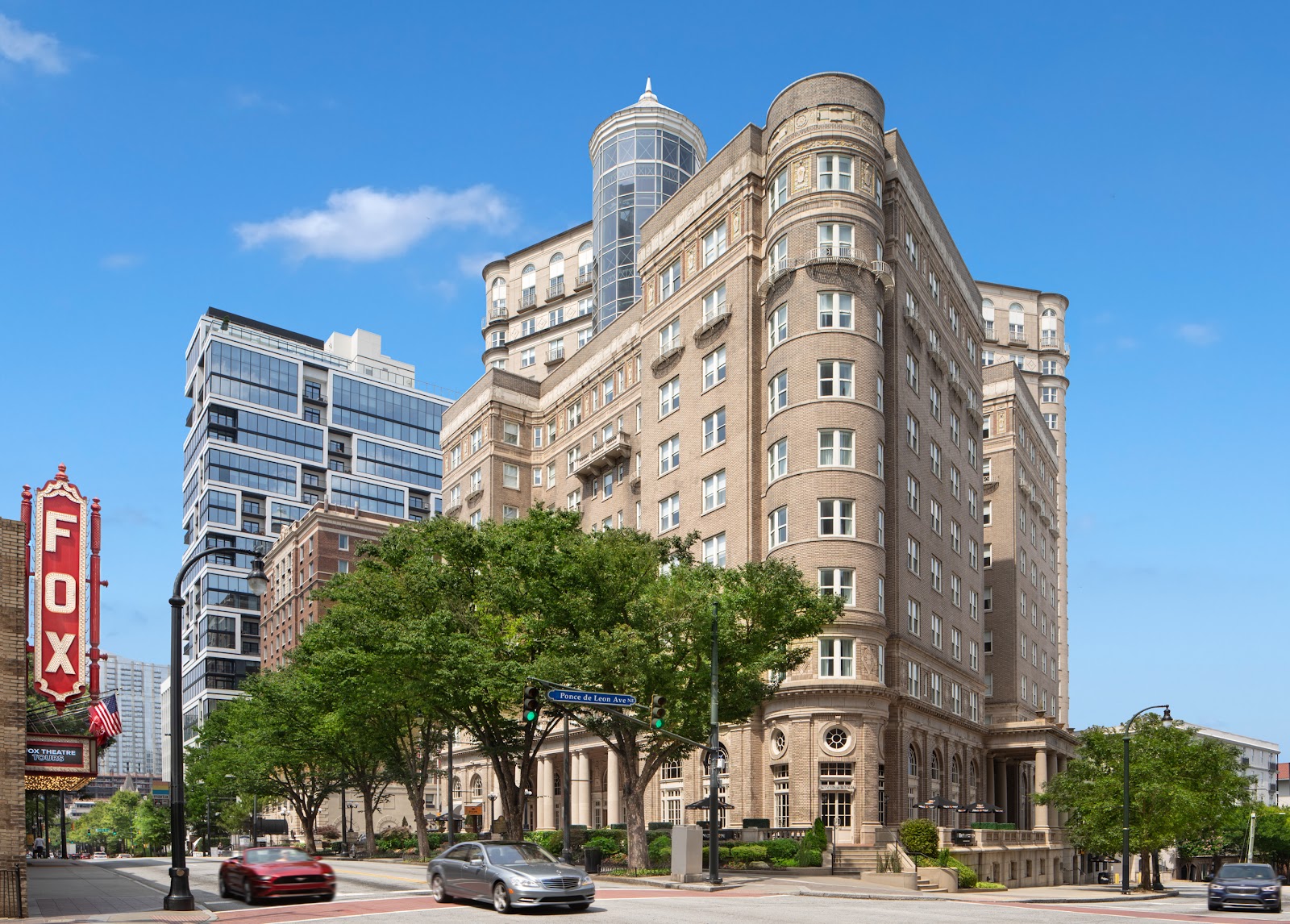
The Georgian Terrace, Atlanta: Field Notes on a Historic Hotel
A hotel named for its terrace is telling you where to look. The terrace is a different venue from the hotel.
The Georgian Terrace is one of those Atlanta locations that catches the eye immediately — and, as the original description was honest enough to say, we have not shot there either.
A historic hotel with a named terrace is really two venues in one booking, and the naming is a clue worth following. The interiors are period: warm, ornate, absorbing, and lit by a house scheme that does not change from mid-morning to midnight. The terrace is outdoors: open to the sky, tied to the street, swinging four or five stops through the day, and changing character completely between noon and dusk. One of those can be photographed at any hour and the other cannot.
These are field notes: the conditions you will meet in each and what they need. We have not photographed a wedding at the Georgian Terrace; historic hotels with terraces behave consistently. Which spaces are included, whether the terrace and any rooftop are exclusive, and whether the ballroom lighting is adjustable are the questions for their team.
The Georgian Terrace at a glance
| Where | Atlanta, Georgia |
| Character | A historic hotel with period interiors, a terrace and rooftop space |
| Two venues | Interiors that never change, and outdoor space that changes hourly |
| Best hours outdoors | The last ninety minutes, and twenty after sunset |
| Ask first | Spaces included, terrace and rooftop exclusivity, lighting control |
What you meet indoors, and what each one needs
Low ambient is the first condition of a period interior and its cause is the surfaces rather than the windows. Usable room light is mostly bounced light, and timber, patterned carpet, deep paint and heavy textiles absorb rather than return it — so two rooms with identical windows, one panelled and one painted pale, differ by two stops or more.
That means bounce flash does very little. A flash aimed at a timber ceiling or a patterned wall returns a fraction of what it returns in a white-walled room, and what comes back arrives warm. Test it with one frame on arrival; where it fails, a pale wall at a sensible distance is the better surface and direct modified light better than either.
Warm bounce is the second condition and it is the colour problem. Timber, brass and warm paint reflect strongly warm, and the cast arrives on the shadow side of a face from several directions at once — bounced and localised, so global white balance cannot separate it. Let one gelled source be the authority on faces, with white balance set to it, and allow the room to be as warm as it is.
Ornament is the third and it needs the opposite of what a modernised period hotel provides. Plasterwork, cornices and joinery are three-dimensional, so they read only when light crosses them at an angle and casts small shadows; under even downward lighting the same ornament flattens into a pale field and a room photographs blander than it looks. One source placed to graze a surface rather than face it brings the detail back.
High ceilings in the public rooms are the fourth, and they combine with the first to make the interior a genuinely light-hungry environment — which is the compensation as well, because steep fall-off gives free separation: a subject three metres in front of anything else sits against natural darkness.
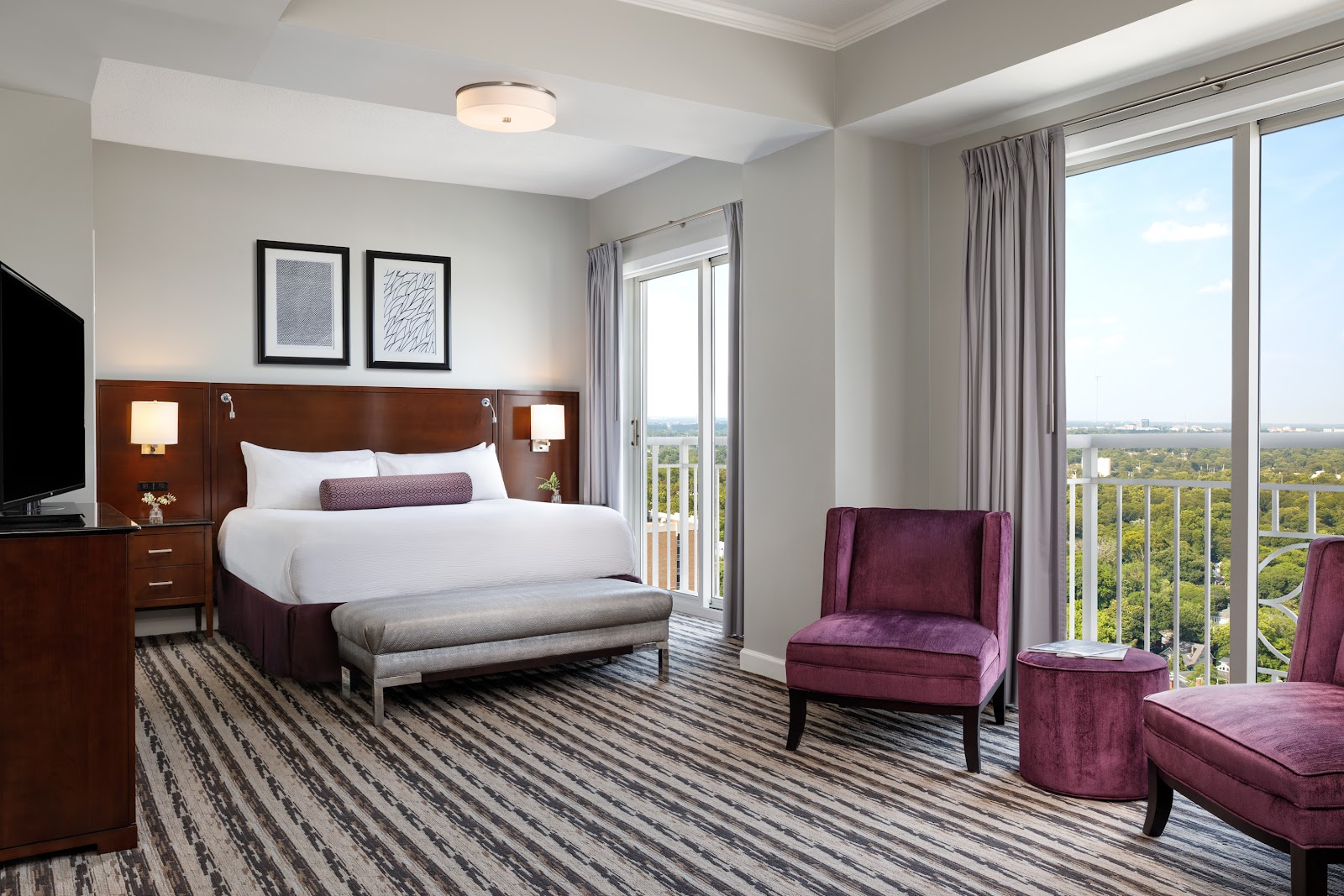
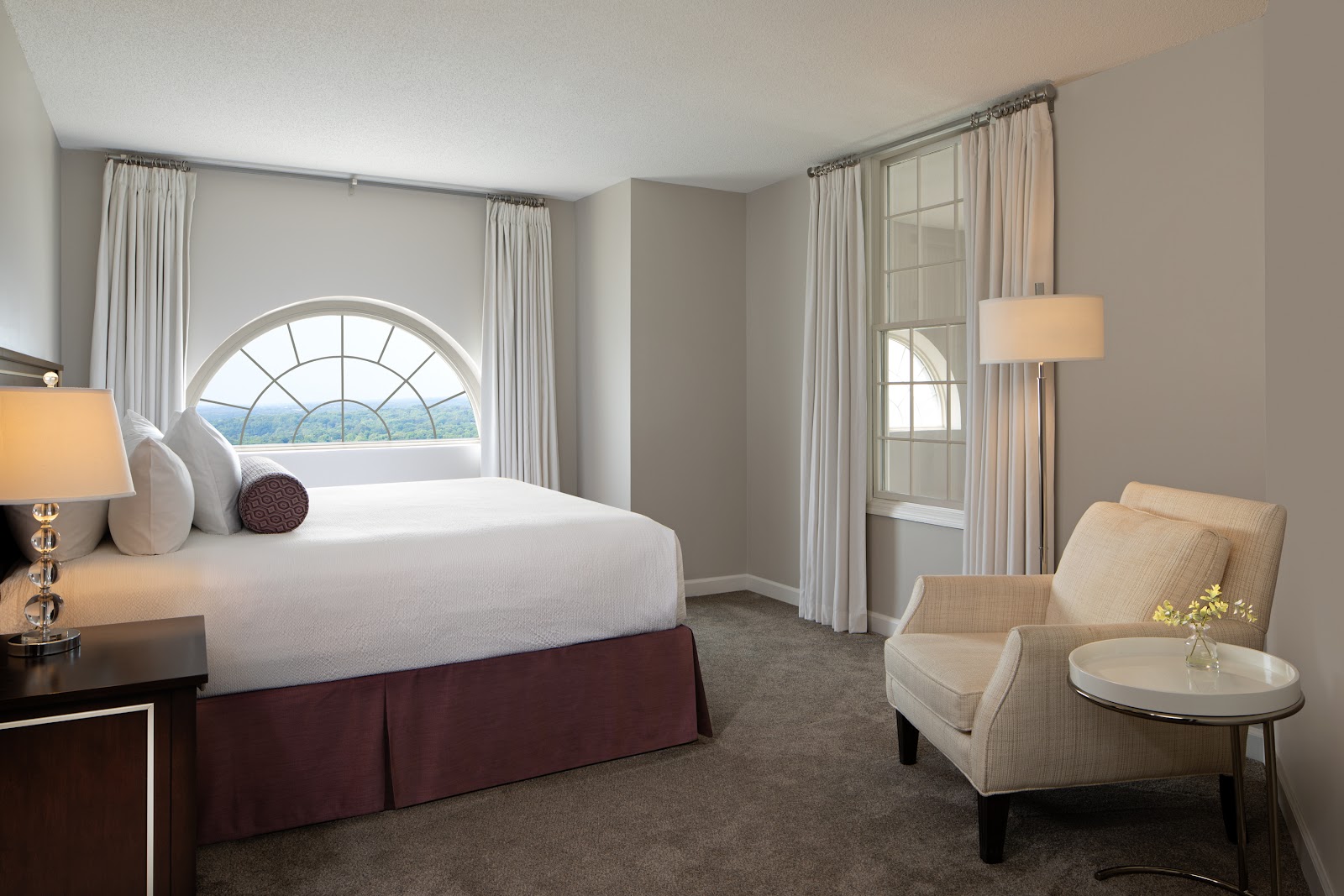
Guest rooms are where the best portrait light is, and in a building of this age the windows may be taller than modern ones, which sends light further into a room and higher up a standing figure — and matters more in a dark-surfaced room than in a bright one. Ask for the largest window on the shaded side, switch off every overhead so the room has one colour of light, and move the lamps out of frame.
A grand stair, where the hotel has one, solves the group problem that tall period hotels otherwise handle badly: steps make rows automatically, and thirty people arrange themselves with everybody visible in a way a flat ballroom floor never allows.
The terrace and the rooftop
A street-facing terrace is a specific kind of outdoor space and it behaves differently from a garden. It is hard-surfaced, open to the sky, bounded on one side by the building and on the other by the street — which means the light is overhead rather than directional, the fill comes off paving rather than off foliage, and the background is the street.
Overhead light is the first thing to fix, and it is cheap: a reflector held low, a lifted chin, or a small source at face height. Paving already returns some light from below, so the correction needed is small.
The building’s own shadow is the terrace’s shade and it moves. Learning where the shade line will be at the ceremony hour rather than at the site-visit hour is the most useful piece of preparation, and in an Atlanta summer it is the difference between a workable block and an unworkable one.
Any overhead cover — an awning, a canopy, a colonnade — is better still, because a roof above with an open side becomes a large directional source: an architectural softbox available all day and working in rain. At a terrace venue that position is the most valuable one on the property.
The street is the background whether you want it or not. Traffic, signage, pedestrians and parked cars are all potentially behind a subject, so either compose to exclude them or use a long lens at a wide aperture so the street becomes an unreadable soft field. Accepting it by accident is the failure.
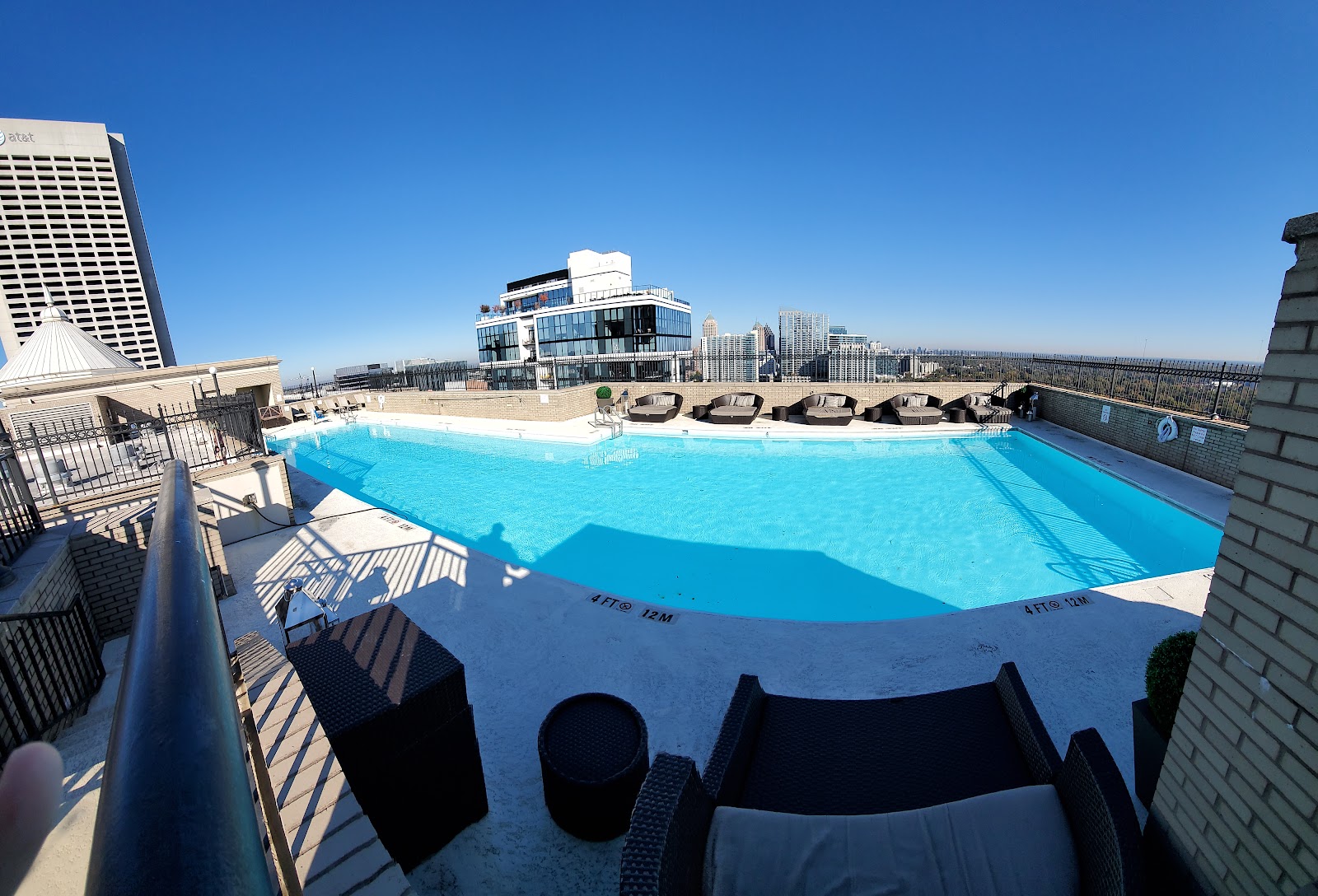
A rooftop, where the hotel has one, follows outdoor rules entirely: nothing bounces, so every source is direct; the ambient after dark is close to zero; and the good light is confined to the last forty minutes of daylight and roughly twenty minutes after sunset. Above the surrounding roofline low sun arrives earlier than at street level, which is worth extra time in the schedule — and in Atlanta, where the towers are clustered rather than continuous, a rooftop is where the skyline becomes a layered mass that a long lens can stack.
Rooftop wind is stronger and gustier than at street level, so a veil becomes a held-or-removed decision and any stand needs real weight. And the dusk crossing is the one immovable frame: sunset plus fifteen, in position, couple already there, with one warm-gelled source at face height about a stop under the sky.
- Test bounce once indoors; period surfaces return almost nothing
- Graze the ornament with one source or it flattens to a pale field
- Find where the terrace shade line will be at the ceremony hour
- Any awning or colonnade is the best light on the property
- Decide about the street: exclude it, or blur it with a long lens
Atlanta outside, and the year
Atlanta’s geography is worth understanding rather than assuming. The towers are clustered rather than continuous, which produces deep shaded canyons between them where direct low sun rarely reaches street level — and good soft bounced light for much of the day, which is not the same thing as golden-hour light. The lower-rise fabric nearby is where raking light is, and reaching it is usually a short walk.
Glass towers add a specific and underused effect: in the last two hours a glazed facade reflects the sky as a large pale field, which turns a whole building into a soft source aimed down at the street. It costs nothing and only exists where there is glass above.
Atlanta’s tree canopy is abundant — this is one of the most heavily wooded major cities in the country — so mature shade is rarely far from any address. That is the midday resource outdoors, with dapple as its hazard: hot spots several stops above the surrounding shadow, shifting with any breeze, so full shade, open light, or wait for the sun to drop.
Summer heat and humidity make long outdoor blocks genuinely difficult in formal clothes, so trips should be short and purposeful. Afternoon thunderstorms are close to a daily feature rather than an occasional event, which for a hotel is almost entirely an advantage — the day continues indoors without a decision — but a terrace ceremony needs a stated fallback with a capacity and a decision time.
The light after a cell passes is frequently the best of the day: a dark sky, low sun coming in underneath, and wet streets returning reflections of a lit facade. On a terrace that is a genuinely good frame and worth stepping back out for.
Humidity produces the region’s equipment problem, and a hotel with effective air conditioning is where it bites hardest: a camera chilled indoors fogs comprehensively on reaching the outside air and can take many minutes to clear — long enough to lose an arrival or a dusk window. Warm the kit twenty or thirty minutes before the outdoor block and plan one excursion rather than three.
Spring brings pine pollen in late March and April, coating surfaces in a visible yellow film and hanging in the air. A hard-surfaced terrace is exactly the sort of pale surface it lands on, and it shows in photographs as a yellow cast — a cloth and an awareness of which surfaces have been wiped is the whole of the answer.
And Atlanta’s winters are mild enough that a terrace stays usable much of the year, which is a real advantage. A clear winter afternoon gives low raking light for hours rather than for ninety minutes, which on a terrace is the best condition it will ever have.
More frames from The Georgian Terrace
The Georgian Terrace wedding photography: common questions
Why is a period interior so dark?
Because timber, patterned carpet, deep paint and heavy textiles absorb rather than return light, and usable room light is mostly bounced. Identical windows in a panelled room and a pale one differ by two stops.
How do you handle the warm cast?
Let one gelled source be the authority on faces, with white balance set to it, and allow the room to be as warm as it is. The cast is bounced and localised, so global white balance cannot separate it.
What is the first thing to fix on a terrace?
The overhead direction. A reflector held low, a lifted chin or a small face-height source does it, and because paving already returns some light the correction needed is small.
What is the best position on a terrace venue?
Under any awning, canopy or colonnade. A roof above with an open side is an architectural softbox — available all day and working in rain.
What about the street in the background?
Exclude it or blur it with a long lens at a wide aperture. Accepting it by accident is the failure, and on a street-facing terrace it is always there.
Why is a rooftop worth asking about in Atlanta?
Because the towers are clustered rather than continuous, so from a height the skyline reads as a layered mass a long lens can stack — and low sun reaches a roof while the streets below are already dark.
More Atlanta, GA venue guides
We are writing a photographer’s guide to every venue we would happily shoot in Atlanta, GA. Here are three more, plus the full index:
- The Goat Farm Arts Center, Atlanta: A Walk Through an Industrial Site
- The King Plow Arts Center, Atlanta: Field Notes on a Converted Factory
- Piedmont Park, Atlanta: One Frame and How It Is Made
All Atlanta, GA Wedding Venues →
Planning a wedding at The Georgian Terrace?
The terrace sets the clock. Tell us your date and we will build the day around it.