 The Stoweflake Mountain Resort, Stowe: One Frame, and How It Is Made
The Burlington Waterfront: The Light Through the Day
West-facing water with mountains behind it. Follow the day.
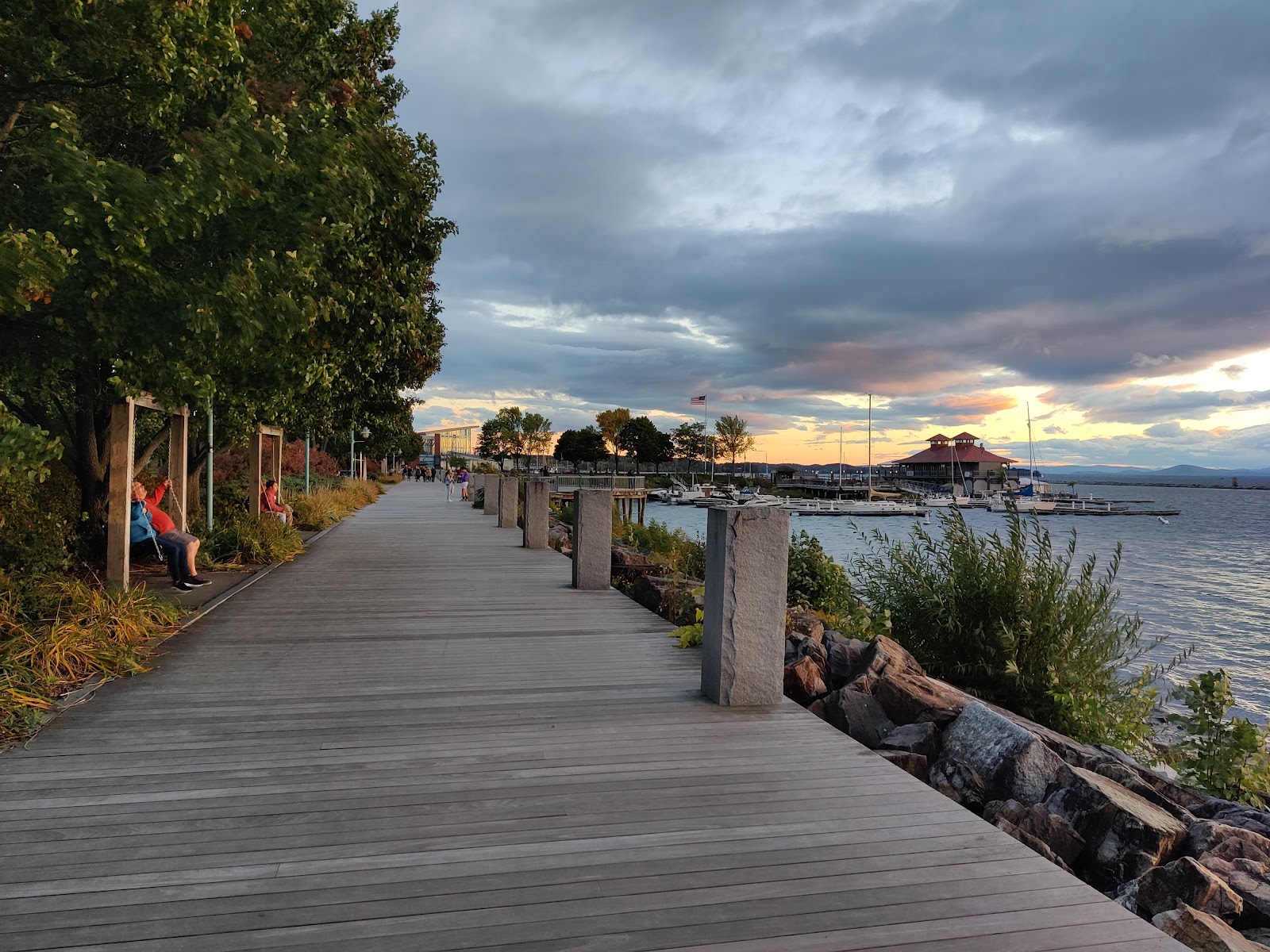
This site has a combination that is genuinely rare: it faces west across a large body of water at a mountain range on the far side.
Lake Champlain runs roughly a hundred and twenty miles north to south between Vermont and New York, and Burlington sits on its eastern shore — which means the city looks west across perhaps ten miles of water at the Adirondack High Peaks rising on the New York side.
Almost every waterfront venue in this library has either water or mountains. Having both, with the water in front of the mountains and the sun setting behind both, is a different proposition — and it means the whole photographic day is organised around a single fact: the good light is at the end of it, and it is exceptional.
That also means the morning is back-lit and the afternoon is front-lit, which is the reverse of an east-facing shore. A west-facing lakefront has the sun behind the camera for most of the working day and in front of it at the end — so the frames divide cleanly rather than blending.
The second thing to understand is the lake itself. Champlain is large enough to behave like an inland sea: it generates its own weather, it produces genuine waves in a blow, it fogs when warm air moves over cold water, and it freezes in a hard winter.
And the third is the latitude. Burlington sits at about forty-four and a half degrees north, which is the furthest north in this library’s continental venues and it shows in the numbers: a midsummer day of around fifteen hours thirty-five, a midwinter one of about eight hours forty-five, and civil twilight running roughly thirty-six minutes — the longest figure here.
That long dusk matters enormously on a west-facing shore, because it means the best light of the day lasts as a working session rather than a moment.
What follows is the day in order. We have not photographed a wedding here; what is bookable on a public waterfront, what covered alternatives exist and the permitted hours are questions for whoever manages the site.
The Burlington Waterfront at a glance
| Where | The Lake Champlain waterfront at Burlington, Vermont, facing west |
| The rare combination | Water in front, the Adirondacks behind it, and the sun setting past both |
| The structure | Back-lit morning, front-lit afternoon, exceptional last hour |
| The latitude | About 44.5°N — a 36-minute twilight, the longest in this library |
| Ask first | What is bookable on a public waterfront; covered alternatives; hours |
Morning into afternoon
The first hours face into the light and they are the ones most people skip, which is a mistake.
On a west-facing shore the morning sun is behind the land and low over the water’s far side, which means the lake is back-lit: a bright field with the Adirondacks in silhouette behind it. That is a high-contrast condition and it produces a specific and very good frame — a couple on the shore in soft front light from the sky with a bright shimmering lake and dark mountains behind them.
The mountains read better back-lit than front-lit, which is counterintuitive. In silhouette the High Peaks are a clean ridgeline with no distracting detail, and the layered ranges separate by atmospheric haze into distinct planes — which is a stronger graphic frame than the same range rendered in full sunlight with all its texture competing.
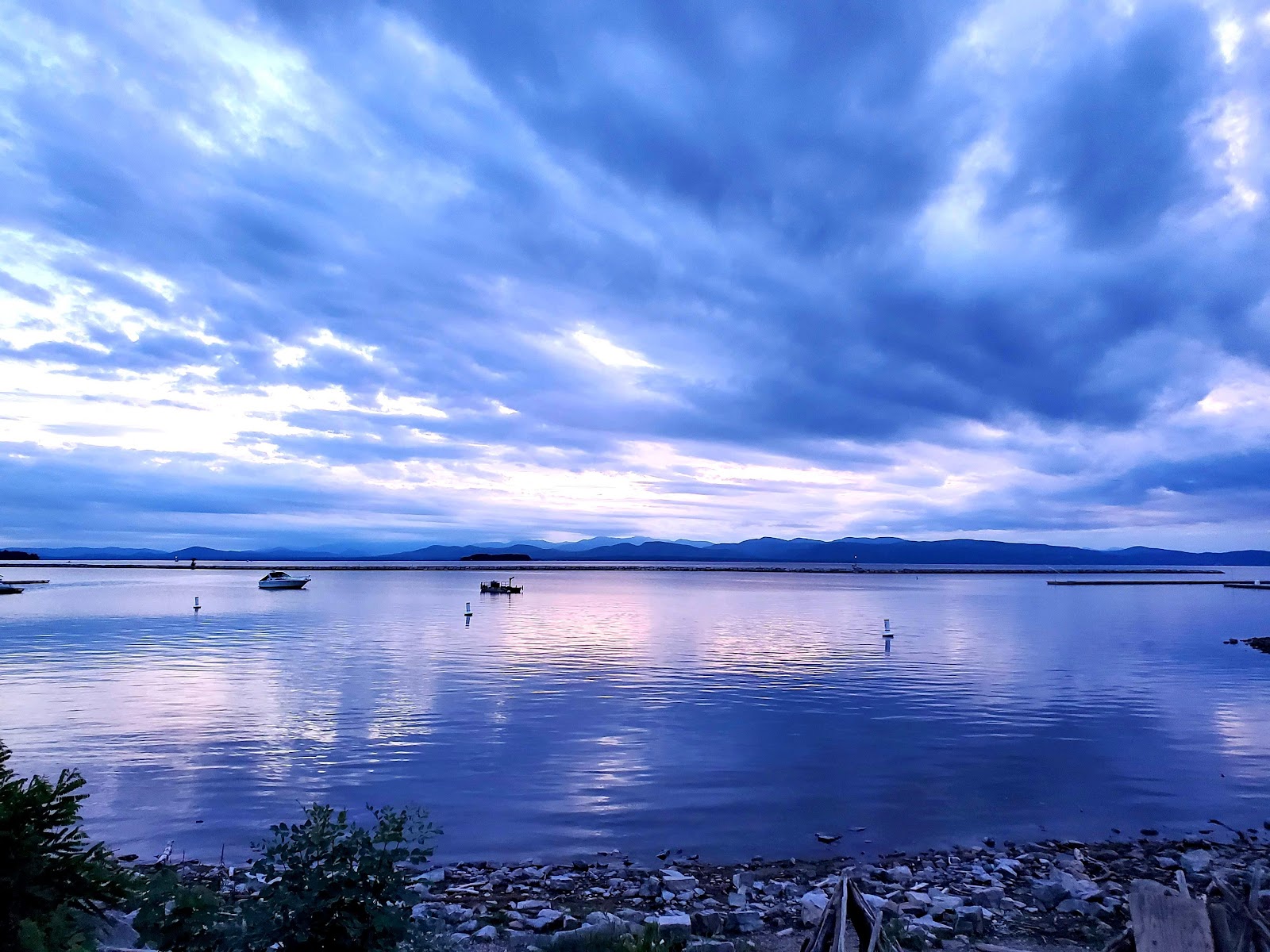
Mornings are also calm. Overnight the water and the air above it stabilise, so the lake is at its stillest at dawn and the breeze builds through the day. That matters more here than at a small water body, because Champlain can genuinely roughen — so the mirror frames belong in the first hours and nowhere else.
A still lake at dawn with mountains reflected in it is the single best water frame the site offers, and it is available for perhaps ninety minutes.
Fog is the other morning possibility and it is worth knowing about. In spring and early summer, warm air moving over cold lake water condenses — and Champlain stays cold into June, so fog is common through May. A fogged lake with the mountains erased and the shoreline dissolving is an exceptional condition and entirely unplannable.
Through mid-morning the sun climbs and crosses to the land side, and the lake stops being back-lit. By ten or eleven the water is lit from behind the camera, which means it reads as colour rather than as shimmer — and on a clear day Champlain is a genuine deep blue, because it is deep, cold and clean.
This is the hour the mountains are front-lit, and they are worth a frame then for the opposite reason to the morning: with the sun on them the High Peaks show their relief, their forest cover and their rock faces, which in October means visible colour on the far slopes.
A moderate telephoto is required. Ten miles of water renders the Adirondacks at a modest angular size, and a wide lens makes them a low ridge across the top of the frame. Compression brings them forward into something with mass, and it is worth walking back from the shore to get the distance.
By the middle of the day the site is at its least interesting, which is the honest position. At sixty-nine degrees of sun elevation in midsummer the water is bright and flat, the mountains are washed out by haze, and a shoreline with no shade is a difficult place for a portrait.
The answers are the built shade and the trees. A public waterfront usually has some structure — a pavilion, a boathouse, a covered walk — and any of those is a large soft source with a hard mask, controlled by depth from the open edge.
The trees are the Vermont answer. Northern hardwoods here — sugar maple, basswood, oak, with paper birch closer to the water — carry dense rounded crowns and cast solid shade with no dapple to manage, which means a midday portrait under one is straightforward. Paper birch is worth finding specifically: white bark peeling in papery layers, which against dark water or conifer is one of the most distinctive natural backgrounds in the northeast.
Afternoon to dark
The afternoon is when the site becomes what it is for, and the last two hours are exceptional.
As the sun descends toward the Adirondacks the light warms and the geometry becomes ideal: front-lit subjects with warm modelled faces, a deep blue lake behind them, and mountains catching the last light on their eastern slopes.
That is the frame the venue exists to produce, and it needs almost nothing — a position, and a reflector or a light fill if the ratio wants evening out.
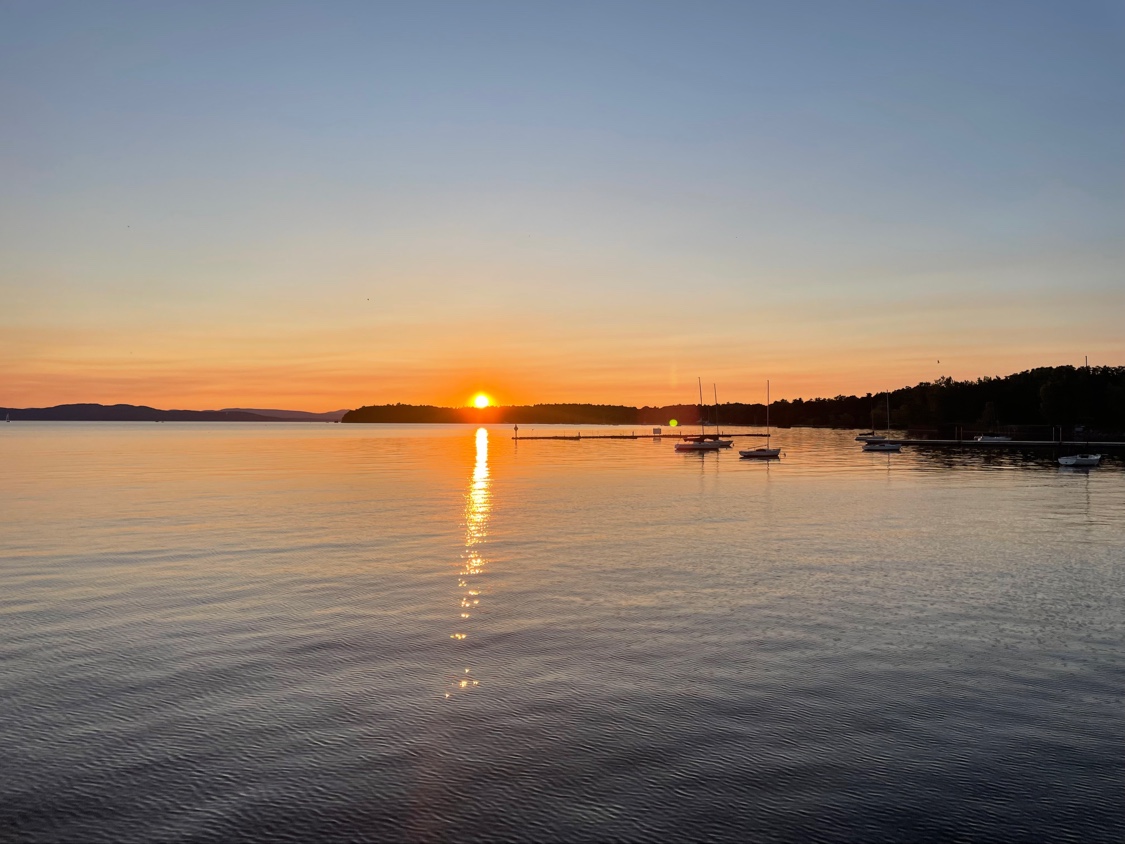
Then the sun goes down behind the mountains rather than into the water, which is the important distinction. On a west-facing shore with a range on the far side, sunset happens early relative to the published time — the sun sets behind the High Peaks perhaps fifteen or twenty minutes before it would set on a flat horizon.
That is worth knowing precisely, because it means the golden hour ends earlier than an app predicts and the afterglow begins sooner. Asking a local or standing on the shore at the right hour is the only reliable way to establish it.
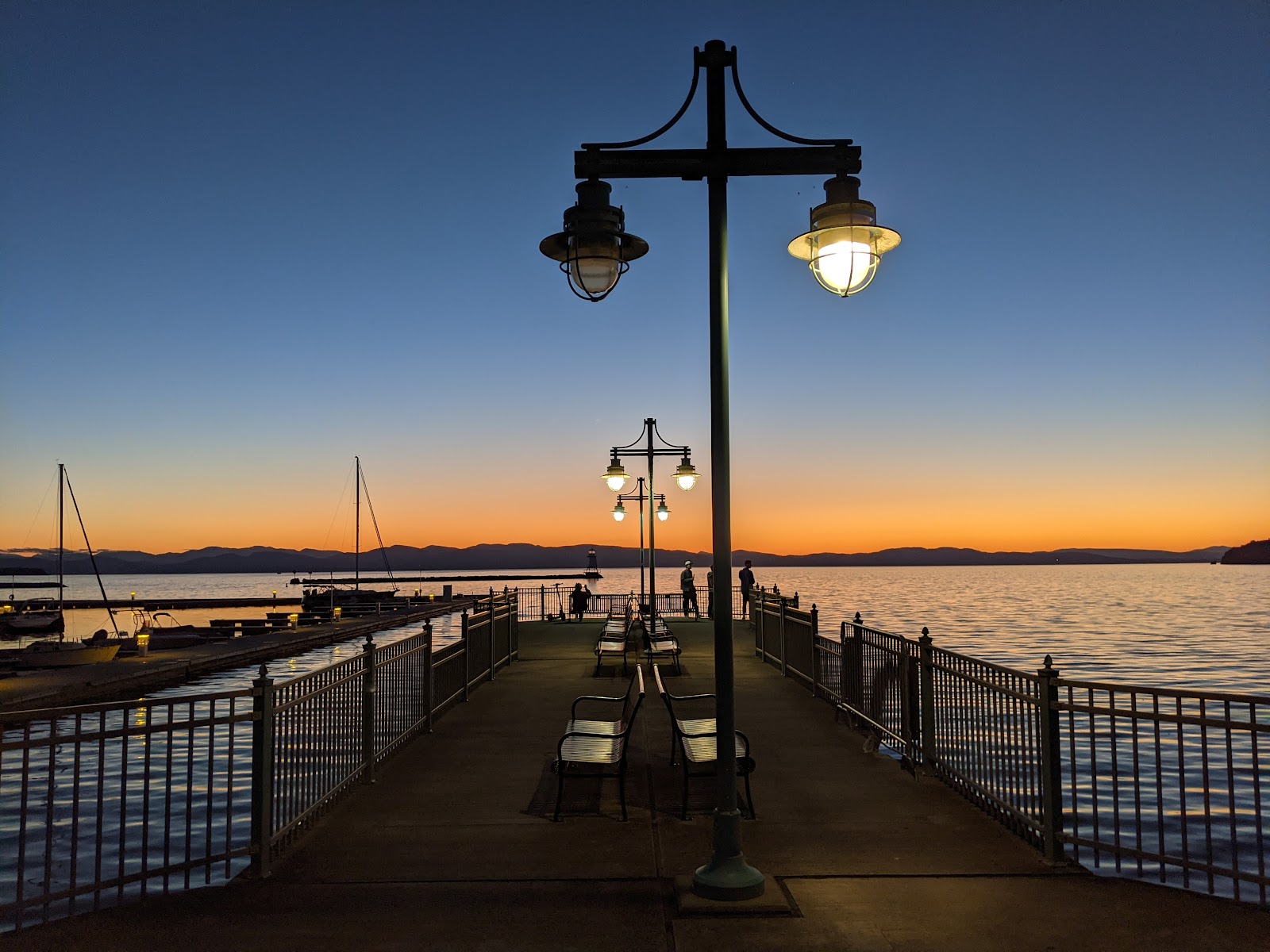
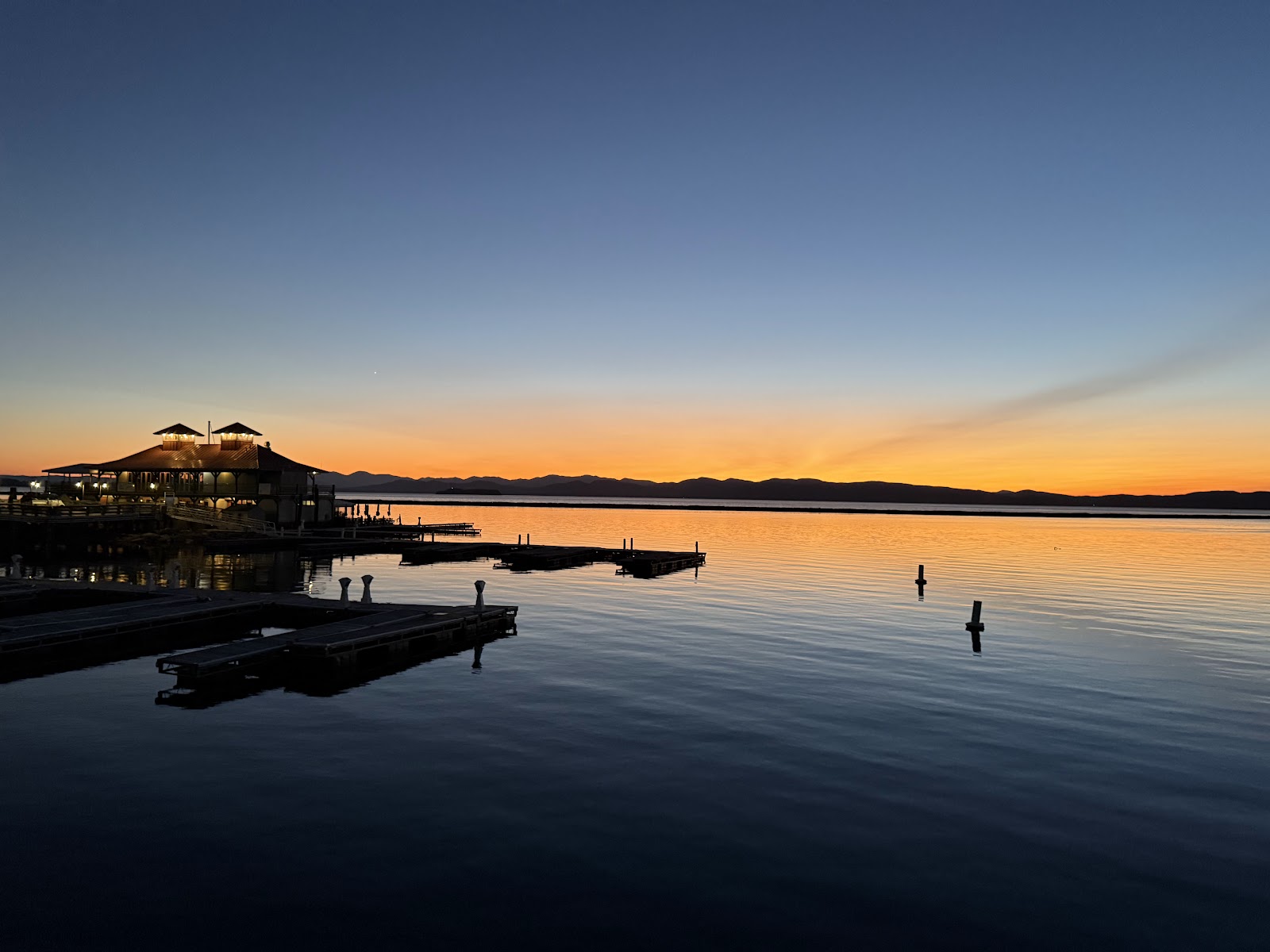
What follows is the reason to be here. Once the sun is behind the ridge, the sky above and beyond the mountains holds colour while the lake picks it up — and because the mountains are dark and the water is reflective, the frame separates into three clean bands: colour sky, black ridgeline, colour water.
That is a frame almost nowhere else in this library can produce, and it lasts as long as the twilight does.
Which here is long. Thirty-six minutes of civil twilight at forty-four and a half degrees north is the most generous figure in this library — roughly half again what the Texas venues get and substantially more than the desert ones. In practice that means three or four distinct setups fit comfortably into the blue hour rather than one being rushed.
The water doubles everything if the breeze has dropped, which by dusk it sometimes has. A reflection sits about a stop darker than what it reflects, which keeps the whole frame inside a single exposure.
Broken water is not a loss. A low camera turns a rippled surface into a bright specular path running toward the lens, and at knee height that path stretches the full depth of the frame rather than sitting as a short patch. That is the cheapest improvement available on any shoreline and it is worth kneeling for.
After dark the site keeps working. Burlington is a small city, which means relatively little light pollution by urban standards — and looking west across ten miles of water at largely undeveloped mountains means the darkest part of the sky is the part in front of the camera.
A thirty-second exposure on a tripod with the couple lit by a small warm source, the lake black and the Adirondacks a silhouette under stars, is a frame this geography permits and a city waterfront cannot.
The practical constraints of a public waterfront apply throughout. It will be in use — walkers, cyclists, boats, a bike path — which means people in the background of most frames at water level, and that is normal rather than exceptional. Early morning and after dark are when it empties.
And wind is the constant. Champlain generates its own breeze on any warm day and can produce a real blow in a front, which means no unweighted light stands anywhere near the shore and a five-hundredth of a second for hair and fabric. A veil on a Champlain shoreline will be moving; read the direction and rotate the couple so it carries across or away rather than into their faces.
- Mornings are calm and back-lit — the mirror frames belong there
- Compress the Adirondacks with a telephoto; a wide lens makes them a low ridge
- The sun sets behind the ridge fifteen to twenty minutes early — check on site
- Thirty-six minutes of twilight: three or four setups, not one
- Knee height lengthens the specular path across the whole frame
The lake's year, and Vermont's
Lake Champlain is large enough to shape the seasons of its shore, and Vermont’s calendar does the rest.
The lake is a thermal mass and it lags. Spring is late and cold because the water stays near freezing into May, which delays leaf-out on the shore and produces the fog described above. Autumn is mild and extended because the water holds summer heat into November, which pushes the colour later on the lakeshore than inland at the same latitude.
So the season is shifted rather than simply short, and a lakefront date in early October benefits from both the colour and the retained warmth.
Early October is the peak and it is the most famous autumn in America. Sugar maple dominates these hillsides and produces a scarlet and orange no other North American maple matches — and on this site there is a specific advantage: the colour appears on both sides of the water.
Ten miles west, the Adirondack slopes turn at the same time, which means a compressed telephoto frame of the far shore in October shows mountains in full colour across the lake. That is a frame this geography permits and very few places can offer.
The air also reaches its clearest in October, which matters here more than at most venues because the signature frames are long compressed views. The Adirondacks read sharply in October and dissolve into haze in August, and the difference is entirely atmospheric.
Mud season is Vermont’s notorious spring and it applies inland more than on a paved waterfront — but late April and early May remain the least photogenic weeks of the year here: the snow gone, the grass not greened, the trees not leafed, and the lake at its coldest.
Sugaring is the late-winter compensation and it is the most specifically Vermont thing available. Sugar maple sap runs when nights freeze and days thaw, roughly late February into early April, and a sugarhouse boiling with steam pouring into cold air is a frame nothing else offers. It is inland rather than on the waterfront, and worth knowing if part of the day travels.
Summer is long-lit at fifteen hours thirty-five — the most daylight of any venue in this library — and it is the season when the waterfront is busiest and the haze is heaviest. The lake is warm enough to swim in by August, which means boats, and boats in frame are either an asset or clutter depending on composition.
Winter transforms the site completely and it is worth taking seriously. Champlain freezes in a cold winter — not always completely, but substantially, and the ice can extend for miles. A frozen lake with the Adirondacks beyond it is a flat white plane leading to a mountain range, which is a genuinely extraordinary frame and one almost nobody photographs at a wedding.
Ice also produces specific phenomena on a large lake: pressure ridges where sheets buckle against each other, ice shoves piled on the shore by wind, and spray frozen onto anything near the water’s edge. Those are striking and they are hazardous, and the ice’s condition is never something to take on trust.
The constraints are cold and light. About eight hours forty-five of December daylight — the shortest in this library — and temperatures on an exposed shore that limit standing outside to minutes rather than hours. A winter date here is a short excursion, planned tightly, from somewhere warm.
The compensation is that the twilight is still thirty-six minutes long in winter and it arrives around half past four, which puts the best light of the day comfortably before a reception rather than in the middle of it.
More frames from The Burlington Waterfront
The Burlington Waterfront wedding photography: common questions
What makes this site unusual?
It faces west across ten miles of water at a mountain range. Most waterfront venues have water or mountains; having both with the sun setting past them is rare.
When are the mirror frames?
Dawn. The lake and the air above it stabilise overnight, so Champlain is stillest in the first ninety minutes and the breeze builds through the day.
Why do the mountains look better back-lit?
In silhouette the ridgeline is clean and the ranges separate into planes by haze. Front-lit, their texture competes with the subject.
Does the sun set on time here?
No. It goes down behind the Adirondack ridge fifteen to twenty minutes before the published flat-horizon time, so golden hour ends early.
How long is the dusk?
About thirty-six minutes — the longest in this library. Three or four setups fit comfortably rather than one being rushed.
Does the lake freeze?
Substantially in a cold winter, sometimes for miles. A frozen lake leading to the Adirondacks is extraordinary — and ice condition is never to be taken on trust.
More Vermont venue guides
We are writing a photographer’s guide to every venue we would happily shoot in Vermont. Here are three more, plus the full index:
- The Hilton Burlington: The One Decision That Governs Everything
- The Marsh-Billings-Rockefeller Park, Woodstock: The Problem, and Four Ways Out of It
- The Stoweflake Mountain Resort, Stowe: One Frame, and How It Is Made
Planning a wedding at The Burlington Waterfront?
A lake, a mountain range, and the longest dusk here. Tell us your date.