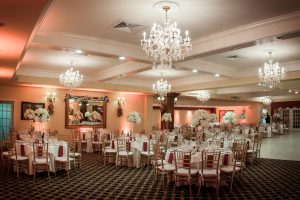
 Woodwinds, Branford: The Problem, and Four Ways Out
The Bond Ballroom, Hartford: One Frame, and How It Is Made
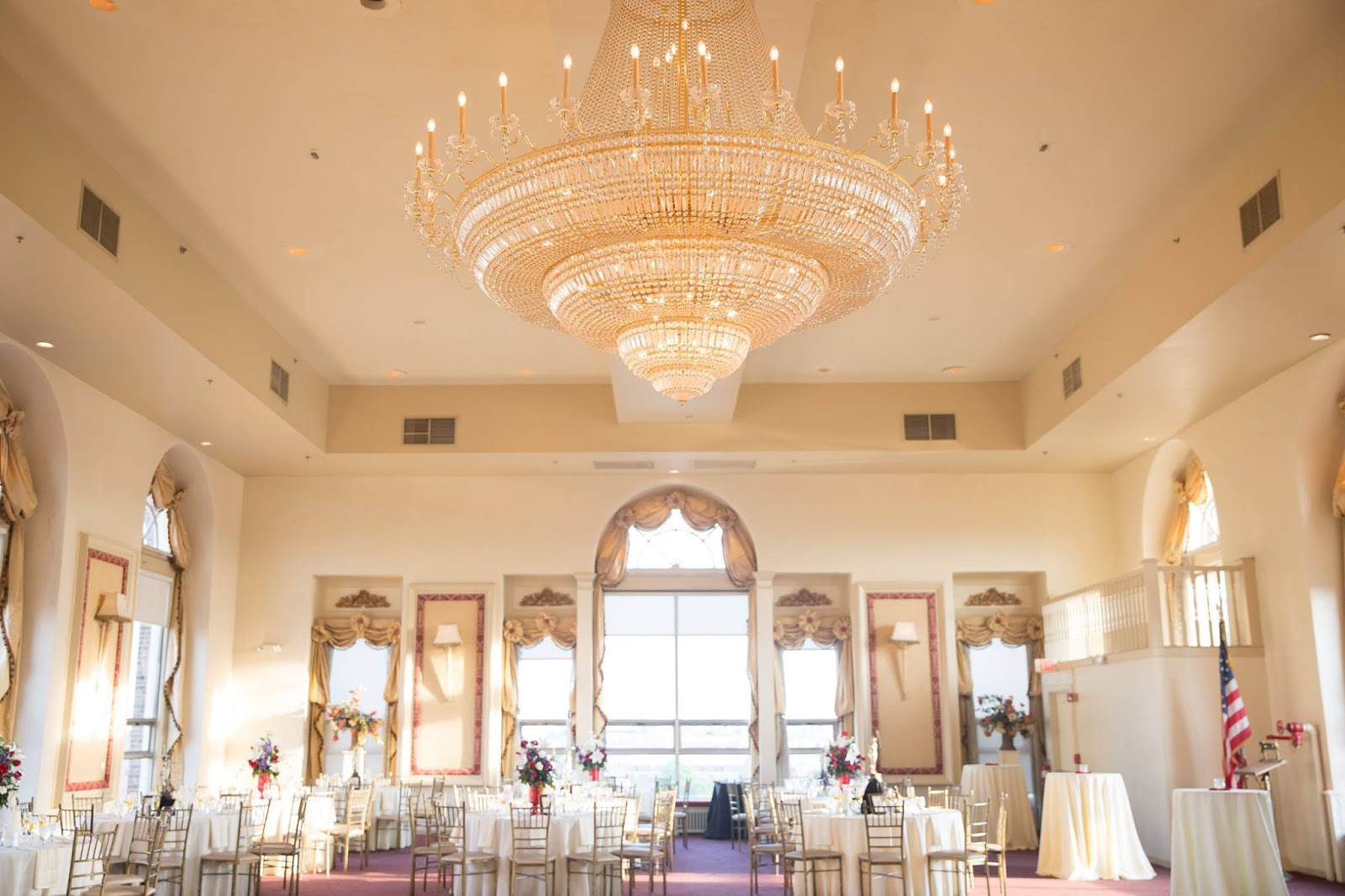
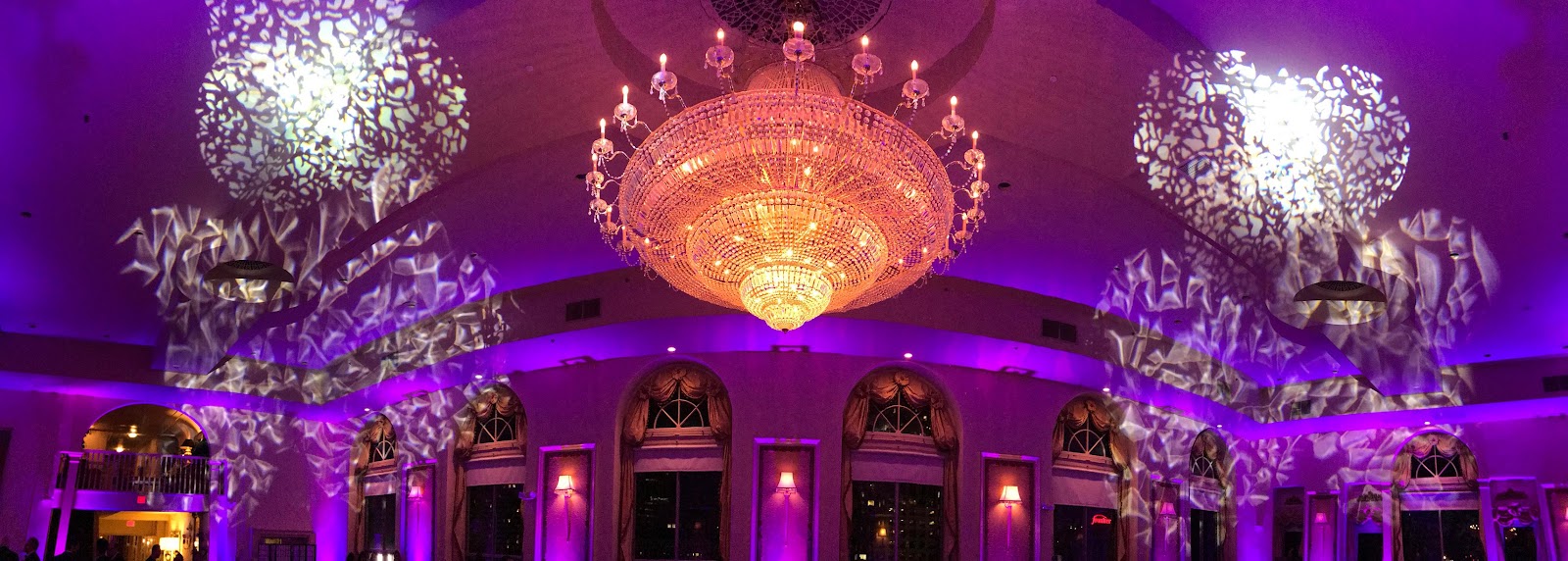
One frame: the whole room, from above, before anybody has sat down.
This guide is about a single photograph, and the thing that makes it possible is height.
The Bond Ballroom is a restored ballroom in a downtown Hartford hotel building of nineteen-thirteen, put up when this city’s insurance wealth was building on a generous scale. It is a single decorated volume — plasterwork, applied ornament, a coffered or moulded ceiling, chandeliers — of the kind that early-twentieth-century hotels built for public assembly and that very few of them still have.
A room like that has one great photograph in it and it is the room itself. Not a portrait with the room behind, and not a detail of the plasterwork: the whole volume, seen from above, with the floor, the walls and the ceiling all legible in one frame and the wedding laid out beneath.
That frame depends on getting the camera up, and in a period ballroom there is very often a way to do it. Ballrooms of this date frequently have a balcony, a gallery, a musicians’ platform or a mezzanine running along one side or around the room, put there for an orchestra or for spectators — and from that level you are looking down into the volume rather than across it.
From the floor, a decorated ballroom is walls and a ceiling you cannot see properly. From eight or ten feet up, it is a room: the pattern of the floor, the arrangement of the tables, the rhythm of the walls and the whole ceiling all in one composition.
So the first question at this venue, before anything else, is whether there is an elevated position and whether you may use it. Ask specifically — a balcony may be closed, used for equipment, or out of bounds for safety — and ask early, because if the answer is no, the guide below still works but the frame becomes a harder one made from a ladder or from the top of a stair rather than from a gallery.
The second thing is timing, and it is the part most photographers get wrong: the frame has to be made before the wedding begins.
A dressed ballroom with the tables laid, the chairs straight, the candles lit and nobody in it is a photograph of an event about to happen, and it is genuinely lovely. The same room twenty minutes later has bags on chairs, jackets on backs, half-drunk glasses and people mid-conversation, and the composition is gone.
So the empty-room frame happens in the window between the venue finishing the setup and the guests arriving, which is usually fifteen or twenty minutes and is often not on anybody’s schedule. Put it on the schedule.
What follows is how to build it, what else the room gives, and what downtown Hartford offers outside.
The Bond Ballroom at a glance
| Where | A restored 1913 hotel ballroom in downtown Hartford, Connecticut |
| The frame | The whole volume from an elevated position, dressed and empty |
| The requirement | A balcony, gallery or mezzanine — ask whether you may use it, early |
| The timing | The fifteen minutes between setup finishing and guests arriving |
| Ask first | Elevated access, whether stands and tripods are permitted, and lighting control |
Building the frame
First, get up there and find the position in advance, not on the day.
From an elevated position, the composition is decided by two things: how much of the ceiling you can include, and whether the room reads as symmetrical. A ballroom is almost always a symmetrical space, and from a gallery on one side you are off its axis — which means the frame will be asymmetrical unless you are at the midpoint of that side, looking straight across.
So find the centre of the balcony, not just a spot on it. From the midpoint, the room’s own symmetry does the composing: the far wall is square, the tables are arranged evenly either side of the centre line, and the ceiling’s pattern runs straight away from you.
Use a level. A tenth of a degree of roll in a symmetrical interior is visible, and from an elevated position with converging verticals it is worse.
Then decide the lens. Wide enough to hold the far wall, the floor and a good portion of the ceiling — usually somewhere between twenty and twenty-eight millimetres — and no wider than necessary, because an ultra-wide from a gallery stretches the corners and turns a handsome room into a fisheye distortion of one.
Stop down to f/8 or f/11. The room is the subject, so the plasterwork on the far wall and the ornament on the ceiling both have to be sharp, and depth of field from an elevated position covering fifteen metres of floor is not generous. That means a tripod and a slow shutter.
Ask whether a tripod is permitted on the balcony. It is a reasonable thing for a venue to refuse, and if it is refused, brace against the balcony rail, use a high sensitivity and accept the noise — a slightly noisy frame that exists beats a clean one that does not.
Now the exposure, which is the crux. A period ballroom is lit by chandeliers and wall fixtures, which means the light sources are in the frame and they are far brighter than anything they illuminate. Expose for the room and the chandeliers clip to white blobs; expose for the chandeliers and the room goes black.
The answer is to let the chandeliers clip, deliberately and slightly. A lit chandelier in a photograph of a ballroom is meant to read as a light rather than as an object, and a small blown core with the arms and drops still holding detail around it looks correct. What looks wrong is a chandelier blown to a featureless white mass, so pull back until the fitting’s shape survives and let the bulbs themselves go.
Then lift the room. This is where the frame is won: a ballroom lit only by its own fixtures has a bright ceiling around the chandeliers, bright walls near the sconces, and a dark floor and dark corners. One or two lights bounced up into the ceiling from the floor, out of frame at the near corners, lift the whole volume by a stop and a half and make the plasterwork read everywhere rather than only near the fittings.
Check the ceiling colour before committing to that, because a pale plaster ceiling is an ideal bounce surface and a dark or heavily gilded one absorbs almost everything. In a period ballroom pale is likely, which is why this works.
Warm whatever you bring to match the chandeliers, because the ambient will be very warm and a neutral flash will read cold and inserted.
Finally, ask whether the house lighting can be adjusted. In a room whose lighting is in the frame, being able to bring the chandeliers down a little changes everything — a dimmed chandelier holds detail and still reads as lit, and the room’s exposure range collapses to something a single frame holds comfortably. A venue with dimmable lighting and a cooperative manager is worth a great deal here, and it is one question.
Total time at the position: six minutes, if the setup is finished. Time to find the position, check the sightline and test the exposure: fifteen minutes on arrival, before the room is dressed.
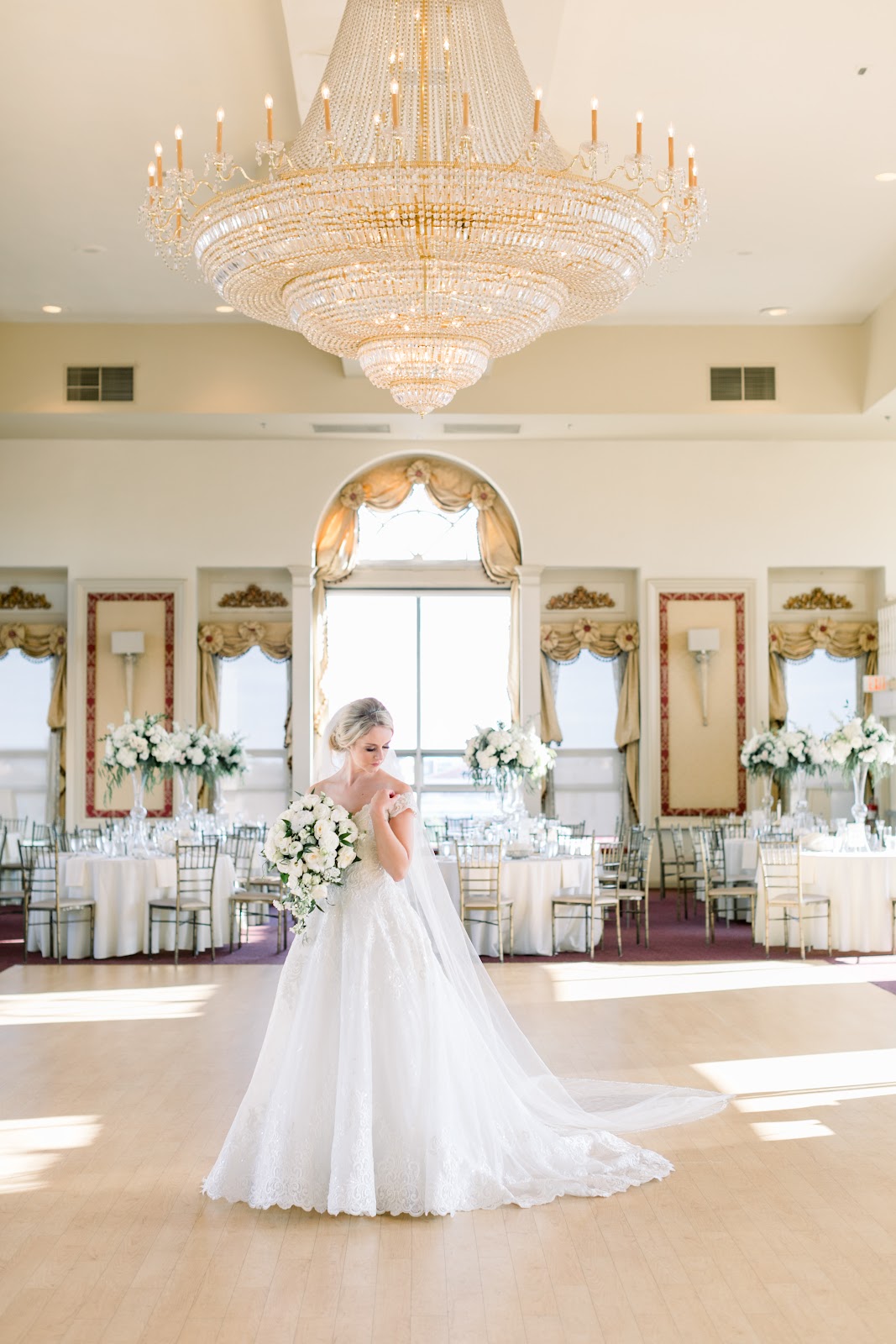
Two variants worth having. The same frame with the couple in the empty room, small, standing in the middle of the floor — which turns an architectural photograph into a photograph about them, and takes thirty seconds. And the same position later in the evening with the room full and the dance floor busy, at a slower shutter so movement smears, which is a completely different picture and the one that records what actually happened.
What else the room gives
Away from that one frame, a period ballroom offers four things and one constraint.
The first is the plasterwork, at close range. Applied ornament — cornices, mouldings, rosettes, panel frames, brackets — is all relief, and relief needs raking light. A source placed almost parallel to a plastered surface throws every profile into its own small shadow and the ornament reads as three-dimensional; the same surface lit frontally goes flat and becomes a pattern. That is a whole register of detail frames available at any hour with one light held at a shallow angle.
The second is height used from the floor. A ballroom is a tall room, and tall rooms photograph well from low angles: get the camera down and let a pilaster, a door surround or a run of wall panels rise out of the top of the frame. The scale reads even when the ceiling does not, and it is the frame to make when the gallery is unavailable.
The third is the floor. A ballroom floor is usually timber, often patterned or parquet, and polished — which means it is reflective. A lit subject standing on it gets a second dimmer image beneath them for nothing, and a wide frame with a strongly lit couple on a polished floor is doubled without any effort. Get low to exploit it; from standing height the floor is a surface and from a metre it is a mirror. It also means every light you put up appears twice, so check for reflections of your own stands.
The fourth is the windows, if there are any. A hotel ballroom of this date may have tall windows onto the street, and if it does, they are the best natural light in the building and worth finding on arrival. A tall window in a deep reveal collimates the light into a directional beam with fast falloff — step the positions out, because a metre and a half in is superb and three metres in is not — and bring something pale to hold opposite, because a decorated room with dark carpet gives less fill than the window size suggests.
If the ballroom is internal with no windows at all, which is entirely possible, then it is unaffected by the hour and by the weather. That is a genuine advantage and it means all the scheduling freedom sits with the outdoor work: establish when the light outside will be good and build the day around that, using the ballroom for everything else.
The constraint is that a single grand volume is a single grand volume. There are no anterooms, no variety of background and nowhere to hide equipment — every frame made in that room is made against the same four walls, and after twenty minutes a set begins to look repetitive.
The answer is to establish what else is in the building. A hotel of this date and scale will have a lobby, a stair, corridors, a bar and function rooms, and those are where the variety comes from. Ask which are available and which have windows, because a stair hall with a tall window is worth more to a portrait than the ballroom is.
A stair especially. If there is a period stair anywhere in the building, use it in the first twenty minutes: a height difference, a diagonal, a leading line, and a way to arrange a group at several levels with no riser. From the bottom looking up for drama, from the top looking down for pattern.
And ask about the condition of the restoration. A restored ballroom has surfaces that are original and surfaces that are not, and at f/11 from a gallery the difference can show. That is not a reason to avoid it — the alternative was a room lost — but it is a reason to work at distance and in raking light rather than close and frontal, which is the same rule that applies to any restored interior.
Two practical notes about working in one room with a hundred people in it. Sound carries and there is nowhere to be discreet, so choose a position for the ceremony and stay in it, letting a short zoom do the moving. And the room will be warm once it is full, which affects both people and equipment — a camera brought from a cold street into a full ballroom will fog briefly, so bring it in early.
Downtown Hartford, and the year
The city outside is better than its reputation and it provides the variety the ballroom cannot.
Hartford built substantially on insurance and finance wealth, and its downtown core carries a dense stock of late-nineteenth and early-twentieth-century commercial architecture in stone, brick, terracotta and bronze. That is the same material world as the ballroom, which means exterior frames made within a block of the building sit naturally alongside the interior ones.
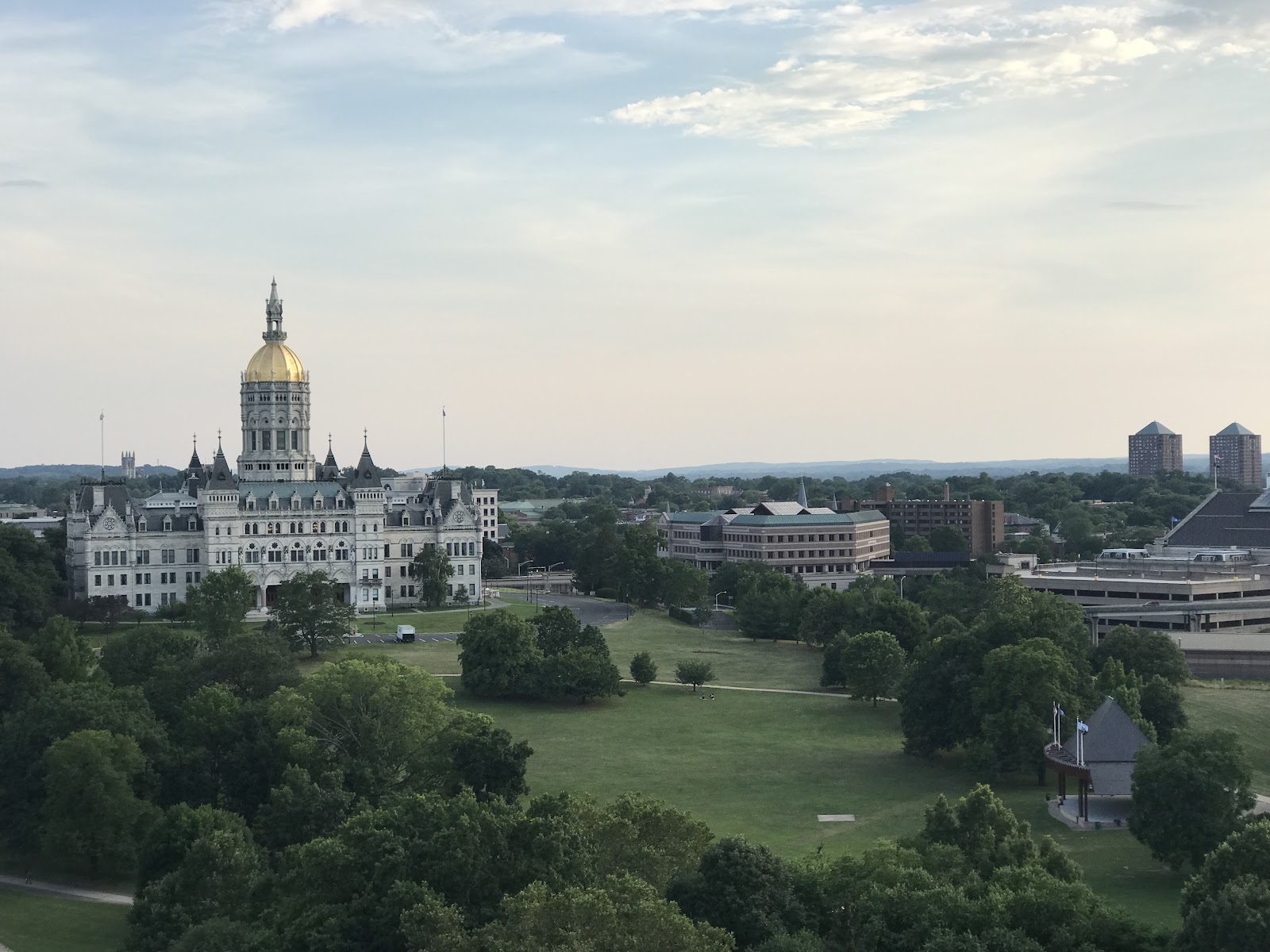
Two specific places are worth walking to. A large public park sits by the downtown core — one of the first publicly funded parks in the country — containing a monumental memorial arch of the eighteen-eighties, which is a frame with a built-in border and genuine scale, and a historic carousel, which is a dense field of painted colour and mirrors and an entirely different register from a plastered ballroom. And the state capitol stands on rising ground above that park, a high-Victorian building with a gold-leafed dome, which from the park reads as a terminated vista at the end of a green foreground.
Whether either is usable for a ceremony is a conversation with the city or the park authority rather than with the venue, and a commercial photography permit is likely to be required. Ask early and expect the public to be present.
The reliable street fallback is two things within a block of almost any downtown venue: a large flat field of stone or brick to use as a background at a long focal length, and a deep doorway or arch that produces a band of open shade in front of it. The second is the answer to the middle of a summer day.
Now the year. Hartford sits at about forty-two degrees north in a humid continental climate with four genuinely distinct seasons, and it gives one useful number: civil twilight runs roughly thirty-one minutes in midsummer, with a usable balance point of thirteen to sixteen minutes. That is among the longer dusks in this library and generous enough for two exterior positions if both are decided in advance.
The midsummer noon sun reaches about seventy-two degrees, meaningfully lower than the South’s, which means midday outdoors still has some direction in it and open shade functions properly. The midwinter noon sun sits near twenty-five degrees and rakes stone facades from late morning to mid-afternoon — the best exterior light of the year, lasting hours rather than minutes.
Late September into early November is the strongest window: the summer humidity drops out so the air is clear and stone reads crisply, temperatures are comfortable for walking in formal clothing, sunset lands around six so the balance point falls at a civil hour, and New England’s colour peaks in the second half of October. In a city that means street trees and a park rather than hillsides, but it is genuine and it is brief.
May into June is the other good window, mild and lengthening, with sunset after eight by late June and the park at its best.
Summer is workable with the middle of the day given to the interiors, which at this venue may cost nothing at all — if the ballroom is windowless it is identical at every hour, so the worst three hours of a July day are free. July dewpoints around seventy fill shadows by roughly two stops outdoors, softening shadow edges and keeping detail in eye sockets, at the cost of a pale washed sky and a lens that fogs coming out of an air-conditioned building into humid air.
Thunderstorms move through quickly in the warm months, and the half hour afterwards is the best exterior light of the year: washed air, wet stone and wet pavement several tones darker and far more saturated, reflections in the street doubling everything, and a low sun under a broken ceiling into a street canyon. Wet stone is a considerably better material than dry stone. If a cell goes through at six, do not pack.
Winter is long and genuinely cold, with sunset before half past four in late December, snow in most years and temperatures well below freezing. That puts the balance point before five — during cocktails rather than after dinner, and therefore a named item on the timeline — and limits any outdoor session to minutes rather than an hour.
In exchange, winter is when this kind of venue is at its strongest. The clearest air of the year outside, a low sun raking stone all afternoon, bare street trees letting facades read cleanly — and, more to the point, a grand interior whose entire value is unaffected by the season. A January wedding in a period ballroom is a genuinely good proposition and it will be easier and cheaper to book than an October one.
The hazard to plan for is the nor’easter, which brings wind and heavy wet snow to this coast and is a travel problem for guests and suppliers rather than a photographic one. A winter date deserves a contingency that assumes some people cannot drive.
And the closing instruction is the opening one restated, because it is the thing that decides whether this venue’s best photograph gets made at all. Find the elevated position on arrival, test the exposure before the room is dressed, and be standing there in the fifteen minutes between the setup finishing and the doors opening. Nobody else will have put that on the schedule.
More frames from The Bond Ballroom
The Bond Ballroom wedding photography: common questions
What is the one frame?
The whole room from above — floor, walls and ceiling all legible in one composition, dressed and empty. A ballroom of this date often has a balcony, gallery or musicians’ platform put there for an orchestra, and from eight or ten feet up the volume reads as a room rather than as walls and a ceiling you cannot see properly. Ask early whether the elevated position exists and whether you may use it, because a balcony may be closed or out of bounds and the answer changes the plan.
Why does it have to be early?
Because a dressed ballroom with the tables laid, the chairs straight, the candles lit and nobody in it is a photograph of an event about to happen — and the same room twenty minutes later has bags on chairs, jackets on backs and half-drunk glasses in it. The composition is gone. That window between the venue finishing setup and the guests arriving is usually fifteen or twenty minutes and it is almost never on anybody’s schedule. Put it on the schedule.
How do you handle the chandeliers?
Let them clip, deliberately and slightly. The light sources are in the frame and far brighter than anything they illuminate, so exposing for the room blows them and exposing for them blacks out the room. Pull back until the fitting’s shape and arms survive and let the bulbs themselves go — a small blown core with detail around it reads as a light, which is correct, while a featureless white mass does not. Better still, ask whether the house lighting can be dimmed, because a dimmed chandelier holds detail and the room’s exposure range collapses to something one frame holds.
How do you light a whole ballroom?
One or two lights bounced up into the ceiling from the floor, out of frame at the near corners. A room lit only by its own fixtures has a bright ceiling near the chandeliers, bright walls near the sconces, and dark corners and floor — the bounce lifts the whole volume by a stop and a half so the plasterwork reads everywhere. Check the ceiling colour first: pale plaster is an ideal bounce surface and a dark or gilded one absorbs almost everything. Warm your light to match the chandeliers.
What is the limitation of a single grand room?
That it is a single grand room. There are no anterooms, no variety of background and nowhere to hide equipment, so every frame is made against the same four walls and after twenty minutes the set begins to repeat. The answer is to establish what else is in the building — a lobby, a stair, corridors, a bar, other function rooms — and which of those have windows. A period stair hall with a tall window is worth more to a portrait than the ballroom is.
Is a winter wedding here sensible?
It is when this kind of venue is at its strongest. A grand interior’s value is unaffected by the season, so a January wedding is a genuinely good proposition and an easier, cheaper booking than October — while outside you get the clearest air of the year and a low sun raking stone facades all afternoon. The costs are a sunset before half past four, which puts the dusk frame during cocktails and makes it a named timeline item, and a nor’easter contingency worth having for guests and suppliers.
More Connecticut venue guides
We are writing a photographer’s guide to every venue we would happily shoot in Connecticut. Here are three more, plus the full index:
- The Hartford Club, Hartford: Suits and Does Not Suit
- The Society Room, Hartford: The One Decision That Governs Everything
- Barns at Wesleyan Hills, Middletown: The Building’s Own Logic
Planning a wedding at The Bond Ballroom?
Find the balcony, then be on it for fifteen minutes. Tell us your date.