 The Thunderbird Inn: Field Notes on a 1964 Motor Inn
The Mighty Eighth Air Force Museum, Pooler: The Problem, and Four Ways Out of It
A huge dark room with aeroplanes in it. Four ways round that.
The problem here is a large dark volume with very large objects in it, and it is a specific technical problem rather than a vague one.
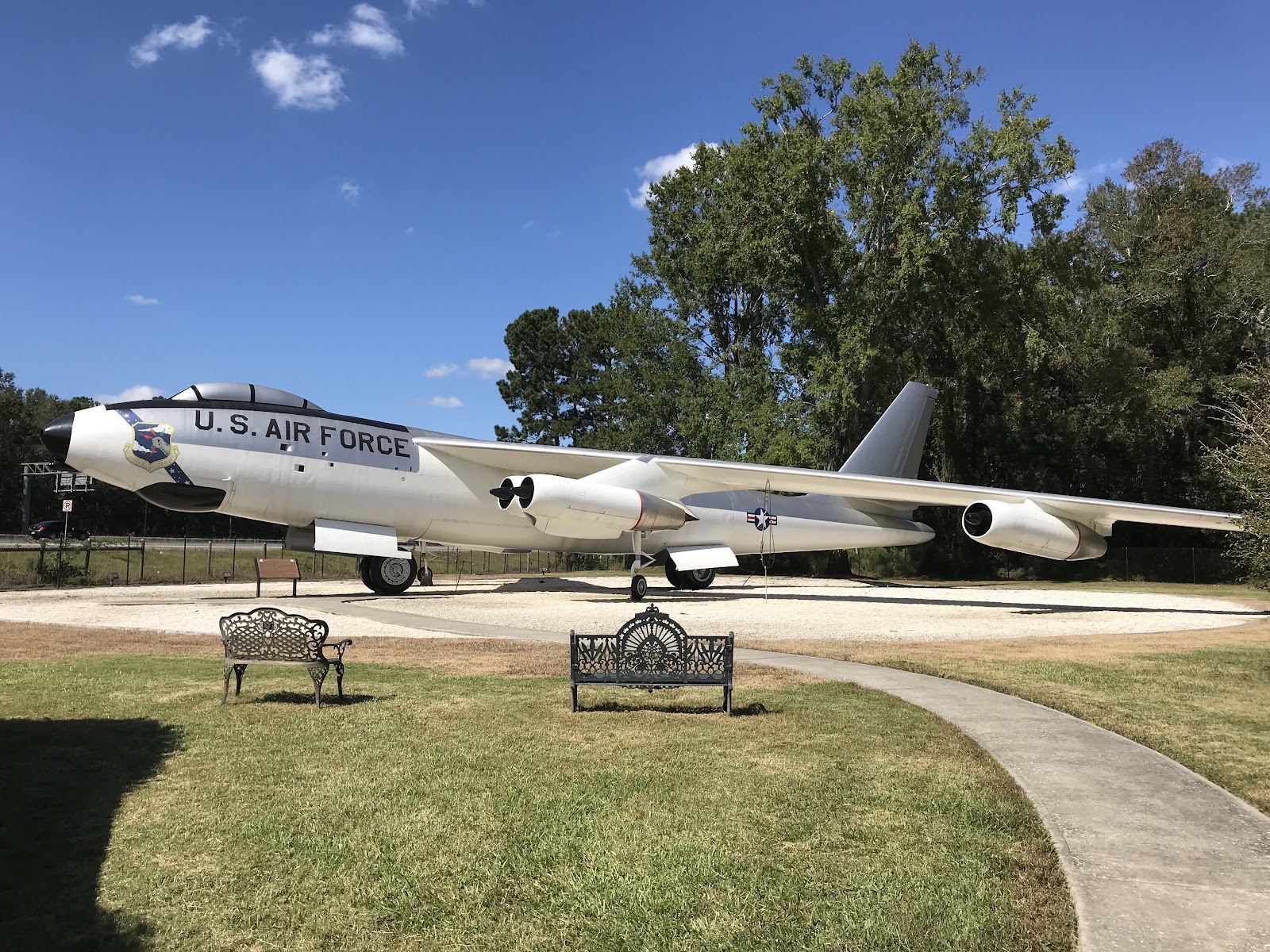
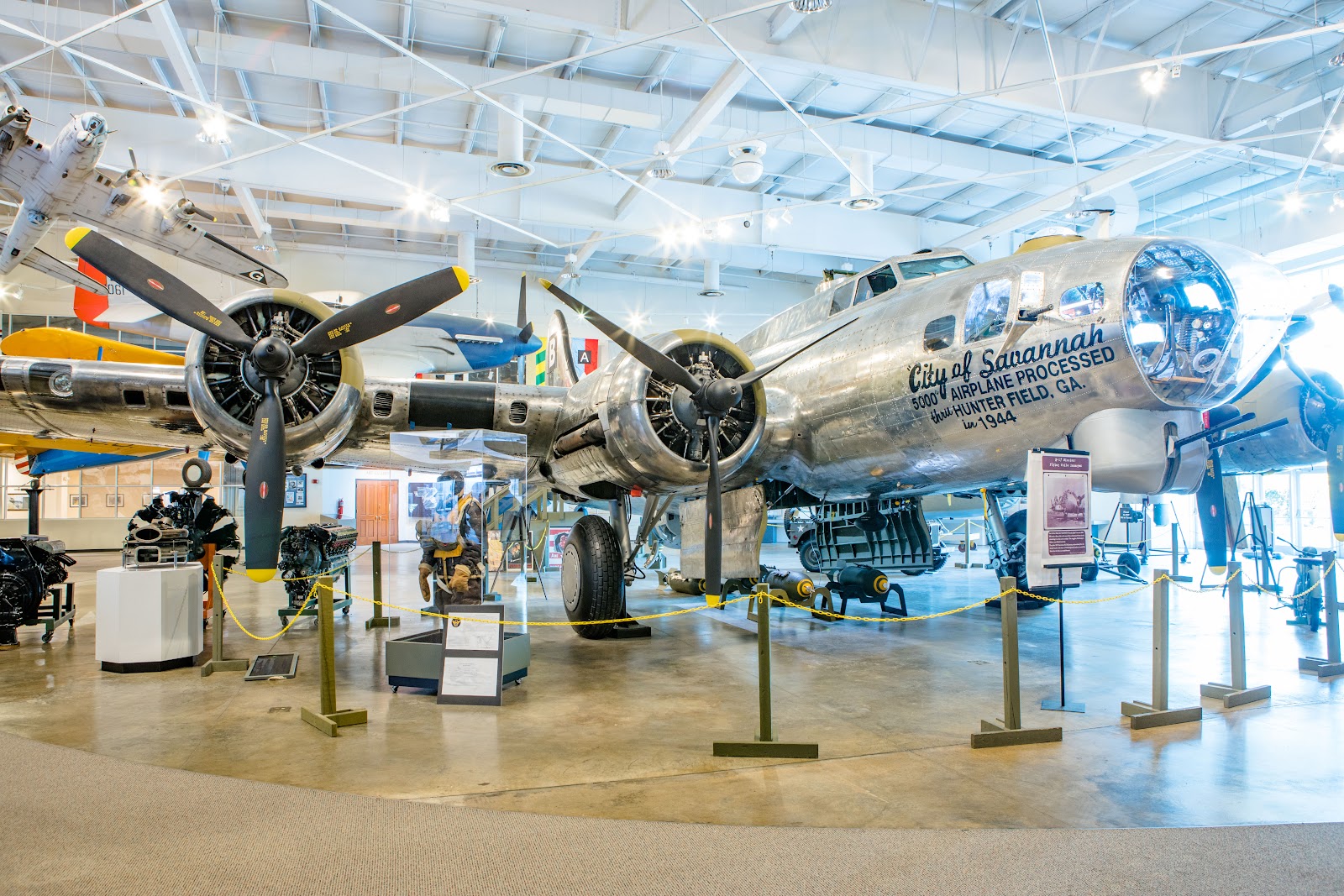
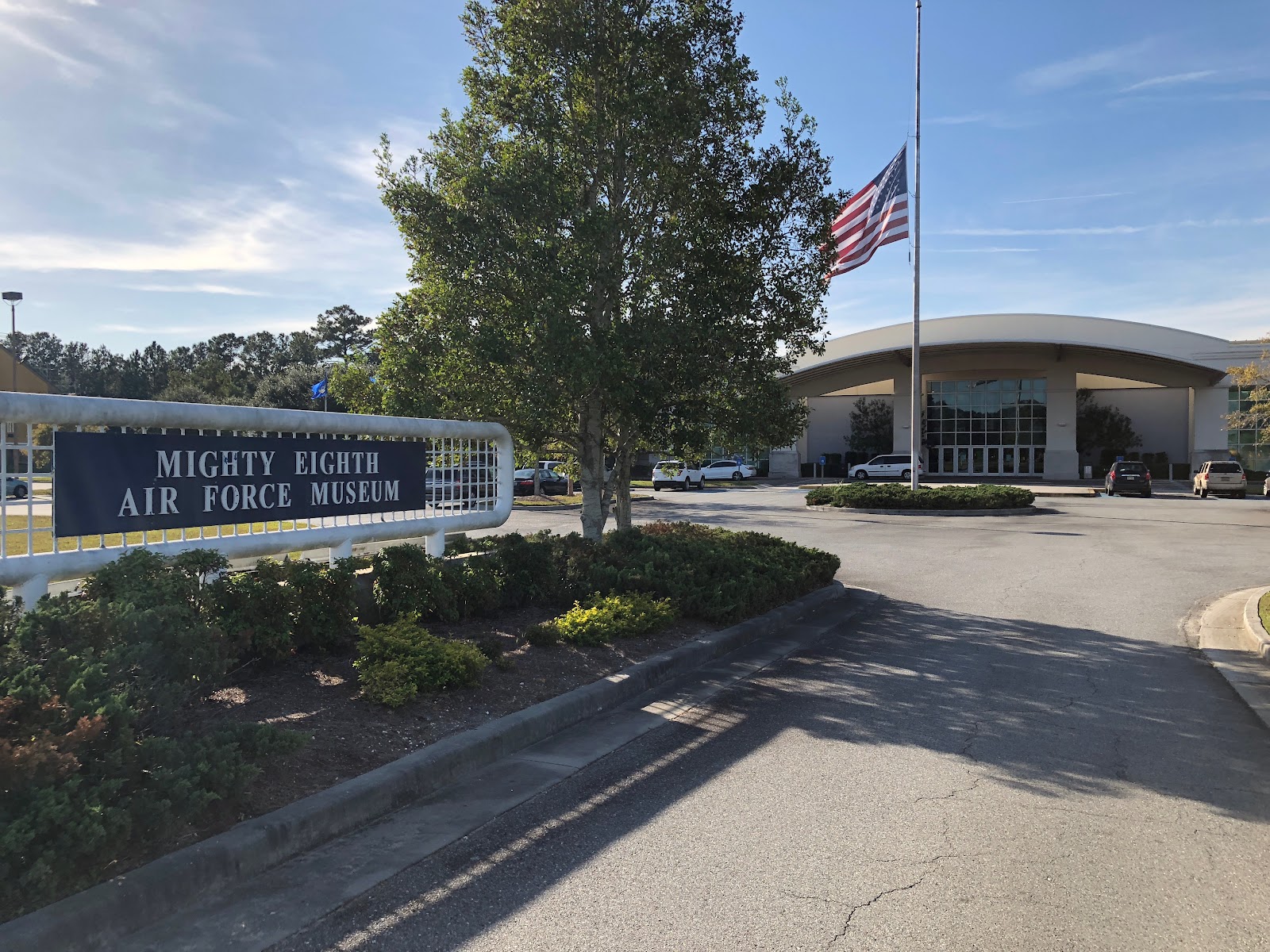
The Mighty Eighth Air Force Museum is at Pooler, just west of Savannah, and it commemorates the Eighth Air Force. It holds aircraft — including a heavy bomber — displayed in a large hall, along with galleries, a chapel with stained glass, and memorial gardens outside.
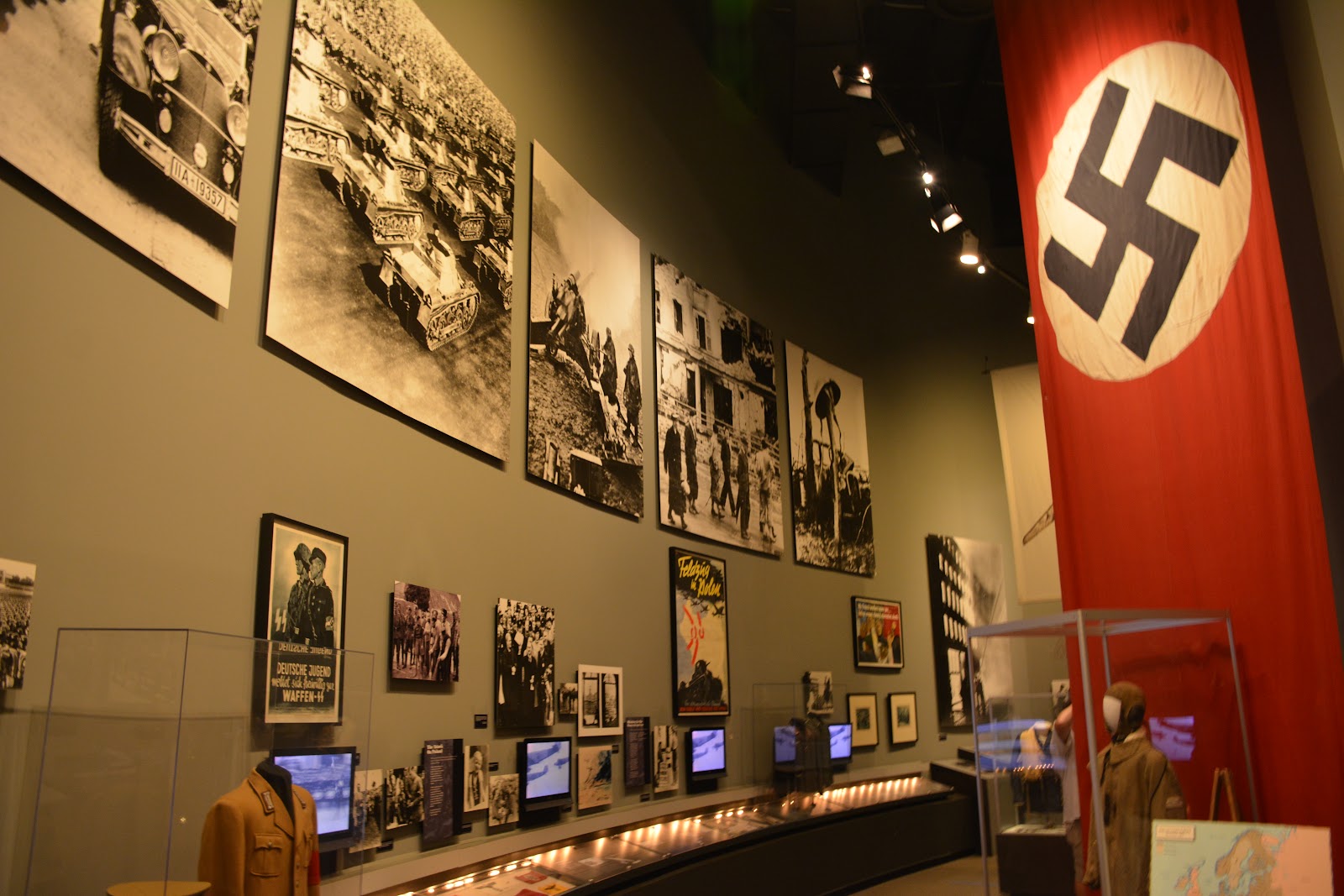
Before the technique, the tone. This is a memorial museum as much as a collection. It exists to commemorate people who were killed, there are memorial features on the site and names on them, and the chapel is a chapel. A photographer should work here the way they would work in any memorial space: the objects and the memorials are legitimate subjects, and they are not props. Nobody climbs on anything, nobody poses against a wall of names, and the celebratory frames happen in the spaces intended for events rather than in front of a memorial. That is a one-sentence conversation with the couple in advance and it prevents the only genuinely bad outcome available here.
Now the problem, which has four parts.
The space is very large and very dark. An aircraft hall has the volume of a hangar because it holds hangar-sized objects, and it is lit for viewing rather than for photography — which at that volume means a low level of light arriving from a long way up.
The light comes from above. High-bay lighting at the top of a tall space puts flat top light on everything beneath it: no modelling, shadows in eye sockets and under jaws, and no direction to work with.
The light is mixed. A hall of that kind accumulates fixtures across decades and renovations, so metal halide, fluorescent, newer LED and exhibit accent lighting may all be present at once, at different colour temperatures with different and sometimes spiky spectra that no single white balance reconciles.
And the objects are difficult. A military aircraft is a large matte or semi-matte metal shape with a complex outline, surrounded by barriers, stanchions, interpretive panels and floor markings — all necessary, all in frame, and none of it designed to be a background.
None of that makes this a poor venue. It makes it a venue where nothing is found and everything is made, and where the good frames come from four specific manoeuvres.
The first is the chapel, which is the one space in the building with proper light in it.
The second is scale: putting people small beneath something enormous, which is the one thing an aircraft hall can do that nowhere else can.
The third is to stop fighting the darkness and use it — a large dim volume is a black studio, and separation comes free.
And the fourth is to go outside to the gardens, which are the only daylight on the property.
Each in detail, then the Savannah-area year.
The Mighty Eighth Air Force Museum at a glance
| Where | An air force museum at Pooler, just west of Savannah, Georgia |
| The problem | A hangar-sized dark volume, top light, mixed colour, and difficult objects |
| Four ways out | The chapel, scale, using the dark as a studio, and the gardens outside |
| The tone | A memorial museum: the objects and memorials are subjects, not props |
| Ask first | Flash and tripod rules, which spaces are bookable, and chapel availability |
Ways one and two: the chapel, and scale
The chapel first, because it is the only space here with genuinely good light and it will carry the ceremony coverage.
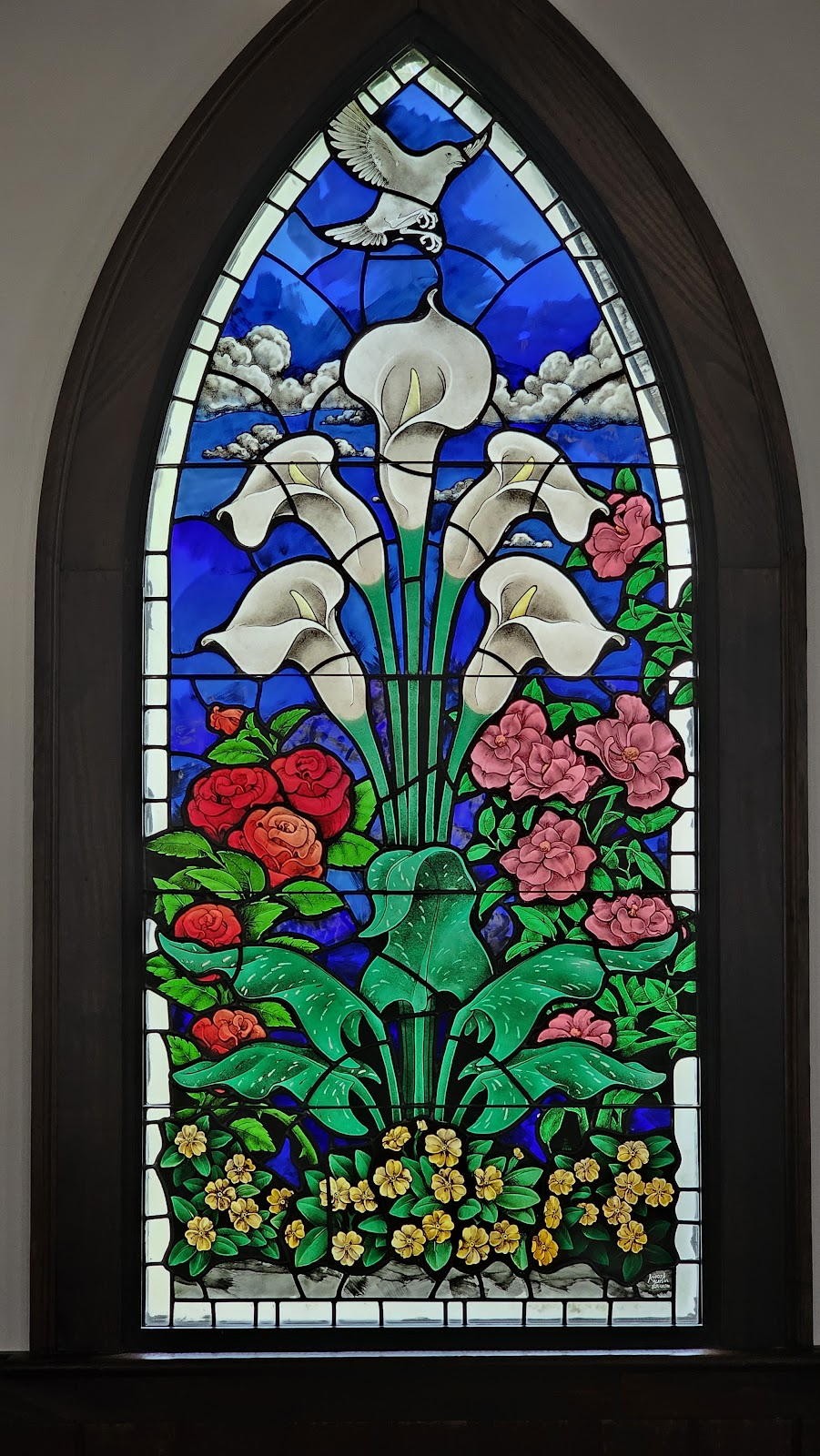
A chapel with stained glass gives you three things a hall does not: a modest volume that can actually be lit, daylight arriving through glazing, and a designed axis with a focal point at one end. Photographically that is an ordinary and very workable set of conditions, and it is a relief after the hall.
The stained glass needs handling as coloured light rather than as decoration. Light through coloured glass takes that colour completely, and a face half in a coloured patch and half in neutral light reads as a mistake that no white balance corrects, because the cast is in the light rather than in the file. There are two coherent approaches and the middle fails: place someone deliberately inside a coloured patch and let the cast be the point, or keep faces entirely clear of the patches and photograph the glass as its own subject.
The patches move through the day in a predictable way. Fifteen minutes working out where they will be at the hour of the ceremony is worth more than any amount of correction afterwards.
Backlit glass photographed as pure pattern, filling the frame, is a strong image and it takes a minute. Ask about flash near it — the answer is often no, and the reason is usually conservation or simple decorum rather than preference.
Work the chapel’s axis. A modest room with a defined centre line rewards being square to it, and a frame down the aisle with the couple at the end and the glass beyond is the picture the room was built to give. Use a level.
For the ceremony itself, choose one position and commit. A small chapel has nowhere to stand that is not in somebody’s sightline, so pick a spot slightly off the centre aisle, low, from which both faces are visible, and let a short zoom do the moving instead of your feet.
Now the second manoeuvre, which is the hall’s one great gift.
A heavy bomber is enormous, and enormous is the frame. Two small figures standing beneath a wing, with the aircraft filling the upper two-thirds of the picture, is a photograph that cannot be made anywhere except a venue with an aircraft in it — and it is worth far more than a tight portrait in front of a fuselage.
So get low, go wide, and stand well back. A low camera beneath a wing with the couple small and the airframe above them reads as scale; the same couple at portrait distance against the same aircraft reads as two people in front of a grey wall.
Use the geometry. An aircraft is all line and repetition — propeller blades, engine nacelles, the run of rivets along a fuselage, the taper of a wing, the framing of a turret or a canopy. Those are compositional elements and a frame built on one of them, rather than on the whole object, is usually stronger than a general view.
Shoot up through the undercarriage or between wheels and struts, so the structure frames the couple. A complex machine gives you foregrounds that an empty room does not.
The surfaces are the technical problem. Bare or painted aluminium is semi-specular: it does not have a diffuse surface that records tone evenly, so it reflects whatever is above it — which in a hall means high-bay fixtures appearing as bright streaks and dark voids between them. The fix is the same as with any semi-specular object: control what it is reflecting rather than lighting the metal. A large pale surface nearby, or a bounced light if permitted, gives a broad soft highlight running along a panel, which reads as form. A hard light pointed at aluminium gives a bright dot and a lot of black.
And keep faces away from painted metal at close range if the paint is strongly coloured, because it will throw that colour onto skin.
Two rules that are not negotiable. Nobody touches, leans on or climbs on an airframe, and nobody is posed in a way that suggests they are about to. These are collection objects and several are irreplaceable. Ask which have any access at all and treat the floor markings as boundaries.
Ways three and four: use the dark, and go outside
The third manoeuvre is the one that makes the rest of the building work, and it starts with a question to ask months ahead.
Ask whether lights on stands are permitted, where, and at what hours, and ask whether tripods are allowed. Museums frequently restrict both, for reasons of risk to objects and to visitors, and the answer changes the whole plan. Get it in writing.
Assuming lights are permitted, do not try to lift the hall. You cannot: the volume is enormous, the ceiling is high and dark and full of services, so there is no useful bounce surface, and raising the ambient by a stop across a hangar would need more output than is practical.
Instead treat it as a black studio, which is exactly what it is. One modifier, close to the subject and feathered, with a great depth of dark hall behind them, and they separate completely because the background sits four or five stops down and records as almost nothing. That is separation for free, with no long lens and no wide aperture, and it takes about ninety seconds per position.
It also suits the material. A single pool of light on two people with a vast dark space behind them, and perhaps the suggestion of an airframe at the edge of the light, is a more atmospheric and more appropriate photograph in a memorial museum than a brightly lit group shot would be.
Warm the light you bring. The hall’s ambient is likely to be cool and greenish from discharge lighting, and a neutral flash in that room will read cold and inserted.
On the mixed colour: choose the dominant source, balance for it, gel your own light to match, and let the rest fall. Do not average, because averaging is what makes large institutional interiors look grey and dead. And watch for flicker — older high-bay discharge lamps can pulse at a rate that interacts with a fast shutter, producing banding or shot-to-shot colour shifts. If you see it, drop to a sixtieth of a second or slower and it generally disappears. Test on arrival rather than discovering it in the files.
If flash is not permitted at all, the hall becomes an available-light problem. It is workable with a fast lens at a high sensitivity, and the honest advice is to accept noise — a slightly noisy frame that exists beats a clean one that does not. Look for the pools of light the exhibit lighting already creates, because museum lighting is directional by design and a subject placed at the edge of a lit area is well modelled with a dark background for free.
The fourth manoeuvre is the gardens, and they are the only daylight the property has.
Memorial gardens at a site like this are typically formal or semi-formal: lawns, paths, planting, and memorial features. Photographically the useful facts are that they are open to the sky, which makes them an ends-of-the-day space at this latitude, and that they are the place where a wedding party can be photographed in natural light at all.
Treat the memorial features with the care described in the lede: do not use names, plaques or monuments as backdrops. There will be plenty of garden that is simply garden.
Look for live oaks. This is coastal Georgia and live oak is the region’s signature tree — evergreen, broad, low-crowned, with heavy limbs that run out horizontally and dip toward the ground, casting solid shade with no dapple in January exactly as in July. One of them is a natural room that shades a group of forty and frames a ceremony with no structure at all, and it is the midday answer in any month. Spanish moss hanging from the limbs glows when backlit against a low sun and places the frame in this region immediately.
Two canopy rules as always: position for open sky arriving from the side rather than light filtered through leaves, which is genuinely green, and avoid dappled shade entirely, because hard bright patches several stops above the surrounding skin cannot be recovered.
And the aircraft outside, if there are any on static display. An airframe in daylight is a completely different and much easier subject than the same object indoors: the surface has a sky to reflect rather than a ceiling of fixtures, so it reads as form, and in low raking light the panel lines and rivets throw shadows and the whole machine acquires texture. If there is anything on the apron or the lawn, the last hour of the day is when to photograph it.
Coastal Georgia, and the year
This is the Savannah area, at about thirty-two degrees north, and the numbers are Gulf-South numbers with slightly more forgiving margins.
The midsummer noon sun reaches about eighty-one degrees, which is high enough to be difficult on open ground from roughly eleven to three, and the midwinter noon sun sits near thirty-four and a half degrees, which is low enough to model properly all day. Civil twilight runs about twenty-three to twenty-four minutes in midsummer, with a usable balance point of ten to twelve.
At a venue whose principal spaces are interior and artificially lit, those numbers matter less than they do at a garden — and that is worth saying as an advantage. Almost nothing at this museum depends on the weather or the hour, which makes it an unusually weather-proof venue on a coast where weather is a real consideration.
Humidity is the region’s defining atmospheric condition. Summer dewpoints sit in the mid to high seventies, which fills shadows by something like two and a half stops against a dry climate — soft shadow edges, detail in eye sockets, and midday open shade that is genuinely workable. The costs are a pale washed sky, haze on long lenses, and a lens that fogs within seconds moving from an air-conditioned building into this air.
That last point is acute here. A museum with collection objects in it is air-conditioned hard and controlled tightly, and a photographer moving between a cooled hall and a humid garden will meet condensation on every transition. Keep the body warm rather than cool, or plan the garden work as a single block rather than several trips.
December through April is the season on this coast and the reversal against most of this library is emphatic: mild, comparatively dry, sunny, with a February noon sun near forty-five degrees that models a face rather than flattening it. Azaleas and camellias through late winter and early spring. And because the live oaks are evergreen and the Spanish moss hangs year-round, a January frame looks much like an October one — so the off season costs almost nothing in appearance and gains everything in comfort.
May through September is the constraint outdoors. Nineties heat with high-seventies dewpoints, in formal clothing, is a welfare matter before a photographic one, and coastal Georgia has mosquitoes and biting midges that will determine how long anybody stands anywhere near dusk. The practical shape is the two ends of the day in the gardens and the middle of it inside — which at this venue is a genuine convenience rather than a compromise.
Afternoon convection is near-daily in the wet season and this region receives a great deal of lightning, so any outdoor element in summer needs a covered alternative. Here that is not a problem: the building is the covered alternative and it is enormous. That resilience is one of the strongest practical arguments for this kind of venue on this coast.
Hurricane season runs June through November and peaks in August and September, and on the Georgia coast it is a real consideration rather than a remote one — a named storm offshore a week out disrupts travel, suppliers and accommodation whether or not it makes landfall nearby. A summer or early-autumn date deserves a genuine contingency.
The compensation is the half hour after a cell clears, which is the best outdoor light of the year: washed air, wet paving reflecting the sky, planting at full saturation, live oak bark at full contrast, and a low sun under a broken ceiling. Wet aluminium on any aircraft outside is also considerably better than dry — a wet semi-specular surface picks up a sheen and reads as form. If a storm goes through at six, do not pack.
Two closing practical notes for this venue specifically.
Establish what else is on site on the date. A museum runs its own programme — exhibitions, ceremonies, veterans’ events, school visits — and a commemorative event in the hall you were counting on is both a scheduling problem and a situation in which a wedding party should not be photographing. Ask, and be prepared to work around it with good grace, because that programme is what the institution is for.
And establish the visitor situation. Unless a booking closes an area, the public will be present in the hall, and a large museum near a major tourist city has plenty of them. Work tighter than instinct suggests, use a long lens to compress a background into texture rather than into people, and ask whether an after-hours window exists — which at a museum is a genuine product and, given that the interiors are unaffected by the hour, is the single best thing to buy here.
More frames from The Mighty Eighth Air Force Museum
The Mighty Eighth Air Force Museum wedding photography: common questions
What is the main problem in the aircraft hall?
A hangar-sized dark volume, lit for viewing rather than photography. The light level is low and it arrives from a long way up, which puts flat top light on everything — no modelling, shadows in eye sockets. The fixtures are mixed across decades, so metal halide, fluorescent, LED and accent lighting may all be present with spectra no single white balance reconciles. And the objects are large semi-specular metal shapes surrounded by barriers, stanchions and floor markings, none of it designed to be a background.
What is the one thing this venue does better than anywhere?
Scale. Two small figures beneath a wing, with the aircraft filling the upper two-thirds of the frame, is a photograph that cannot be made anywhere without an aircraft in it — and it is worth far more than a tight portrait against a fuselage. Get low, go wide, stand well back. Also shoot up through undercarriage, struts and wheels, because a complex machine gives you foregrounds an empty room does not.
How do you light a space that large?
You do not. The volume is too big and the high dark serviced ceiling gives no useful bounce, so treat it as a black studio instead — one modifier, close and feathered, with a great depth of dark hall behind the subject, which separates them completely because the background sits four or five stops down. That takes about ninety seconds per position and it suits the material: a single pool of light with a vast dark space behind is more appropriate in a memorial museum than a brightly lit group shot.
How should the stained glass be handled?
As coloured light rather than decoration. Light through coloured glass takes that colour completely, and a face half in a patch and half in neutral light reads as a mistake no white balance corrects. Either place someone deliberately inside a patch and let the cast be the point, or keep faces entirely clear and photograph the glass as its own subject — the middle fails. The patches move predictably, so fifteen minutes working out where they will be at the ceremony hour is worth more than any correction afterwards.
Is there anything not to do?
Yes, and it matters more here than the technique. This is a memorial museum: it commemorates people who were killed, there are names on memorial features, and the chapel is a chapel. Nobody touches, leans on or climbs on an airframe — several are irreplaceable collection objects — and nobody is posed against a wall of names or a monument. Keep the celebratory frames to the spaces intended for events. It is a one-sentence conversation with the couple in advance and it prevents the only genuinely bad outcome available here.
Is this a weather-proof venue?
Unusually so, and on this coast that is a real argument for it. Almost nothing here depends on the hour or the weather — the principal spaces are interior and artificially lit, so a rained-off day costs the gardens rather than the wedding, and the covered alternative for any outdoor element is an enormous building already on site. Given that, the single best thing to buy is an after-hours window if one exists, because the interiors are identical at any hour and the only variable worth removing is the visiting public.
More Georgia venue guides
We are writing a photographer’s guide to every venue we would happily shoot in Georgia. Here are three more, plus the full index:
- The Savannah Civic Center, Savannah: The Light Through the Day
- The Tybee Island Lighthouse, Tybee Island: A Walk Through the Station
- The Cotton Sail Hotel: Building the Shot List on River Street
Planning a wedding at The Mighty Eighth Air Force Museum?
Buy the quiet hour, then work the scale. Tell us your date.