 The Thunderbird Inn: Field Notes on a 1964 Motor Inn
The Tybee Island Lighthouse, Tybee Island: A Walk Through the Station
Not just a tower. A whole station, and then a beach.
Most lighthouse venues are a tower and a car park. This one is a complete station, which is a different and much better proposition.
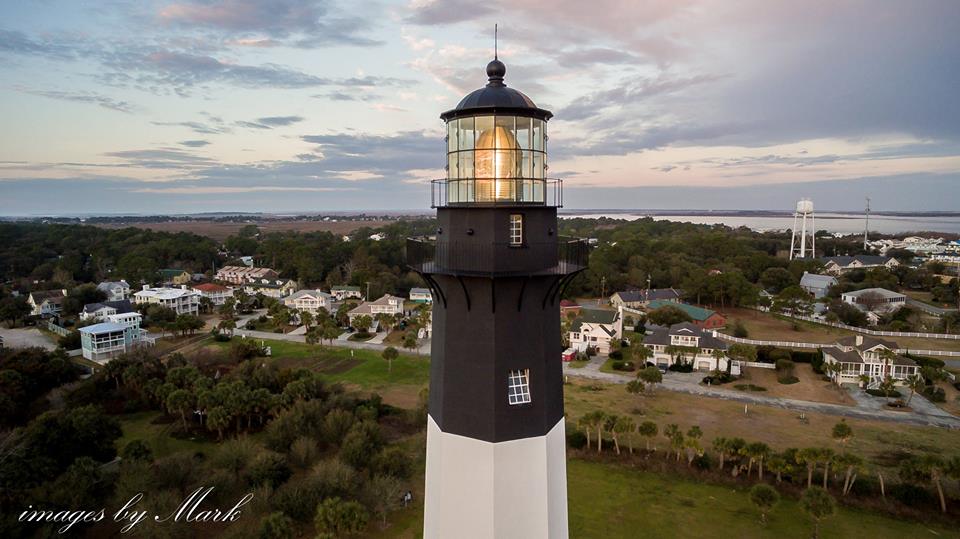
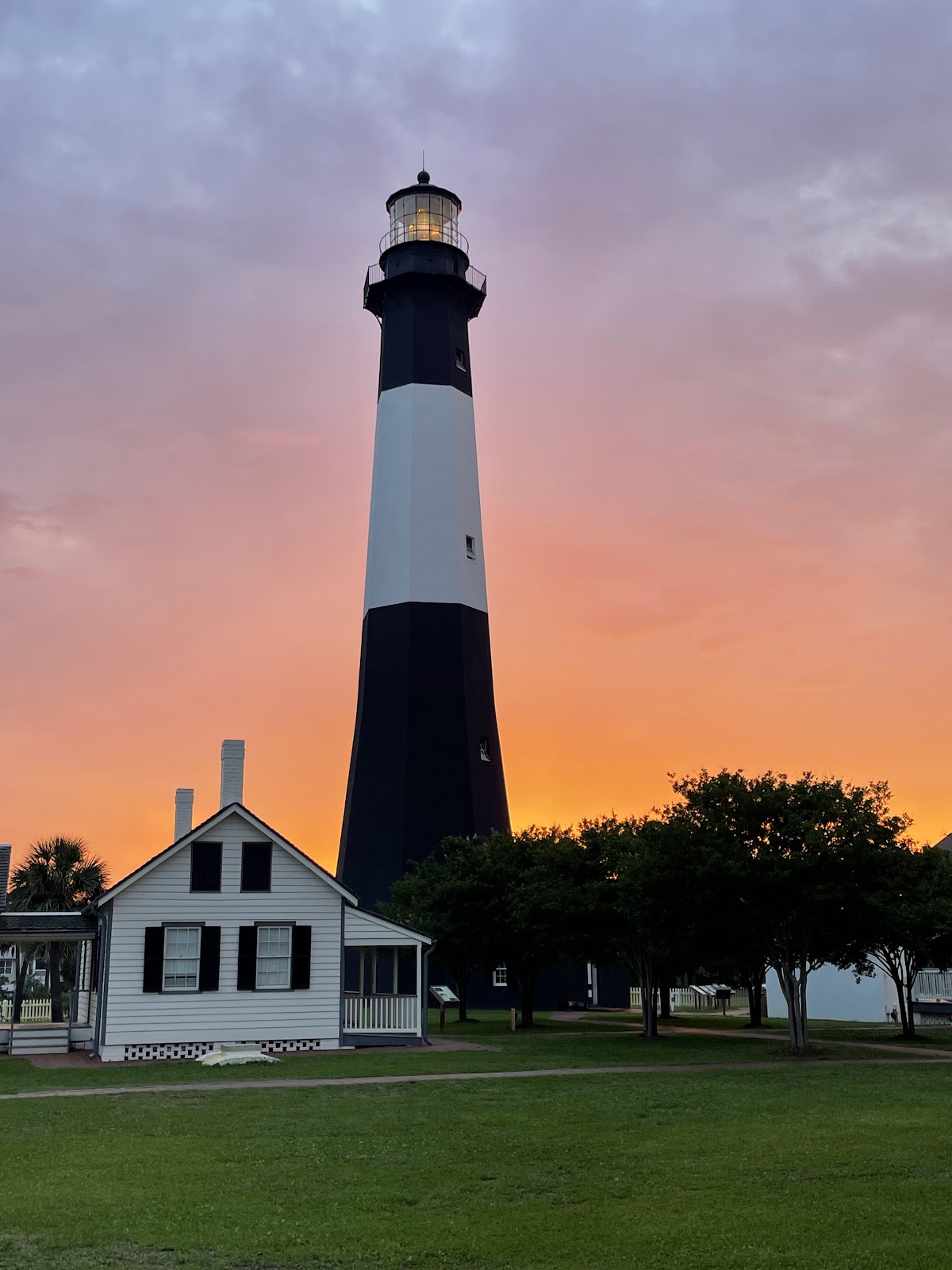
The Tybee Island Light Station stands at the northern end of Tybee Island, at the mouth of the Savannah River, some eighteen miles east of Savannah. The tower runs to around forty-four metres with a hundred and seventy-eight steps, and it is a composite structure — the lower portion dates from the seventeen-seventies and the upper part was rebuilt in the eighteen-sixties. It carries a black, white and black daymark that makes it instantly recognisable.
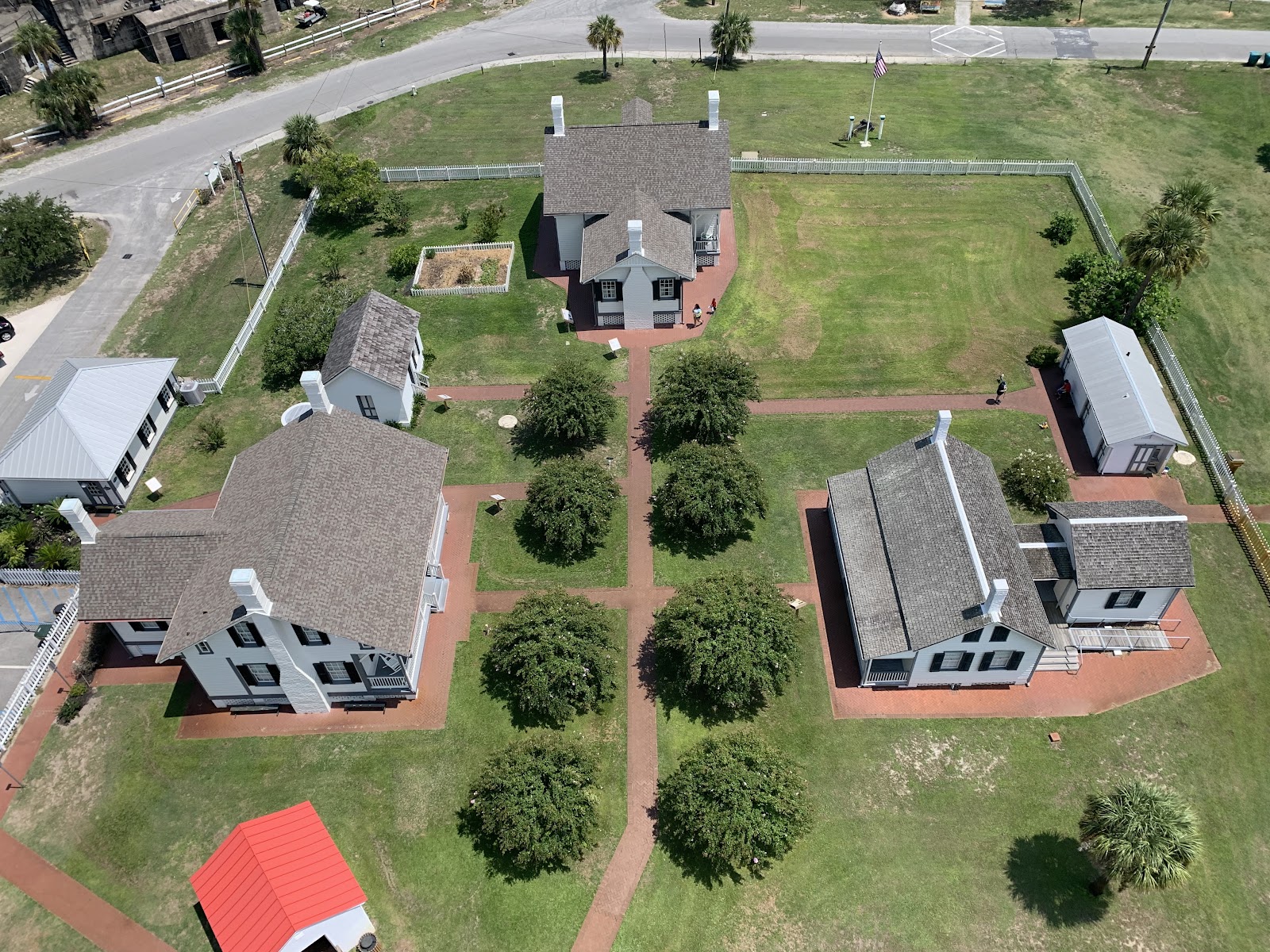
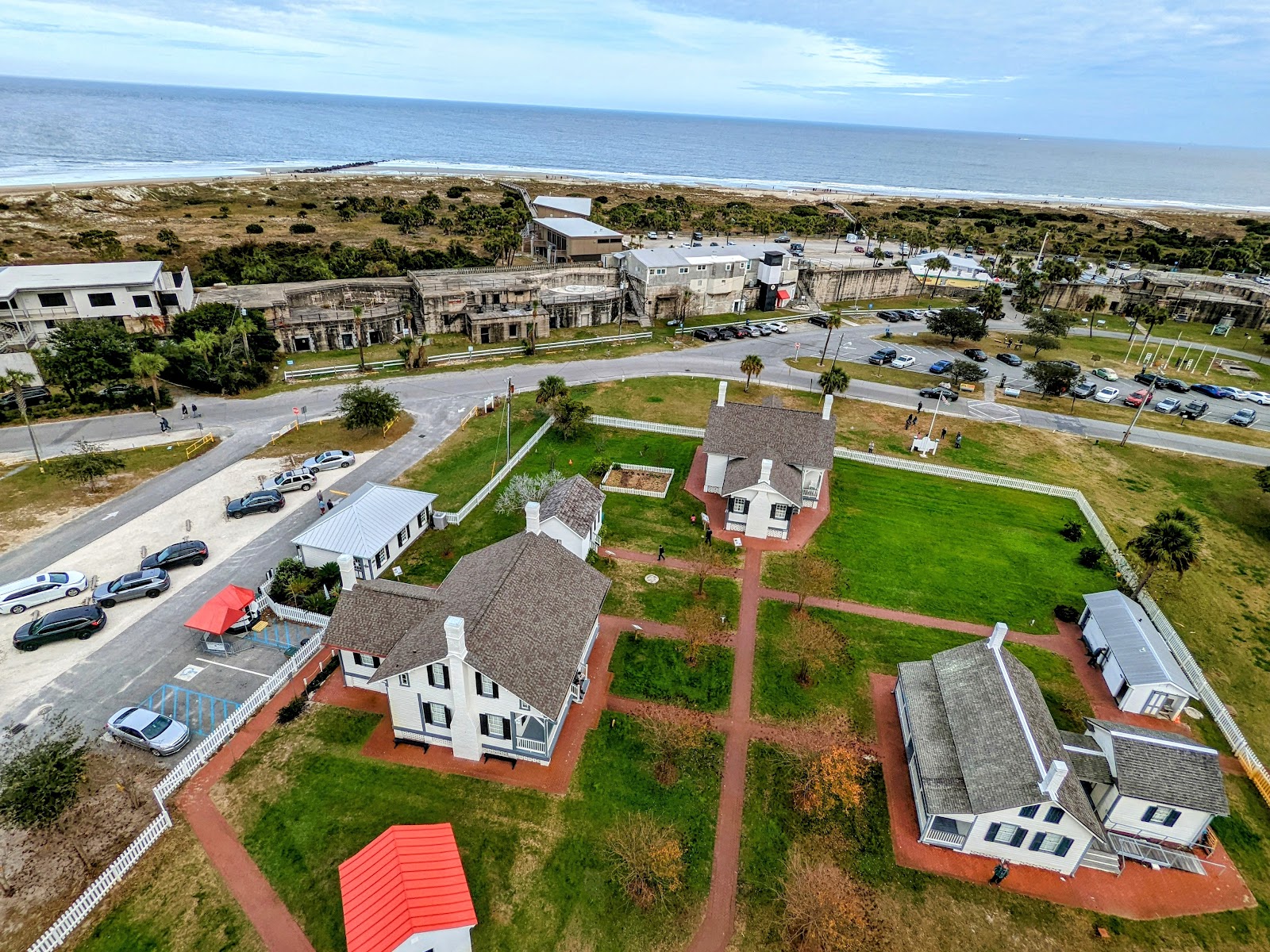
What distinguishes it, though, is what stands around it. The head keeper’s cottage survives, and so do two assistant keepers’ cottages, a summer kitchen, an oil house and a cistern — which makes this one of the most intact light stations in the country. A working nineteenth-century station is not one building but a small settlement of them, arranged for the job, and having the whole set is unusual.
For a photographer that means the site has three registers rather than one: the tower, which is a monumental vertical; the domestic buildings, which are modest, painted, domestic-scaled structures with ordinary windows and ordinary rooms; and the outbuildings, which are small, plain and functional.
That variety is the venue’s real asset. A tower alone gives you one frame repeated; a station gives you a sequence.
Two facts about the setting govern the day and both are worth establishing before the walk.
The first is the tide. Tybee is a barrier island on a coast with a tidal range of something like two to two and a half metres, which is large for this region — and on a gently shelving beach that means low water exposes a very wide plain of flat wet sand. That plain is the single most useful photographic surface on the property, because flat wet sand is a mirror, and the difference between high tide and low tide here is the difference between a narrow strip of dry sand and a hundred metres of reflective ground.
So the tide, not the hour, decides the beach frames. Tide tables for this coast are published and free, and checking them is the most useful ten minutes of preparation available.
The second is the orientation. The main beach faces east to the Atlantic and the northern end faces north across the river mouth. Which means sunrise is over open water, sunset is inland over salt marsh, and the northern beach looks out at a working shipping channel with very large vessels entering and leaving the Savannah River close inshore.
That is three different directions with three different kinds of light and subject, and a photographer who knows which is which can use all of them in one evening.
So the walk goes: the cottages, the tower, the top if you can get to it, the beach, and the marsh behind. One number for the schedule — at about thirty-two degrees north, civil twilight runs roughly twenty-three to twenty-four minutes with a usable balance point of ten to twelve.
The Tybee Island Lighthouse at a glance
| Where | A complete nineteenth-century light station at the north end of Tybee Island, Georgia |
| The asset | Tower, three keepers’ cottages, summer kitchen and outbuildings all surviving |
| The governing fact | A two-metre-plus tidal range: low water exposes a wide mirror of wet sand |
| The orientation | Sunrise over the Atlantic, sunset over marsh, ships to the north |
| Ask first | Tower and cottage access, what may be booked, and the tide table for the date |
The cottages, the tower and the top
Start with the cottages, because they are the part of the station most photographers walk past on the way to the tower.
A keeper’s cottage is a modest painted timber or masonry house with ordinary windows, ordinary rooms and a porch. That sounds unremarkable and it is precisely what makes it useful: after the tower, which is a vast vertical with no human scale in it at all, the cottages give you domestic-scaled architecture — doorways, window frames, porch posts, steps — which are the elements a portrait needs.
The windows are the best interior light on the site, if interiors are accessible. A modest sash window in a painted room, with something pale opposite, gives soft directional light with a fast falloff. Work side-on at a metre or so and step the positions out rather than guessing, because a small room with a modest opening has a steeper falloff than a large one.
Ask what is accessible, because a station of this kind usually has some buildings open as museum and others not, and the answer is a defined list. Ask also about flash and tripods indoors, because these are collection interiors and the answer may reasonably be no.
The painted exteriors are the thing to use outdoors. A white or pale-painted timber wall is an efficient reflector, which means a subject standing a couple of metres off one on the shaded side is filled beautifully for nothing — the exact opposite of the timber problem at a barn or a lodge. Find the shaded side of a pale building and you have a softbox.
Painted weatherboard also takes raking light well: the shadow lines under each board give a horizontal rhythm that reads as texture at a low sun angle and disappears under a frontal one. Light it from the side.
The outbuildings are the third register and they are small, plain and functional — an oil house, a kitchen, a cistern. Photograph them close and tight, in raking light, as details. Brick, whitewash, iron fittings and small openings are all textural, and a sequence of those frames gives a wedding set a documentary register that the tower alone cannot.
Now the tower, and it needs the treatment you would give any monumental vertical.
Get low and go wide, so the base is near the bottom of the frame and the whole height runs up through it. From standing height and a comfortable distance, a forty-four-metre tower looks like a modest cone; from close and low, angled up, it reads as the scale it is.
Two cautions. A wide lens tilted up converges the verticals hard, and on a symmetrical tower convergence looks like an error rather than a style — so either keep the camera level and accept more foreground, correct afterwards, or commit to a steep angle where the convergence is obviously deliberate. The mild middle case looks wrong.
And the daymark is a strong graphic element with hard tonal divisions in it. A black-and-white banded tower against a bright sky is a high-contrast subject: meter so the white bands hold rather than clip, because a blown white band next to a black one is unusable, and accept that the black will go dense. That is the right way round.
Use scale rather than proximity. Two small figures at the base of the tower is a stronger photograph than a tight portrait against its wall, and the frame then contains the thing that makes the site remarkable.
If the tower is climbable and access is permitted, the top is worth the hundred and seventy-eight steps for two frames that exist nowhere else on the island. Looking down, the station buildings, their roofs and the paths between them read as a plan — an aerial-feeling frame of a nineteenth-century settlement laid out for a purpose. And looking out, you have the only elevated view on a completely flat barrier island: beach, marsh, river mouth and ocean all in one sweep.
Two practical notes about a climb. Establish whether a wedding party may go up at all and how many people at once, because a lighthouse stair is narrow and its capacity is a safety limit rather than a preference. And a couple in formal clothing climbing a hundred and seventy-eight steps in a Georgia summer will arrive at the top too warm to be photographed immediately — build in two minutes.
The beach, the ships and the marsh
Down to the beach, and the tide is the first question rather than the light.
At low water this shore exposes a broad plain of flat wet sand, and flat wet sand is a genuine mirror. A couple reflected in it with a low sun behind them, camera at ground level, is the best frame this island offers — and it is not available at high tide, when the same beach is a narrow strip of dry sand with the water at the top of it.
So check the tide table for the date and plan the beach session around low water rather than around sunset. If the two coincide, that is the evening. If they do not, take the beach at whichever end of the day the tide allows and put the other end somewhere else.
Work from the ground. A mirror is only a mirror from close to its own level: from standing height, wet sand is a shiny grey surface, and from twenty centimetres it doubles everything above it. Lie down.
Dry sand at the ends of the day is the other beach surface and it works differently. Low raking light across dry sand picks out every ripple and footprint, so the ground becomes textured rather than flat — and it means footprints matter. Walk in from the side and keep the frame’s foreground clean, because a set of tracks leading to the couple reads as carelessness unless you put them there deliberately.
At midday the beach is the worst place on the island: bright, contrasty, reflecting upward into faces, with no shade anywhere. That block belongs at the station, under a live oak or inside a cottage.
Then the ships, which are specific to this end of the island and are genuinely worth planning for.
The northern beach looks out across the mouth of the Savannah River, which is a working shipping channel serving a major port, and very large container vessels pass close inshore on their way in and out. A ship of that size moving behind a couple on a beach, or behind the lighthouse, is a frame that says exactly where you are and it has a scale relationship in it that nothing else provides.
Use a long lens so the vessel compresses and looms; at a wide focal length it is a distant grey shape and the photograph is of a beach. Traffic is frequent but not scheduled, and a ship takes several minutes to cross a sightline — enough time to reposition a couple if you notice it coming and no time at all if you do not. It is worth having someone watching the channel.
Then the marsh behind the island, which is where the sunset is.
Because the beach faces east, the sun sets inland over salt marsh — and a Georgia salt marsh at sunset is one of the better landscapes on this coast. It is a plain of cordgrass cut by tidal creeks, and those creeks catch the low sun as bright winding lines through dark grass, which from any slight elevation is a superb graphic subject.
The marsh changes colour completely with the season. It is green through summer and turns a deep gold-brown through winter, which means a February frame and a July frame of the same view look nothing alike — and the winter version, gold grass under a low sun with silver creeks in it, is arguably the better one.
The tide works here too: at high water the creeks are full and wide and the marsh is a pattern of water, and at low water they are narrow channels in exposed mud. Both are good and they are different pictures.
Two cautions about the marsh. The mud is genuinely deep and sticky, and nobody in formal clothing should be anywhere near the edge of a creek — stay on boardwalks, causeways and hard ground, and say so in advance. And biting midges and mosquitoes are serious on a Georgia marsh at dusk in the warm half of the year, which will determine how long anybody is prepared to stand there. Mention it; it photographs as discomfort.
Then the balance point, ten to twelve usable minutes after sunset. At this venue the best version is the tower, lit if the station lights it, against a graduated sky, with the couple small and lit by one warmed source — and if the light itself is active, a long exposure recording the beam as a streak across the sky is the one frame that says lighthouse rather than landmark. Ask whether the tower is floodlit and from what time, and whether the light operates.
The barrier island, and the year
A barrier island is a specific kind of place and three of its properties matter to a photographer.
It is flat. There is no relief at all except the tower and the dunes, which means no elevated viewpoints, no slopes to separate a subject from a background, and a level horizon in every direction — so any camera tilt is immediately obvious. Use a level outdoors, and treat the top of the tower as the only high ground you will get.
It is exposed. There is nothing between this shore and the open Atlantic, so a sea breeze builds on most warm afternoons and an onshore wind arrives unimpeded. A veil on an open beach in fifteen knots is a two-person job and a lightstand needs sandbagging. The lee side of any station building is the calm ground, and the marsh side of the island is more sheltered than the ocean side.
And it is salty. Salt air is corrosive and a breezy day on a beach puts a fine saline mist on lenses, bodies and contacts. Wipe everything down the same evening rather than the next week, and change lenses with your back to the wind, low down, or not at all. Sand is the other half of that problem and it is worse: sand in a zoom barrel is a repair rather than a clean.
The vegetation is worth knowing for two elements. Live oak, which grows on the island’s higher ground and is the region’s signature tree — evergreen, broad, low-crowned, with heavy limbs running out horizontally, casting solid shade with no dapple in January exactly as in July. One of them is the midday answer in any month, and Spanish moss hanging from the limbs glows when backlit against a low sun. And cabbage palmetto, which gives almost no useful shade because the crown is high and the fronds sparse, but which is a strong graphic vertical against open sky and places a frame on this coast immediately.
Sea oats on the dunes are the third: tall, translucent seed heads that backlight beautifully and turn a dune line into a glowing screen at a low sun angle. They are also usually protected as dune stabilisation, so photograph them and do not walk into them.
The year, then, and December through April is the season with the usual Gulf-South reversal. Mild, comparatively dry, sunny, with a February noon sun near forty-five degrees that models a face properly and rakes painted weatherboard and brick rather than flattening them. The marsh is gold, the live oaks are evergreen so the station does not look bare, and the beach is empty of crowds.
That last point matters at a barrier island more than at most venues. Tybee is a beach destination and in the warm half of the year the beach is busy — which unless a booking closes an area means strangers in every frame. In February it is yours.
The cost is a shorter day, with sunset around half past five in February, which puts the balance point before six — during cocktails rather than after dinner, and therefore a named item on the timeline.
May through September is the constraint. Nineties heat with high-seventies dewpoints, in formal clothing, on an exposed beach with no shade, is a welfare matter before a photographic one. Humidity fills shadows by something like two and a half stops against a dry climate, which genuinely helps faces, at the cost of a pale washed sky and a lens that fogs within seconds coming out of an air-conditioned building into this air. And the biting insects on the marsh side are serious near dusk.
Afternoon convection is near-daily in the wet season and this coast receives a great deal of lightning. On a flat exposed barrier island, at the foot of a forty-four-metre tower, that is a safety matter rather than an inconvenience: if there is active convection nearby, be indoors, and do not be standing on an open beach. Ask what the covered alternative is and get its capacity as a number.
Hurricane season runs June through November and peaks in August and September, and on a Georgia barrier island it is a genuine consideration rather than a remote one. A named storm offshore a week out disrupts travel, suppliers and accommodation whether or not it lands nearby, and a barrier island has one road on and off it. A summer or early-autumn date deserves a real contingency and a conversation about insurance.
The compensation is the half hour after a cell clears, which on this coast is the best light of the year: washed air so the river mouth and the shipping channel resolve, wet sand at its most mirror-like regardless of the tide, painted timber and brick several tones darker and far more saturated, the marsh beaded and glowing, and a low sun under a broken ceiling. If a storm goes through at six, do not pack.
Two closing notes. Fog is worth watching for in late winter and early spring, when warm moist air moves over cooler water — a banded tower emerging from fog is an unusual and rather beautiful frame that cannot be planned, so work immediately if it happens, because coastal fog lifts. And establish what else is on at the station and on the island on the date, because a small barrier island with one access road is genuinely affected by events, and a busy weekend changes parking, crowds and access in ways that alter the plan.
More frames from The Tybee Island Lighthouse
The Tybee Island Lighthouse wedding photography: common questions
What makes this different from other lighthouse venues?
It is a complete station rather than a tower and a car park. The head keeper’s cottage survives along with two assistant keepers’ cottages, a summer kitchen, an oil house and a cistern, which makes it one of the most intact light stations in the country. That gives three photographic registers instead of one: a monumental vertical, domestic-scaled painted buildings with ordinary windows and porches, and small plain functional outbuildings. A tower alone gives you one frame repeated; a station gives you a sequence.
Why does the tide matter so much?
Because this coast has a tidal range of something like two to two and a half metres, which is large for the region, and on a gently shelving beach that means low water exposes a very wide plain of flat wet sand — which is a genuine mirror and the single most useful photographic surface on the property. At high tide the same beach is a narrow strip of dry sand. So plan the beach session around low water rather than around sunset, and check the published tide table for the date.
How do you use the wet sand?
From the ground. A mirror is only a mirror from close to its own level: from standing height wet sand is a shiny grey surface, and from twenty centimetres it doubles everything above it. Lie down, put a low sun behind the couple, and the reflection fills the lower half of the frame. Also watch the foreground on dry sand, because low raking light picks out every footprint — walk in from the side and keep it clean unless the tracks are deliberate.
Where is the sunset?
Inland, over salt marsh, because the beach faces east. That is a genuine asset rather than a disappointment: a Georgia salt marsh at sunset is a plain of cordgrass cut by tidal creeks, and those creeks catch the low sun as bright winding lines through dark grass. The marsh is green in summer and deep gold-brown in winter, so the same view looks nothing alike in February and July — and the winter version is arguably better. Stay on boardwalks and hard ground, because the mud is deep and sticky.
What about the ships?
The northern beach looks across the mouth of the Savannah River, a working channel serving a major port, so very large container vessels pass close inshore. A ship that size moving behind a couple or behind the tower is a frame that says exactly where you are and carries a scale relationship nothing else provides. Use a long lens so it compresses and looms — at a wide focal length it is a distant grey shape. Traffic is frequent but not scheduled, so have someone watching the channel.
When is the best time of year?
December through April. Mild, comparatively dry and sunny, with a February noon sun near forty-five degrees that models faces and rakes painted weatherboard properly, a gold marsh, evergreen live oaks so the station does not look bare — and, importantly at a beach destination, a beach with nobody on it. In the warm half of the year the beach is busy, which means strangers in every frame unless a booking closes an area. The cost is a shorter day, with the dusk window falling before six.
More Georgia venue guides
We are writing a photographer’s guide to every venue we would happily shoot in Georgia. Here are three more, plus the full index:
- The Cotton Sail Hotel: Building the Shot List on River Street
- The Forsyth Park Fountain: A Photographer Answers Your Questions
- The Hamilton-Turner House: A Season-by-Season Guide
Planning a wedding at The Tybee Island Lighthouse?
Check the tide first, then walk the station. Tell us your date.