 The Audubon Aquarium: Field Notes on Photographing Through Glass
The Houmas House, Darrow: The Venue’s Own Logic
The gardens are new. That is the most useful thing to know.
The logic of this venue is not the house. It is the gardens, and the single most useful fact about them is that they are modern.
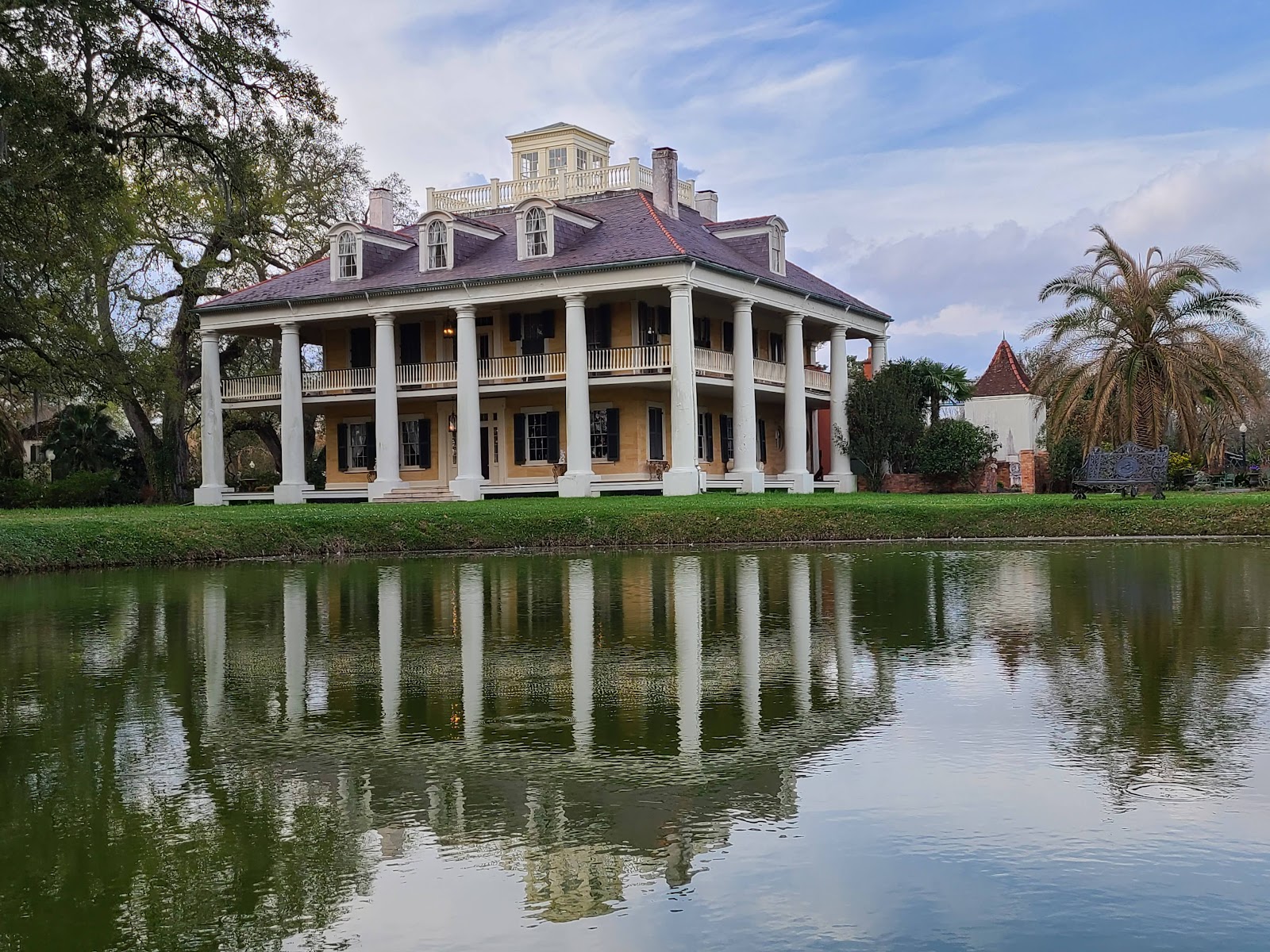
Houmas House stands on the River Road at Darrow, between New Orleans and Baton Rouge. The building has an older rear section from the late eighteenth century and a Greek Revival front added in the eighteen-twenties, and the estate was for a period one of the largest sugar producers in the country. From the early two-thousands a private owner restored the house and laid out extensive formal gardens around it — something in the order of a few dozen acres of them — which is what most of a wedding day here actually happens in.
State the history plainly first, because it is not optional. This was a sugar plantation, and a sugar plantation was a forced-labour camp. Sugar was among the most lethal agricultural industries in North America, and the scale that made this estate one of the largest producers in the country is a measure of how many enslaved people were worked here. The property today presents primarily as a house museum and gardens rather than as a site of interpretation, which is a choice, and it is a different choice from the one some neighbouring properties have made.
So a couple should decide about this deliberately. A substantial number of people, photographers included, decline plantation venues outright for exactly this reason, and that is a coherent position. Others book them having thought it through. Booking without thinking about it is the option that tends to be regretted, sometimes publicly.
With that established, back to the gardens and to why their being modern matters so much.
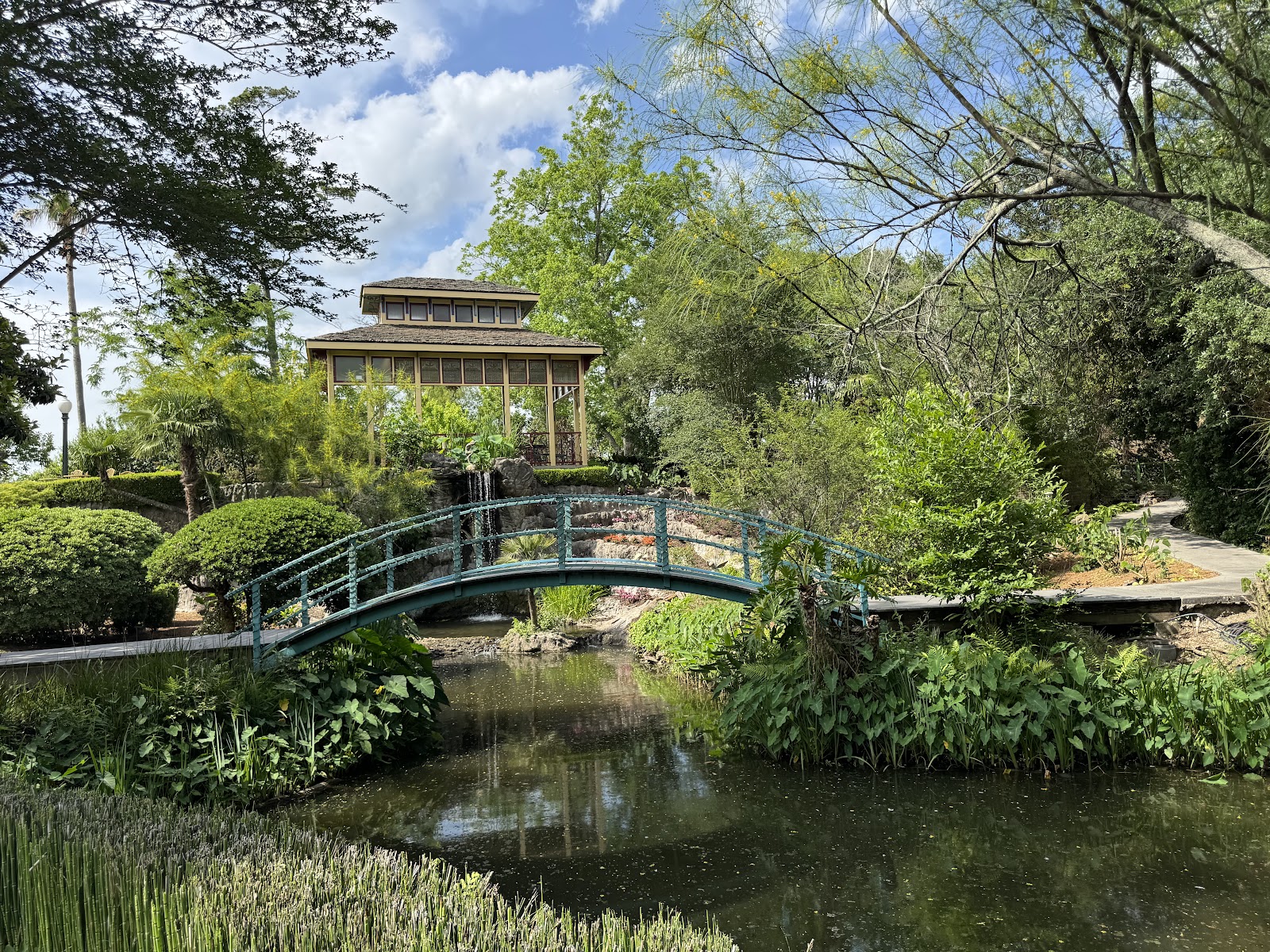
A twenty-year-old garden is not a two-hundred-year-old one, and the difference is visible in every frame. The bones are younger: hedges are at designed height rather than overgrown, paths are level and properly surfaced, sightlines are intentional, and the whole thing was laid out by someone who knew where they wanted people to look. Set against that, the specimen planting has not had time to reach the scale that an old garden’s has, so the enclosure is often at shoulder or head height rather than overhead.
For a photographer that is mostly good news. Intentional sightlines mean there are genuinely composed views available rather than accidents you have to discover. Level surfaced paths mean a wedding party can move without ruining shoes. And designed hedge heights mean a great many enclosed rooms at exactly the scale that suits a group of six to twenty — which is the scale most wedding photography actually happens at.
What it means practically is that this venue should be read as a sequence of outdoor rooms with different sky exposure, exactly as a botanic garden should be, rather than as a house with grounds. Sort them by how much sky each one sees and the day plans itself.
The older layer — the house, the galleries and the mature live oaks — is then the second half of the venue rather than the first, and the oaks are the part of it that matters most.
What follows is how to read the rooms and route a day through them, then the trees and the sugar country around them, then the year — which on the River Road is decisive.
The Houmas House at a glance
| Where | A River Road house at Darrow, LA, with extensive modern formal gardens |
| The logic | A sequence of outdoor rooms; sort them by how much sky each sees |
| Why it matters | The gardens are a 21st-century creation: intentional sightlines, level paths |
| The older layer | The house, its galleries, and mature live oaks |
| Understand first | A forced-labour sugar plantation, once among the largest producers |
Reading the rooms, and routing the day
Sort every space you are given by one variable — how much sky it can see — because that decides what the light does more than any fact about the planting.
A garden room fully open to the sky is a hard-light problem for most of the day and a glorious one for the last hour. At thirty degrees north the midsummer noon sun reaches about eighty-three and a half degrees, within seven degrees of overhead, which on an open parterre means no modelling, black eye sockets and radiated heat off the paths. The same parterre after about five in the afternoon in the same month is superb: the sun is low enough to rake across the beds, the planting throws long shadows that give flat ground depth, and flowers backlight, which is how flowers want to be lit, because petals are translucent and a backlit flower glows in a way a frontlit one never does.
So for open rooms: ceremony early or late, portraits in the last ninety minutes, and if a ceremony must be in the middle of the day, orient it so guests have their backs to the sun and the couple are side-lit rather than front-lit.
A room enclosed by hedge or wall is the controllable one and at this venue there are many, because the hedges are at designed height. An enclosed room behaves like a courtyard: light arrives from the sky above and from bounce off the boundary, so the whole space is soft with a gentle top-down direction. Stand a subject three or four metres out from a sunlit hedge or wall rather than up against it — further out, the boundary subtends a wider angle and wraps the light around a face, while at a metre it is a hard slab from one side.
Enclosed rooms are also the wind answer, which matters more than photographers allow for. A veil in open ground in a fifteen-knot breeze occupies two people full-time; behind a hedge it is an ornament.
A room under mature canopy is the midday answer, and here it means the oaks rather than the garden planting, because a twenty-year-old garden does not yet have overhead canopy of its own. That is the main limitation of a young garden in this climate: plenty of enclosure at head height, not much shade. So the route through a summer day has to include the oaks and the galleries deliberately rather than relying on the beds.
Water is the structural feature worth planning around, and a designed garden usually has it in the form of ponds, rills or fountains. Water does three things at once: it bounces light up, which lifts a chin; it reflects, so a low camera on a near bank turns the far planting into a second image below the first; and it holds colour after the sun has gone, because it reflects the sky and the sky stays bright for twenty minutes after the ground has gone dark. The last frame of a garden evening belongs at the water.
A fountain adds one more thing: moving water, which at a fast shutter freezes into distinct droplets and at a slow one becomes a soft veil. Both are useful and they are different pictures. Decide rather than defaulting.
Now the routing, which is where days go wrong. A garden of a few dozen acres sounds like an invitation to use six locations. It is not. A wedding party of a dozen in formal clothing moves at perhaps fifty metres a minute with stops, so two garden rooms plus the house is a thirty-minute proposition before a single frame is made. Plan two, walk the route beforehand, and time it.
Ask about carts. A property of this size may run one for a wedding party, and if it does the arithmetic changes completely; if it does not, knowing that before promising three locations is the difference between a calm hour and a rushed one.
Ask also about the public. A house museum with gardens has paying visitors, and unless your booking closes an area, expect strangers in frame. Work tighter than instinct suggests, and use a longer lens to compress a background into a wash of colour rather than a wide one that includes a tour group. If a private window exists it will be early morning or after closing, and it is worth asking about specifically.
And one honesty note to carry into the planning conversation: a modern garden is at its designed best in its designed seasons. Find out what is actually in flower in the week of the date rather than promising a couple the photographs on the website, which were made in the fortnight when the garden peaks. The structure — hedges, paths, water, the oaks — is there all year, and structure is what should carry the plan.
The oaks, the cane and the levee
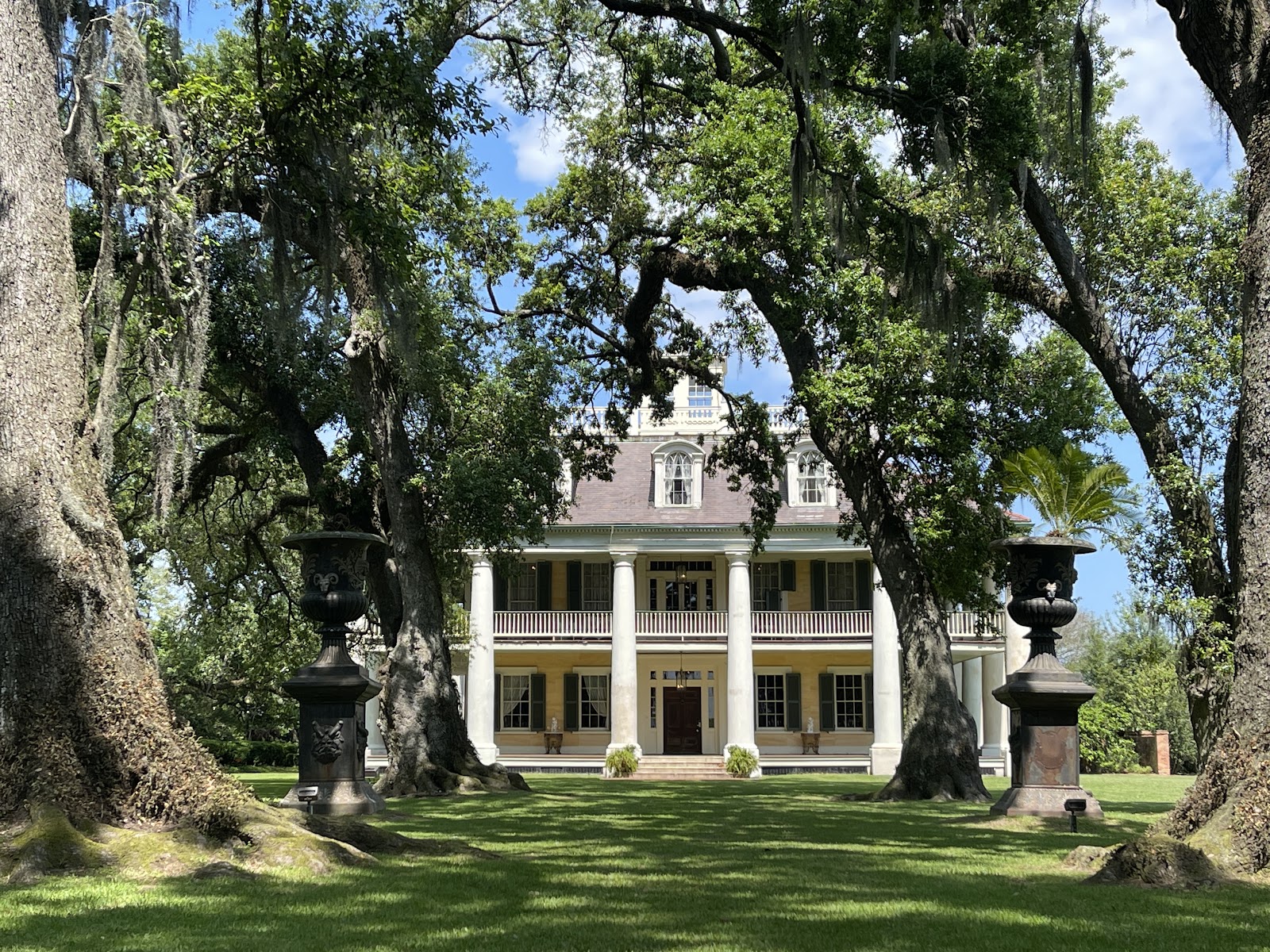
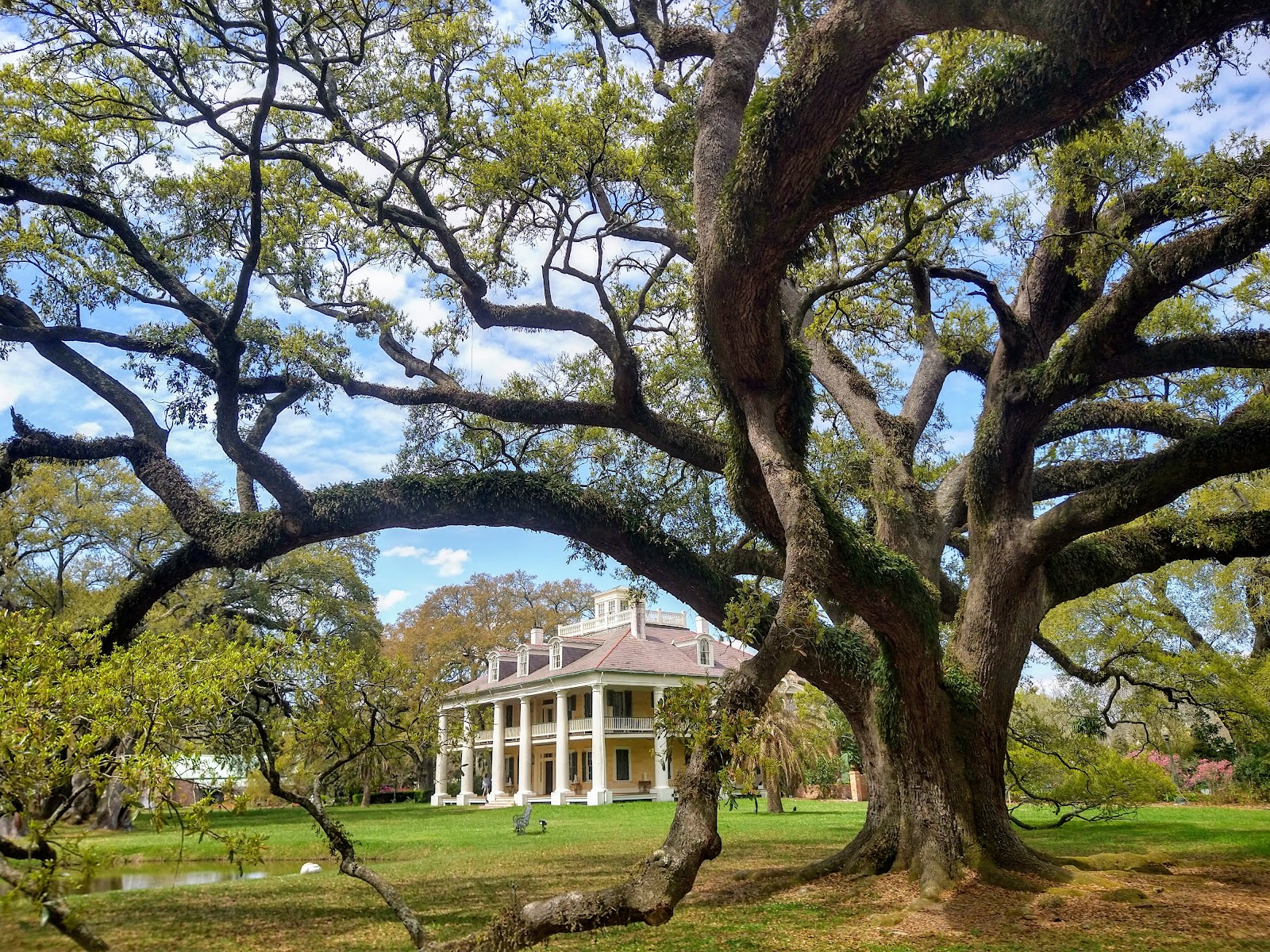
The mature live oaks are the oldest and best thing on the property and they behave unlike any tree in the northern half of this library.
Live oak is evergreen, broad and low-crowned, with heavy limbs that often run out horizontally and dip toward the ground. It holds its leaves year-round, which means it casts genuine solid shade with no dapple in January exactly as in July. That is unusual here — most canopies in this collection vanish for half the year — and it has two consequences. One of these trees is a reliable midday position at any time of year. And a winter frame at this venue looks much like an autumn one, which makes the off season a far better proposition than it is further north.
The trade is that the canopy is dark, several stops below open ground, so a subject under an oak with sunlit lawn beyond is a four-stop frame that needs either a fill or a committed silhouette. And the usual canopy rules apply without exception: light that has passed through leaves is green, so position for open sky arriving from the side rather than filtered light from above, and avoid dappled shade entirely, because hard bright patches on a face several stops above the surrounding skin cannot be recovered. Full shade or full sun, never the edge.
As the sun drops the oaks stop being shade and become subject. Low light under a broad crown rakes along the limbs and picks out bark that on an old live oak is deeply furrowed and full of small shadow. The same tree at noon is a dark mass with a bright edge; at six it is a structure.
Spanish moss is the detail that places a frame geographically, and it is not a moss — it is a bromeliad, an air plant, hanging in grey-green translucent streamers. Backlit against a low sun it glows, and a curtain of it in the foreground gives depth to a frame that would otherwise be flat. Look for resurrection fern on the upper surfaces of the big limbs while you are there: it greens within hours of rain and curls brown crisp in a dry spell, so the same limb photographs completely differently depending on the week. After a shower the oaks look furnished; in a drought they look bare.
The house’s galleries are the other part of the older layer worth using properly. A roofed gallery is an outdoor room with a ceiling, and at this latitude that geometry is the best portrait light on any property of this type: the roof removes the overhead sky, which is the part that puts shadows in eye sockets, and what reaches you arrives horizontally from a large bright area with the floor bouncing a little back up. Work about a metre inside the line of the columns facing out, and step the positions rather than guessing, because falloff is roughly a stop per step.
Beyond the gardens the crop is sugarcane, and it gives the year a shape found nowhere else in this collection. Cane grows through summer to two or three metres, which turns the surrounding fields into a green wall that blocks the middle distance entirely. Grinding season runs from October into January, and afterwards the same fields are flat stubble with an open horizon. So the landscape beyond a garden hedge is completely different in September and in December, and it is worth knowing which you will have.
Then the levee, and the region’s most counter-intuitive fact. The Mississippi here runs between artificial levees at a level higher than the surrounding land, so the river is above the fields rather than below them. A grass embankment blocks it completely and the strip between levee and water is wooded. There is no frame of this house with the river behind it and nobody should be promised one.
What the levee gives instead is the only high ground for miles: a clean grass ridge with an unobstructed sky above it, which from below is a superb minimal horizon and from the top — if you may go up, and it is worth asking — is the one position with a genuine long view and a low western sky.
That flatness is worth stating generally. This is delta sediment, dead level, with the natural levee beside the channel as the highest natural ground, which is why the houses are strung along the river at all. There is no relief, no elevated viewpoint, no slope to separate a subject from a background, and a level horizon in every direction — which makes any camera tilt immediately obvious. Use a level outdoors here, not only indoors.
And one working note about the history, because it affects what you photograph rather than only how you think about it. Keep the wedding coverage to the house, the galleries, the gardens and the oaks. If there are any surviving or reconstructed quarters on the property, leave them out entirely. Using them as a picturesque backdrop is the specific failure that gets this genre of venue written about badly, and it happens by accident rather than intent, because weathered timber photographs well and nobody paused to ask what building it was. Agree it with the couple in advance; it takes one sentence.
The River Road year
Darrow sits at about thirty degrees north, the lowest latitude of any mainland venue in this collection, and two numbers govern every wedding day here.
The midsummer noon sun reaches about eighty-three and a half degrees, which is genuinely extreme and dominates the middle of the day from May into September. And civil twilight runs about twenty-two minutes, among the shortest in this library, of which perhaps ten minutes is the usable balance point where the sky and any lighting are within a stop of each other. The day has a difficult middle and two short ends, and the ends are shorter than a northern photographer’s instincts expect.
Humidity is the compensator and it is among the strongest in this collection. Summer dewpoints in the mid to high seventies mean the air is saturated with water vapour, and vapour scatters light into shadows — a sunlit parterre here in July carries something like two and a half stops less shadow contrast than the same sun angle in Arizona. Shadow edges are soft, eye sockets hold detail, and midday open shade is genuinely workable rather than merely survivable. So the extreme sun angle and the generous fill partly cancel, and the desert rule about the middle of the day does not apply here with anything like the same force.
The costs are a pale washed sky that contributes nothing to a wide frame, visible haze on long lenses, and one equipment problem that is acute: a lens moving from an air-conditioned interior into this air fogs within seconds and takes minutes to clear. On a day alternating between a cooled house and a July garden, that is a recurring event. Keep the camera warm rather than cool.
January through April is the season and the reversal against most of this library is emphatic. Mild, comparatively dry, sunny, with a February noon sun near forty-five degrees that models a face properly rather than flattening it. Azaleas and camellias through late winter and early spring, which in a designed southern garden is a genuine display rather than a token one. And because the live oaks are evergreen and the Spanish moss hangs year-round, a January frame looks very much like an October one — so the off season costs almost nothing in appearance and gains everything in comfort and sun angle. This is the best time to photograph here by a wide margin, and it is also the most heavily booked.
May through September is the constraint and it is serious. Afternoon temperatures in the nineties with dewpoints in the high seventies, in formal clothing, standing on open garden paths, is a welfare matter before it is a photographic one, and discomfort photographs as discomfort. Mosquitoes on the River Road in summer are not a joke and they will determine how long anybody stands anywhere, in a garden particularly. The practical shape of a summer day is the two ends outdoors, and the middle under a gallery roof, under an oak, or indoors — which for a garden venue means the gardens are available for perhaps four hours of a fourteen-hour day.
Louisiana receives among the highest lightning densities in the country, and afternoon convection is near-daily in the wet season. An outdoor ceremony in summer needs a covered alternative that genuinely exists and is reachable in minutes, and at a house with domestic-scale interiors its capacity has to be known as a number rather than assumed. Hurricane season runs June through November and peaks in August and September; a named storm in the Gulf a week out disrupts travel and suppliers whether or not it lands nearby.
The compensation is the half hour after a cell passes, and in a garden it is worth more than anywhere: washed air, wet paving and gravel reflecting the sky, planting at full saturation, water beading on leaves, resurrection fern greened up on the oak limbs within hours, and a low sun under a broken ceiling. That is the finest light of the year here. If a storm goes through at six, wait twenty minutes rather than packing.
Two closing notes. The house is pale, which means in bright sun the facade will blow out at any exposure that keeps a face in the shade of a gallery — meter for the wall and light the face, or keep both in the same light. And the property is rural and genuinely dark once the twenty-two minutes are gone, with no city glow and no ambient at all. Everything after that is lit entirely by you.
Which brings the whole thing back to the logic at the start. Sort the rooms by sky, pick two, protect the last ninety minutes, take one frame at the balance point, and this is a straightforward and generous venue to photograph.
More frames from The Houmas House
The Houmas House wedding photography: common questions
What is the most useful thing to know about this venue?
That the gardens are modern — laid out from the early two-thousands rather than inherited. That is mostly good news: sightlines are intentional rather than accidental, paths are level and properly surfaced, and hedges are at designed height, which gives a great many enclosed rooms at exactly the scale wedding photography happens at. The limitation is that a twenty-year-old garden has enclosure at head height but little overhead canopy, so the shade in a summer day has to come from the mature oaks and the galleries instead.
How should we plan the route?
Sort the spaces by how much sky each one sees, then pick two plus the house. A few dozen acres of garden looks like an invitation to use six locations, but a wedding party in formal clothing moves at about fifty metres a minute with stops, so two rooms plus the house is already a thirty-minute proposition before a frame is made. Walk the route beforehand and time it, and ask whether a cart is available, because that changes the arithmetic entirely.
When is the best light in the gardens?
The last ninety minutes before sunset for anything open to the sky — the low sun rakes across the beds and flowers backlight, which is how translucent petals want to be lit. Avoid open ground between about eleven and three in summer, when the sun sits within seven degrees of overhead. Enclosed hedge rooms work at any hour, and the mature live oaks are the reliable midday position in every month, because live oak is evergreen and casts solid shade year-round.
Will the flowers be out on our date?
Some of them, and which depends entirely on the week. A designed garden is at its best in its designed seasons, and the photographs on any venue’s website were made in the fortnight when it peaks. Ask what is actually in flower in the week of the date and let the structure — hedges, paths, water and the oaks — carry the plan, because structure is there all year and colour is not. Azaleas and camellias in late winter and early spring are a genuine display here rather than a token one.
Can we see the Mississippi?
No. The river runs between artificial levees at a level higher than the surrounding land, so a grass embankment blocks it completely and the strip beyond is wooded. There is no frame of this house with the river behind it. The levee itself is the only high ground for miles, and from below it is an excellent minimal horizon with nothing on it; ask whether you may walk up.
What should we know about the history?
This was a sugar plantation, which is to say a forced-labour camp, and sugar was among the most lethal agricultural industries in North America — the scale that once made this estate one of the largest producers in the country is a measure of how many enslaved people were worked here. The property today presents primarily as a house museum and gardens rather than as a site of interpretation, which is a choice and a different one from some neighbouring properties. Decide deliberately either way, and on the day keep any surviving or reconstructed quarters out of the wedding coverage entirely.
More Louisiana venue guides
We are writing a photographer’s guide to every venue we would happily shoot in Louisiana. Here are three more, plus the full index:
- The Laura Plantation, Vacherie: Suits and Does Not Suit
- The Oak Alley Plantation, Vacherie: One Frame, and How It Is Made
- The San Francisco Plantation, Garyville: The Problem, and Four Ways Out of It
Planning a wedding at The Houmas House?
Two rooms, sorted by sky, and the last ninety minutes protected. Tell us your date.