 The Henry Clay: Lighting a 1920s Lodge Building
The Woodford Reserve Distillery: The Venue’s Own Logic
Follow the whiskey. The buildings are in that order for a reason.
A distillery has a logic that almost no other venue has: the buildings are arranged in the order a liquid moves through them, and that order is fixed by gravity and by process rather than by anybody’s taste.
Grain arrives and is milled. It is cooked with water into a mash. The mash ferments in open vats. The fermented beer goes to the stills, which are copper. What comes off the stills goes into new charred oak barrels, and the barrels go into warehouses to sit for years. Every one of those steps has its own building or its own room, each is a completely different photographic environment, and they sit next to each other in sequence.
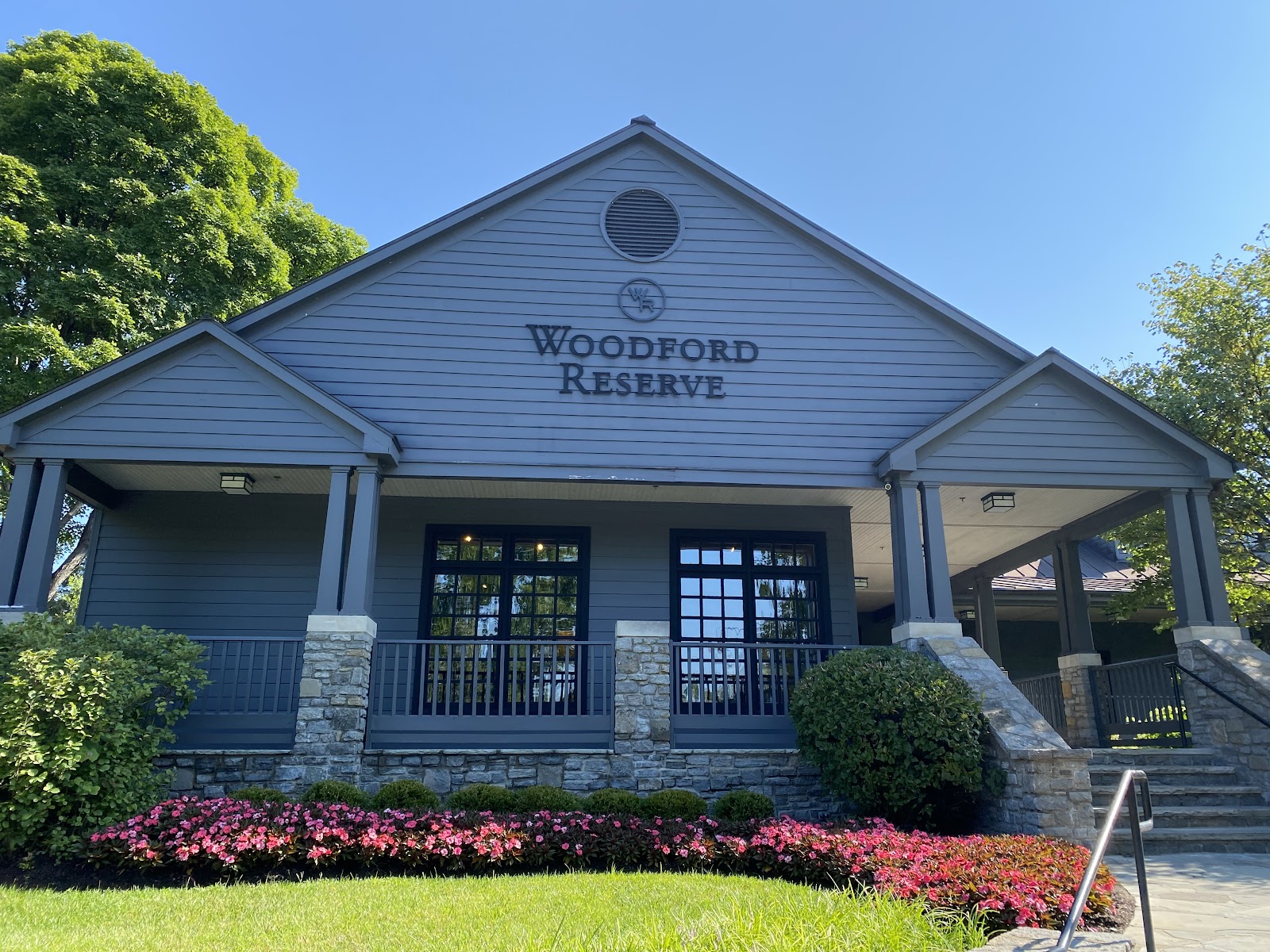
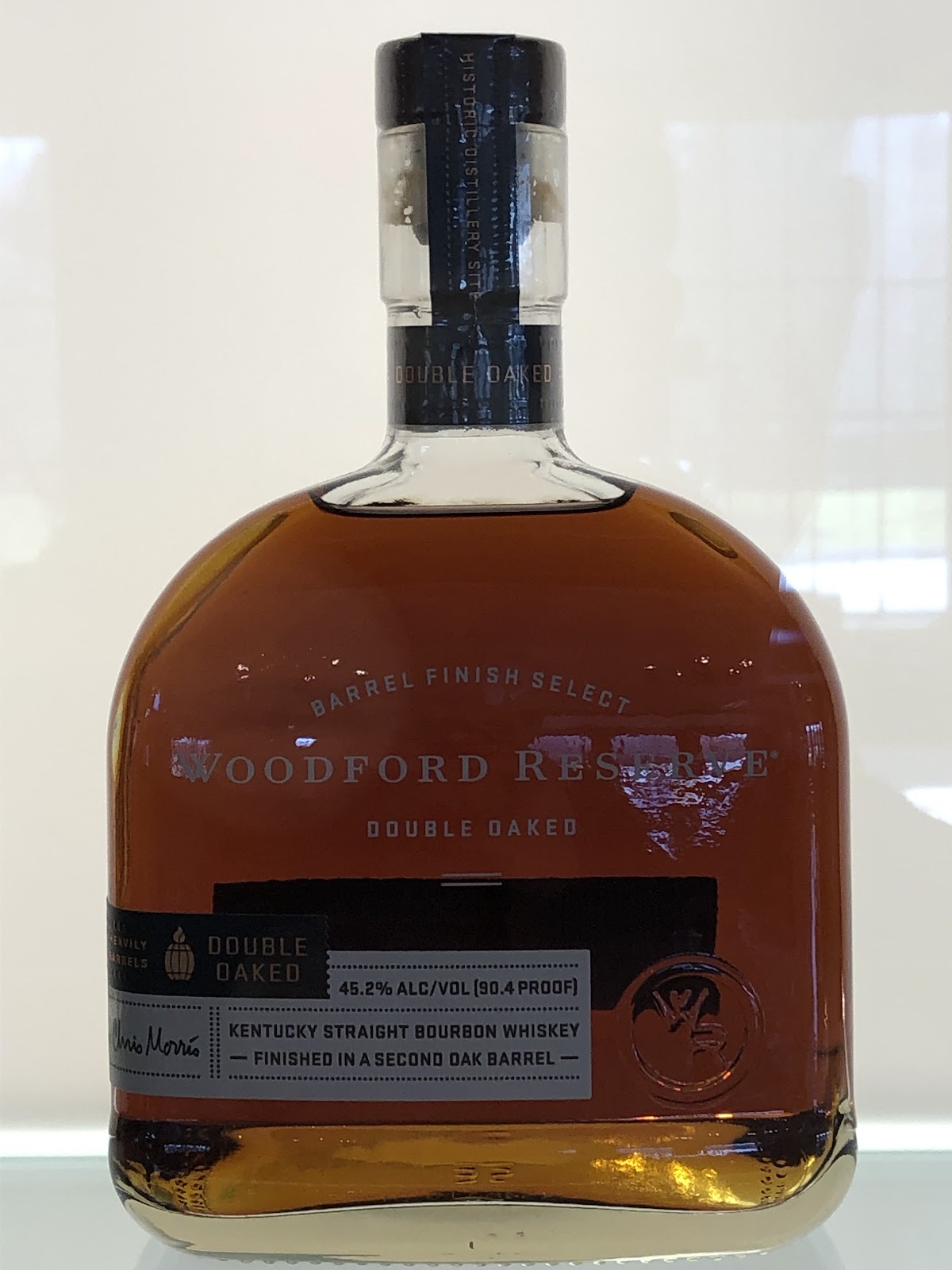
Woodford Reserve occupies a limestone-built site in Woodford County, in the middle of the Inner Bluegrass, on one of the oldest distilling sites in the state, and it is a National Historic Landmark. The buildings are masonry rather than industrial shed, the stills are copper pot stills rather than columns, and the site sits in a creek valley with the pasture and stone fences of the Bluegrass around it.
For a photographer, reading the site as a process rather than as a collection of rooms is the whole trick, because the process tells you what the light will do before you get there. A mash room is hot and full of steam. A fermentation room has open vats giving off carbon dioxide. A still house has a large warm specular object in the middle of it. A warehouse is dark, cool and full of repetition. Those are four entirely different problems and the walk between them takes ninety seconds.
There is one question that has to be asked before anything else, and it is not aesthetic. A working distillery has areas with alcohol vapour in the air, and those are classified environments with real restrictions on electrical equipment. Flash, continuous lights, radio triggers and even where a battery may be carried can all be limited in specific rooms, and the limits are a safety matter rather than a preference.
Ask the distillery, in writing, which rooms permit what. Then plan around the answer. A photographer who turns up with a lighting kit expecting to use it in a still house may find that the one room they most wanted is available to them on ambient only — and ambient in that room is not generous.
That constraint is also, usefully, the thing that produces the best work here. Ambient-only in a masonry building with small windows forces you into positions you would not otherwise find, and the frames that come out of it look like the place rather than like a lighting setup.
What follows is the process stage by stage and what each one needs, then why this industry is in this county at all, and then the year.
The Woodford Reserve Distillery at a glance
| Where | A limestone distillery on a historic site in Woodford County, KY |
| The logic | Buildings sit in process order: mill, mash, ferment, still, barrel, warehouse |
| Ask first | Which rooms permit flash and electrical equipment — a safety matter, not a preference |
| The problem | Heat, steam, low light and hard specular copper, all within ninety seconds |
| The payoff | Masonry, repetition and Bluegrass pasture in the same hour |
Reading the process, stage by stage
The mash room is hot, wet and full of vapour, and it is the hardest room on site.
Cooking grain with water at temperature produces steam, and steam does three things to a camera. It fogs the front element within seconds, it scatters every light source into a visible beam, and it sits between you and your subject as a low-contrast veil. The first is the real problem: a lens that fogs in a humid room stays fogged, and wiping it makes it worse.
Two fixes. Let the camera reach room temperature before you need it, which takes several minutes and means carrying it in early rather than arriving with it. And accept a shorter working time in there than you planned — five minutes, not twenty.
Use the steam rather than fighting it. A shaft of light through vapour is visible, and visible light is a strong graphic element that no other room on site will give you. Backlight it, expose for the highlight, and let the room go dark.
The fermentation room is cooler and stranger. Open vats of fermenting mash give off carbon dioxide, which is heavier than air and collects, and which you cannot see. Follow the venue’s instruction about how long anybody stands over an open vat, and do not lean in for a better angle. That is not a photographic consideration but it is the one on the list that matters most.
Photographically, fermenters are large circular forms — often timber — in rows, which means repetition, and repetition photographed down a line with a long lens compresses into a rhythm. That is the frame in that room. A wide shot of a fermentation room mostly looks like a room with tanks in it.
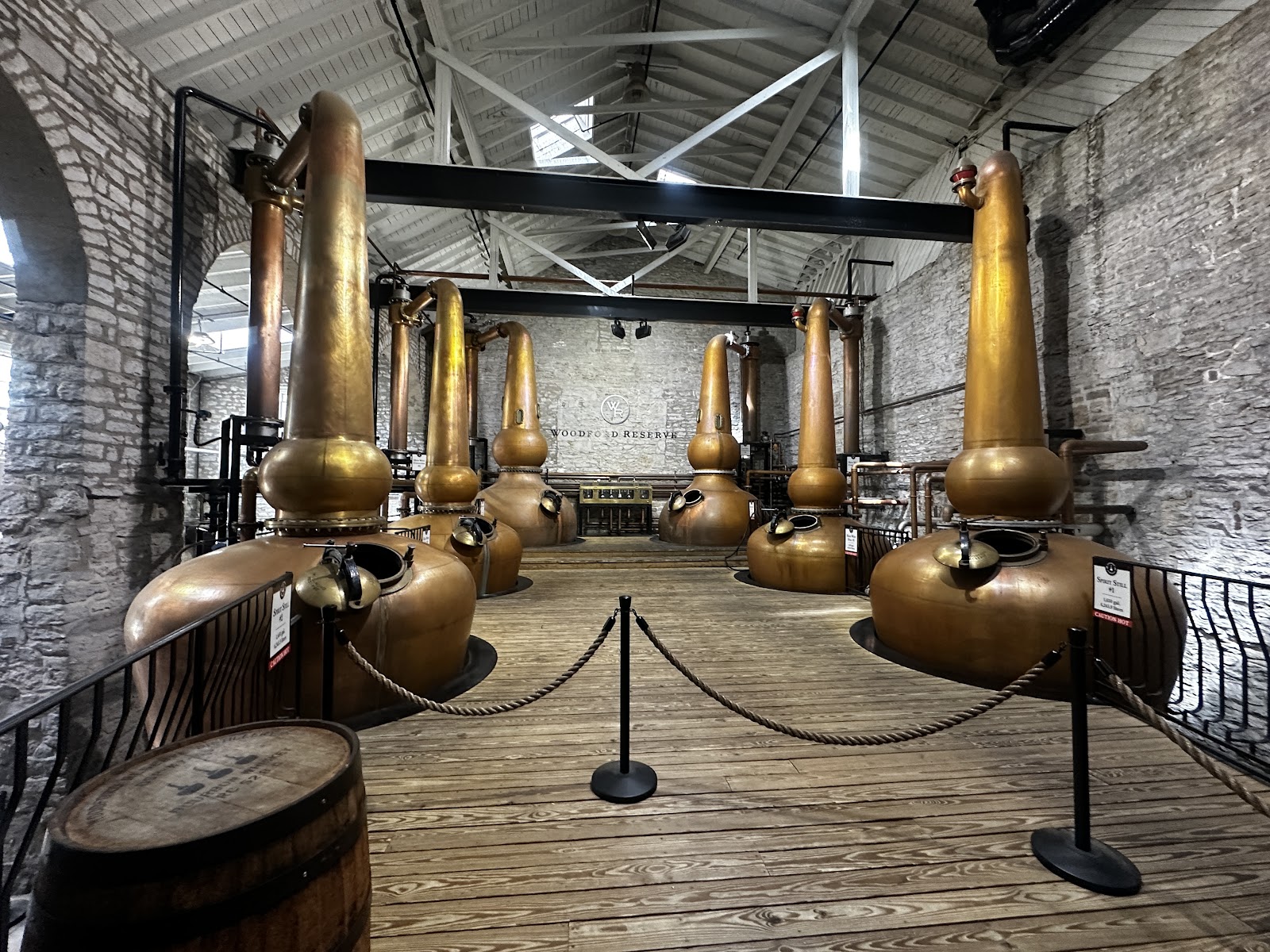
The still house is the room everybody wants and it has one specific problem: copper.
A copper pot still is a large, curved, highly polished, warm-coloured specular object. Three consequences follow. It reflects the entire room back at you in a distorted wide-angle view, and that reflection includes the photographer, so your position determines whether you are in the picture. It throws warm light onto anything near it, so a face standing next to a still picks up a copper cast that is genuinely on the skin rather than in the file. And because it is specular rather than diffuse, it does not photograph as a shape — it photographs as a pattern of bright reflections, and those reflections are of whatever is around it.
So the way to photograph copper is to control what it is reflecting, not to light the copper. A large pale surface near it — a wall, a bounced light if permitted, even a white board — becomes a broad soft highlight running down the curve, which reads as form. Point a hard light at it and you get a small bright dot and a lot of black.
For the people in that room, stand them away from the still by two or three metres and light or place them separately, then let the copper be warm behind them. Adjacent to the metal they will be orange.
Then the barrel warehouse, and this is the frame that will define the set.
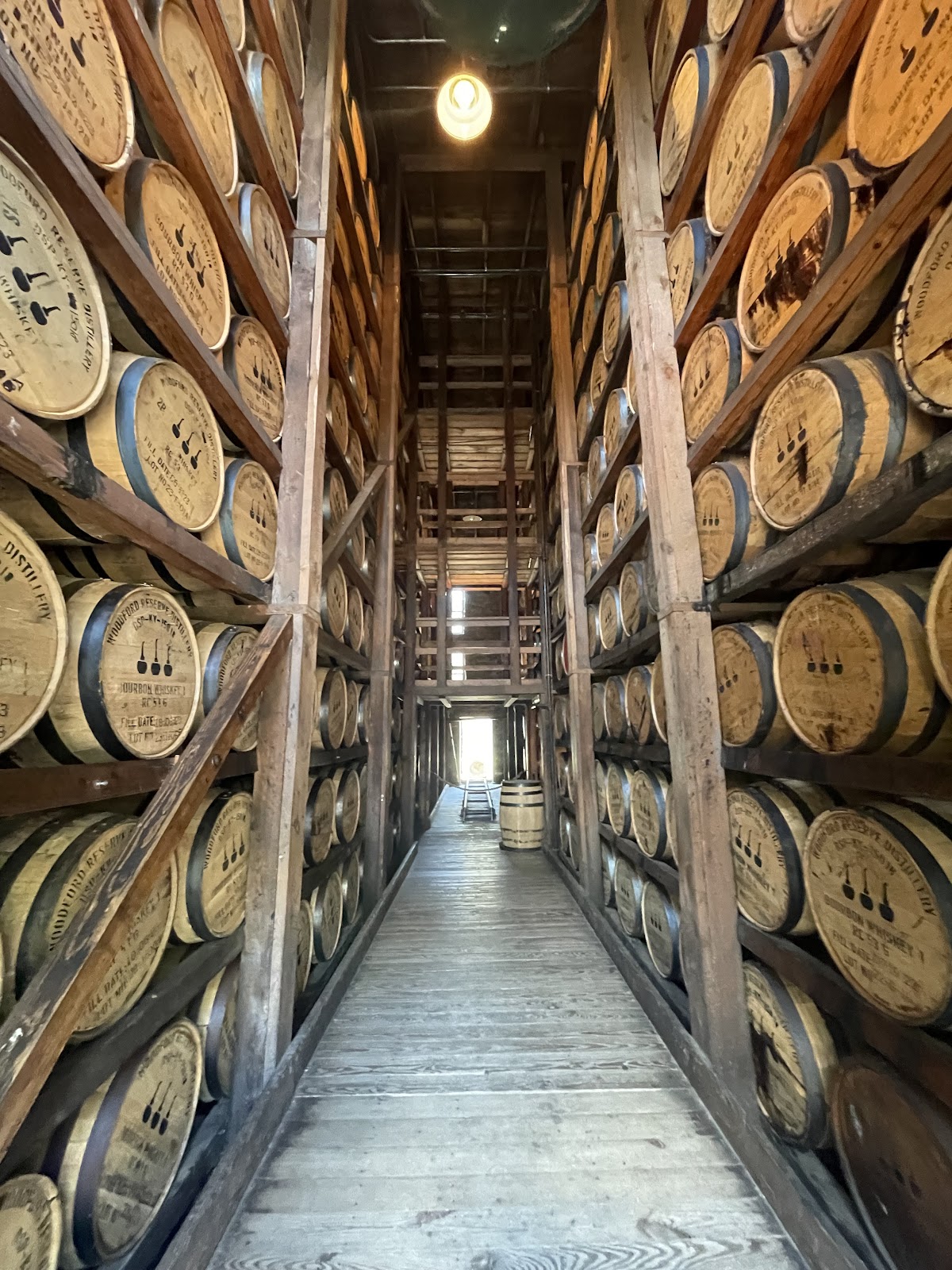
Kentucky barrel warehouses come in two kinds and the difference is entirely photographic. Timber-clad rickhouses have louvred or shuttered sides for air movement, and those louvres throw hard parallel bands of light across the interior — a slatted light that lands on barrels, on the floor and on a face, and which is one of the most distinctive lighting conditions available anywhere in this library. Masonry warehouses, which is what stone-built sites tend to have, are darker and more even, with light entering through small deep openings and falling off fast. Ask which you have, because the two need opposite approaches.
If it is louvred: the bands are the picture. Place a subject so a band crosses their face at an angle rather than straight across their eyes, expose for the lit band and let the rest go, and do not fill it. The contrast is the point.
If it is masonry and dark: you are working near the openings, at the edge of the falloff, and the frame is about the recession of barrels into darkness. A long lens down an aisle compresses hundreds of barrel heads into a single texture, which is the strongest graphic frame on the property.
Two practical notes about warehouses. They are hot in summer — deliberately, because temperature cycling is part of how the whiskey matures — so a party in formal clothing has a short tolerance in there. And the air smells strongly of evaporating spirit, which is pleasant for five minutes and tiring for thirty.
Finally, the outside, which people forget because the interiors are so distinctive. A masonry distillery in a creek valley with Bluegrass pasture around it is a handsome exterior subject, and the last hour of light on a limestone wall is worth as much as anything indoors. Do not spend the whole evening in the buildings.
Limestone, water, and why this is here
Bourbon is made in Kentucky for a geological reason, and knowing it changes how you see the landscape a distillery sits in.
Under the Inner Bluegrass is Ordovician limestone, and rain moving through it does two things: it picks up calcium and magnesium, and it drops out iron. Water with iron in it ruins whiskey — it turns it dark and spoils the flavour — and water with calcium in it helps fermentation. So limestone country produces exactly the water a distiller wants, and the industry settled where the rock was rather than where the transport was.
The same limestone is unusually rich in phosphate here, which puts minerals into the soil, which puts them into the grass, which builds bone in the animals that eat it. That is why the land around every distillery in this region is horse pasture. One rock formation produced both industries, and the two of them together produced the entire look of the county: pasture, stone, white and black fences, and big open-grown trees.
The stone is the local building material for the same reason it is the aquifer — it is directly underfoot. Bluegrass limestone is a grey, hard, fossil-bearing stone, laid down as a shallow tropical sea floor, and it photographs cool, going genuinely blue in shade. It needs warming deliberately in post, particularly on an overcast day, or a set of distillery exteriors will look lifeless beside the warm interiors from the still house.
It also weathers with a great deal of surface texture, which means raking light is everything. A limestone wall at four in the afternoon in October is a field of small shadows and reads as material; the same wall at noon in June is a flat grey plane. Photograph the buildings early or late and the stone does the work.
The dry-laid stone fences in the surrounding fields are the same rock, lifted from the fields and stacked without mortar, built in large part by Irish immigrant and enslaved masons in the nineteenth century. They are one of the defining features of this landscape and they photograph best in exactly the same low raking light for exactly the same reason.
There is one more thing the industry puts into the landscape and it is worth recognising rather than being surprised by. Barrels lose spirit to evaporation as they age — the angel’s share — and the ethanol vapour in the air around a warehouse feeds a black fungus, Baudoinia, which darkens roofs, walls, fences and tree trunks downwind. It is harmless and it is a signature of the region, but it means the surfaces near a warehouse are darker than they look and read almost black in a photograph. Meter for it rather than assuming a mid-grey.
And the water itself is visible. This is karst country, so creeks appear from springs and run clear over limestone shelves. A creek in a distillery valley is a genuine asset in the last hour of light: shallow moving water over pale rock, throwing a broken specular pattern, with a low sun behind it.
Get low at the creek. A camera near the surface compresses ripples into a luminous path, and it puts the building above the waterline rather than beside it.
The Woodford County year
The Inner Bluegrass sits at about thirty-eight degrees north, which is three degrees further north than Memphis and makes a measurable difference at both ends of the day.
Civil twilight here runs about twenty-nine minutes in midsummer. That is five minutes more than western Tennessee, and in practical terms it is roughly a fifty per cent longer balance-point window — the block where the sky and any building lights are within a stop of each other. On a rural site with almost no light pollution, the sky also holds colour visibly longer than it does over a city. That is a real advantage and it is worth building the evening around.
The midsummer noon sun reaches about seventy-five degrees, high enough to be difficult on open gravel and pasture in the middle of the day, and the midwinter noon sun sits near twenty-eight degrees, low enough to rake along a limestone wall for the whole afternoon.
Humidity is Ohio Valley humidity — July dewpoints around seventy — which fills shadows by roughly a stop and a half to two stops against a dry climate. That is genuinely helpful outdoors and it is actively unhelpful in the mash room, where the interior humidity is far higher again and the camera fogs. The general cost is a pale sky in wide frames and haze on distance, which matters more here than in a city because the long views across pasture are part of the appeal.
Season by season, and at a working industrial site the seasons interact with the process as well as with the light.
Late September into October is the best window and it is not close. The air dries out, the haze lifts so the valley and the pasture resolve properly, temperatures are comfortable in formal clothing — including inside a warehouse, which in August is genuinely hot — and sun angles stay low enough all afternoon that limestone has texture from lunchtime onward. The hardwoods along the creek turn in the second half of October.
Late April into May is the other good window and the wetter one: pasture at its most saturated, dogwood and redbud in the woods, long evenings. It is also the active part of the severe-weather season, with organised fast-moving systems rather than passing showers, and a site with most of its attractions indoors is comparatively resilient to that — which is a genuine advantage of an industrial venue over a marquee in a field.
Summer is workable but the buildings work against you. Warehouses are hot by design, mash rooms are hotter, and a party in formal clothing has a short tolerance in either. Plan the interiors early in the day or late, keep the visits brief, and use the long evening — sunset after nine in late June — for the exteriors and the creek. The half hour after an afternoon thunderstorm clears is the finest light the site gets all year: washed air, wet limestone at full saturation, steam rising off gravel and a low sun under a broken ceiling. Wet limestone is a different and much better material than dry limestone.
Winter is quiet and clear. Sunset near half past five in December is early, and at a rural site with no lighting the day effectively ends there, so the whole outdoor portion belongs to the early afternoon. What you get in exchange is the clearest air of the year, a low sun raking limestone all day, bare trees that let the structure of the valley show, and — if a cold snap coincides — steam from a working distillery visible in the air, which is a photograph you cannot make in July. Against it: rural roads, freeze-thaw and occasional Kentucky ice, which is a travel problem for guests and suppliers rather than a photographic one.
One process note that changes what you can photograph in any season: a distillery does not necessarily run every day, and the rooms are entirely different working and idle. A still house with the stills running is warm, alive and steaming; the same room shut down is a museum with metal in it. If the couple wants the place working, that has to be asked about specifically and it may not be available on a weekend. Find out which you are getting and set expectations accordingly.
Ask that in the same email as the question about flash. The two answers together determine almost everything about how the day is photographed.
More frames from The Woodford Reserve Distillery
The Woodford Reserve Distillery wedding photography: common questions
What is the most important thing to ask before the day?
Which rooms permit flash, continuous lights and electrical equipment. A working distillery has areas with alcohol vapour in the air, and those are classified environments with genuine restrictions — a safety matter rather than a preference. The room you most want may be available on ambient light only, and ambient in a masonry building with small windows is not generous. Get the answer in writing and plan around it.
Why does copper photograph badly?
Because it is specular rather than diffuse, so it does not record as a shape — it records as a pattern of reflections of whatever is around it, including you. Control the reflection rather than lighting the metal: a large pale surface nearby becomes a broad soft highlight running down the curve, which reads as form, while a hard light gives you a small bright dot and a lot of black. Also keep people two or three metres clear, because copper throws a warm cast onto skin that is genuinely there and cannot be corrected out.
What is the best frame on the site?
The barrel warehouse, but which frame depends on which kind it is. Timber rickhouses have louvred sides that throw hard parallel bands of light across the interior — place a face so a band crosses at an angle, expose for the band, and do not fill it, because the contrast is the point. Masonry warehouses are darker and more even, and there the frame is a long lens down an aisle compressing hundreds of barrel heads into one texture. Ask which you have.
Why are the surfaces near the warehouses so dark?
Barrels lose spirit to evaporation as they age, and the ethanol vapour in the air feeds a black fungus called Baudoinia that darkens roofs, walls, fences and tree trunks downwind. It is harmless and it is a signature of the whole region, but it means those surfaces read almost black in a photograph. Meter for them rather than assuming a mid-grey.
Will the distillery be running on our date?
Ask, because it changes the rooms completely. A still house with the stills working is warm, alive and steaming; the same room shut down is a museum with metal in it. Production does not necessarily run every day and may not run at a weekend. Find out which you are getting before anybody promises a photograph of a working still.
When is the best time of year?
Late September into October, clearly. The air dries out so the valley and pasture resolve instead of hazing, temperatures are comfortable in formal clothing — which matters here because warehouses are deliberately hot and in August they are punishing — and sun angles stay low enough that limestone keeps its texture from lunchtime onward. Late April and May are the other good window, wetter and more storm-prone, though a venue whose best rooms are indoors handles that better than a marquee would.
More Kentucky venue guides
We are writing a photographer’s guide to every venue we would happily shoot in Kentucky. Here are three more, plus the full index:
- The Brennan House: Who This Small Venue Suits
- The Brown Hotel: Reading the Light in a 1923 Grand Hotel
- Churchill Downs: Who This Venue Suits
Planning a wedding at The Woodford Reserve Distillery?
Ask about flash, ask if it is running, then follow the whiskey. Tell us your date.