 The Memphis Botanic Garden: The Venue’s Own Logic
The Memphis Zoo: The Problem, and Four Ways Out of It
The problem is the enclosures. There are four ways past it.
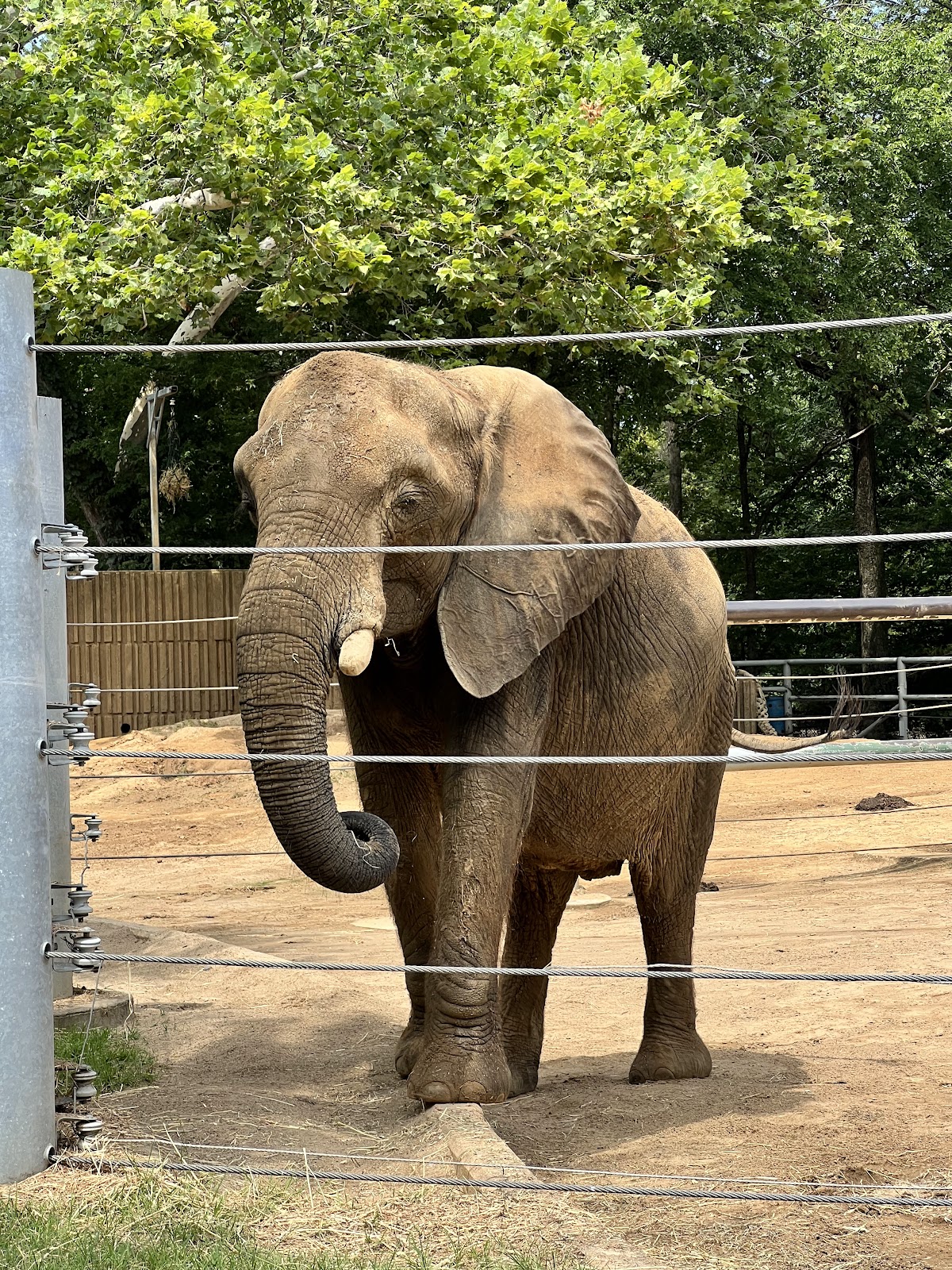
The problem with a zoo is that nothing in it was designed to be a background.
Every surface you can see exists to keep an animal safe, healthy and contained, and to let several thousand visitors a day look at it. That produces mesh, laminated glass, dry moats, safety rails, interpretive signage, service gates, bins, feed stations and hose bibs, all of them necessary and all of them in frame. It also produces wayfinding in strong institutional colour, which will fight anything you put in front of it.
This is not a complaint about the zoo. It is a good zoo doing the job a zoo exists to do. But a photographer arriving expecting the sort of neutral architecture a hotel or a garden hands you will spend the evening cropping around railings.
The second half of the problem is that a zoo is a public attraction with fixed opening hours and a paying audience, so for most of the day the frame contains strangers as well as furniture. And the third half, if there is one, is that the animals are not props. They are on their own schedule, they are frequently indoors or out of view, and an enclosure that had a giraffe in it when you scouted may have nothing in it on the day.
So the honest framing for a couple is this: the zoo is a wonderful place to get married and a demanding place to photograph, and the good photographs from it come from four specific manoeuvres rather than from wandering with a camera.
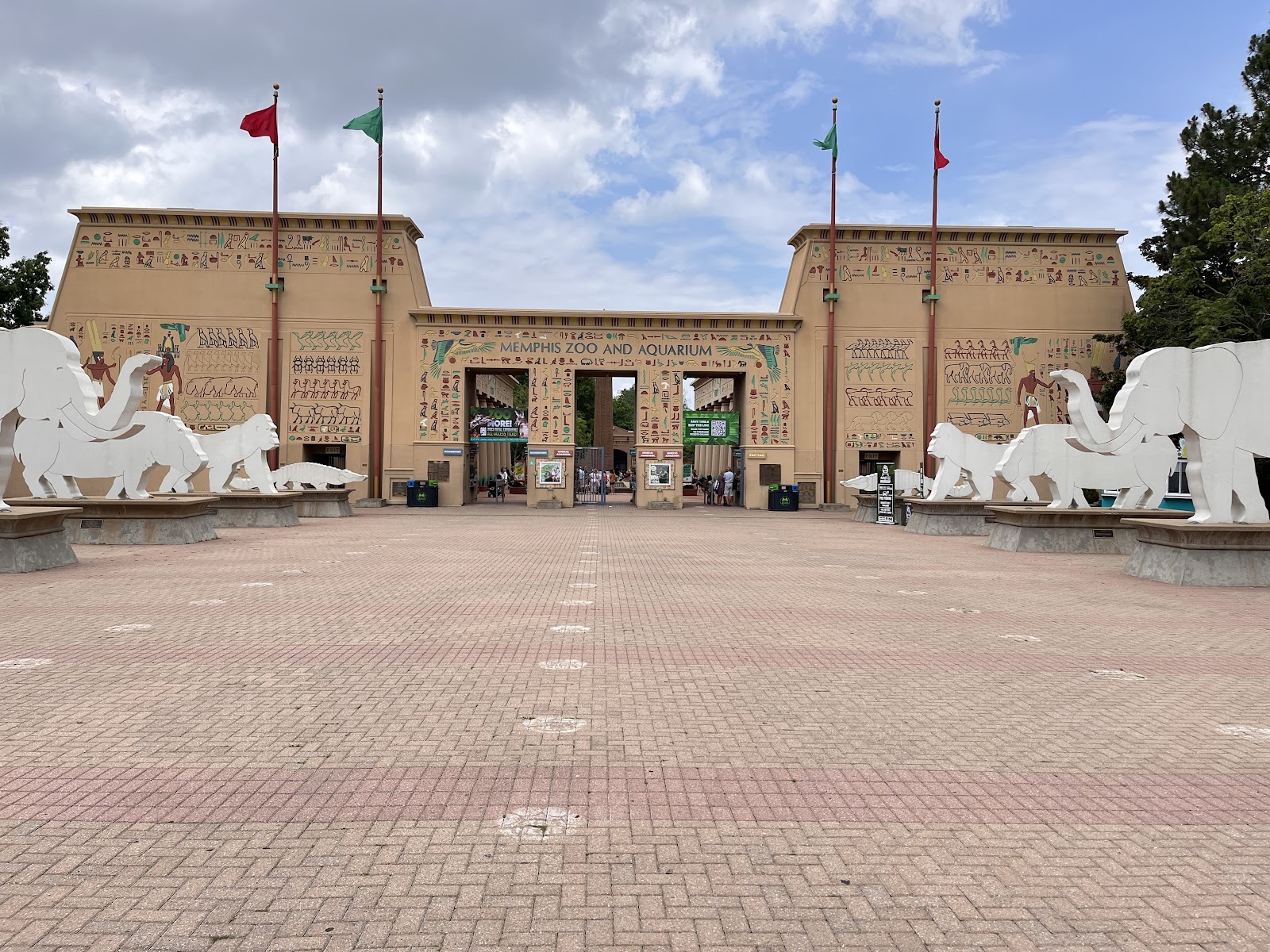
The first is to use the one piece of genuine architecture on the site. The zoo’s main entrance has carried an Egyptian Revival treatment since the early years of the last century — columns, a monumental gateway, a frontality quite unlike anything else in the city — and it is a real building rather than a themed facade. It is the strongest fixed background on the property by a wide margin.
The second is to leave. The zoo sits inside Overton Park, and the park holds an old-growth forest designated as a state natural area, along with an open-air amphitheatre and an art museum. Whether any of that is available to your wedding is a conversation with the park or the city rather than with the zoo, and the answer may be no, but the forest in particular is a background of a quality the zoo itself cannot offer.
The third is to be there when the public is not, which at a zoo means the end of the day rather than the beginning — and which happens to coincide with the only light that will make the place look good anyway.
The fourth is to stop trying to include the venue at all: work tight, work shallow, and use the planting as a wall. A zoo is heavily planted, and planting is the one thing on site that reads as background rather than as apparatus.
What follows is each of those four in practical detail, and then what Memphis itself does to the hours you have.
The Memphis Zoo at a glance
| Where | A zoo inside Overton Park, midtown Memphis |
| The problem | Mesh, rails, glass, signage and a paying public in every frame |
| Way out | The Egyptian Revival entrance, the park beyond, after hours, or go tight |
| The light | Last ninety minutes only, in summer; all afternoon in winter |
| Ask first | Private hours, which areas are bookable, and whether the park is separate |
Ways one and two: the entrance, and leaving the zoo
The entrance first, because it is the answer to the question a couple will actually ask, which is whether there is anywhere here that looks like a wedding venue.
An Egyptian Revival gateway is a specific and unusual thing to have. It is symmetrical, it is frontal, it is built of real material at monumental scale, and it has the two qualities that make architecture photograph well: strong verticals, and deep-set openings that produce their own shade. There is nothing else in Memphis like it and there is nothing else on this site remotely comparable.
Photograph it the way you would photograph a temple front, which is to say either dead square on the centre line or firmly off it, never in between. A monumental symmetrical facade shot from three degrees off axis looks like a mistake; from twenty degrees off it looks like a decision, and the columns separate into distinct verticals with real spacing between them instead of merging.
Scale is the thing to exploit. Put two small figures at the base of a large order and the frame is about the building’s mass, which is a better photograph than a tight portrait against a column would be. Resist filling the frame.
The light on a frontal facade depends entirely on which way it faces and at what hour, and that is a thing to establish on site rather than guess. What is reliable is that a deep colonnade produces a band of open shade in front of it at every hour, and that band is excellent portrait light: soft, directional, with the sky as the source and the paving as a weak bounce.
At dusk, if the gateway is lit — and monumental entrances usually are — this becomes the best frame on the property. Warm architectural uplighting on a pale stone order against a deep blue sky, with two figures in it, is a strong photograph made by the building rather than by you. It needs about ten minutes and it needs those ten minutes to be the right ones, which the last section covers.
Practically: the entrance is also the entrance, which means it is busy while the zoo is open and empty once it is closed. That points the same direction as everything else here.
Now the second way out, which is to walk out of the gate.
Overton Park is a large early-twentieth-century city park laid out in the Kessler manner, and the significant thing inside it is a substantial stand of old-growth forest, protected as a state natural area. Old growth in an American city is rare and it does not look like a park wood. The trees are large, the canopy is high and closed, the understorey is comparatively open, and the whole thing has a vertical scale that a planted wood simply does not.
For a photographer that means a background of trunks receding into soft green darkness, with no fence, no sign and no apparatus in it — exactly the thing the zoo cannot provide. It is worth more than any single position inside the gates.
Two cautions. A closed high canopy is dark, several stops below open ground, so a subject in the forest with sunlit ground visible beyond is a four-stop frame and needs either a fill or a committed silhouette. And light that has come through leaves is green; find a position lit by open sky from the side — a path, a clearing, a canopy edge — rather than by filtered light from above, or faces will read sickly whatever you do afterwards.
The park also holds an open-air amphitheatre of some age and an art museum, both of which are photographically interesting structures. But — and this matters — the zoo, the park, the museum and the amphitheatre are not one organisation. Permission to be married at the zoo is not permission to photograph at the museum steps, and a park may have its own permit process for commercial photography. Ask about all of it early, in writing, and be prepared for some of the answers to be no. Turning up and hoping is how a photographer gets moved on in front of a wedding party.
Walking distance is the other constraint. Getting a party of a dozen from inside the zoo out through the gate and into the forest and back is realistically twenty-five to thirty minutes. That is a genuine slice of the evening and it competes directly with the dusk frame at the entrance. Pick one. Trying for both in the same twenty-five minutes is how you get neither.
Ways three and four: after hours, and working tight
The third way out is the simplest and it costs money rather than effort: be there when nobody else is.
A zoo’s evening event operation exists, it is a real product at most zoos of this size, and it changes the venue completely. With the public gone, the paths are empty, the furniture is still there but nobody is leaning on it, and you can stand where you like for as long as you like. It also means the animals are settling, which is its own kind of content.
The coincidence that makes this worth paying for is that the zoo only looks good in the last ninety minutes of the day anyway. Open paved paths under a high summer sun are the worst possible surface to photograph people on: hot, bright, contrasty, and reflective straight up into a face from below. The same paths at seven in the evening in June are warm-toned, raked by a low sun, with long shadows giving the ground shape. You were never going to want the middle of the day here. So a schedule built around an evening private window is not a compromise, it is the correct plan.
Establish precisely what a private window means. It may mean the public has left but staff are still working, service vehicles still moving and some areas closed off for the night. That is fine, but it is different from an empty zoo, and knowing which you have bought determines how much you can promise.
Ask about the animals explicitly and honestly. Many species go indoors at dusk, some exhibits close before the rest of the site, and no venue will hold a keeper schedule for a photograph. If a couple’s one non-negotiable image involves a particular animal, that has to be raised with the zoo months ahead, and the answer may simply be that it cannot be guaranteed. Say so early. A disappointed couple at nine in the evening is a worse outcome than a managed expectation in February.
The fourth way out is a technique rather than a booking, and it is the one that saves the frames you did not plan.
Work long and work open. A hundred and thirty-five millimetres at f/2 turns a background of mesh, signage and railings into a soft graded wash in which none of it is legible. The same background at thirty-five millimetres and f/8 is an inventory of zoo furniture. This is the single highest-value equipment decision at this venue and it is worth carrying the lens specifically for it.
Use the planting as the wall. A zoo is densely planted, because planting screens enclosures and shades animals and visitors, and that planting is the one element on site that reads as background rather than apparatus. Find a bank of foliage, put the subject two metres in front of it, get far enough back to be at a long focal length, and the zoo disappears.
Shoot into shade, not into sun. A subject in open shade with a shaded background behind them has a manageable contrast range; a subject in shade with a sunlit path behind them is four stops of trouble. In a place this open, backgrounds are more often sunlit than not, so the position is chosen by what is behind rather than by what is in front.
Get low, and get high. Low puts sky or canopy behind a subject instead of paving and railings, which solves the background problem outright. High — from any raised walkway, bridge or viewing platform, and zoos have plenty — puts planting behind instead of the horizon. Both are better than eye level, which is the height at which all the apparatus lives.
Finally, the honest note to put in front of a couple. A zoo produces a distinctive and joyful set of photographs and it produces fewer classically elegant ones than a hotel or a garden does. The ones it produces are about a specific place and a specific kind of day out, and they will not look like anybody else’s wedding. That is a genuine trade and most couples who choose a zoo have already made it. The photographer’s job is to be honest about which column each frame falls in, and then to be very good at the four manoeuvres above.
Memphis, the park and the year
Two numbers from the latitude govern everything here, and at an open-air venue they govern it more than at most.
Memphis sits at about thirty-five degrees north. Midsummer noon sun is near seventy-eight degrees, which is close enough to overhead to be brutal on open paving between roughly half past eleven and half past two — flat top light, black eye sockets, and heat radiating back up off the surfaces. That is the single worst condition this venue offers and it lasts three hours.
Civil twilight runs about twenty-four minutes in midsummer, less at the equinoxes. So the good light comes late and leaves fast. Know the closing frame in advance — the lit entrance, most likely — and walk to it rather than deciding on the spot.
Humidity is the unexpected ally. Dewpoints in the low to mid seventies through July mean the air is full of water vapour, and water vapour scatters light into shadow. A sunlit path here in July carries something like two stops less shadow contrast than the same sun angle in a dry climate: soft shadow edges, eye sockets that hold detail, and midday open shade that is genuinely usable rather than merely survivable. What it costs you is a pale washed sky that contributes nothing to a wide frame, and haze on anything past about eighty-five millimetres — which is awkward, given that a long lens is the main technique here. Get closer than you would elsewhere.
The condensation problem is acute at this venue specifically, because an outdoor day with an air-conditioned indoor event space means repeated transitions. A camera brought from cool air into July air outside fogs in seconds and clears in minutes. Keep bodies warm rather than cool between uses.
Now the seasons, which at an open-air venue are the whole story.
October into early November is the best window here and it is not close. Dry air, no haze, cool enough that formal clothing outdoors is comfortable, sun angles low enough that the entire afternoon is usable rather than just the last hour of it, and the old forest next door turning over. If a couple is flexible about date, this is the answer.
Late March into April is the second window and it is the gamble. Dogwood and redbud, mild air, lengthening evenings, and an eastern position on the continent’s most active severe-weather corridor. The systems that arrive in that window are the organised kind, with real wind, and a zoo is a large open site with limited hard cover. Establish what the actual rain plan is — which building, what capacity, how far to walk — and look at it. Do not accept the existence of a plan as a description of one.
Summer works only if the schedule accepts what the middle of the day is. Ninety-five degrees, a seventy-five degree dewpoint, formal clothing, open paving: that is a welfare problem before it is a photographic one, and discomfort photographs as discomfort. The compensation is real, though — sunset after eight in late June means a seven o’clock ceremony is in daylight and the hour after it is the best light of the year.
Summer storms are convective, local and common in the late afternoon, and the half hour after one clears is the finest light this venue ever gets: washed air, wet paving reflecting the sky, saturated planting, a low sun under a broken ceiling, and a stone gateway that saturates when wet in a way it never does dry. If a cell goes through at six, wait.
Winter is short but the light is good, and at a venue this exposed that combination is more useful than it sounds. A December noon sun near thirty-one degrees models a face at every hour, there is no haze at all, and the crowds are thinner. Against that: sunset before five compresses the day into almost nothing, more animals are indoors, and cold on an open site with no shelter is its own problem. A winter date here is an early-afternoon event or it is nothing.
The last thing to check is what else the venue is doing. Zoos run large seasonal programmes — light installations in winter, holiday events, school seasons — that occupy exactly the paths and spaces you want, and that install temporary structures and cabling in them. None of it is visible when you scout in June. Ask what is on site on the date.
Ask that, buy the evening window, carry a long lens, and know which of the four ways out you are using for each frame. That is the whole job here.
More frames from The Memphis Zoo
The Memphis Zoo wedding photography: common questions
What is the main problem with photographing a zoo wedding?
Nothing on site was designed to be a background. Mesh, laminated glass, dry moats, safety rails, signage and service apparatus are all necessary and all in frame, and for most of the day there is a paying public in frame too. The good photographs come from four specific manoeuvres rather than from wandering: use the entrance architecture, use the park outside, book an after-hours window, or work long and shallow so the apparatus dissolves.
Is there anywhere here that looks like a traditional venue?
The main entrance. It has carried an Egyptian Revival treatment since the early years of the last century — a monumental symmetrical gateway with a real order, deep-set openings and its own band of open shade. Photograph it square on the centre line or firmly off axis, never three degrees off, and put small figures at the base to let the scale be the subject. Lit at dusk against a deep sky it is the best frame on the property.
Can we use Overton Park and the old forest?
Possibly, but it is a separate permission. The zoo, the park, the amphitheatre and the museum are not one organisation, and a park may have its own commercial photography permit process. Ask early and in writing. The forest is worth the effort — old growth in a city is rare, with high closed canopy and open understorey and none of the zoo’s apparatus in it — but budget twenty-five to thirty minutes to move a party there and back, which competes directly with the dusk frame at the entrance.
Should we pay for an after-hours window?
If it is available, yes, and not mainly for privacy. The zoo only looks good in the last ninety minutes of the day anyway — open paving under a high sun is the worst surface to photograph people on — so an evening window is the correct plan rather than an upgrade. Establish what private actually means: the public gone is not the same as the site empty, and staff, vehicles and closed exhibits may all still be in play.
Will the animals be in our photographs?
Some, unreliably. Many species go indoors at dusk, some exhibits close before the rest of the site, and no zoo will hold a keeper schedule for a photograph. If one particular animal matters to a couple, raise it with the zoo months ahead and accept that the answer may be that it cannot be promised. Managing that expectation in February beats disappointing someone at nine in the evening.
What is the best time of year?
October into early November, clearly: dry air, no haze, comfortable temperatures, and sun angles low enough that the whole afternoon works. Late March into April is beautiful but sits in an active severe-weather corridor, so the rain plan has to be real and looked at. Summer needs the middle of the day given up entirely; the half hour after an afternoon storm clears is the best light the place ever offers.
More Memphis, TN venue guides
We are writing a photographer’s guide to every venue we would happily shoot in Memphis, TN. Here are three more, plus the full index:
- The Peabody Memphis: The One Decision That Governs Everything
- The Memphis Botanic Garden: The Venue’s Own Logic
Planning a wedding at The Memphis Zoo?
Four manoeuvres, one long lens and an evening window. Tell us your date.