 The Hilton Garden Inn Fargo: Field Notes on a Standardised Hotel
The Chateau de Mores, Medora: A Walk Through the Building
A chateau in name, a frame house in fact. Both matter.
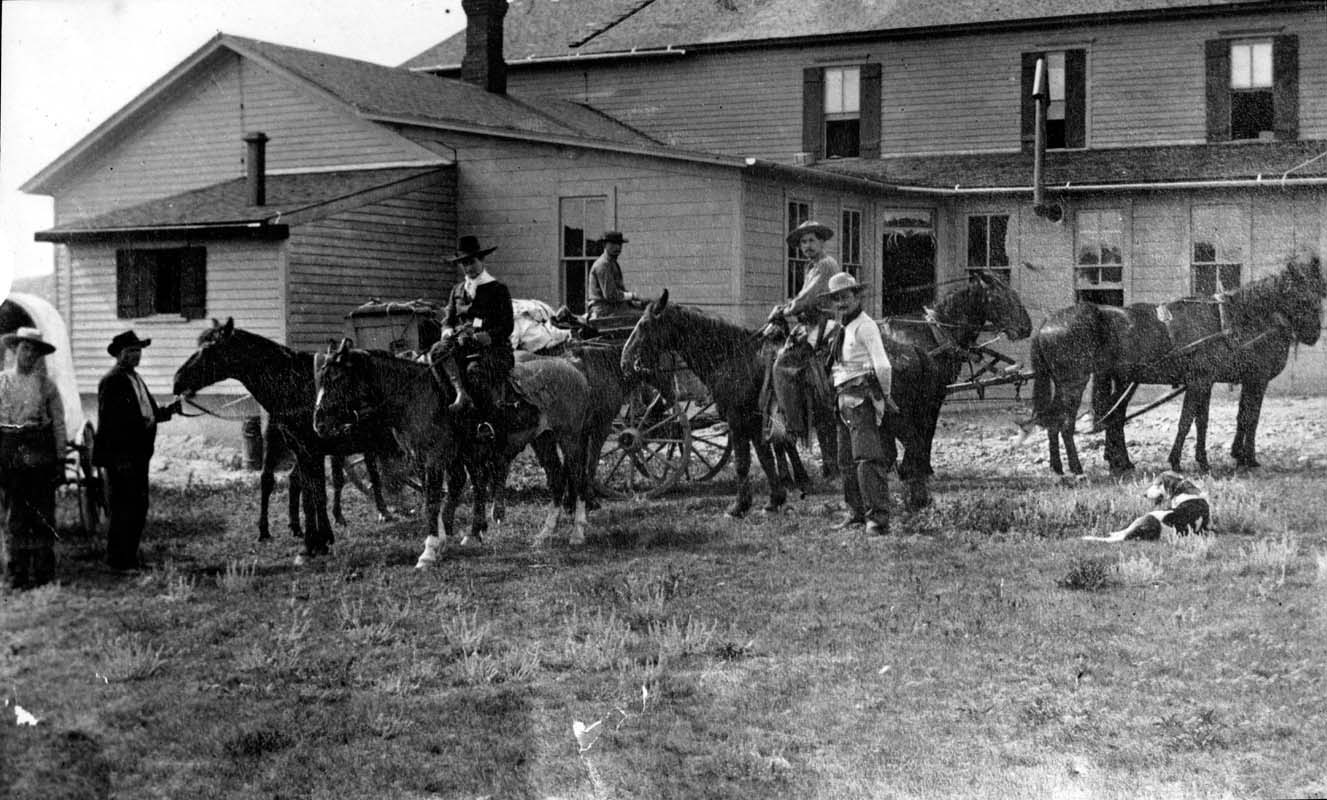
This building is a chateau in name and a timber frame house in fact, and holding both ideas at once is the key to photographing it.
It was built in 1883 by the Marquis de Morès, a French nobleman who arrived in the Dakota badlands with capital and a plan to build a meatpacking operation shipping dressed beef east by rail. He founded the town below and named it for his wife, Medora. The venture failed within a few years and he left.
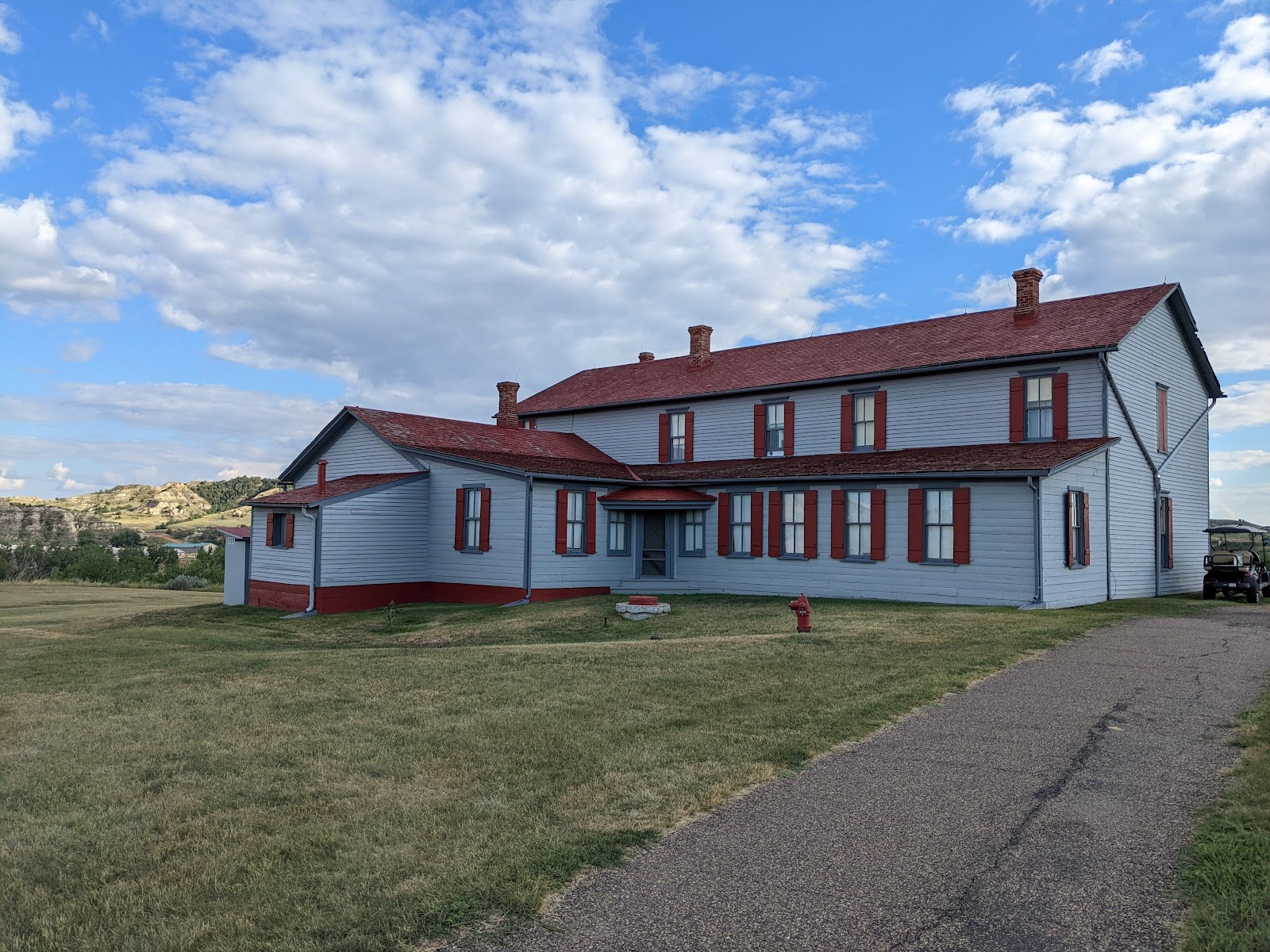
The house he built is a substantial frame building of twenty-odd rooms on a bluff overlooking the town and the Little Missouri — comfortable, well-appointed for its remoteness, and entirely a frontier structure rather than a European one. Timber, clapboard, a veranda, small windows.
So the name sets an expectation the architecture does not meet, and that is the photographic trap. Photographed as a chateau it will disappoint, because it is a wooden house on a hill. Photographed as what it is — a well-made frontier house in an extraordinary position — it works very well.
The position is the point. A bluff above a badlands valley gives elevation, long sightlines, and a view over eroded country banded in grey-blue clay, tan sandstone, black lignite and red scoria. That is a landscape almost nothing else in this library can match, and the house has it on three sides.
The second governing fact is the interior light, and it follows from frontier construction. Small windows in a timber frame — because glass was freighted in at expense and winters here reach twenty or thirty below — produce dim rooms with a specific quality: a window at the bottom of a framed reveal collimates the light so it arrives defined and directional with rapid falloff.
That is a snoot built into the architecture and it is the best portrait light in the building.
And the third is that this is a house museum. The rooms are furnished to period with original family possessions, which means what may be moved, touched or leaned against is restricted absolutely — and establishing that early avoids asking mid-wedding.
Medora sits at about forty-seven degrees north at roughly two thousand three hundred feet. The June noon sun reaches around sixty-six and a half degrees, the December noon sun about nineteen and a half, days run from about eight hours twenty to fifteen hours fifty-five, and civil twilight is roughly thirty-eight minutes — long.
What follows is a walk through in the order a wedding uses the building. We have not photographed one here; what is bookable, what the museum permits and the seasonal dates are questions for the site.
The Chateau de Mores at a glance
| Where | An 1883 frame house on a bluff above Medora, North Dakota |
| The trap | The name says chateau; the building is a frontier timber house |
| The asset | A bluff above banded badlands, with the view on three sides |
| Indoors | Small windows in framed reveals — snoots built into the architecture |
| Ask first | What the museum permits, what is bookable, seasonal dates |
The approach and the veranda
The approach is uphill and that is the first thing to use, because a building on a bluff wants to be photographed from below.
From the valley the house sits above the camera against sky, which gives it presence and makes the bluff read as the platform it is. From level ground beside it, the same house is a wooden building on grass. The difference is entirely the camera’s height relative to the site.
Keep the camera square in the vertical. A frame building with a veranda emphasises horizontals, and tilting up to include the roof converges the corner posts so the house appears to lean back — which on a simple rectilinear structure is immediately wrong. Raise the camera rather than tilting it, or correct afterwards and accept the crop.
The clapboard is the material problem and it is the same one throughout the northern plains and New England alike. Painted timber reflects around eighty percent of incident light against skin’s thirty-five, which in direct sun puts a wall two stops or more above a correct face exposure.
So the exterior frames are shade frames: open shade, overcast, or the hour when the elevation being photographed is in the building’s own shadow. Which elevation that is depends on the orientation, and establishing it on a site visit is worth more than any technique.
Northern plains skies deliver a great deal of overcast, and for painted timber that is a gift rather than a compromise — a flat grey sky gives perhaps a two-thirds-of-a-stop range across an entire facade, which holds every line of trim, every window surround and every corner board without help.
The veranda is the most useful photographic space on the property and it is worth understanding properly. A covered veranda is optically a large soft source with a hard mask: light enters from the open side, bounces off the deck and the ceiling, wraps around a subject, and falls off with depth.
Depth back from the open edge is the entire control. At the edge the light is bright and nearly frontal with a low ratio. A metre back it acquires direction and opens to around three to one, which is close to ideal for a face. Two or three metres back against the house wall the ratio is dramatic and the sunlit ground beyond has fallen four stops.
The ceiling colour decides the wrap. A pale painted veranda ceiling is an efficient overhead reflector that fills eye sockets; a stained timber one returns very little and the same veranda is two stops darker and less flattering. Looking up before positioning takes three seconds.
And because a veranda on a bluff-top house usually faces the view, it has the badlands as its background — which means the best unassisted portrait light on the property has the best landscape behind it. That coincidence is the reason to build the day around the veranda.
The posts are the rhythm and they reward precision. A camera moved a few inches decides whether a post bisects a face or frames it, and a couple centred between two posts with the veranda receding behind them turns repetition into composition.
Inside, and the bluff
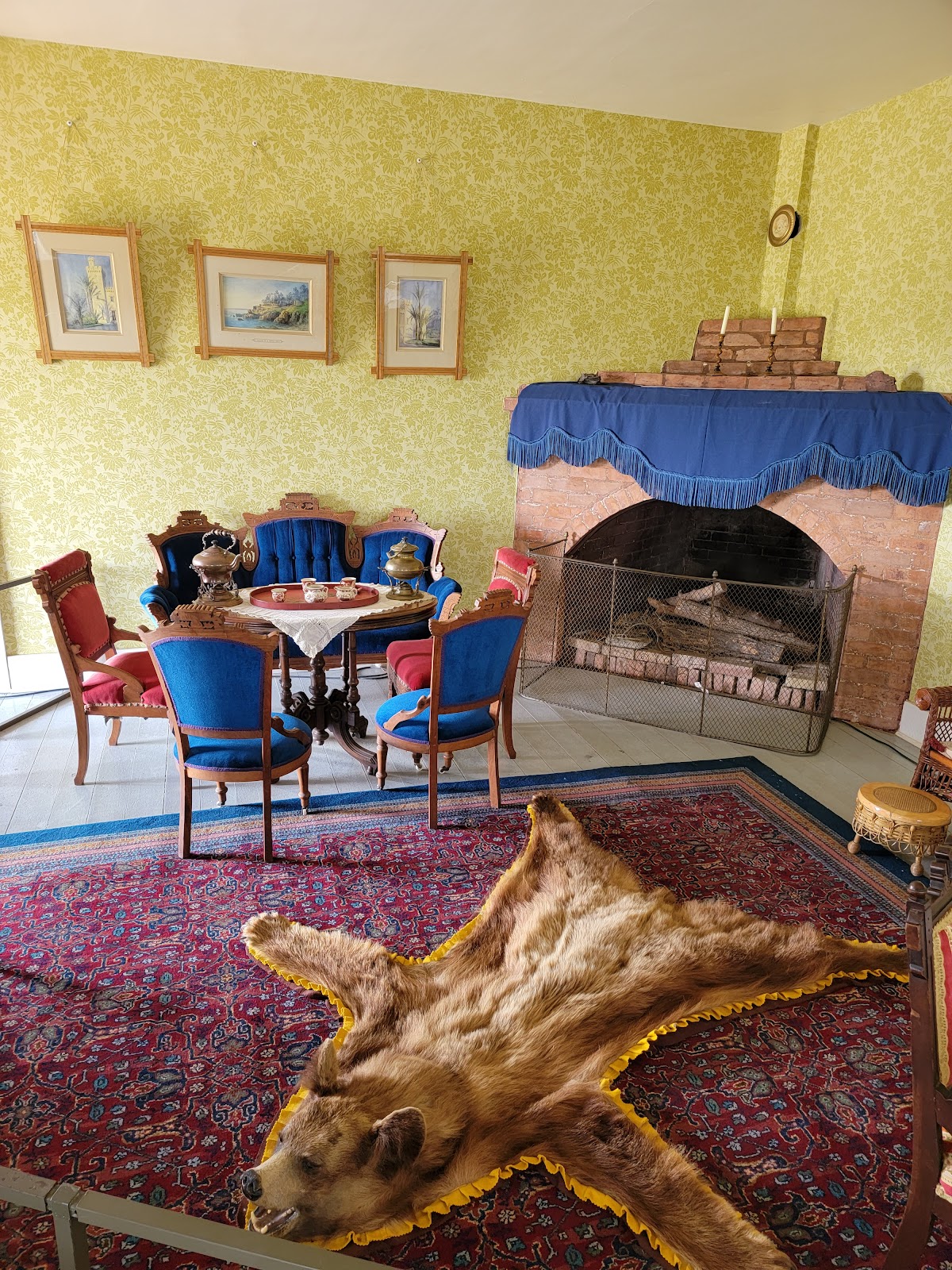
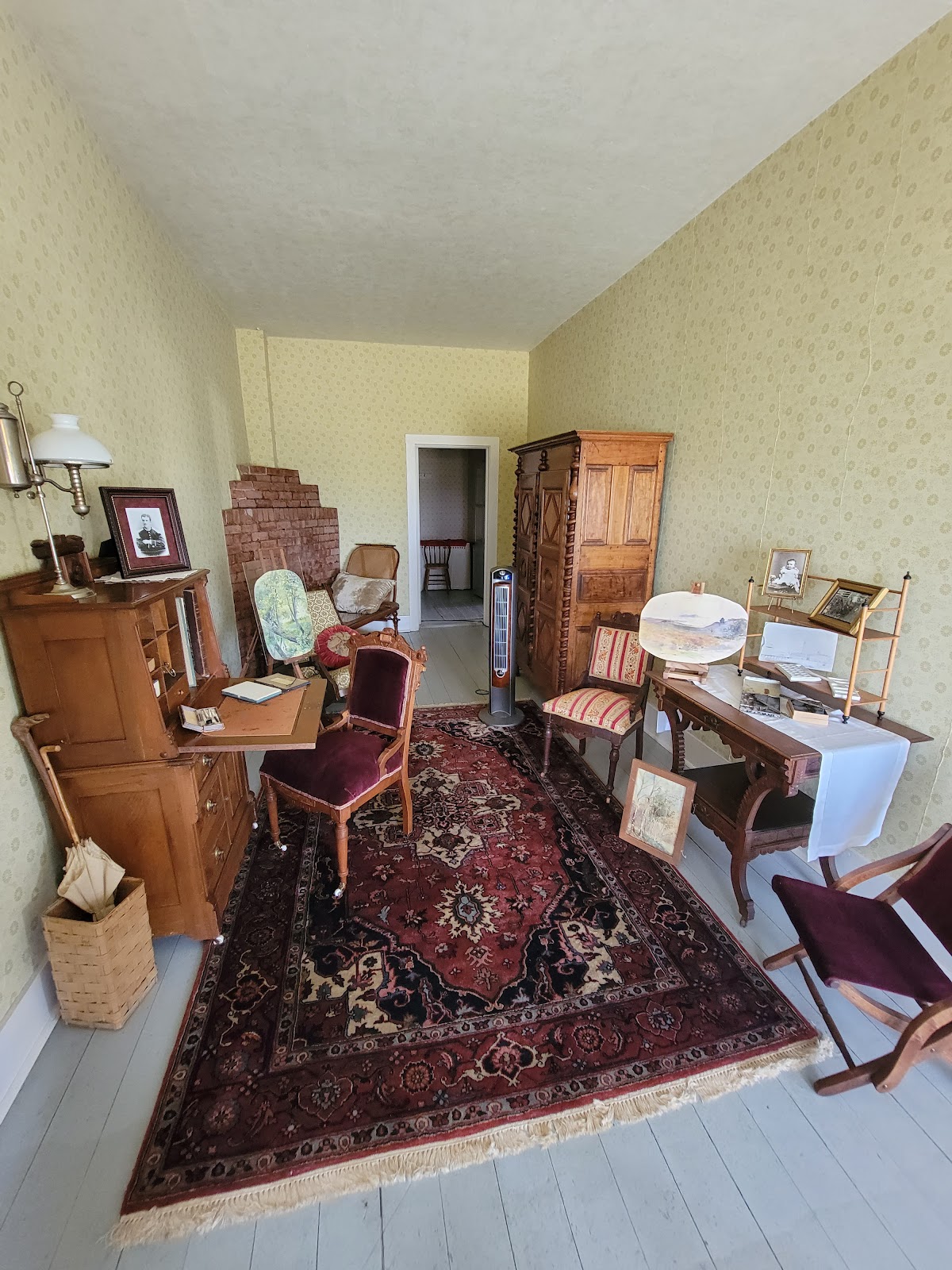
The interior is a furnished house museum and the light in it is entirely about the windows.
A small window in a framed wall is a snoot: the reveal collimates the beam so it arrives as a defined shaft with a hard edge rather than spreading across the room. A subject placed in or immediately beside one has a strong directional key, a rapid falloff and a dark surround — which is the light a studio spends money to reproduce.
Respect the falloff, because it is steep. One step back from the window drops a stop, two steps drops two, and four steps back the subject is effectively unlit. The positions are precise rather than approximate, and moving someone a foot is a real adjustment.
The reveals are also warm, because painted or stained timber returns the incoming light with a warm tint — so the light in a window reveal is warmer than the daylight outside it, which flatters skin and separates a subject from any cooler shade beyond.
Bounce is limited. Frontier interiors use painted or papered timber walls with stained joinery, and those return relatively little — so a flash aimed at a wall gives back less than expected. Where a ceiling is pale, bounce off that; otherwise go direct through a modifier with the room left dark, which suits the register better than flat overall light.
Gel warm and drag the shutter. A period house museum is lit by warm tungsten or warm LED at modest levels in period fittings, and a daylight-balanced flash against that puts a blue-white face in a warm timber room — the commonest error in historic interior coverage. A quarter to a half warm gel with a correspondingly warm white balance resolves it, and a thirtieth to a sixtieth keeps the fixtures visible.
The furnishings are collection items and the restrictions on them are absolute. That is worth establishing in specifics — which chairs, which rooms, what may be set down where — because the person who unlocks the door will know exactly what is original.
Outside, the bluff is the site’s real asset and the view is the frame.
Looking out over the badlands means looking at banded sedimentary rock — grey-blue bentonite clay, tan and buff sandstone, black lignite seams, and red scoria where a coal seam burned underground and baked the clay above it. Those bands read only in raking light: at midday the buttes flatten into pale washed masses with the colour drained out, and at low sun they separate and the reds saturate.
So the view is an ends-of-the-day subject, and it wants a moderate telephoto rather than a wide lens. From a bluff, a wide lens renders a badlands valley as a flat band across the middle of the frame; compression brings the buttes forward into layers with real mass.
Expose for the rock and lift the subjects with a warm-gelled source at about a stop over whatever ambient falls on them. Ungelled is the error: at this latitude in clear air the sky is a deep blue, so open shade reads distinctly cool while sunlit rock reads warm, and a neutral flash puts a slightly green face in front of a red butte.
The vegetation is sparse and each species counts. Rocky Mountain juniper grows on north-facing slopes and is near-black in a photograph, which makes it the best natural separation available against pale rock. Cottonwood grows along the Little Missouri and nowhere else, giving the river bottom the only substantial trees for miles. And the mixed-grass prairie — little bluestem above all — turns russet in autumn and holds it all winter, because the dead growth stands until spring.
One safety note that applies to anyone leaving a path. Bentonite clay becomes genuinely slick when wet and stays greasy for a day or more after rain — not merely soft but treacherous on a slope, which matters for anyone in wedding shoes on a bluff.
- Photograph the house from below; on level ground it is just a wooden building
- Painted clapboard wants open shade or overcast — direct sun is two stops too much
- Depth back from the veranda edge is the whole control; check the ceiling colour
- Small windows are snoots: precise positions, one step is one stop
- Compress the badlands with a telephoto and expose for the rock
A seasonal town, and a northern year
The building is a house museum in a seasonal town at a northern latitude, and all three of those shape the calendar.
Late September into early October is the best window and it is not close. The cottonwoods along the Little Missouri turn clear yellow, the little bluestem goes full russet, the air reaches its clearest of the year, the heat has broken, and a low sun rakes the banded buttes for most of a shortening day.
That combination — yellow river bottom, russet prairie, red scoria, blue-grey clay and a deep northern sky — is the strongest thing this landscape produces, and from a bluff with the view on three sides it is all available from one position.
The cost is that the seasonal town begins to close. Medora’s economy is built on summer visitors and much of it shuts for the winter, with the dates varying. Establishing what will actually be open and staffed on a date in late September or October is a real question rather than a formality, and it applies to the museum itself.
Summer is the operating season and it is long-lit: almost sixteen hours of daylight at the solstice. The noon sun reaches about sixty-six and a half degrees, which is meaningfully lower than the southern venues in this library — so even midday light retains angle, faces are modelled rather than flattened, and the badlands never flatten completely.
That is a real northern advantage and it makes a summer midday workable here in a way it is not further south. The costs are heat on open ground with almost no shade, haze softening the long views, and the town at its busiest.
Spring is the weakest season. April and May are cold, the prairie is brown and dead before it greens, the cottonwoods are bare, and melt makes bentonite slopes treacherous. There is no spring display here of the kind a woodland or a desert offers, and the museum may not yet have opened.
Winter is severe and the honest position is that this is not a winter venue for an event. Temperatures reaching twenty or thirty below, genuine blizzards, about eight hours twenty of December daylight, and a town where most things are closed.
What winter gives photographically is nonetheless remarkable, for anyone with access. Snow on banded badlands fills the gullies and ledges while the exposed faces stay red and grey, which exaggerates the banding rather than hiding it — and snow bounces light upward into faces, so a midday portrait is flattering rather than harsh. A white frame house against snow reduces to pure tone and line, which is arguably its clearest expression.
Two things the latitude gives are worth planning for.
Civil twilight runs about thirty-eight minutes, among the longest figures in this library. In a landscape where the good light is at the ends of the day, that generous dusk is a genuine working session — three or four setups fit comfortably rather than one being rushed. In June it lands near ten in the evening, well after dinner; in late September around seven-thirty, more conveniently.
And the night sky is exceptional. The northern plains are among the darkest inhabited regions in the continental United States — very little population, no nearby city, and a high dry atmosphere. The Milky Way is plainly visible on any clear moonless night, and at forty-seven degrees north the aurora borealis is a genuine possibility several times a year, most likely near the equinoxes.
A lit frame house on a bluff under a visible Milky Way, with banded badlands below it, is a thirty-second tripod frame that almost nothing else in this library can offer. A date near a new moon is worth more than any equipment, and checking an aurora forecast on the night costs nothing.
More frames from The Chateau de Mores
The Chateau de Mores wedding photography: common questions
What is the trap with this building?
The name. It is called a chateau and it is a frontier timber frame house — photographed as the former it disappoints, as the latter it works well.
Where should I stand?
Below it. From the valley the house sits against sky on its bluff; from level ground beside it, it is just a wooden building on grass.
How do I handle the clapboard?
Open shade or overcast. Painted timber reflects about eighty percent against skin’s thirty-five, so direct sun puts the wall two stops above a correct face.
What is the best interior light?
A window reveal. Small windows in framed walls act as snoots — defined directional light with steep falloff and a warm tint off the timber.
When is the best window?
Late September into early October: yellow cottonwoods, russet prairie, the clearest air of the year, and the view lit from a single position.
Is the night sky worth planning for?
Genuinely. This is among the darkest inhabited regions in the lower forty-eight, and at 47°N aurora is a real possibility several times a year.
More North Dakota venue guides
We are writing a photographer’s guide to every venue we would happily shoot in North Dakota. Here are three more, plus the full index:
- The Fort Abraham Lincoln State Park, Mandan: What It Suits, and What It Does Not
- The International Peace Garden, Dunseith: Field Notes
- The Medora Musical: The Light Through the Day
Planning a wedding at The Chateau de Mores?
A frontier house with a marquis’s name. Tell us your date.