 The Westin Book Cadillac, Detroit: A Walk Up Through a Restored 1924 Hotel
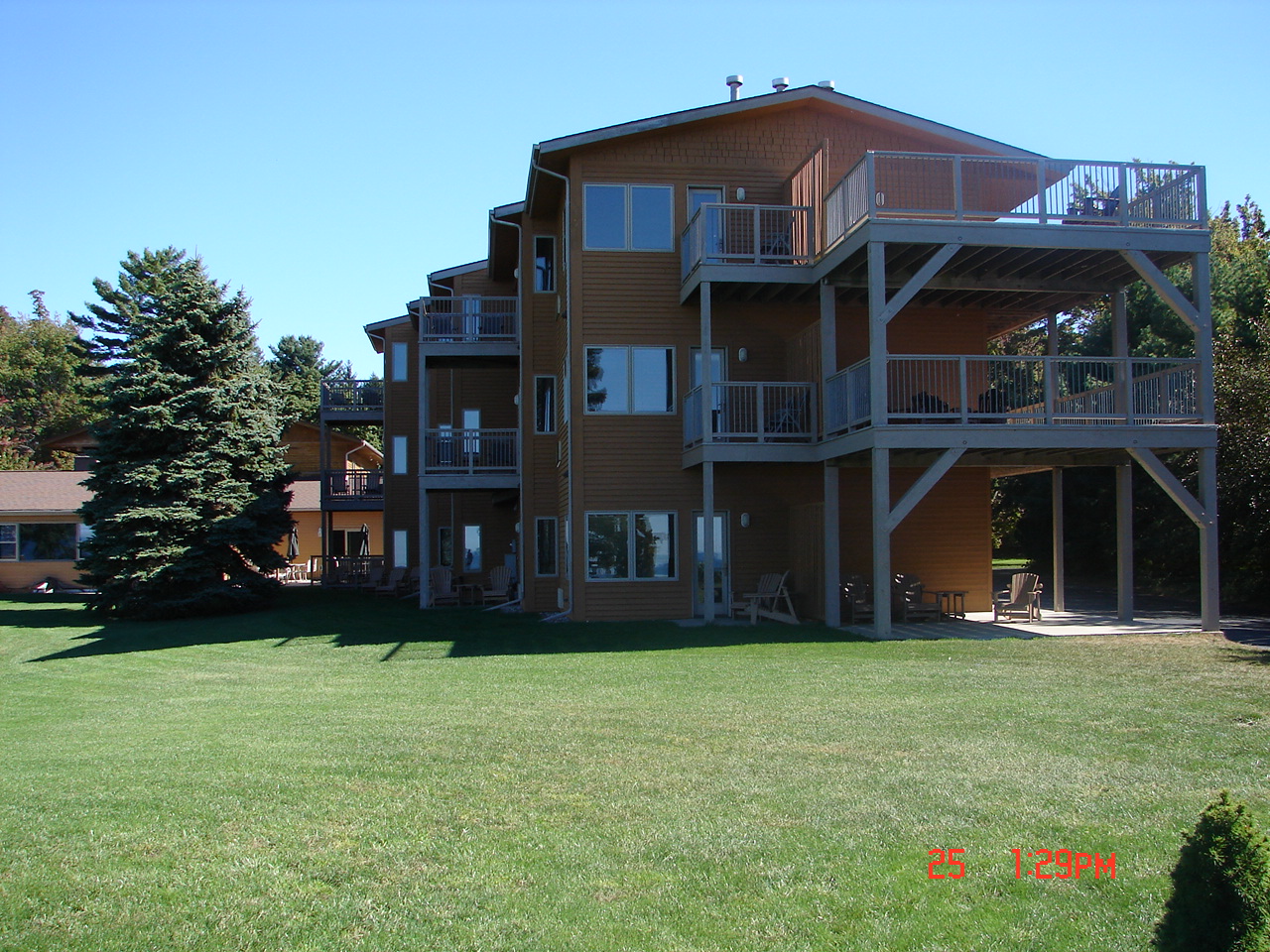
The Lake Bluff Inn & Suites, Mackinaw City: The One Decision That Governs Everything
One decision: is the bridge in the frame, or is it not?
There is one overwhelming feature here and the decision is whether it appears in a given photograph.
The Mackinac Bridge opened in 1957 and spans the Straits of Mackinac, where Lake Michigan and Lake Huron meet. It runs about five miles from shore to shore, making it one of the longest suspension bridges in the world, and from the Mackinaw City shoreline it is inescapable — a pair of towers and a shallow cable curve running out across open water and disappearing into distance.
That is a landmark rather than a background, and it behaves like one. Include it and the photograph is about the bridge with people in it; exclude it and the photograph is about people on a Great Lakes shoreline, which is a perfectly good and completely different picture.
The reason it has to be a decision rather than a preference is scale. The bridge is five miles long, which means at any focal length wide enough to show its extent, the people are tiny — and at any focal length that renders a face properly, only a fragment of a tower is visible.
There is no setting at which both read equally. That is the fork, and a photographer who has not chosen in advance ends up with a series of frames in which the bridge is a distracting grey line behind someone’s shoulder.
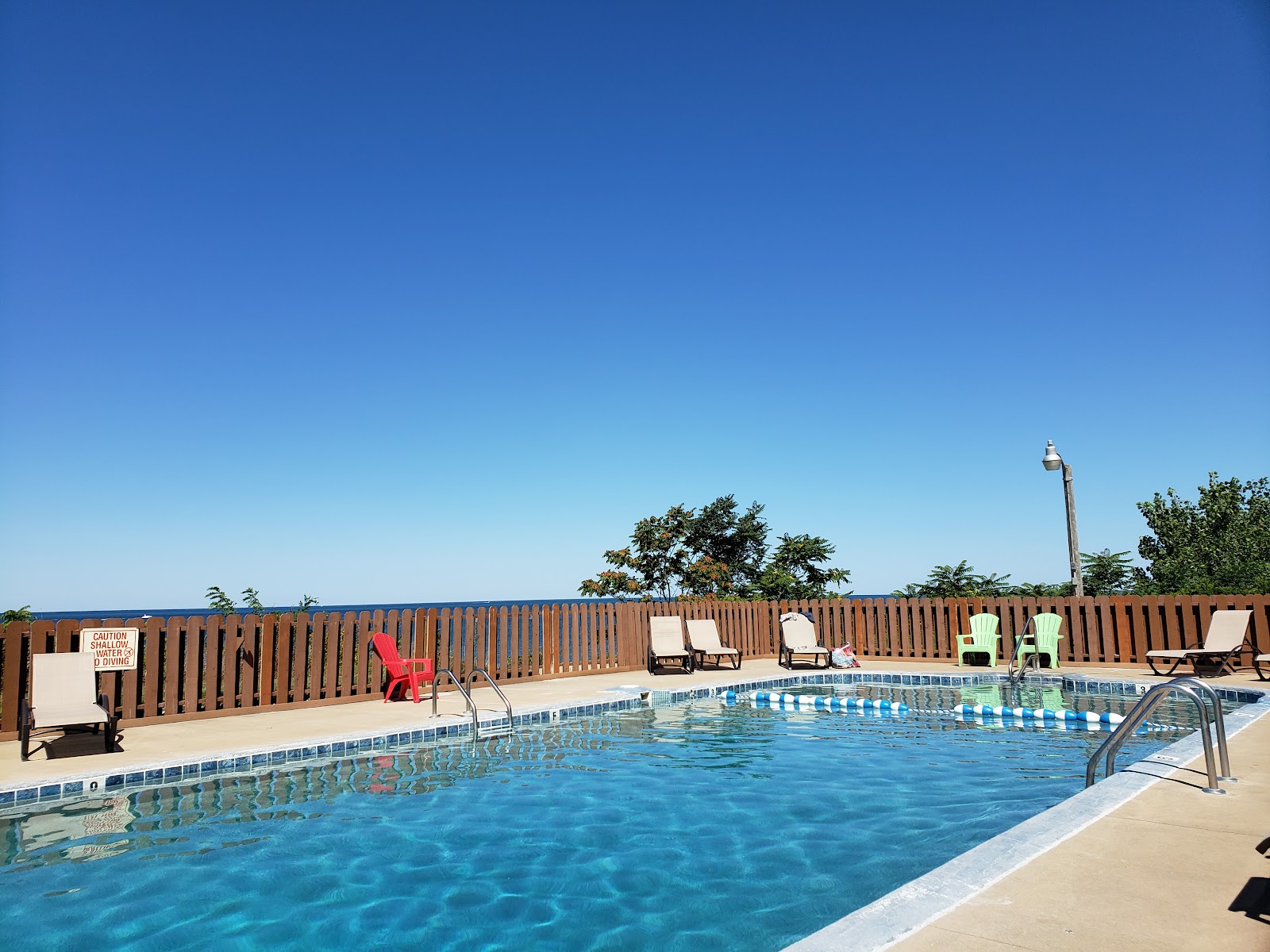
The second governing fact is the water. The Straits are open, cold and exposed, with a long fetch in both directions — which means genuine wind most days, very large skies, and a shoreline that is a real edge rather than a decorative one.
Mackinaw City sits at about forty-five and three-quarter degrees north at roughly six hundred feet. Summer days run to around fifteen hours thirty-five at the solstice, winter days to about eight and a half, and civil twilight is roughly thirty-six minutes — a notably long working dusk.
We have not photographed a wedding here. Which spaces are bookable, what covered alternatives exist and the permitted hours are questions for their team.
The Lake Bluff Inn & Suites at a glance
| Where | A waterfront inn at the Straits of Mackinac, Mackinaw City |
| The decision | Whether the five-mile Mackinac Bridge is in the frame or not |
| Why it must be decided | At any focal length showing its extent, the people are tiny |
| The setting | Open cold water, long fetch, real wind and very large skies |
| The latitude | About 45.75°N — 36 minutes of civil twilight |
With the bridge
If the bridge is the subject, the frames are landscape photographs that happen to contain a couple, and they need building that way.
The scale decision comes first. There are three workable treatments and they are genuinely different pictures.
The full span, wide, with the couple very small on the shoreline in the foreground. That reads as a landscape and it works — the people give scale to something that otherwise has none, which is exactly what a figure in a landscape is for. It needs the couple large enough to read as two people and small enough not to compete, which in practice means they occupy perhaps a twentieth of the frame height.
The towers compressed, using a moderate to long telephoto from further back, which brings the structure forward and stacks the cables into a dense curve. At that focal length the couple can be a half or three-quarter length and the bridge still dominates behind them — which is the frame most people actually want and the one that requires the most walking backwards.
Or a fragment: a single tower, a section of cable, the roadway’s underside from beneath, with the couple close. That reads as graphic rather than as landscape and it is the most reliable of the three, because it does not depend on the whole structure being legible.
The exposure is the recurring problem and it is the same one at any waterfront. A bright sky over open water is several stops above a shaded face, which means a couple photographed against the bridge in daylight is either silhouetted or standing in front of a blown white sky.
The answers are the usual ones. Silhouette them deliberately, which against a bridge’s ironwork is a strong graphic frame. Or light them to within about a stop and a half of the ambient, which at the distances involved needs a real source rather than an on-camera flash. Or wait for the light to come down.
The last is the best answer and it is worth building the schedule around, because a suspension bridge at low sun is a genuinely different object. The towers take the warm light frontally, the cables catch it as a thin bright curve, and the whole structure separates from the water behind it.
And after sunset the bridge is lit, which is the frame to plan the day around. Its towers and cables carry lighting, and against a sky still holding deep blue — thirty-six minutes of civil twilight at this latitude gives a generous window — a lit five-mile bridge over dark water is about as strong an exterior background as this library contains.
That frame wants a tripod, an exposure anchored on the bridge lights, and a warm-gelled source on the couple at about a stop under the ambient. The water doubles it if the wind has dropped, which at the Straits is a matter of luck rather than schedule.
One caution about the towers. A suspension bridge photographed from close to one end foreshortens dramatically, so the near tower appears enormous and the far one nearly invisible. From further along the shore the two towers separate and the span reads as a span. That position is worth walking to.
Without the bridge
If the bridge is out, the site becomes a northern Great Lakes shoreline and it has plenty.
The water is the main asset and it behaves as open water does. It reflects the sky, which makes it a very large low-angle source — filling under the chin and lifting the eye sockets, an effect that strengthens sharply at low sun angles because water’s reflectivity rises at grazing incidence. So a subject at the water’s edge in the last hour is lit from below as well as from the side, which flatters faces without any equipment.
The Straits run clear and cold over a limestone and cobble bottom, and in bright overhead light the shallows read a genuine turquoise — a colour more Caribbean than Midwestern and startling in photographs. That colour only appears when the sun is high enough to penetrate rather than reflect, which makes midday, usually the worst hour, the right one for a frame about the water itself.
The shoreline is the compositional structure. Where the land meets the water there is a definite line — cobble beach, low bluff, rock — and a frame composed along it, running across or diagonally through the picture, has an anchor that an open view lacks.
The stones are worth close attention. Great Lakes beaches here are cobble rather than sand, and the stones are rounded limestone and granite in greys, whites and pinks, often wet and therefore saturated. A low camera on a wet cobble beach with the couple beyond gives a textured foreground that a sand beach cannot.
The sky is the other half of any frame on an exposed shore, and it is large. With water to the horizon there is nothing taking a bite out of it, which means half of any wide frame is sky — so the wide pictures are only as good as the weather. Broken cloud, a passing front or the long northern twilight give a sky worth half a frame; a cloudless midday does not.
The wind is the constant and it needs managing rather than resenting. The Straits are open in both directions with a long fetch, which means breeze most days and genuine wind often.
Practically: a five-hundredth of a second rather than a two-hundred-and-fiftieth, no unweighted light stands anywhere near the shore, and no collapsible diffuser on an exposed beach unless someone is holding it and braced.
The opportunity is the veil. A long veil extended by a steady breeze is one of the most reliably striking frames at any waterfront venue, and it needs the wind to exist. Read the direction first — blowing toward the camera it obscures faces, across it reads as a shape, away from the camera it extends into the frame. Only one of those is wanted, and rotating the couple ninety degrees is the whole fix.
One honest note about comfort. The Straits stay cold all season, and a breeze off genuinely cold water makes an exposed shoreline feel far colder than the air temperature suggests. A wedding party standing on it for a forty-minute ceremony in June will feel it, and that is worth saying to anyone planning an outdoor ceremony here early in the season.
- Decide about the bridge before the day — there is no focal length that serves both
- Walk along the shore so the two towers separate rather than foreshorten
- Water fills faces from below, and most strongly at low sun
- Midday is the only hour the shallows read turquoise
- Rotate the couple so the wind carries the veil across or away, never toward you
The season, and a northern latitude
The latitude and the water together define what each part of the year offers, and the range is wider than in most of this library.
Summer is short and generous. Around fifteen and a half hours of daylight at the solstice, with a thirty-six-minute civil twilight, means the working day is long and the dusk is a genuine session rather than a scramble — three or four setups fit comfortably into the blue hour, which is the single biggest technical advantage of a northern venue.
It also means late timings. Blue hour in late June falls near ten in the evening, which puts the bridge frame well after the reception has started. That is easier on everyone than interrupting dinner, and it needs the couple briefed that the best picture of the day happens late.
The water stays cold through the season, which keeps the shoreline cool and, more usefully, keeps the air above it stable in the mornings. Early mornings here are frequently calm when afternoons are not, so anything that needs still air belongs at the start of the day.
Late September into early October is the best photographic fortnight. The northern hardwoods turn — sugar maple to scarlet and orange, birch and aspen to yellow — against dark conifer, and the Straits’ clear autumn air gives visibility that summer haze does not. The bridge reads sharply across five miles in October in a way it does not in August.
That colour peaks earlier here than in southern Michigan because of the latitude, usually in the first half of October, and the surrounding water moderates it enough that it holds a little longer than the inland mainland at the same latitude.
The honest warning for autumn is wind. The Straits get the season’s first serious blows from late September, and on a site defined by its exposure that is a real risk to an outdoor ceremony. A covered alternative that genuinely exists is not a formality here.
Winter is severe and worth understanding rather than dismissing. At forty-five and three-quarter degrees north the December day is about eight and a half hours, and the Straits region gets substantial snow — both synoptic and lake-effect, with the open water of the Straits contributing moisture until it begins to ice.
The Straits do ice, partially or substantially, in most winters, and ice on the water with the bridge above it is a genuinely striking and rarely photographed subject. So is snow on a cobble shoreline. The light is short and often flat grey, and the blue hour arrives around half past five — which means a lit-bridge frame is available before the reception rather than during it.
A winter wedding here is a small indoor event with two or three deliberate exterior excursions, and it can be excellent if planned that way rather than as a summer wedding with snow.
Spring is the weakest season and it is worth saying so. The lakes delay warming substantially, which means April and May are cold, the hardwoods leaf late, the gardens are behind and the water is at its coldest. The days are long and the setting is not yet at its best.
One final practical note specific to this location. Mackinaw City is the mainland terminus for the Mackinac Island ferries, which means the waterfront is a working transport hub with a great many day visitors in season. Frames taken near the docks will have people in them; frames taken along the shoreline away from the terminal will not. Ten minutes of walking is the difference, and it is worth knowing before the day rather than discovering during it.
More frames from The Lake Bluff Inn & Suites
The Lake Bluff Inn & Suites wedding photography: common questions
Why must the bridge be a decision?
At five miles long, any focal length that shows its extent makes the people tiny, and any focal length that renders a face shows only a tower fragment. Nothing serves both.
What is the strongest bridge frame?
The lit bridge against a sky still holding blue, fifteen to thirty minutes after sunset, on a tripod with a warm-gelled source on the couple.
Where should I stand along the shore?
Far enough along that the two towers separate. Close to one end the near tower foreshortens enormously and the far one nearly disappears.
When does the water look turquoise?
Midday only, when the sun is high enough to penetrate rather than reflect off the surface and the limestone bottom shows through.
How windy is it really?
Breezy most days and genuinely windy often — the Straits are open in both directions. Use a five-hundredth and never leave a light stand unweighted near the shore.
Is winter worth considering?
Yes, if planned as a winter wedding. The Straits ice in most years, and ice under the bridge is a striking and rarely photographed subject.
More Michigan venue guides
We are writing a photographer’s guide to every venue we would happily shoot in Michigan. Here are three more, plus the full index:
- The Pinnacle Center, Hudsonville: What It Suits, and What It Does Not
- The Castle in the Country, Allegan: The Venue’s Own Logic
- The Henry Ford Museum, Dearborn: The Problem, and Four Ways Out of It
Planning a wedding at The Lake Bluff Inn & Suites?
A five-mile bridge and a cold clear shoreline. Tell us your date.