 The Westin Book Cadillac, Detroit: A Walk Up Through a Restored 1924 Hotel
The Castle in the Country, Allegan: The Venue’s Own Logic
A building that quotes a style. Photograph the quotation, not the original.
This building has a logic and it is worth naming plainly, because getting it wrong produces disappointing pictures.
It is a castle in style rather than in fact. A romantic revival building of this kind — turrets, crenellations, steep roofs, arched openings — is quoting a medieval European vocabulary in a American domestic building, at domestic scale, in timber and stucco or brick rather than in three feet of stone.
That is not a criticism. Romantic revival architecture has been doing this for two centuries and it is a legitimate and enjoyable tradition. But it sets a specific photographic trap: photographed as though it were a real castle, it will not withstand the comparison, because the scale, the materials and the massing are all domestic.
Photographed as what it is — a picturesque building in a woodland setting, with silhouette and detail as its strengths — it works very well.
The distinction comes down to what you show. A real castle rewards wide frames that emphasise mass, weight and the thickness of walls. A revival castle rewards frames that emphasise outline, detail and setting: a turret against sky, an arched doorway framing a couple, a crenellated roofline above trees.
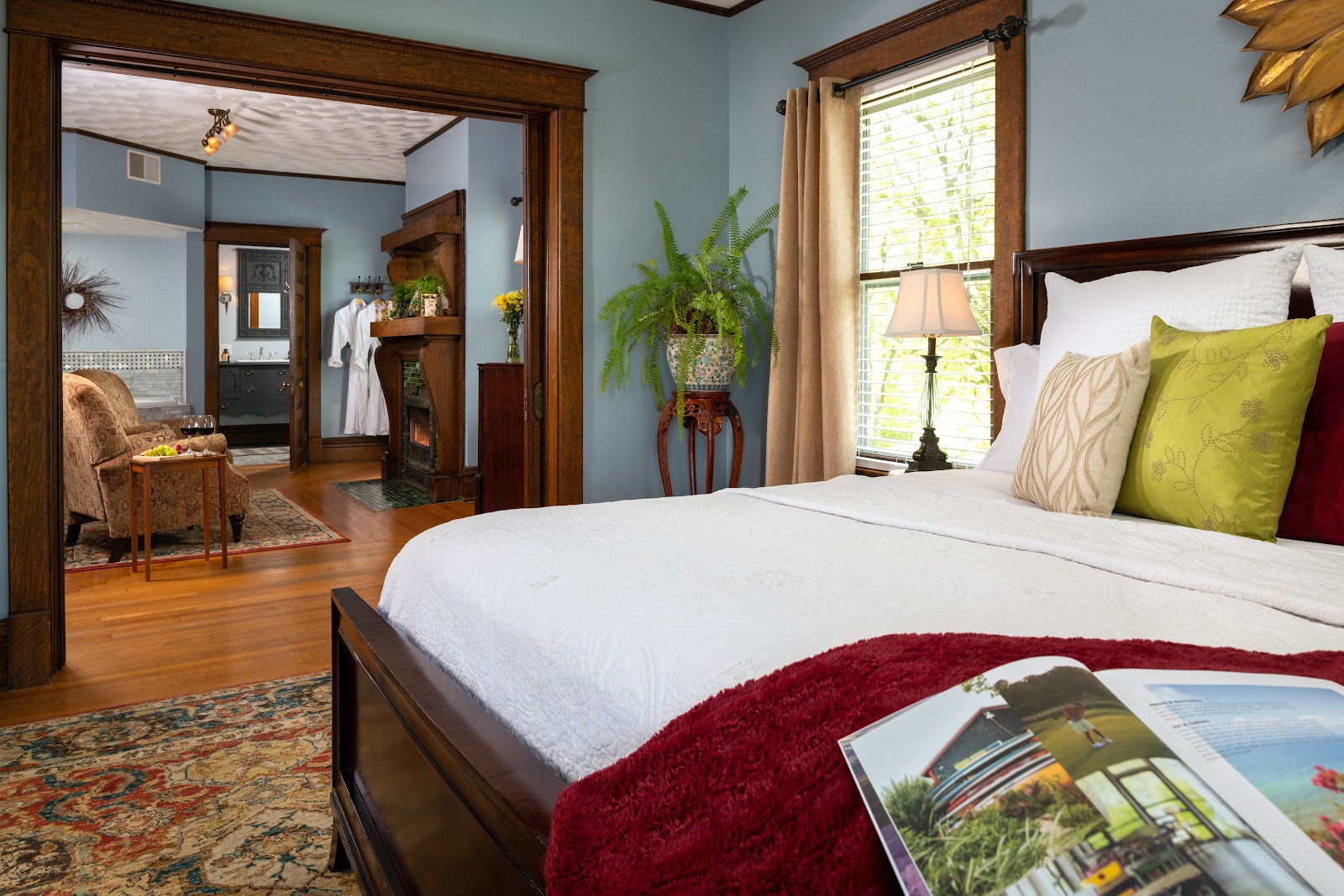
The second thing that follows from the building’s logic is the interior scale. A castle-styled inn is a house, which means the rooms are domestic — sitting rooms, bedrooms, a dining room — rather than halls. That is an advantage for portraits and a limitation for large groups, and it needs knowing before the day.
And the third is the setting, which for this kind of building is not incidental. A picturesque building was designed to be seen in a landscape, and a wooded site in southwest Michigan supplies exactly the context the style asks for.
Allegan sits at about forty-two and a half degrees north at roughly seven hundred feet, in southwest Michigan about twenty-five miles from Lake Michigan. The June noon sun reaches around seventy-one degrees, the December noon sun about twenty-four, days run from about nine hours ten to fifteen hours fifteen, and civil twilight is roughly thirty-one minutes.
We have not photographed a wedding here. Which rooms and grounds are included, what the capacity really is and the permitted hours are questions for their team.
The Castle in the Country at a glance
| Where | A castle-styled inn in woodland near Allegan, southwest Michigan |
| The logic | A romantic revival quotation, at domestic scale in domestic materials |
| The trap | Photographing it as a real castle — the comparison it cannot win |
| The approach | Silhouette, detail and setting, not mass and weight |
| Ask first | Real capacity, included rooms and grounds, permitted hours |
Photographing a quotation
The outline is the building’s strongest asset and it wants a low sun or a bright sky behind it.
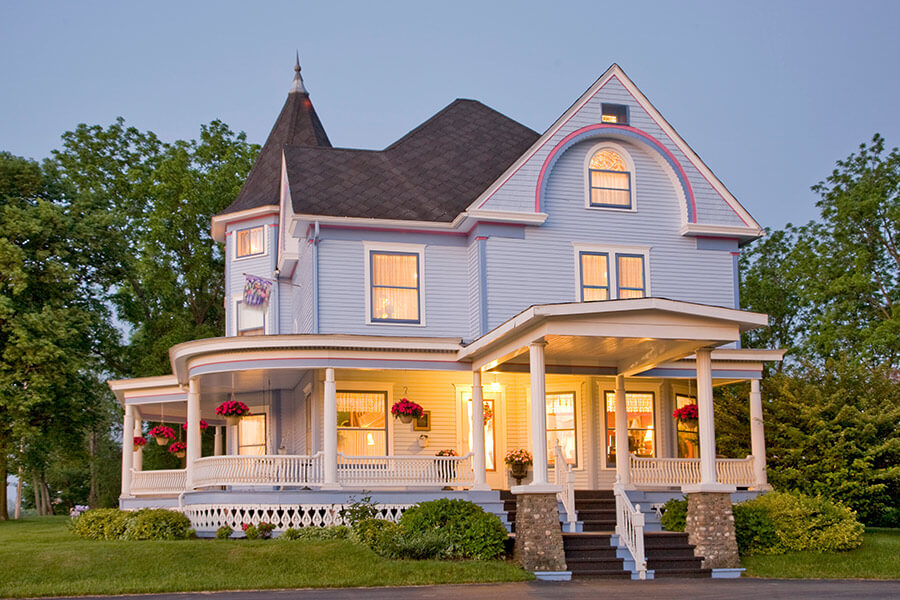
A crenellated roofline, a turret and a steep gable are all silhouette features — they read as shape rather than as surface — which means they are at their best when the building is darker than what is behind it. Against a bright sky at dusk, or backlit by a low sun, the outline reads cleanly and the domestic scale stops mattering because there is no surface detail to give it away.
That suggests the building’s best exterior hours are the ends of the day, and specifically the blue hour, when a lit interior behind a dark silhouette gives the most convincing version of the picture the architecture is reaching for.
Civil twilight here runs about thirty-one minutes, which is a genuine working window. The frame worth scheduling is the building against a deep blue sky with its windows lit, taken fifteen or twenty minutes after sunset — turrets dark against colour, glass glowing, and the woodland a mass rather than a collection of trees.
The details are the second asset and they reward close work. Revival buildings carry their style in specific elements — an arched doorway, a stone or cast surround, leaded glazing, a turret window, ironwork — and each of those photographs well at close range, where the materials and scale are exactly appropriate to what they are.
An arched doorway is the most useful. An arch is a strong frame, and a couple standing in one is both framed and separated from the surroundings — and at close range the arch reads as an arch rather than as a small arch. One of those per wedding is enough before it becomes a mannerism.
What to avoid is the mid-distance wide frame in flat light. A revival castle photographed side-on, whole, under overcast, at eye level, looks like a large house with battlements — which is what it is, and which is the least flattering version of it available.
If a whole-building frame is wanted, take it from low and close with a wide lens, which exaggerates the verticals and the massing, or from further away with the woodland framing it so the setting does the work. Both are better than the neutral middle distance.
Inside, the domestic scale is a genuine advantage for portraits. Small rooms mean short distances, which means one bounced source fills a room entirely, and every position is a few steps from every other.
The windows are the light. A house of this kind has domestic-scale windows, often with leaded or decorative glazing, and a subject placed a metre in from one and turned three-quarters toward it is lit with clear direction and a soft shadow edge. The room falls away behind them and the separation needs nothing added.
Leaded or patterned glazing is worth using deliberately rather than ignoring. It throws a patterned light and, photographed from inside against a bright exterior, reads as a graphic dark lattice — which is a strong detail frame that plain glass cannot give.
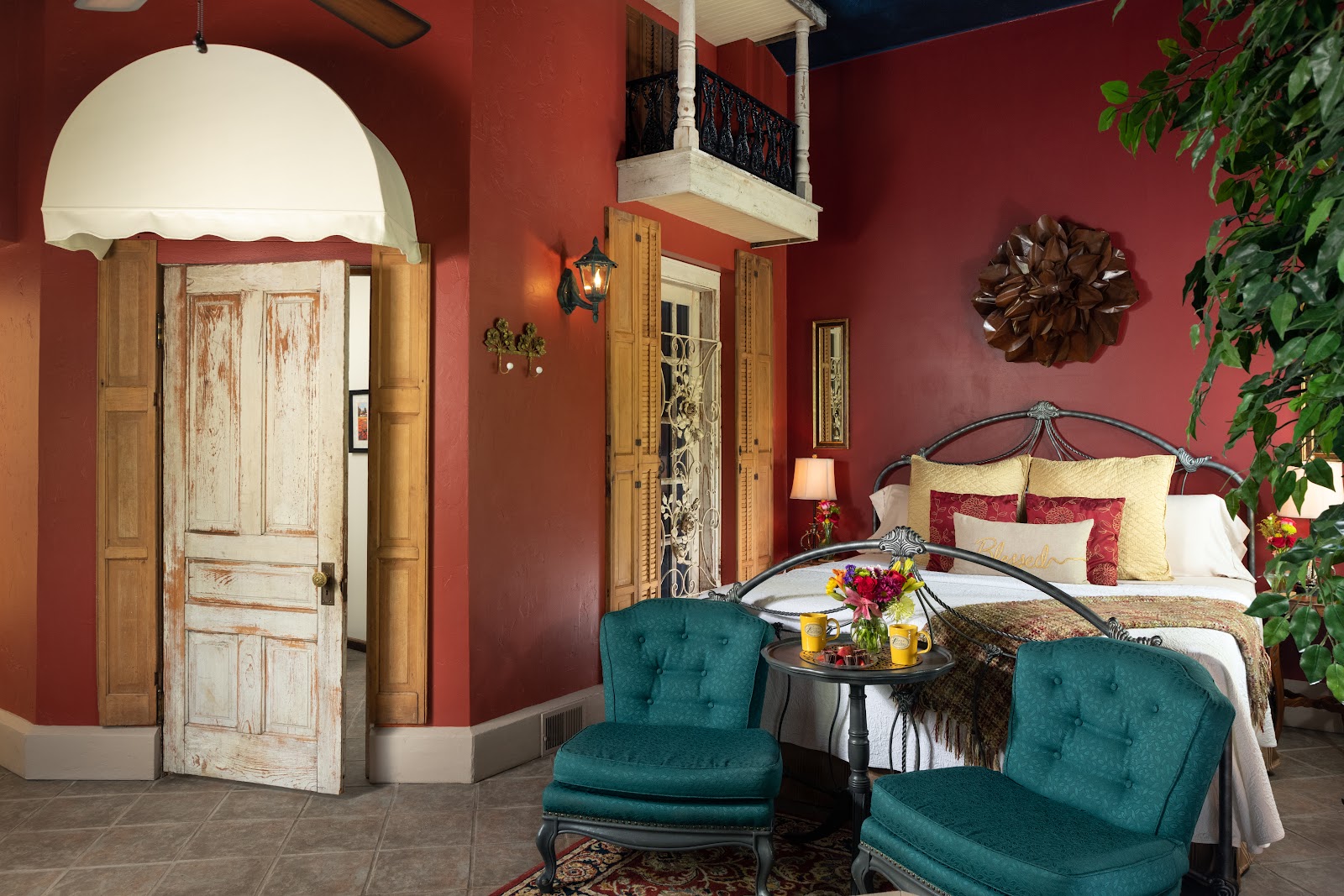
Revival interiors are often dark — stained timber, deep colours, heavy fabrics — which means bounce may be limited and a pale ceiling is the surface to look for. Where the finishes are dark, direct light through a modifier with the room left dark suits the register better than flat overall light does.
The woods, and what the setting gives
The woodland is the other half of the venue and southwest Michigan’s forest is specific enough to be worth knowing.
This is northern hardwood country: sugar maple, red maple, American beech, oak, hickory, with white pine and hemlock mixed in. That composition matters because the species behave differently as photographic material.
Sugar maple and oak have dense rounded crowns of broad leaves and cast clean solid shade with no dapple to manage. That is worth stating as a regional fact, because it is the opposite of the filigree canopies in this library’s arid regions — under a Michigan hardwood at midday a face is evenly lit, and a midday portrait is straightforward rather than a problem.
American beech is the background to hunt for. Its bark is smooth, pale grey and almost unmarked, so a mature trunk is a large uniform light-toned surface — effectively a natural studio backdrop, and about as good as an outdoor portrait background gets in any climate.
White pine and hemlock give the dark. An evergreen mass behind a subject reads as near-black in a frame, which provides separation that a deciduous background cannot — so a couple placed against conifer with light on them is cleanly isolated without any equipment.
That combination — pale beech trunks, dark conifer, dense maple canopy — means a woodland here offers three quite different backgrounds within a short walk, and choosing between them deliberately is the difference between varied coverage and repetitive coverage.
The canopy edge is the best light in any wood and it is worth finding. A metre or two inside the tree line, a subject has soft directional light coming from the open ground in front of them and three or four stops of darkness behind — the single most reliable free portrait setup in forested country.
Shafts are the other woodland frame. On a clear day with a high sun, gaps in the canopy throw defined beams onto the forest floor, and those are visible if there is any haze or dust in the air. A subject standing in one, with the surrounding wood two or three stops down, is theatrical and needs only the position.
The risk is dapple on faces. A partial canopy at midday puts hard bright patches across a face, and in a hardwood forest that is a real problem in the gaps even though it is not under the crowns. The fix is a step: move half a metre and look again, or move fully under a crown.
The seasons here are pronounced and each offers something different.
Spring is the short brilliant window. Before the canopy closes in early May, light reaches the forest floor and the woodland flowers — trillium, spring beauty, trout lily — appear in quantity. A woodland floor covered in white trillium under bare branches is a frame available for perhaps two weeks and it is genuinely spectacular.
Summer closes the canopy, which darkens the forest substantially and makes the canopy edge and the shafts the only usable light inside it. The open lawns become the working spaces instead.
Mid to late October is the best fortnight. Sugar and red maple turn scarlet and orange, beech goes a clear bronze that holds late, and oak turns russet — and against a revival building’s silhouette that colour is the setting the architecture was designed for. Southwest Michigan runs a little later than the north of the state, and the lake’s moderating influence extends it slightly.
Winter is short on light — about nine hours in December — and this part of Michigan gets substantial lake-effect snow off Lake Michigan twenty-five miles west, which is a genuine planning fact rather than a background detail. Snow on a castle-styled building in woodland is, admittedly, the picture the architecture has been waiting for its entire existence, and it is worth hoping for.
Bare hardwoods against a grey sky read as fine black branch structure, which is a graphic frame a leafed tree cannot make — and a silhouetted building among bare trees is a stronger composition than the same building among summer foliage, because the outline that is the architecture’s best feature reads without competition.
- Photograph the outline and the details, not the mass
- Blue hour with the windows lit is the building’s best exterior frame
- Avoid the neutral mid-distance wide shot in flat light
- Beech for a pale background, conifer for a dark one — both within a short walk
- A metre inside the canopy edge is the best free portrait light in a wood
Size, and what it suits
The practical question at a venue like this is capacity, and it is worth being precise because the published figure and the photographic figure are different.
A capacity number describes how many people fit into a room. It does not describe how many can be photographed in it. A domestic-scale sitting room that seats forty leaves no space for a photographer to stand back, no aisle to move along and no clear background anywhere — which means the coverage becomes close, tight and repetitive by necessity rather than by choice.
At a house venue the useful figure is smaller than the stated one. Thirty people in a building like this gives room to work, positions to choose and backgrounds that are not other guests; sixty fills it, and the pictures will show a full room rather than a place.
So this suits a small wedding well and a medium one poorly, and the honest advice is that the grounds rather than the house are where any larger group photograph happens.
It suits a party that wants an atmosphere rather than a spectacle. A romantic revival inn in woodland has a specific register — enclosed, storybook, slightly theatrical — and a couple who lean into that will get coherent pictures. One who wants something clean and contemporary is fighting the building.
It suits a multi-day event, which is the real advantage of an inn over a hall. Rooms on site mean a welcome dinner, a morning, the wedding and a breakfast, which for a photographer means coverage across several kinds of light in a relaxed register rather than eight hours of one day.
It suits autumn more than any other season, for the reason given above: the architecture was designed to be seen in a picturesque landscape, and mid-October in southwest Michigan is that landscape at its best.
It does not suit a large seated reception in the house. The rooms are domestic and a marquee on the lawn is a different venue with different problems — chiefly that a marquee’s interior is a white or ivory tent lit by whatever comes through the fabric, which is soft, even and characterless, and which none of the woodland or the building appears in.
It does not suit a party unwilling to walk. The good positions in a wooded site are spread through it, and a short walk on uneven ground is the price of variety. That is worth mentioning to anyone in delicate shoes.
And it does not suit a photographer who arrives without scouting. A woodland site’s good positions — the canopy edge that faces the right way, the beech with the clean trunk, the gap where the shafts land, the angle from which the building silhouettes properly — cannot be found during a wedding. Half an hour beforehand is worth more here than at any building-dominated venue, because the building is the smaller part of what is available.
One final honest note. The nearest large body of water is Lake Michigan, twenty-five miles west, which means this site has no water of its own unless there is a pond on the property. Water is worth asking about specifically, because a pond changes what an evening is capable of — reflection, doubled light, and a horizon in a landscape that otherwise has none.
More frames from The Castle in the Country
The Castle in the Country wedding photography: common questions
What is the trap with a revival castle?
Photographing it as a real castle. The scale, materials and massing are domestic, so wide frames emphasising mass lose a comparison the building cannot win.
What should I photograph instead?
Outline, detail and setting. A turret against sky, an arched doorway framing a couple, a crenellated roofline above trees.
What is the best exterior frame?
The building silhouetted against a deep blue sky with its windows lit, fifteen to twenty minutes after sunset.
Which trees should I look for?
American beech for a pale uniform background, white pine or hemlock for a near-black one, and any hardwood crown for clean solid midday shade.
What headcount does it really suit?
Around thirty in the house. A stated capacity tells you who fits, not who can be photographed — at sixty there is nowhere to stand back to.
When is the best season?
Mid to late October. The architecture was designed to be seen in a picturesque landscape, and that is when southwest Michigan supplies it.
More Michigan venue guides
We are writing a photographer’s guide to every venue we would happily shoot in Michigan. Here are three more, plus the full index:
- The Henry Ford Museum, Dearborn: The Problem, and Four Ways Out of It
- The Lake Bluff Inn & Suites, Mackinaw City: The One Decision That Governs Everything
- The Pinnacle Center, Hudsonville: What It Suits, and What It Does Not
Planning a wedding at The Castle in the Country?
A building that knows it is a quotation. Tell us your date.