 The Bierstube: What Changes When the Reception Is in a Bar
Lake Yellowstone Hotel: How the Light Moves on a High Lake
A very large lake at very high altitude. Both facts change the light.
Two numbers govern the light here and they are both unusual. The lake is large — one of the largest high-elevation lakes in North America — and it sits at about seven thousand seven hundred feet.
The size matters because a big body of water behaves differently from a small one. It develops its own wind pattern, it holds heat and releases it slowly, it produces a horizon rather than a far bank at close range, and it is a reflector on a scale that changes the light on everything near it.
The altitude matters because there is roughly a fifth less atmosphere overhead than at sea level, and the consequences are consistent and significant. Direct sun is harder and shadows are deeper than the temperature suggests. The sky is a much deeper blue, which means open shade is lit by a strongly blue source and reads markedly cool. Ultraviolet is high. And the air is exceptionally clear, which is why the ranges across the lake hold detail on a long lens.
Together they produce a venue with a wide tonal range and a strong colour split: warm direct sun, cold blue shade, and a lake that is a deep saturated blue on a clear day because it is deep, cold, clear water under a deep sky.
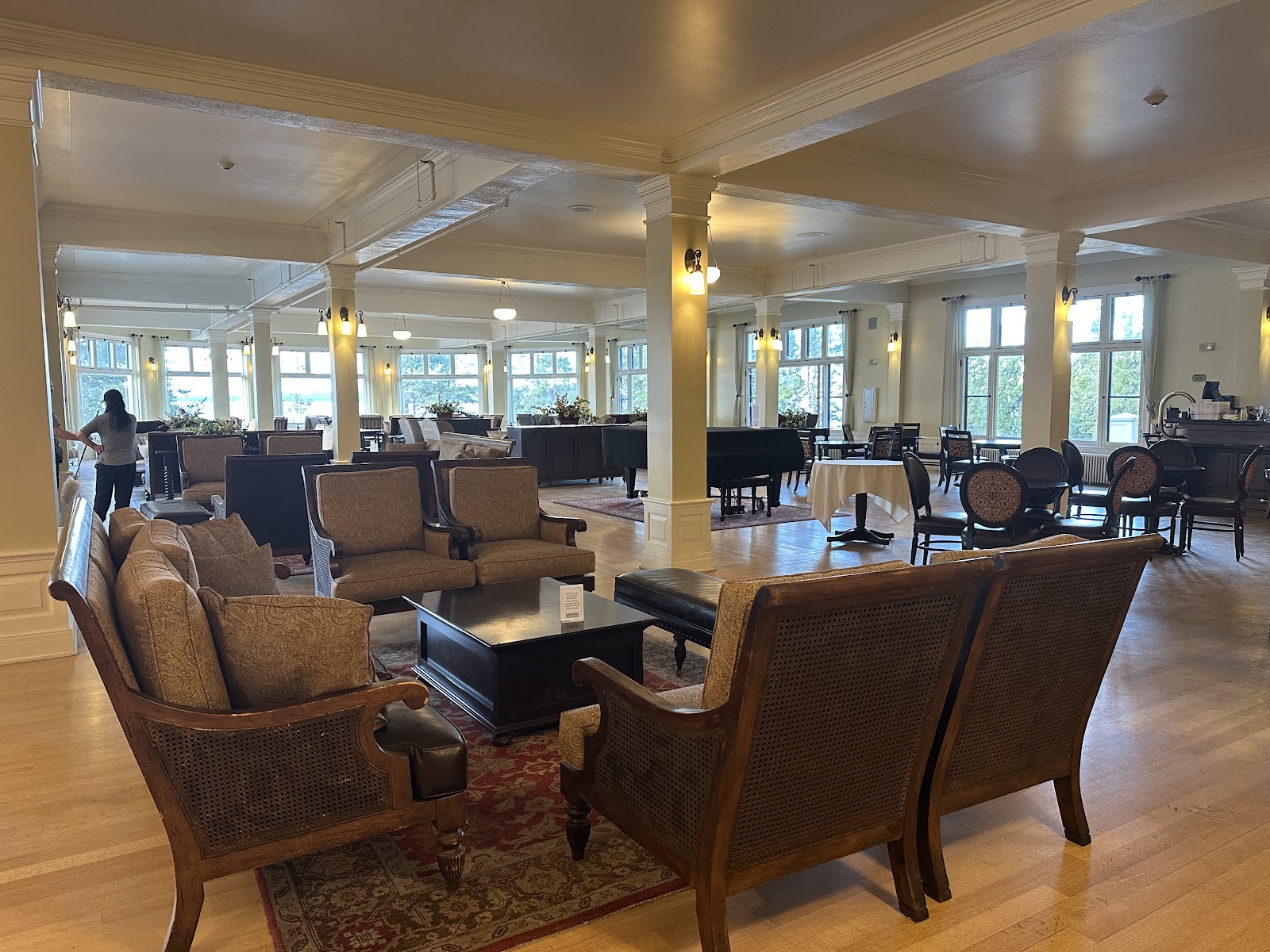
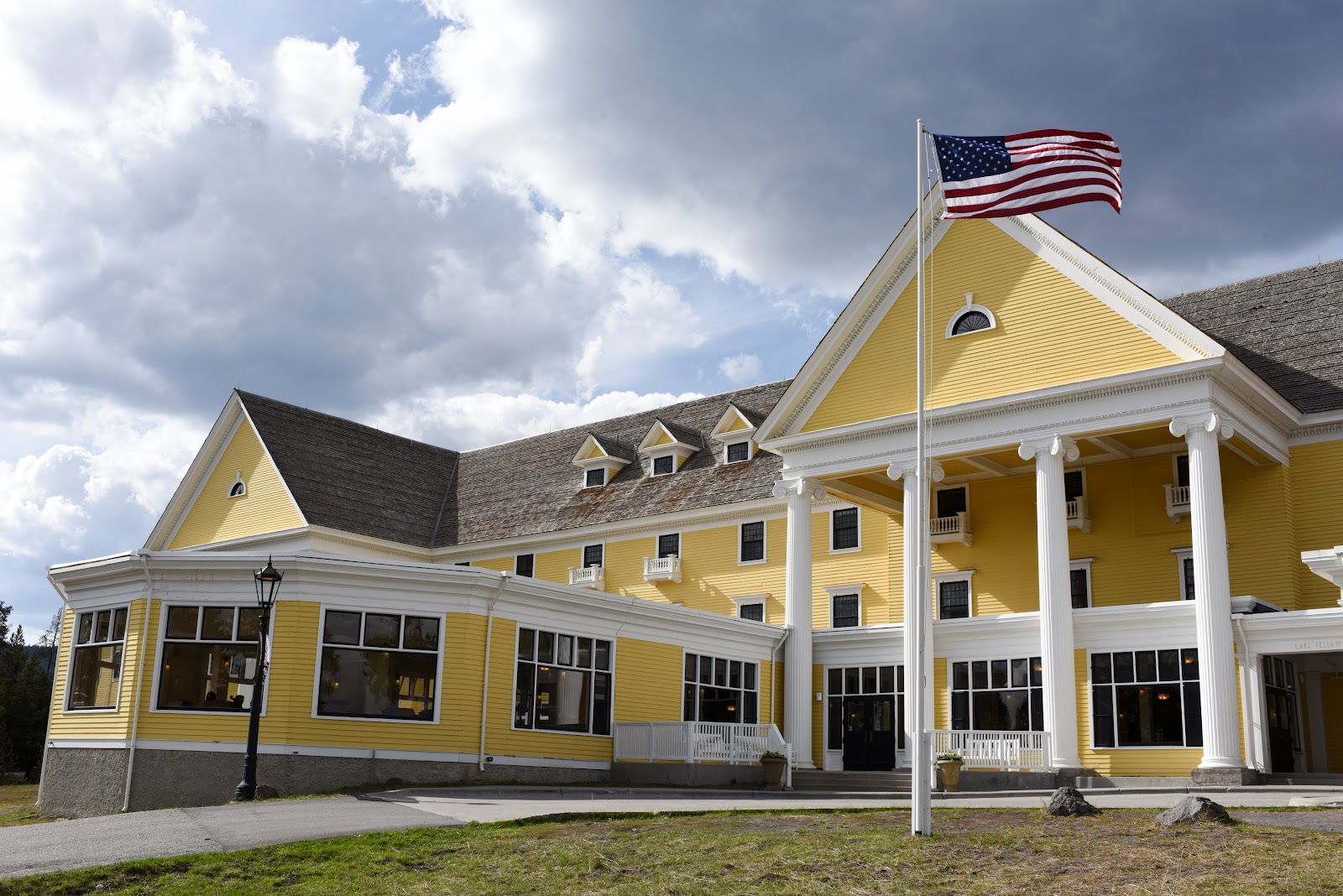
The building is the third element and it is unlike the log lodges elsewhere in the park. This is a pale colonial-revival hotel — painted, columned, with a long sun room facing the water — which means its exteriors are high-reflectance surfaces rather than absorbing ones, and its interiors are lighter and more conventional than a log interior.
That changes the method entirely. In a log hotel the problem is finding enough light and the gift is the darkness; here the problem is separation and the gift is the room-sized window wall facing a very large lake.
Lake Yellowstone sits at about forty-four and a half degrees north. The June noon sun reaches around sixty-nine degrees, the December noon sun about twenty-two, days run from about eight hours forty to fifteen hours forty-five, and civil twilight is around thirty-six minutes.
We have not photographed a wedding here. Whether ceremonies are permitted, what permit is required, which spaces are available and what the hours are, are questions for the park and the concessioner — and at this elevation the operating season is the first thing to establish.
Lake Yellowstone Hotel at a glance
| Where | A colonial-revival hotel on Yellowstone Lake at about 7,700 feet |
| The altitude | A fifth less atmosphere: harder sun, deeper shadow, cold blue shade, clear air |
| The lake | Large enough to have a horizon, its own wind pattern and its own light |
| The building | Pale and columned, with a long sun room — separation, not light, is the problem |
| Ask first | Operating season, park permits, available spaces, hours |
Dawn to midday
The first hour is the best on any lake and on this one it is better than most, because the water is very cold and the air above it at dawn is colder still — which means mist over the surface is a regular morning occurrence rather than a lucky one.
The surface is also unbroken at that hour. A large high lake develops a wind as the day heats: cold air drains off the surrounding plateau overnight, the sun warms the slopes, and by mid-morning there is usually a working breeze. By afternoon a lake this size can have genuine waves.
So the reflection frames belong to the first hour and nowhere else. The technical point is consistent: a reflection is about a stop to a stop and a half darker than the thing it reflects, so a frame exposed for a lit far range has a flat dark reflection, and one exposed for the reflection blows the range.
The reliable solution is to compose so the reflection is of something dark — the far shore’s conifer, or the ranges before the sun reaches them — which brings the two within a stop of each other and needs nothing at all.
Mid-morning is the best land portrait window before the evening. With the sun between twenty and forty degrees, faces have modelling rather than shadowed sockets, and a group with the sun behind the camera at this hour needs nothing added.
It is also when the lake’s colour is at its strongest. Deep, cold, clear water under a high-altitude sky reads a genuinely saturated blue — deeper than almost any lake in this guide, because the atmosphere above it is thin and the sky it reflects is intense. That colour is at its best from mid-morning to early afternoon, which is precisely when the light on people is difficult. A conscious trade.
Midday is the hardest light of the day and at this altitude it is harder than the same hour at sea level. At sixty-nine degrees of elevation with a fifth less atmosphere, the sun puts eyes in deep shadow and foreheads in bright light, and the contrast between the two is greater than the same sun angle would give lower down.
The lake helps: uplight off a large water surface fills the sockets a high sun leaves dark, which makes a subject at the shore at noon workable where the same subject a hundred metres inland is not. It also fools the meter — a frame with bright water and a bright sky underexposes by a stop or more unless the compensation is deliberate and checked on skin.
The colour of that uplight needs noting: it is strongly blue, because it is reflected sky at high altitude. Against warm direct sun that produces a split — warm highlights, cold shadows — which is attractive if intended and muddy if not. A warm gel on any added source resolves it.
The building’s sun room is the other midday answer and it is the best interior light in the park. A long glazed room facing a very large lake receives light that has bounced off water and sky rather than off forest, which makes it bright, clean and neutral — and a subject placed at forty-five degrees to that glazing gets a room-sized softbox with a lit side and a shadow side.
The forest margins are the third answer. The plateau here is lodgepole pine, which grows tall and straight with sparse high crowns and throws a hard shifting dapple — the worst light a face can meet outdoors, and background material only. Engelmann spruce and subalpine fir, which grow in the wetter ground and at the lake’s edge, block almost all direct light: a metre inside their margin gives soft directional light in front and three or four stops of dark behind.
Afternoon to dark, and inside
Early afternoon is the weakest window outdoors and the right time for the interiors, and this building’s interiors are a separation problem rather than a light problem.
A pale colonial-revival interior has light walls, generous windows and painted finishes, which means everything is bright and a subject has nothing to sit against. The answers are three. Find something dark — a doorway into an unlit space, a shaded corner away from the glazing, a piece of dark furniture. Use a window at forty-five degrees so the opposite side of the face falls off naturally. Or add a source a stop over ambient so the subject has a shadow side at all.
The glazing is the best of the three and it is the building’s real asset. A lake-facing window wall is a very large source; the caution is colour, because the light arriving has bounced off blue water under a blue high-altitude sky and is noticeably cool. The white balance goes on a face rather than on a preset.
Corridors and stair halls are, as always in a building of this period, better than they look: a hallway with a window at one end has several stops of fall-off along its length.
The columned exterior is worth its own note. A pale painted colonnade is a rhythm of verticals — the strongest compositional structure architecture offers — and a large area of pale paint is also a substantial neutral reflector, which means the light near it is brighter, softer and more evenly distributed than near a dark building.
That makes standing a subject beside a sunlit pale wall the most flattering free light on the property. It also means the meter is wrong: a frame with much pale façade in it underexposes by about a stop, so compensate deliberately and check on skin. And it means the building has almost no silhouette against a bright sky — which argues for the architectural frames at the ends of the day.
Mid-afternoon into the last two hours is when the site comes back and on a lake the improvement is continuous. The sun drops, the light warms, the water changes from deep blue to gold to slate, and the surface begins to settle as the plateau cools.
Which direction that happens relative to the hotel decides the plan, and it is worth establishing on arrival rather than assuming. Where the sun sets over the water, the standard backlight problem applies and three answers work: a close warm-gelled source at a stop over the ambient with the exposure set for the sky and water; a silhouette exposed for the sky alone, which works well because a lake this size gives a clean unbroken horizon; or turning around and using the low sun frontally with the water behind, which cannot fail.
Then dusk, and at this latitude and altitude it is excellent: around thirty-six minutes of civil twilight, and the thin clear air gives a saturated and long-lasting afterglow that a low-elevation venue does not get. A large still lake under that sky, with the far ranges as a dark band, is the strongest frame of the evening.
Two practical matters. A lake this size and this cold is a genuine hazard rather than a scenic feature — the water is cold enough year-round to be dangerous, and afternoon waves on it are real. And wildlife at this elevation is present rather than theoretical, including bears, which is a matter for the park’s guidance and affects where a party may go.
- Mist on the lake is a regular dawn event at this altitude, not a lucky one
- Compose reflections against dark conifer or unlit ranges, not the sky
- The lake’s uplight is strongly blue — gel any added source warm
- The sun room is the best interior light in the park
- Pale paint fools a meter by about a stop
The high lake year
This is one of the highest venues in this guide and its season is genuinely short — the first thing to establish is whether the hotel operates at all on the date in question.
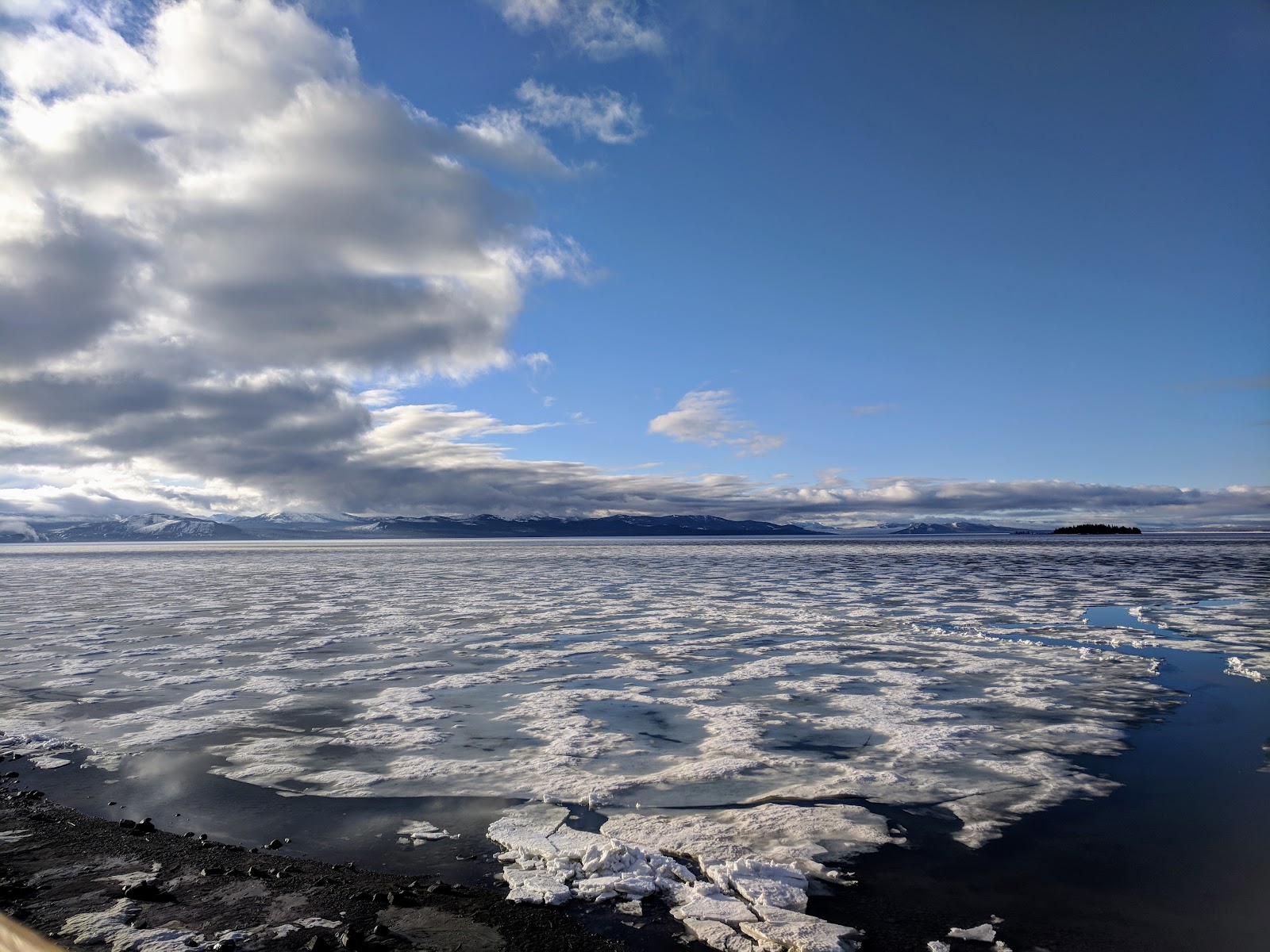
At seven thousand seven hundred feet the lake freezes in winter and stays frozen for months, and most of the park’s interior roads are closed to ordinary vehicles. A winter event here is a question for the park and the concessioner before it is a question for a photographer.
If it is possible, the photographs are extraordinary: a very large frozen lake is a flat white plane of enormous size, ringed by near-black conifer, with the ranges beyond — and the December noon sun at around twenty-two degrees means the whole short eight-hour-forty day rakes rather than floods. Snow is the best natural fill available, lifting shadows to within a stop and fooling a meter by about two stops, so open up deliberately.
Spring at this altitude is very late. Ice-out on a lake this large and this high typically does not happen until late May or into June, and the weeks around it are the least photogenic of the cycle: grey rotting ice, brown shorelines, saturated ground and flat light. Roads open progressively rather than on a date.
Early summer is the strongest part of the short season for one specific reason: the lake has only just cleared, the air is cold, and mist over the water on a clear morning is at its most frequent and most dense. Late June and early July give the best morning conditions of the year here.
Summer is the season and the days are long: over fifteen and three-quarter hours at the solstice with about thirty-six minutes of civil twilight, which means the low light arrives after nine and lasts. The lake is at its most saturated blue, the meadows are green, and the wildflowers are out.
The costs are the middle of the day at sixty-nine degrees and a fifth less atmosphere, afternoon convection — these mountains make their own weather and a clear morning frequently becomes a wet afternoon, and on a lake that means wind and waves as well as rain — and crowds.
The honest late-summer note is wildfire smoke. The northern Rockies’ fire season runs from roughly July into September, and smoke can fill the plateau for days: the sun goes orange, contrast flattens, the far ranges disappear entirely, and everything shifts warm in a way no white balance resolves. For a venue whose wide frames are all across water to distant ranges, that removes them — while leaving the interiors, the sun room and the close water frames intact.
Late September into early October is the best window of the year. The aspen turn, and because a grove is clonal — genetically one organism — a whole stand goes gold at once rather than tree by tree, giving blocks of uniform colour against near-black conifer. The first snow returns to the peaks, the smoke risk has usually passed, the crowds thin, the mornings are cold enough that the lake is at its stillest, and the air is at its clearest of the year.
Gold aspen against dark lodgepole below fresh-snowed ranges, doubled in a still lake at first light, is the strongest photograph this landscape produces. The window is about two weeks and the hotel’s season may end inside it — which is the one thing to check before booking an October date.
By late October the plateau is turning toward winter and the roads begin to close.
More frames from Lake Yellowstone Hotel
Lake Yellowstone Hotel wedding photography: common questions
What does the altitude change?
A fifth less atmosphere overhead: harder direct sun, deeper shadows, markedly cool blue open shade, high ultraviolet, and exceptionally clear air at distance.
When is the lake still?
The first hour after sunrise. A lake this size develops its own wind as the plateau warms, and by afternoon it can have genuine waves.
How do I expose a reflection?
Compose so the reflection is of dark conifer or of ranges the sun has not yet reached. A reflection runs about a stop darker than what it reflects.
Why do my shadows look cold?
Open shade at this altitude is lit by a deep blue sky, and the lake’s uplight is reflected sky. Gel any added source warm and set white balance on a face.
What is the best interior light?
The lake-facing sun room. Light bounced off a very large water surface and a high-altitude sky is bright, clean and cool — a room-sized softbox.
When is the venue at its best?
Late June and early July for the densest dawn mist after ice-out, and late September into early October for clonal aspen gold and the clearest air.
More Montana venue guides
We are writing a photographer’s guide to every venue we would happily shoot in Montana. Here are three more, plus the full index:
- Mammoth Hot Springs Hotel, Yellowstone: One Frame and How It Is Made
- Many Glacier Hotel, Glacier: One Frame and How It Is Made
- Old Faithful Inn, Yellowstone: The Venue’s Own Logic
Planning a wedding at Lake Yellowstone Hotel?
A big lake in thin air. Tell us your date and we will plan the first hour.