 The Bierstube: What Changes When the Reception Is in a Bar
Mammoth Hot Springs Hotel, Yellowstone: One Frame and How It Is Made
A white mineral landscape that rebuilds itself. Nothing else photographs like it.
There is one frame at Mammoth that is worth the day and it is unlike anything else in this guide, because the landscape is made of something that is still being made.
The travertine terraces here are built by hot water rising through limestone: the water dissolves calcium carbonate underground, carries it up, and deposits it at the surface as it cools and degasses. The result is a series of stepped white mineral shelves and pools, growing continuously — which means the terraces are not a fixed feature but an active one, and a vent that was flowing last year may be dry now while a new one has opened elsewhere.
The frame is the couple on or beside those terraces, with the white mineral steps and pools around them and steam rising through it.
What makes it hard is the tonal range. Fresh travertine is nearly white — a very high-reflectance surface — and it is wet, which makes parts of it specular. Steam above it is white and bright. And a face in open light is two or three stops darker than any of that, which means a frame metered on skin gives a featureless white landscape and a frame metered on the terraces gives a silhouette.
What makes it worth the trouble is that there is nowhere else like it, and that the colour is extraordinary: where the water is hottest the mineral is white, and where it has cooled enough for thermophilic microbial mats to grow it runs orange, brown, yellow and green in bands. White mineral, banded colour, blue pools and white steam, all in one frame.
The frame is made of four decisions: where the light is coming from, how the exposure is set, whether the steam is in or out, and — first and decisively — where anyone is permitted to stand.
That last one is not a photographic question. Travertine crust is thin and the water beneath it is at or near boiling, which is why the boardwalks exist. Nobody steps off them, and what is permitted at all is a question for the park rather than a judgement to make on the day.
Mammoth sits at about forty-five degrees north at around six thousand feet — the lowest and driest part of Yellowstone. The June noon sun reaches around sixty-eight and a half degrees, the December noon sun about twenty-one and a half, days run from about eight hours thirty-five to fifteen hours forty-five, and civil twilight is around thirty-seven minutes.
We have not photographed a wedding here. Whether ceremonies are permitted, what permit is required, which spaces and boardwalks may be used, what group sizes are allowed and what the hours are, are questions for the park and the concessioner.
Mammoth Hot Springs Hotel at a glance
| Where | A hotel beside the travertine terraces at Mammoth, northern Yellowstone |
| The frame | Subjects among white mineral terraces with steam rising through |
| The problem | Near-white travertine and white steam against faces two or three stops darker |
| The gift | White mineral, banded microbial colour, blue pools and steam in one frame |
| Ask first | Park permits, permitted boardwalks, group limits and hours — and stay on them |
Building the frame
The light direction is the first decision and raking light is what the terraces need. Travertine is a stepped, textured, three-dimensional surface, and under light arriving face-on it reads as a flat white field with faint shading. Under light raking across it at a shallow angle, every step, lip and rim casts a shadow and the structure appears in full relief.
That makes the terraces a first-or-last-hour subject, and the direction they face decides which. A five-minute check on arrival is worth more than an hour of walking.
It also means that the middle of a bright day is the worst time to photograph them: a high sun on near-white mineral gives a featureless glare with nothing to hold the eye.
The exposure is the second decision and it has to be set from the terraces down. The travertine is the brightest thing in the frame and it holds the detail the picture is about, so meter for it — which usually means a value one to two stops brighter than a neutral reading, because a meter presented with a white subject will render it grey.
Then the subjects need their own light, because at that exposure they will be several stops under. A source close to them, warm-gelled to match a low sun, at about a stop over the ambient falling on them, does the whole job. Close, because fall-off is the only way to light two people without also lighting the white ground around them into a blank.
There is a second, simpler answer available here and it is worth knowing: overcast. Under a solid overcast the whole tonal range collapses to two or three stops, the terraces hold detail without any intervention, faces need no fill, and the colours of the microbial mats are at their most saturated because there are no specular highlights washing them out.
A grey day at Mammoth is genuinely better than a bright one for the colour, and worse for the relief. Knowing that in advance means a forecast changes the plan rather than spoiling it.
The steam is the third decision and it has to be made rather than accepted. Steam is bright, it is opaque where it is dense, and it moves — which means it can hide a subject, obscure the terraces, or make the frame. Backlit by a low sun it glows and makes visible the wind that is otherwise invisible in a still frame; against a dark hillside it reads as white structure; in front of the subjects it is a veil.
The practical approach is to position the subjects so the steam is behind or beside them rather than between them and the camera, and to shoot a great deal, because a plume’s shape changes every few seconds and one frame in five will have it right.
The fourth decision is the microbial colour, and using it deliberately is what distinguishes a good set here. The orange, brown and yellow bands are living mats of heat-loving microorganisms, and they occur where the water has cooled into their temperature range — which means the colour marks a temperature gradient and is arranged in bands parallel to the flow.
Those bands are the strongest graphic element on the site: a subject placed so a colour band runs behind them, or so a band leads into the frame, is composed with something no other landscape offers. Placing them accidentally, so a band cuts across a head, is the same waste as any other misused strong element.
And make the frame more than once: a wide version with the terraces and the subjects small; a close version using one band or one pool rim as the background; one of the terraces alone, because they deserve it; and one close abstract of the mineral surface, which is a photograph in its own right.
The rest of the site
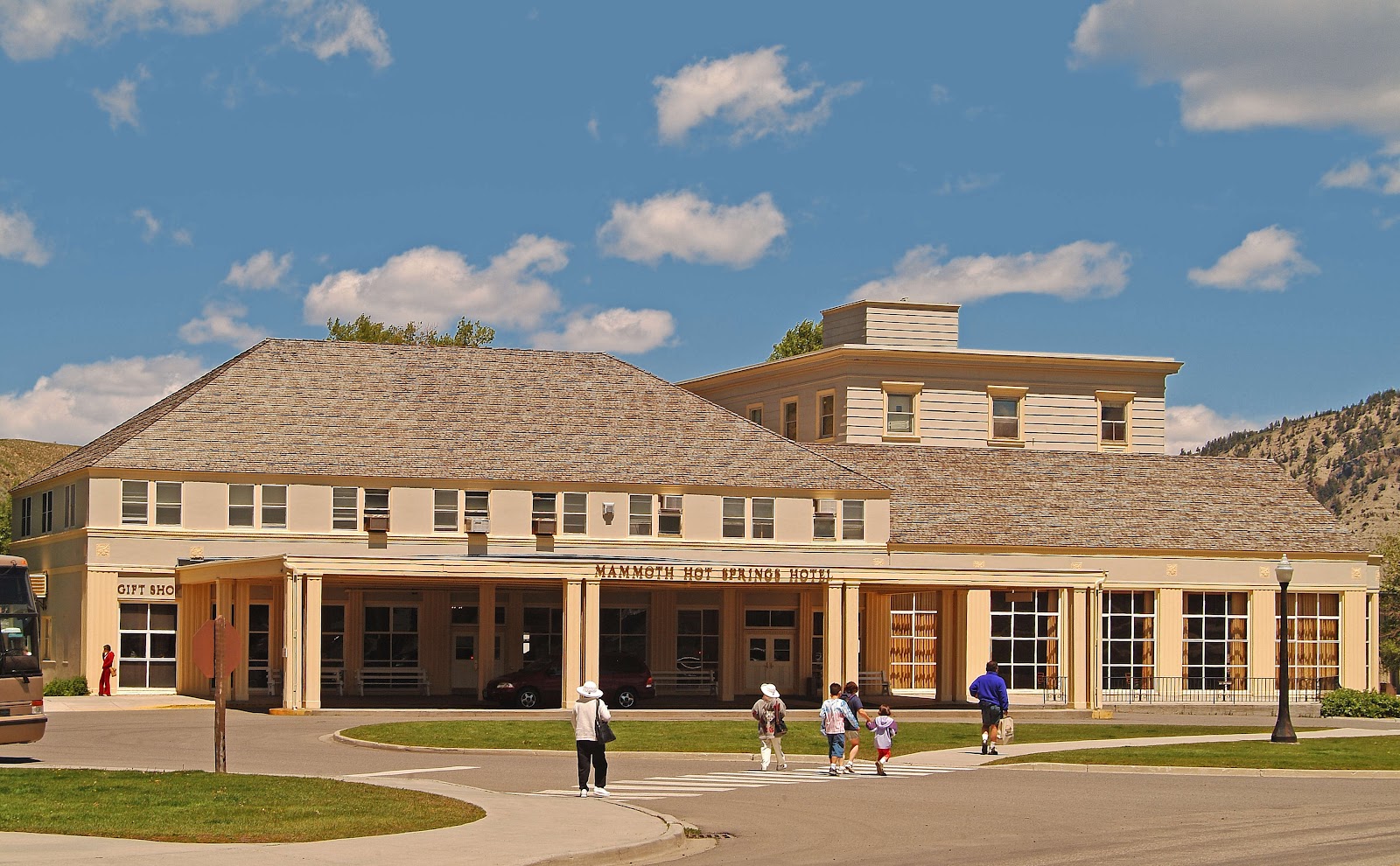
The hotel and the surrounding area are the second environment and they are the driest and most open part of Yellowstone.
Mammoth sits at around six thousand feet in the northern part of the park, in sagebrush and grassland rather than dense forest — which makes it the sunniest, warmest and most accessible corner, and the only part of the park’s interior reachable by road all year.
That open character has photographic consequences. There is little natural shade, which under a sixty-eight-degree summer sun means the open ground is unusable for portraits in the middle of the day. And there is a great deal of sky, which means what the sky is doing matters more here than in a forested valley — a clear high-altitude sky is deeply saturated, and a convective sky with towering cloud is the best background this landscape offers.
The low camera is the answer to both. With the camera below the subjects and sage or grass across the bottom of the frame, everything behind them is above the horizon — sky — which removes the buildings, the roads, the vehicles and the visitors in one move.
The shade that does exist is worth locating. Douglas fir and Rocky Mountain juniper grow on the drier slopes here, and both block far more light than the lodgepole pine that dominates the rest of the park. A subject a metre inside a fir or juniper margin has soft directional light in front and three or four stops of dark behind. Lodgepole, by contrast, holds sparse crowns high on the trunk and throws a hard shifting dapple that is the worst light a face can meet outdoors — background only.
The altitude is a factor throughout. At six thousand feet there is roughly a sixth less atmosphere overhead than at sea level: direct sun is harder and shadows deeper than the temperature suggests, the sky is a deeper blue so open shade reads markedly cool, ultraviolet is high, and the air is exceptionally clear — which is why the ranges hold detail on a long lens.
The wildlife at Mammoth is genuinely part of the setting rather than an occasional sighting: elk in particular are a regular presence on the open ground here, and bison use the warm ground in winter. That is a photographic opportunity and a practical constraint at the same time — an animal in a frame becomes its subject, because attention finds animals first, and distance requirements are a matter for the park’s guidance rather than for judgement.
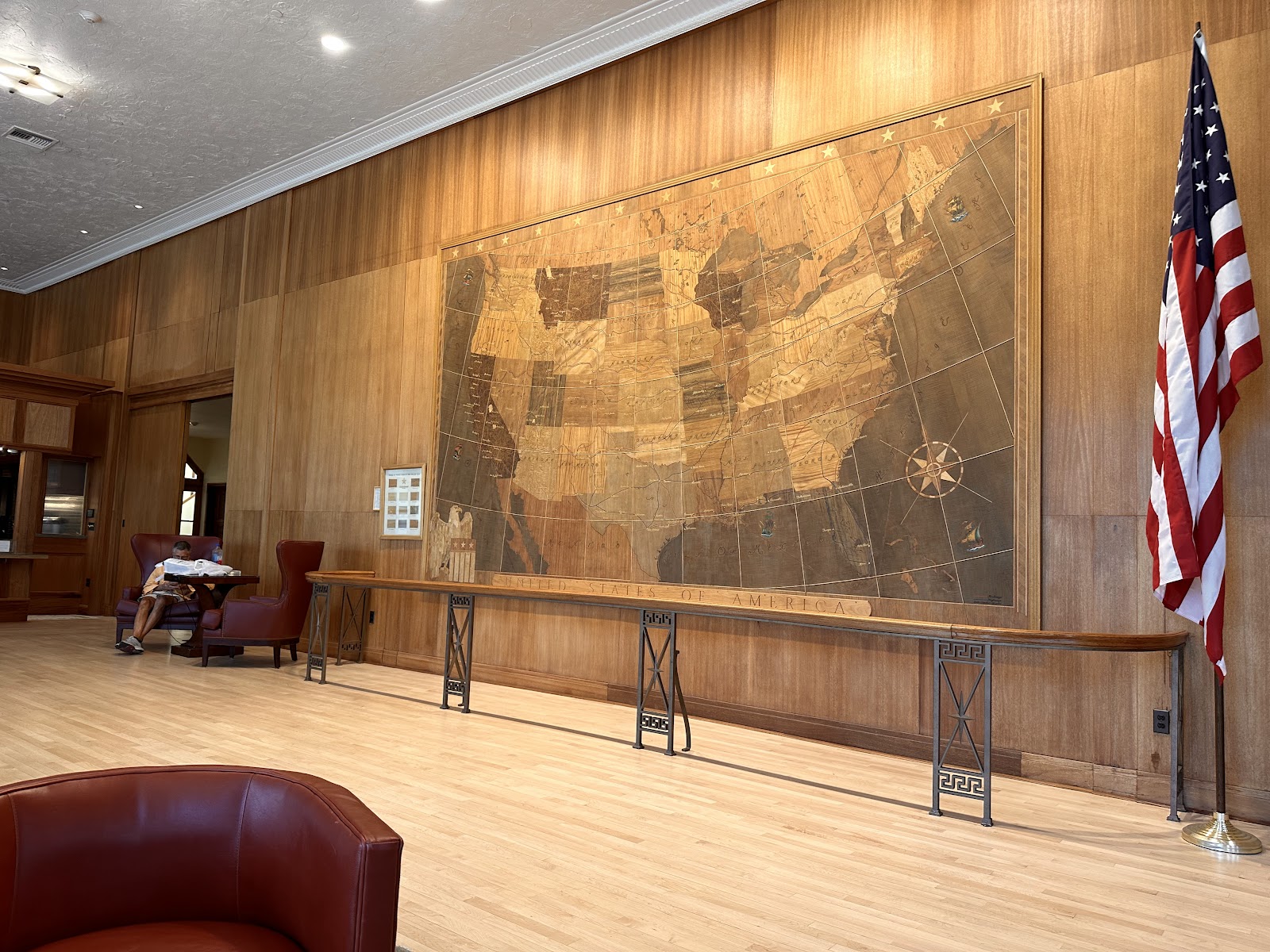
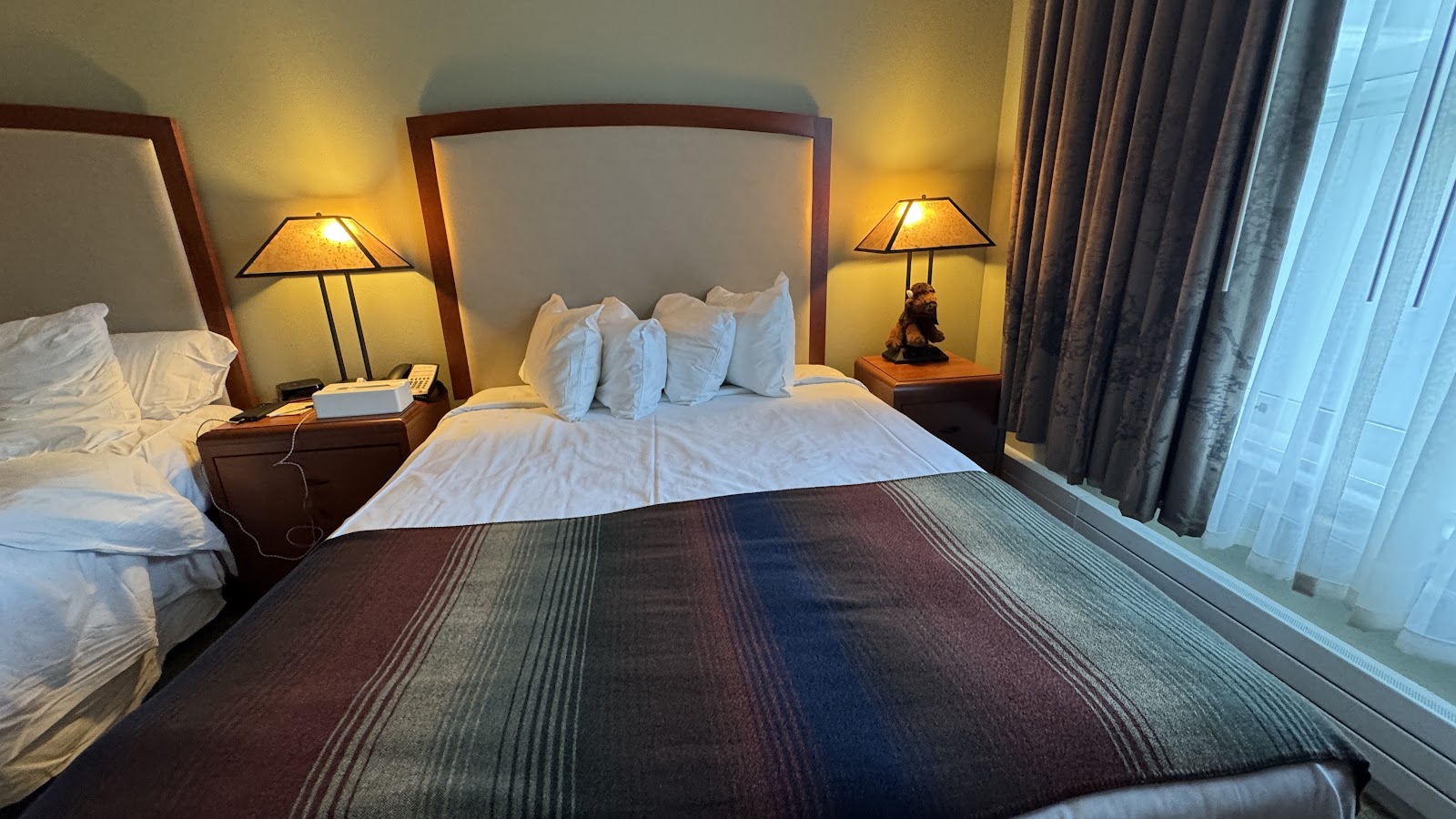
The buildings are historic and mixed: a hotel and a set of structures from the era when this was an army post before it was a park headquarters. That gives stone and rendered surfaces rather than the log construction of the park’s interior lodges — which means the interiors are lighter and more conventional than at a log hotel, and the problem shifts from finding light to finding separation.
In a pale room, a subject needs something dark behind them, a window used at forty-five degrees so the opposite side of the face falls off, or a source a stop over ambient. In a dark-finished room the fall-off is free: meter on skin and let the background go.
Two practical matters. The thermal areas smell strongly of sulphur compounds when the wind is wrong, which nobody expects and everybody notices — worth a word rather than a surprise. And the boardwalks are narrow, which means a wedding party on them is single file and a camera cannot back up far, so the shooting positions have to be found in advance.
- Raking light for relief; overcast for colour. Both are good, differently
- Meter for the travertine one to two stops over neutral, then light the faces
- Put the steam behind or beside the subjects, never between them and the camera
- Use the microbial colour bands as composition, not as accident
- Fir and juniper block here; lodgepole dapples. Know which you are under
The northern Yellowstone year
Four sharply separated seasons, and Mammoth is the one part of the park’s interior that is accessible in all of them — which makes it unusual and worth knowing.
Winter is the most extraordinary season here and it is the reason to consider a winter date in Yellowstone at all. Geothermal steam in air well below freezing produces enormous white plumes and rimes every nearby surface: trees, grass and boardwalk railings become coated in white frost, which is a landscape that exists nowhere else.
Bison and elk gather on the warm ground near the terraces, with frost on their coats. Snow lies on the mineral shelves in patches where the ground is cool and melts where it is warm, which gives a mottled white-on-white landscape of great subtlety.
The light helps too. The December noon sun at around twenty-one and a half degrees means the whole short eight-and-a-half-hour day rakes rather than floods, which is exactly what the terraces need — so the relief the terraces depend on is available all day rather than for twenty minutes. On the light alone, winter is the best season here.
Snow is also the best natural fill available, lifting shadows to within a stop and fooling a meter by about two stops, so open up deliberately.
The costs are severe cold, a short day, batteries draining quickly, glass that fogs on the way into a heated hotel, and conditions that make a thermal area genuinely slippery where the runoff freezes.
Spring at six thousand feet is late and it is the weak window. Snow rots through April and into May, the sage is dun, the grass is brown before it is green, and the landscape looks unfinished. What spring does bring is wildlife at its most visible and the highest water flow through the terraces.
Summer is the season for access and the hardest for light. Days run over fifteen and three-quarter hours at the solstice with about thirty-seven minutes of civil twilight, which gives a long working day — but the middle of it, at nearly sixty-nine degrees of sun elevation on near-white mineral, is the worst light this site ever has.
Summer is also the busiest: Mammoth is on the park’s northern road and receives a great deal of traffic, which means a frame that reads as uncrowded needs early morning or late evening.
The honest late-summer note is wildfire smoke. The northern Rockies’ fire season runs from roughly July into September, and smoke can fill the valley for days — turning the sun orange, flattening contrast and removing the ranges. For a site whose subject is a foreground rather than a distant view, that costs less than it does at a mountain venue, and it does one useful thing: heavy smoke acts as an enormous diffuser, which is exactly what the terraces want.
Late September into early October is the best window overall. The aspen and cottonwood turn — and because an aspen grove is clonal, genetically one organism, a whole stand goes gold at once rather than tree by tree — the first snow returns to the ranges, the elk are in rut and highly visible, the smoke risk has usually passed, the crowds thin, and the air is at its clearest of the year.
Gold cottonwood along the river below white terraces with steam rising through it, in low clear light, is the strongest thing this place produces outside winter. The window is about two weeks.
More frames from Mammoth Hot Springs Hotel
Mammoth Hot Springs Hotel wedding photography: common questions
What is the frame?
The subjects among the white travertine terraces with steam rising through them, and the microbial colour bands used deliberately.
Why is it difficult?
Near-white travertine and white steam are two or three stops brighter than a face in open light, so a single exposure cannot hold both.
How do I expose it?
Meter for the travertine, one to two stops over a neutral reading, then light the faces with a close warm-gelled source.
Is an overcast day bad?
No — it is better for the colour. Overcast collapses the range, holds detail with no intervention, and saturates the microbial mats. It is worse for the relief.
What are the orange and brown bands?
Living mats of heat-loving microorganisms, growing where the water has cooled into their range — so the colour marks a temperature gradient and runs in bands.
When is Mammoth at its best?
Winter, when steam rimes everything and a twenty-degree sun rakes the terraces all day — and late September into early October for gold cottonwood and clear air.
More Montana venue guides
We are writing a photographer’s guide to every venue we would happily shoot in Montana. Here are three more, plus the full index:
- Many Glacier Hotel, Glacier: One Frame and How It Is Made
- Old Faithful Inn, Yellowstone: The Venue’s Own Logic
- Paradise Ranch, Emigrant: A Walk Through the Site
Planning a wedding at Mammoth Hot Springs Hotel?
A white landscape that rebuilds itself. Tell us your date and we will expose for it.