 Dry Tortugas National Park: A Walk Through an Island Fort
Morikami Museum & Japanese Gardens, Delray Beach: One Frame and How It Is Made
A garden designed to be looked at from specific places. One of them is the frame.
Japanese garden design does something no other tradition in this guide does: it tells you where to stand.
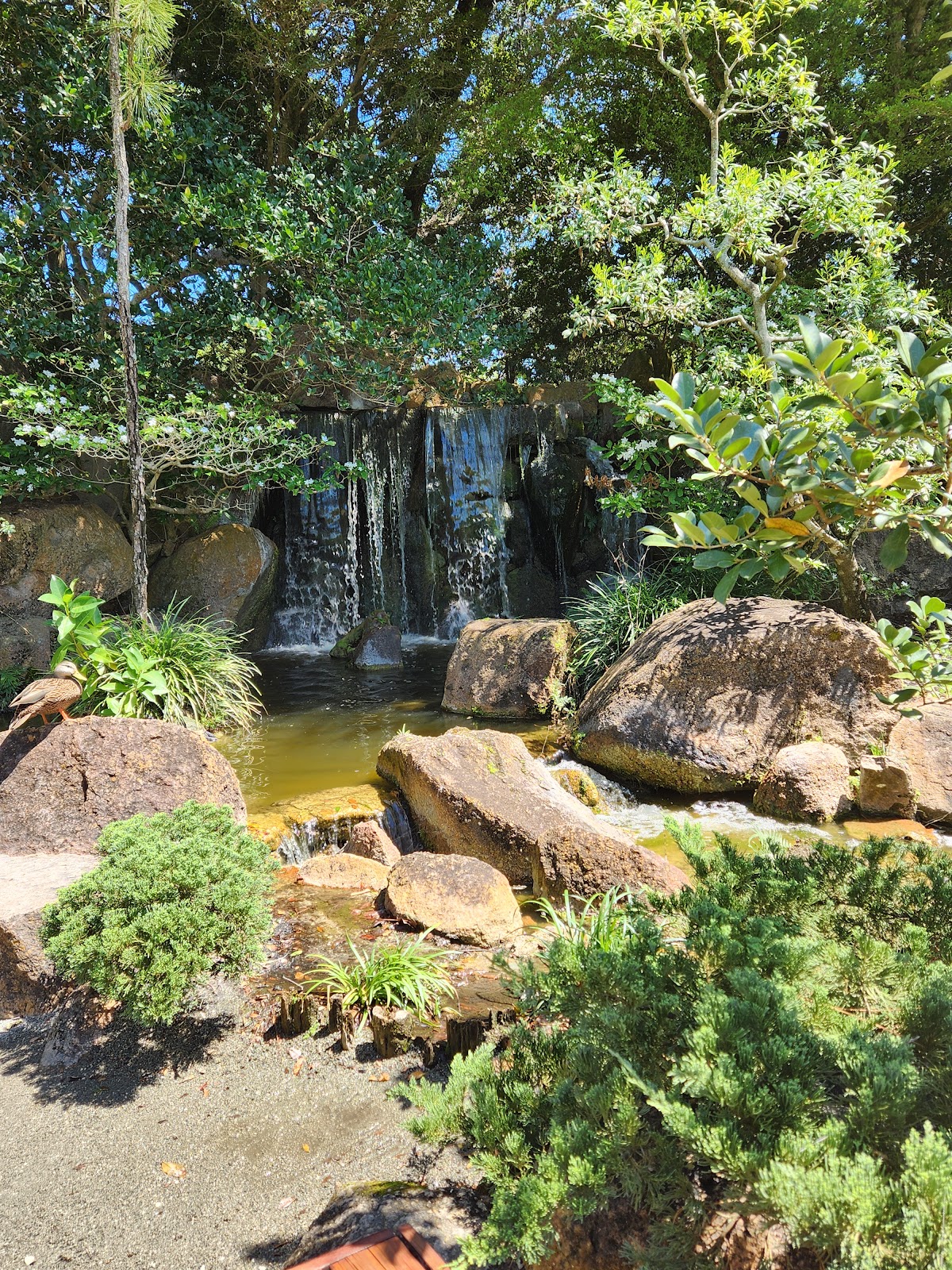
A Western garden is generally arranged so that it looks well from many angles, with a few privileged axes. A Japanese garden is composed from a small number of fixed viewpoints, and the composition is built to be seen from exactly there — with foreground, middle ground and background stacked deliberately, an opening framing the view, and everything outside that opening suppressed. The technical term for using what lies beyond the garden’s boundary as part of its composition is shakkei, a borrowed view, and the design reason for the framing is that the frame excludes what should not be borrowed.
For a photographer this is a gift and a discipline. The gift is that the strongest frames are already located and it is only necessary to find them. The discipline is that stepping two metres off a designed viewpoint produces a worse photograph than almost anywhere else, because the layers that were carefully separated collapse into each other.
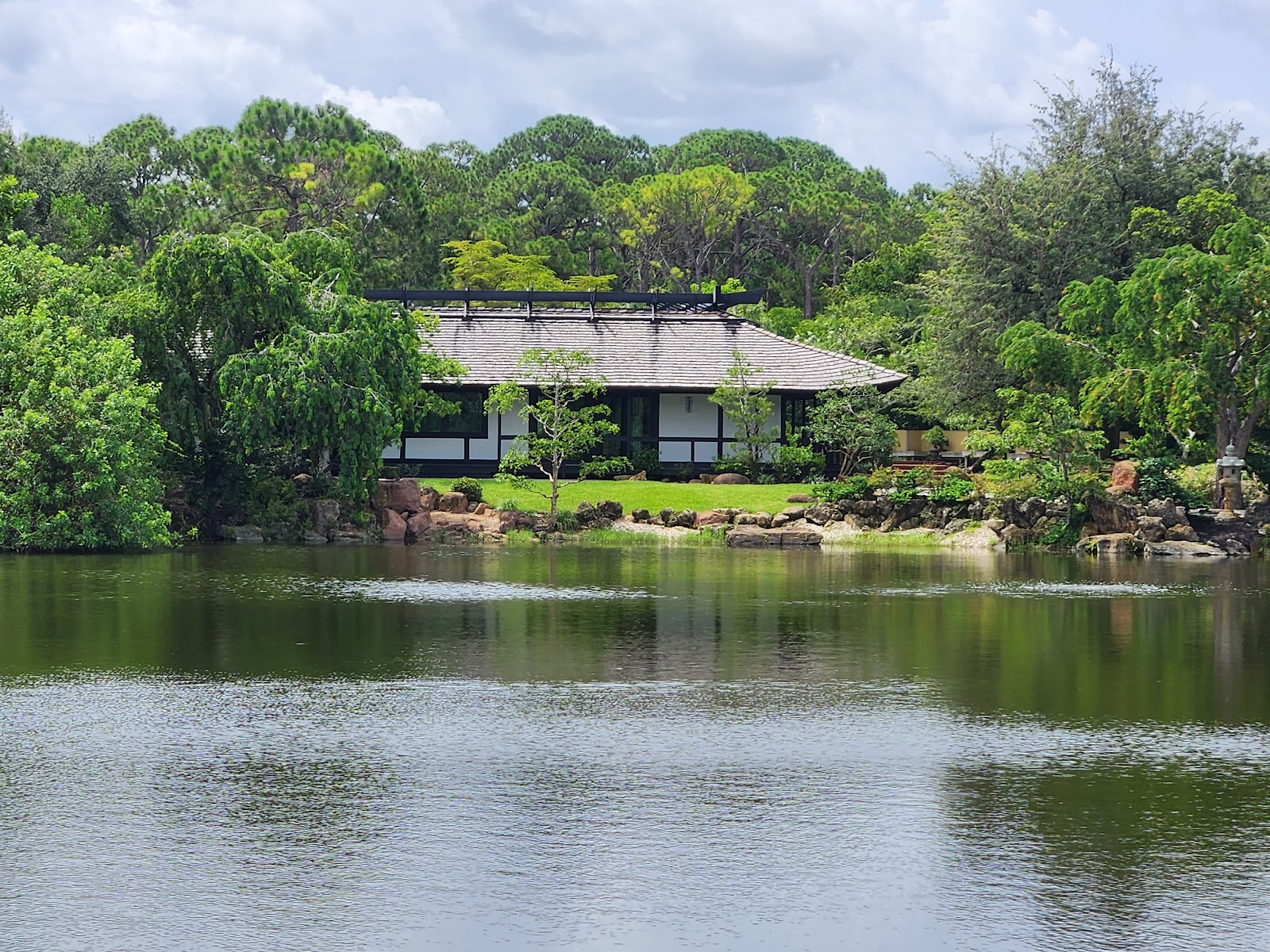
So the frame worth building here is one of those: the couple placed at a designed opening — a gate, a bridge, a gap between clipped masses, a veranda post and beam — with a still pond behind them, and the layered planting beyond that. It is a quiet picture and it is made of four decisions rather than four exposures.
The four are: which opening, where in the opening, how still the water is, and how the pond’s reflection is exposed. None of them involves equipment, which is unusual in this guide and is the point.
Delray Beach sits at about twenty-six and a half degrees north. The June noon sun reaches roughly eighty-seven degrees — near vertical — and the December noon sun about forty. Sunset runs from about half past five in December to about a quarter past eight in June, and civil twilight is a little over twenty minutes, so the low light is short.
We have not photographed a wedding at Morikami. Which garden areas are included, what restrictions apply on the paths, bridges and structures, whether the museum interiors are available and what the permitted hours are are questions for their team.
Morikami Museum & Japanese Gardens at a glance
| Where | Japanese museum and gardens at Delray Beach, Florida |
| The idea | The garden is composed from fixed viewpoints — find them and use them |
| The frame | Couple at a designed opening, still pond behind, layers beyond |
| Stillness | Calm water belongs to early morning, before the day’s breeze |
| Ask first | Included areas, path and bridge restrictions, interior access, hours |
Building the frame
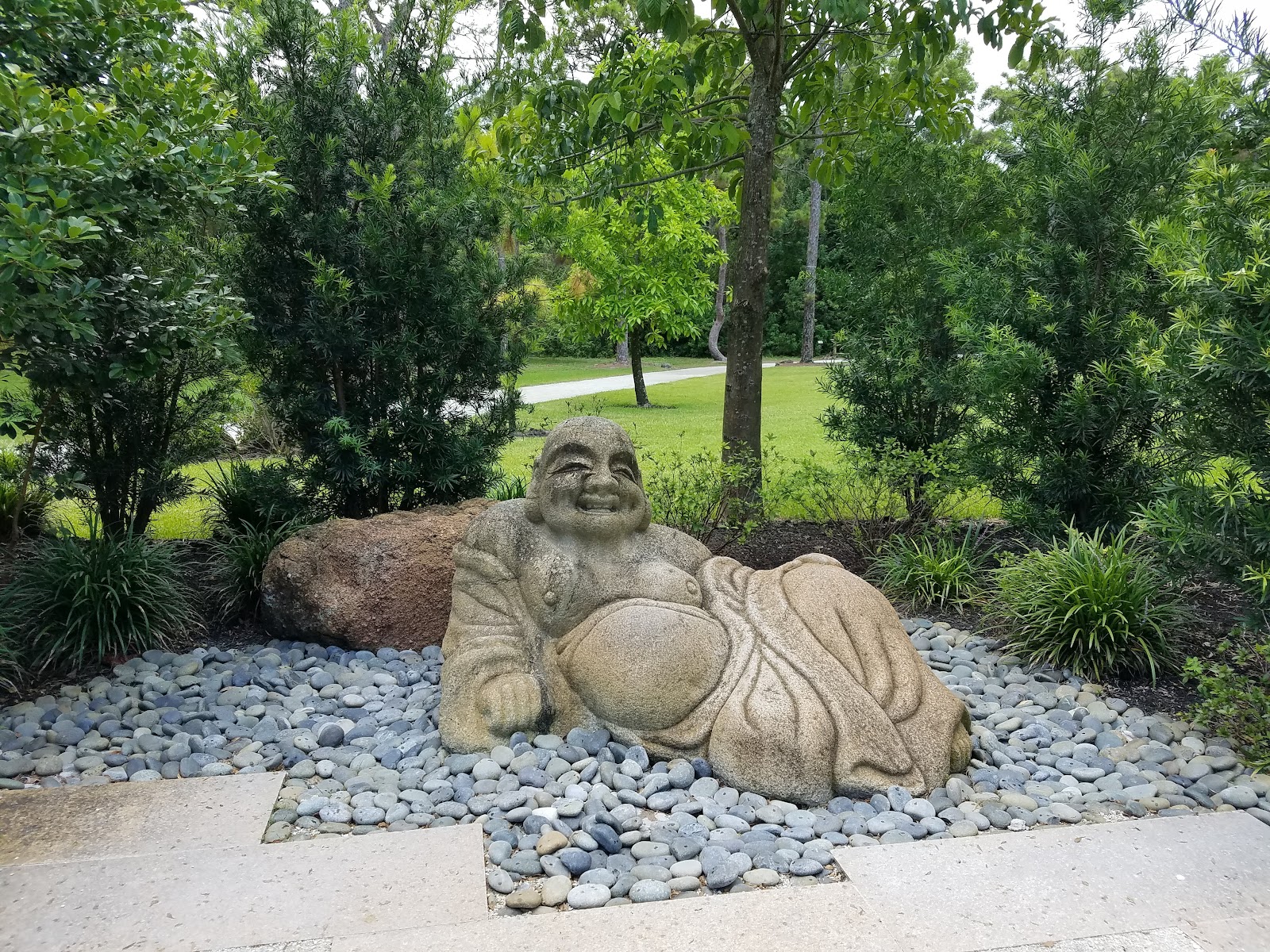
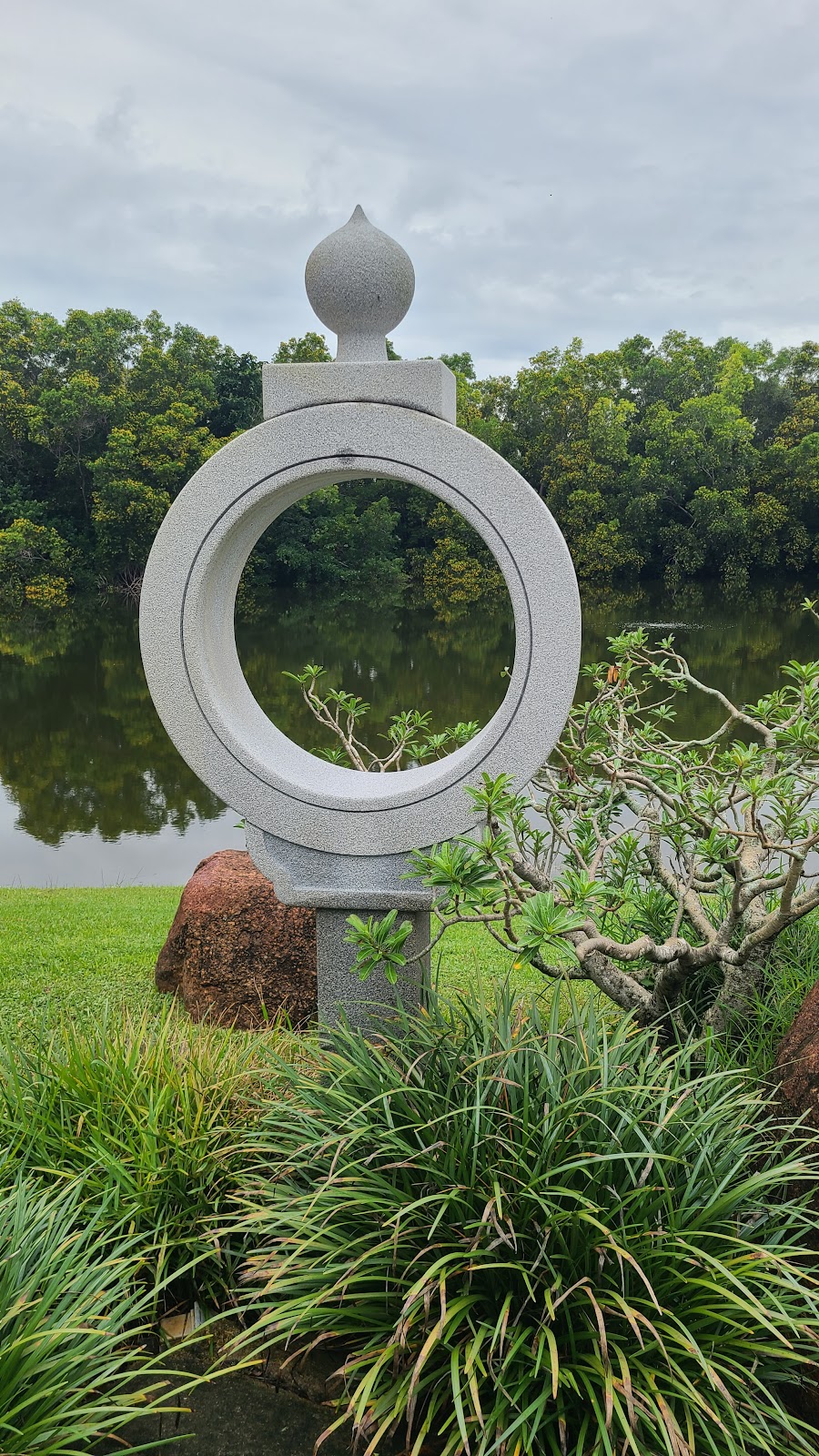
Find the viewpoints first, and find them by looking for openings rather than for views. A designed viewpoint in this tradition is almost always marked physically: a gate, a gap in a hedge, a bridge, the posts and beam of a veranda, a pair of trees pruned to leave a window between them, a stone set where a path turns.
Standing at each of those and looking through it is a five-minute survey that locates every strong frame on the property. It also reveals the ones that do not work for a wedding — the openings too narrow for two people, or the ones whose borrowed view includes something the design borrows happily and a photograph cannot.
Then place the subjects in the opening, not in front of it. This is the decision most often got wrong. A couple standing a few metres in front of a gate is photographed against the gate; a couple standing within it is photographed through it, which is what the design intends and what produces the layered depth the garden was built for.
The difference is visible immediately: in the first version the gate is a backdrop and the picture is flat. In the second, there is something in front of the subjects and something behind them, and the frame has three planes instead of one.
The stillness of the water is the one thing that cannot be arranged and has to be scheduled. A pond mirrors when its surface is unbroken, and the surface breaks when the air moves. In south Florida the air moves as the day heats: mornings are calm and afternoons are not, and by mid-afternoon in the wet season there is usually a working breeze off the coast.
Which means a reflection frame belongs to the first two or three hours after sunrise, and that is the single most useful scheduling fact about this venue. A couple who will do a portrait session at half past seven get a mirror. A couple who arrive at four get texture.
Exposing for the reflection is the fourth decision and it is quietly counter-intuitive. A reflection is always darker than the thing reflected, by roughly a stop or a stop and a half, because a water surface returns only part of what strikes it. A frame exposed correctly for the sky and planting therefore has a reflection that looks flat and dark, and a frame exposed for the reflection blows the real thing out.
The working answer is to expose for the upper half and lift the reflection selectively, or — better, and available here — to choose a viewpoint where the reflection is of something dark rather than something bright. A pond reflecting dense clipped planting and dark structure sits within a stop of it and needs nothing at all. A pond reflecting a bright Florida sky does not.
Once the frame is made, make it three times: wide enough to show the layering, tight enough to show two faces, and once without the couple — because a designed viewpoint in a Japanese garden is a complete photograph on its own, and a set of wedding pictures is better for having two or three of them.
The rest of the garden, and its Florida problems
A Japanese garden in a subtropical climate is an adaptation rather than a copy, and the adaptation is visible in the planting. Many of the species used in Japan will not grow here, so the forms are reproduced with substitutes: tropical and subtropical plants clipped to the shapes the tradition requires, bamboo that thrives, and pines replaced by whatever holds an equivalent silhouette.
The photographic consequence is that the shapes read correctly and the textures do not always. A clipped mass here is often glossier and coarser-leaved than its equivalent in Kyoto, which means it reflects more and reads as a highlight rather than as a dark mass under direct sun. Under overcast it behaves exactly as intended.
That makes this a garden that is better under grey skies than under blue, which is almost the reverse of everything else in Florida.
The raked gravel or sand areas, where they exist, are the site’s most demanding surface. A dry garden is about texture at a very fine scale, and it reads only in raking light — low sun across the pattern, early or late. At midday it is a flat white field that blows out and fools a meter into underexposing everything else in the frame by a stop.
It is also a surface nobody should walk on, which is worth establishing with the venue before a wedding party is standing beside one.
The bridges are the best single structures for people. A bridge is an opening, a platform and a leading line at once, it puts subjects over water so they are filled from below, and it constrains where they stand so posing becomes a matter of small adjustments rather than of arrangement. The limitation is width: most garden bridges take two people and a photographer cannot back up far on one, so the shooting position is from the bank rather than on the bridge.
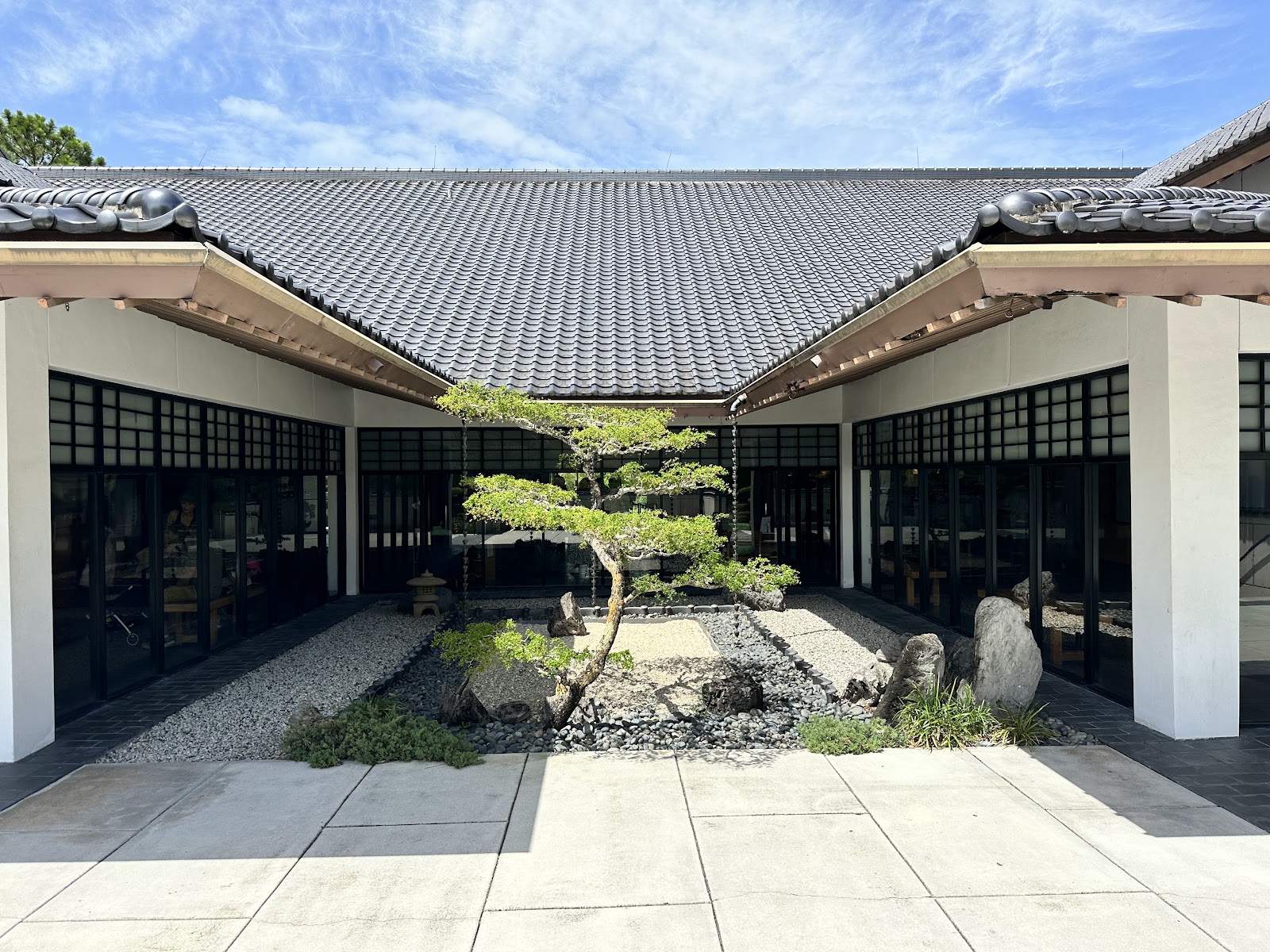
Tea houses, gates and pavilions behave as every covered structure in Florida does, and are the midday solution. A roofed structure with open sides is a directional soft source with rapid fall-off, and the depth of the subject beneath it sets the ratio — two or three metres in gives a lit face against a dark ground with no equipment.
In this tradition those structures are also usually low and dark inside, with heavy eaves, which makes the effect stronger than at a European loggia. A subject seated in a pavilion looking out is one of the easiest good portraits available on the site at any hour.
The museum interiors are a conventional gallery problem: low ambient at a warm colour temperature, lighting aimed at objects rather than at people, strong pools and dark gaps. Gel the flash warm, balance for the room, and use the pools rather than filling them in.
And the standing Florida hazard applies with particular force at a garden, because the transitions are frequent and there is no shelter to recover in. In the wet season an air-conditioned building sits far below the outdoor dew point, so a lens carried out into the garden fogs immediately and takes ten to twenty minutes to clear. At a venue where the best frame depends on still water at a particular hour, that is the failure to plan against.
- Find the openings; they mark the designed viewpoints
- Put the subjects in the opening, not in front of it
- Reflections belong to the first hours — the breeze arrives with the heat
- Choose a viewpoint whose reflection is dark, and it exposes itself
- Raked gravel reads only in raking light and ruins a meter at noon
The southeast Florida year
Two seasons, and for this garden the choice between them is less obvious than elsewhere in the state.
The dry season, roughly November to April, is the comfortable one: lower humidity, clearer air, no afternoon storms, a noon sun around forty degrees that models rather than flattens, and calm mornings that make the reflection frames reliable. It is also the season in which the garden looks most controlled — slower growth, crisper clipped forms, and the planting reading as designed.
Its cost is the short day, about ten and a half hours at the solstice, and an early sunset that puts the low light inside the reception rather than after it — which for most weddings is an advantage.
The wet season, roughly May to October, is hot and humid and the garden is at its fullest. For a tradition built on carefully controlled masses, fullest is not automatically better: growth blurs the clipped forms and the layers that the design separates start to merge. On the other hand, everything is at maximum saturation, and a subtropical Japanese garden in August is an unusual and genuinely striking thing.
Dew points in the mid-twenties Celsius put haze in the air, which lowers contrast at distance. In a garden whose whole method is the separation of foreground, middle ground and background, that haze is more damaging than it would be at an open venue — the layers flatten, and a borrowed view loses the depth that made it worth borrowing.
The compensation is that this garden gains more from rain than almost any venue in this guide. Wet foliage is darker and more reflective, which restores the clipped masses to the dark values the design assumes and fixes the glossiness problem described above. Wet stone shows its structure. The pond surface after rain, in still air, is the best reflection of the year. And the half hour after a cell passes, under broken cloud, is the single best window the garden offers.
Those cells arrive with a mechanism rather than at random. Sea breezes push inland from the Atlantic and from the Gulf and collide over the peninsula, lifting the air — which is why interior Florida records more lightning than anywhere in the country, and why the afternoon is the exposed part of a summer day. A garden ceremony has no cover, so a named alternative between June and September is a requirement.
Hurricane season runs June to the end of November and peaks from mid-August to mid-October, and for a garden of clipped forms a major storm has a long aftermath — shredded foliage takes months to recover its shape. That is a question for the venue after an event, not a forecast.
Bamboo is the one planting here that signals the season audibly rather than visually, and it is worth a frame of its own: a bamboo grove in any wind is movement and sound, and a slightly longer exposure in a grove records that movement in a way that a still photograph of a still garden cannot.
Mosquitoes are a real consideration at dusk in a garden with standing water during the wet season, and they belong in the planning conversation for any evening ceremony.
More frames from Morikami Museum & Japanese Gardens
Morikami Museum & Japanese Gardens wedding photography: common questions
What makes a Japanese garden different to photograph?
It is composed from a small number of fixed viewpoints. The strongest frames are already located; two metres off one, the layers collapse.
How do I find those viewpoints?
Look for openings rather than views — gates, bridges, gaps in clipped masses, veranda posts. The openings mark where to stand.
Where should the couple stand?
In the opening, not in front of it. Through the gate gives three planes; against the gate gives one.
When is the water still?
The first two or three hours after sunrise. The breeze builds with the day’s heat, and by afternoon the mirror is gone.
How do I expose a reflection?
A reflection runs about a stop darker than the thing reflected. Choose a viewpoint whose reflection is of something dark and the problem disappears.
Is this garden better in sun or cloud?
Cloud. The subtropical substitutes for Japanese species are glossier, so they read as highlights in direct sun and as the intended dark masses under overcast.
More Florida venue guides
We are writing a photographer’s guide to every venue we would happily shoot in Florida. Here are three more, plus the full index:
- Naples Grande Beach Resort, Naples: The Problem and Four Ways Out of It
- The Ringling, Sarasota: How the Light Moves Across the Estate
- The Ritz-Carlton Key Biscayne: What It Suits and What It Does Not
Planning a wedding at Morikami Museum & Japanese Gardens?
A garden that already knows where you should stand. Tell us your date and we will get there early.