 Venue at Willow Creek, Huntsville: The Problem, and Four Ways Out
Barn at Woodland Trail, Cherokee: The One Decision That Governs Everything
Inside the barn or outside it. One is controlled and dark; the other is bright and conditional.
At a barn venue there is one decision that governs the photographic day, and it is whether the ceremony happens inside the building or outside it.
That sounds like a weather question and it is more than that, because the two produce genuinely different sets of pictures.
Inside, the ceremony happens in a dark absorbent timber space lit by whatever openings exist and whatever fittings the venue has hung. That means low-key frames with deep shadow, free separation behind every subject, strong directional light from the big door, and complete independence from the weather — and it means added light is needed for anything beyond the openings’ reach.
Outside, the ceremony happens in daylight on open ground. That means neutral colour, real modelling, faces lit from a direction rather than from above, and a background of field, treeline and sky — and also a fixed relationship to the sun that cannot be adjusted, a real risk of hard light or rain, and a guest list looking into whatever direction the seating faces.
Neither is better and a great many weddings end up inside because of the forecast rather than by choice. The point is that the decision changes what the photographs look like, and it is worth making knowingly and early rather than discovering on the day.
The setting is northwest Alabama: the Tennessee River valley and the western end of the state’s hill country, mixed hardwood and pine, red clay, and a genuine late autumn.
We have not photographed a wedding at the Barn at Woodland Trail; barn venues in this region behave consistently. Which buildings and areas are included, whether the barn is cooled, whether the interior lighting can be dimmed, which direction the outdoor ceremony seating faces, and how late the decision between inside and out can be made are questions for their team — and the seating direction decides more than anything below.
Barn at Woodland Trail at a glance
| Where | A barn venue in northwest Alabama at Cherokee |
| The decision | Ceremony inside the barn, or outside on open ground |
| Inside | Dark, controlled, weather-proof — and it needs added light |
| Outside | Neutral colour and real modelling — and a sun you cannot move |
| Ask first | Seating direction, barn cooling, lighting control, decision deadline |
If the ceremony is inside
An indoor barn ceremony removes every weather variable and introduces one lighting problem in its place.
The problem is quantity and distribution. A barn interior is dark because unpainted weathered timber absorbs almost everything, and the light that exists comes from the openings — which means it is strongly directional and falls off steeply, and a couple standing at the far end of the building from the big door is lit by very little.
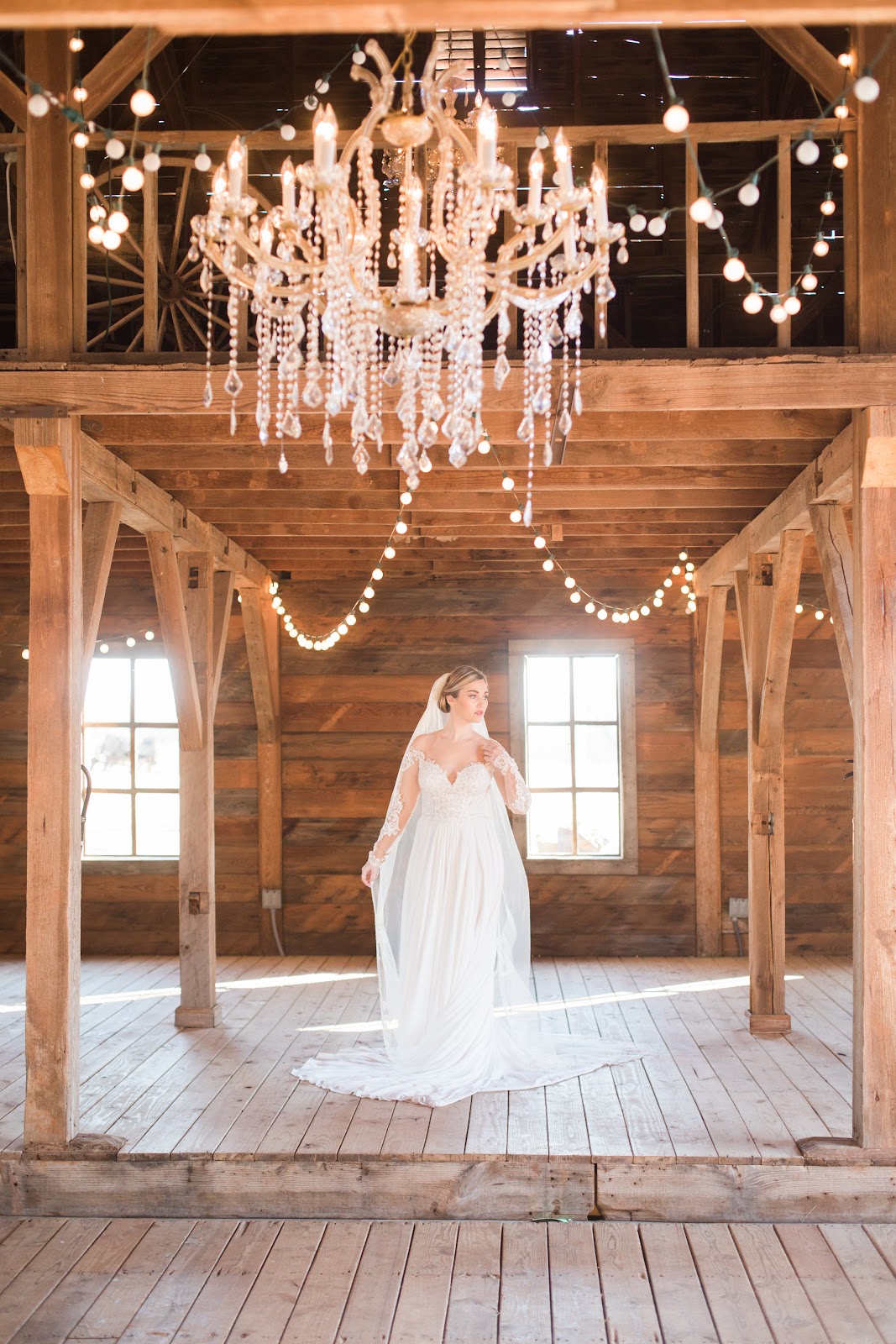
The first response is positional and it is free: hold the ceremony where the light is. A couple standing two or three metres inside the big opening, with the guests seated back into the darker part of the building, is lit horizontally from one side with a near-black background — which is the best frame the building gives and it needs nothing added.
That is worth raising in planning rather than accepting whatever arrangement is default, because moving the ceremony position by five metres can be the difference between a lit couple and a silhouetted one.
The second response is added light, and during a ceremony it has to be placed in advance and left. One source through a modifier, off to one side at the front, gelled warm to match whatever the barn’s fittings are and set just above what the ambient gives the faces, restores the modelling that a dark far end does not supply. It has to be positioned before the ceremony starts, which means walking the barn beforehand and deciding.
The third is the exposure discipline, which is absolute in a timber building: manual, metered on skin, with the timber allowed to go black. A meter looking at a large area of weathered wood tries to lift it toward mid-grey, which overexposes a face by two stops or more — and the bright exterior through the open door fools the same meter hard the other way.
The colour needs deciding rather than averaging. A barn interior typically has warm string lights or festoon fittings, cool daylight through the openings, and light bouncing off warm-toned timber — which means a face can be lit by two or three colours at once. Set the white balance for whatever is landing on the skin and let the rest fall where it falls; skin rendered orange or blue is not recoverable.
The compensating advantage of the indoor ceremony is real and worth stating. Every seat is lit the same, nobody squints, there is no dappling, the conditions do not change during the service, and the exposure set at the start is still right at the end. Outdoors a cloud crossing the sun changes everything mid-vow; inside a barn nothing changes at all.
And the frames match one another, which for a processional or a ring exchange — where a sequence has to hang together — is worth more than a prettier one-off.
Where the barn has a central passage, that is the distinctive indoor frame: light from two directions with darkness at the sides, giving a rim-lit result no single-opening building can produce. It is also the coolest place on the property, which in an Alabama July is not a small consideration — and whether the barn is cooled at all is a question with a definite answer that decides the comfort of an indoor ceremony in summer.
Aiming a flash at a barn roof returns almost nothing, because a dark pitched ceiling absorbs it and colours what little comes back. Direct through a modifier, or bounced off a pale surface brought for the purpose, is the working approach.
If the ceremony is outside
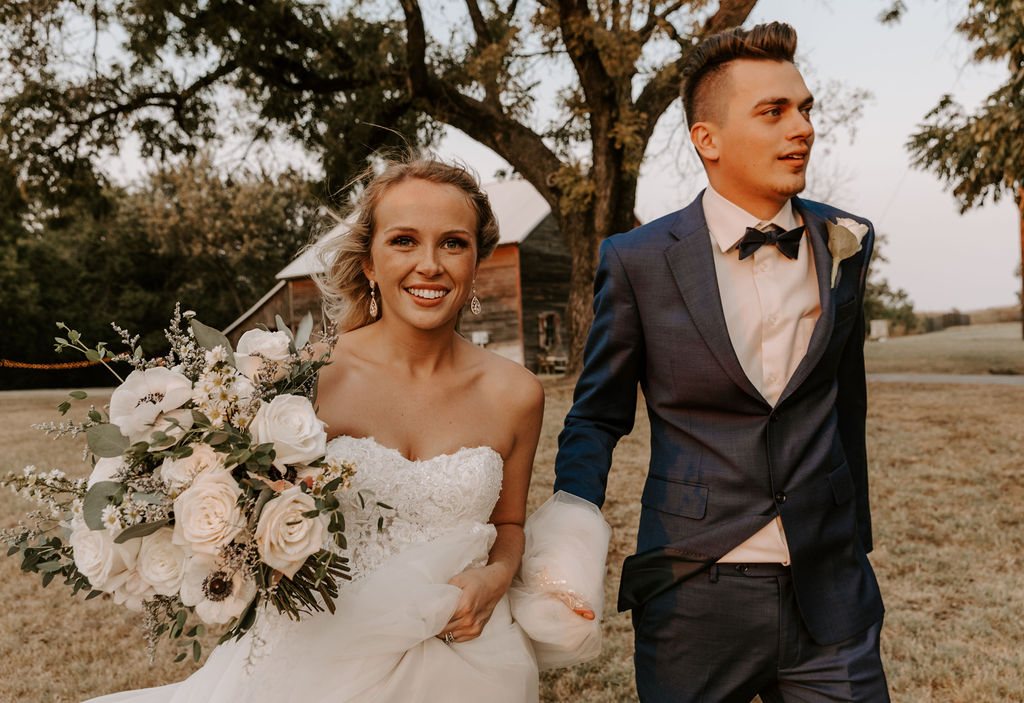
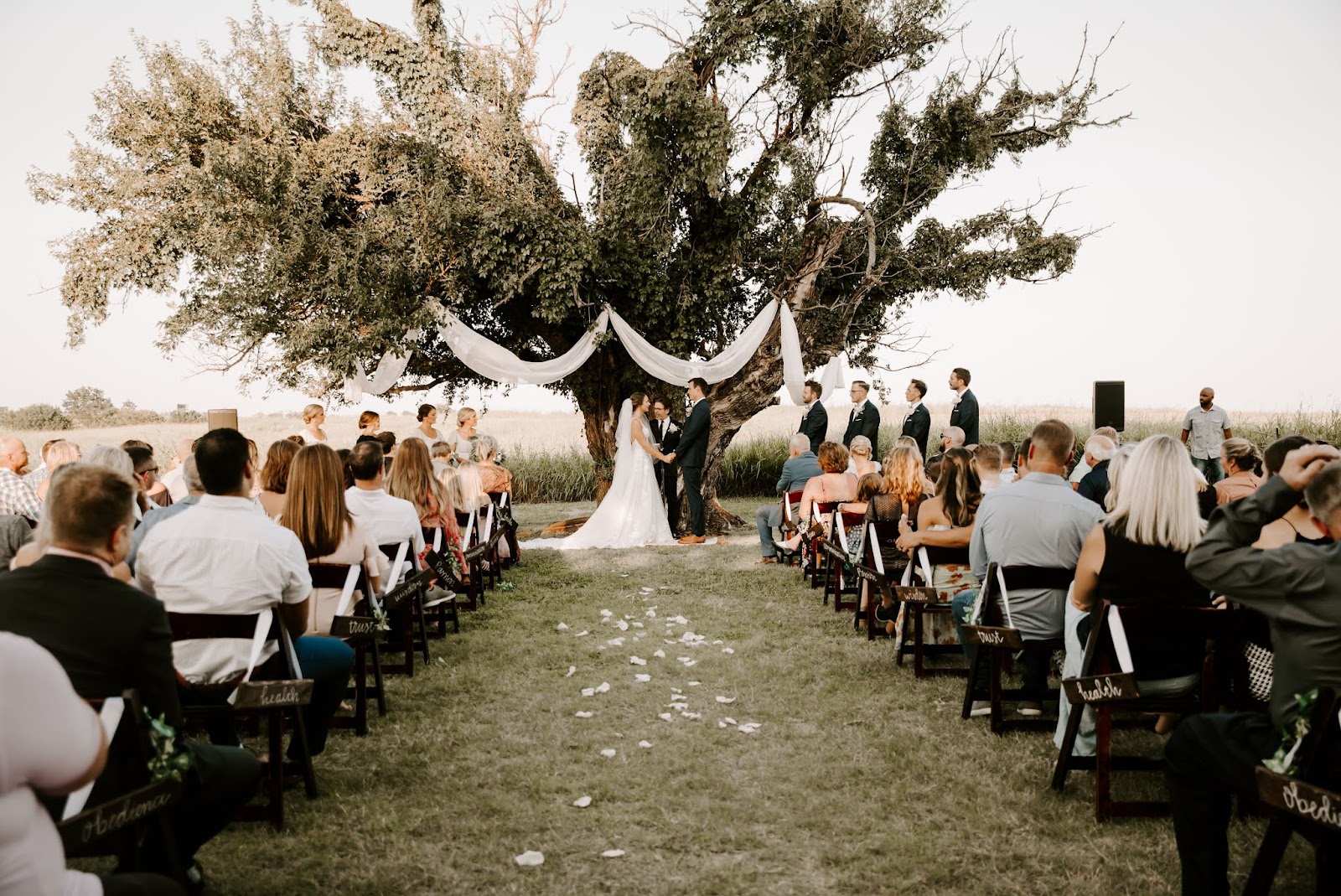
An outdoor ceremony’s photographic quality is decided almost entirely by one thing fixed months in advance: which direction the seating faces relative to the sun.
There are three possibilities and they produce three different ceremonies. With the sun behind them the couple are rim-lit and their faces are in shadow, while the guests have it in their eyes — beautiful backlit frames of the couple and squinting frames of everyone else. Facing the sun, the couple squint and the guests are comfortable. With the sun to one side, everybody is side-lit, which is usually the best of the three.
That is worth asking about explicitly, because almost nobody does and it cannot be changed on the day. The answer combined with the ceremony time tells you exactly what the light will do.
Where the couple are backlit, the frames are exposed for the background with the faces lifted by a close warm-gelled source — because metering on skin gives a white sky and throws away the light. During a ceremony the source has to be placed in advance rather than moved, which is a real constraint.
Where everybody is in hard midday sun, there is no technique that fixes it. Central and northwest Alabama summer sun reaches about seventy-eight degrees above the horizon in June, which gives vertical shadows under the brows, a hard line under every chin and squinting. A later hour is free and it solves it.
Overcast is the outdoor ceremony’s best condition and it is worth saying so to a couple hoping for sun. Under cloud the whole brightness range collapses: no squinting, no dappling, no clipped whites, colour at full saturation, and every seat lit the same. A grey ceremony is technically the easiest of all.
The ground and the surroundings are the other half of the outdoor decision. Open farm ground has nothing overhead, and the region’s trees are mixed hardwood and pine: deciduous canopy filters as much as it blocks and therefore dapples, pine dapples badly and is a background rather than a shade, and magnolia and cedar where they occur are the real blockers.
The canopy edge is the reliable position for the portraits afterwards: a metre or two inside at the margin of an opening gives soft directional light in front and darkness behind, three or four stops of free separation. And the barn’s own shaded wall is the other dependable position — a large timber wall in shade facing open sky is a soft directional source with a dark background behind, which is the interior’s physics applied outdoors.
The metering reverses between the two environments, which is the discipline of any barn wedding: dark timber and dark canopy make a meter overexpose a face, and bright open ground and sky make it underexpose. Manual, metered on skin, reset at every transition — which on a day that moves between an indoor reception and outdoor portraits happens repeatedly.
The red clay of this region is worth handling rather than ignoring. Northwest Alabama soil is strongly red, which means bare ground, tracks and banks bounce warm light onto anything near them — and a custom white balance set on a face turns that from an orange cast into warm skin in warm light.
And the outdoor decision has a deadline, which is worth establishing. At most barn venues the ceremony setup has to be committed to some hours before the event, which means the call between inside and out is made on incomplete information — so knowing when that deadline is, and what the fallback looks like, is a planning question rather than a photographic one.
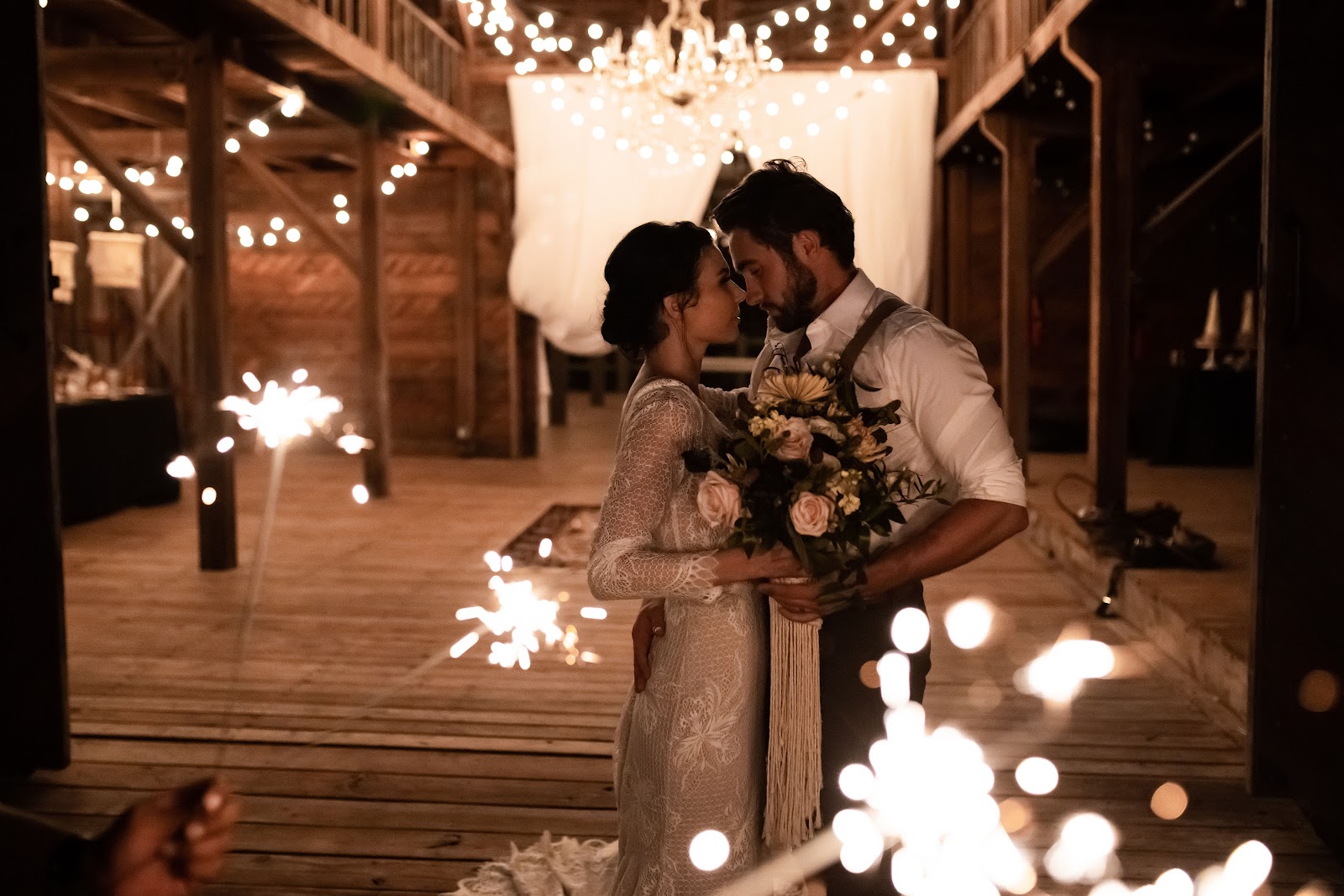
Whichever decision is made, the reception is almost always in the barn — and the standard method applies. Expose the ambient about a stop or a stop and a half under what skin needs, so the string lights keep their presence and the timber keeps its depth, then add one source for the faces gelled warm to match, just above what the ambient gives the skin, and diffused so it does not read as flash.
- Inside: hold the ceremony near the big opening, not at the dark end
- Ask which direction the outdoor seating faces; it decides the ceremony light
- Overcast is the best outdoor ceremony condition, not a disappointment
- Place any ceremony light in advance and leave it; you cannot move it
- Reset exposure and white balance between the barn and the open ground
The northwest Alabama year
Northwest Alabama has a humid subtropical climate with a genuine four-season feel — cooler winters than the Gulf coast, hot humid summers, and a real autumn.
Winter is mild but not warm: hard freezes occur, snow is occasional and rarely lies, and the deciduous canopy is down. For an indoor ceremony the weather matters little, which is the honest argument for a winter date at a barn — though whether the barn is heated is a real question.
Winter is the best season for the barn’s light, and the reason is the sun’s angle. The December sun at this latitude reaches about thirty-four degrees above the horizon, which means light comes through the big openings almost horizontally and reaches much further into the building than a summer sun does — which widens the usable band inside considerably and makes the indoor ceremony position better than it is in June.
Snow, when it comes, is the best natural fill available outdoors and against dark weathered timber it gives the widest brightness range the property offers — expose for the snow and let the wood go black, overexposing deliberately relative to the meter, which snow fools by about two stops. Snow also reflects light up through the openings and brightens the interior.
Frost on red clay and morning fog in the valleys are the more common winter conditions, and a barn rising out of fog is the most atmospheric exterior frame of the year.
Late winter into spring brings the region’s flowering: redbud and dogwood through March and April, azaleas in planted ground, and wisteria on anything it can reach. Against dark timber that saturated colour reads at full strength.
The honest spring caveat is severe weather, and in northwest Alabama it is as pronounced as anywhere in the country. This region sits in one of the most tornado-prone areas in the United States with a spring peak from March through May, and severe thunderstorms are a real feature of that period.
That has a direct bearing on the central decision of this guide: the barn is the covered alternative, and its capacity for a seated ceremony as well as a reception is the question that decides whether an outdoor spring ceremony is a reasonable plan. It is worth asking directly rather than assuming.
Spring proper is the most comfortable season: warm, green, long-lit, and with the canopy leafing out through April.
Summer is hot and humid and it is the hardest season. Low nineties Fahrenheit with high humidity pushes the heat index considerably higher; an outdoor ceremony at three in the afternoon is uncomfortable in a way that shows in the photographs; and a large timber building is warm unless it is cooled.
The answers are scheduling and the building’s own openings: a late-afternoon or evening outdoor ceremony, the breezeway and the big door for the portraits, and the reception inside. Afternoon thunderstorms are near-daily in July and August, which makes the deadline for the inside-or-out decision a real operational matter.
Autumn is the best season by a clear margin. The heat breaks in October, the humidity drops, the air clears, and the hardwood colour arrives late — typically from the last week of October into mid-November in northwest Alabama, weeks later than New England.
Oak russet, maple scarlet, hickory and tulip poplar yellow and sweetgum’s mixed red and purple arrive over two or three weeks, and against dark weathered timber that colour reads at full saturation. An outdoor ceremony in late October in this region has the best odds of the year on both the weather and the light.
The caveat is that November is the state’s second severe-weather peak, which brings the decision back into play.
More frames from Barn at Woodland Trail
Barn at Woodland Trail wedding photography: common questions
What is the governing decision?
Whether the ceremony happens inside the barn or outside it. The two produce genuinely different sets of pictures, not just different weather.
If it is inside, where should it be?
Two or three metres inside the big opening, with the guests seated back into the darker part. Five metres further in is the difference between lit and silhouetted.
What should I ask about an outdoor ceremony?
Which direction the seating faces. With the sun behind them the couple are rim-lit and the guests squint; facing it, the reverse. To one side is best.
Is overcast bad outdoors?
It is the best condition of all — no squinting, no dappling, no clipped whites, and every seat lit the same.
What is the indoor ceremony's advantage?
Nothing changes. Every seat is lit the same, the exposure set at the start is still right at the end, and the frames match each other.
When is the site at its best?
Late October into mid-November for an outdoor ceremony, with the best odds of the year — and January for the barn’s own light.
More Alabama venue guides
We are writing a photographer’s guide to every venue we would happily shoot in Alabama. Here are three more, plus the full index:
- Bellingrath Gardens, Theodore: A Walk Through the Site
- Boathouse at Lake Martin, Alexander City: The Light Through the Day
- Carillon at Forte, Prattville: One Frame, and How It Is Made
Planning a wedding at Barn at Woodland Trail?
Inside or out — decide early. Tell us your date and we will plan both.