 Venue at Willow Creek, Huntsville: The Problem, and Four Ways Out
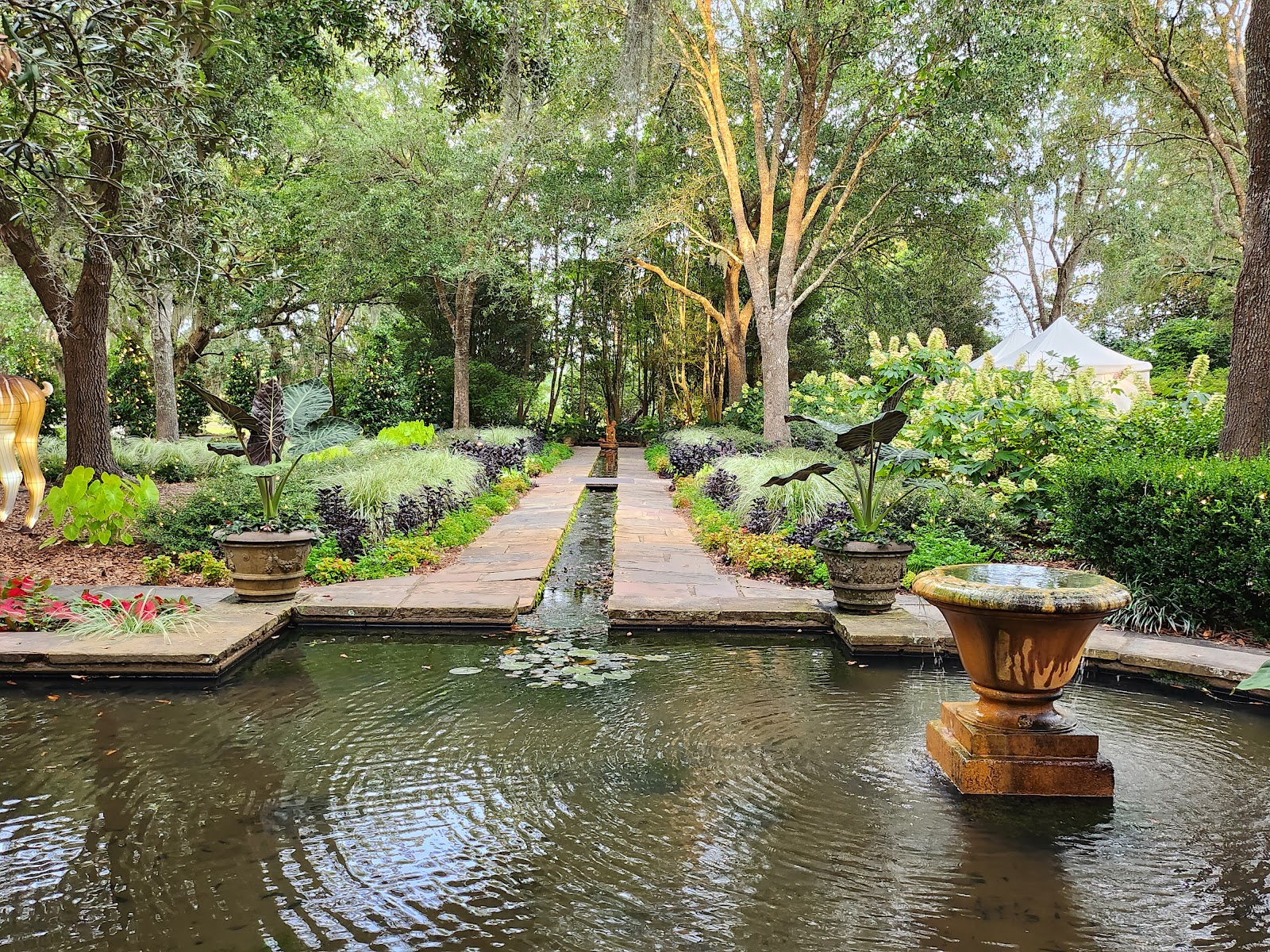
Bellingrath Gardens, Theodore: A Walk Through the Site
Live oaks and Spanish moss make the best shade in this guide. The humidity does the rest.
This is a walk through the site in the order a wedding day tends to use it, and two things about a Gulf Coast garden govern everything on it.
The first is the live oaks. Southern live oak is the defining tree of this coast and it is an extraordinary shade tree: a dense, broad, low-spreading evergreen crown on a massive trunk, with limbs that run horizontally for many metres rather than upward. One mature specimen can shade an area the size of a house, and because it is evergreen it does so in February as well as August.
That is the best natural shade anywhere in this guide, and it is the reason a garden of this kind is workable in a climate where the summer sun is otherwise punishing.
The second is the Spanish moss. It hangs in long grey-green festoons from the oak limbs, and it is worth knowing what it actually is: an epiphyte in the pineapple family rather than a moss, taking moisture from the air, which is why it grows only where the humidity is high. It is not a parasite and it does not harm the tree.
Photographically it is the most useful thing in the garden. Because the strands are fine and translucent, moss transmits light rather than blocking it — which means a backlit curtain of Spanish moss glows, and a canopy hung with it filters harsh sun into something soft. It also gives a frame a texture and a place: nothing else in this guide looks like it.
The third element is the humidity, which on the Gulf Coast is high for most of the year. It softens contrast, reduces clarity at any distance, and warms and diffuses the light at the ends of the day — which flatters skin and works against any long view.
We have not photographed a wedding at Bellingrath Gardens; great Gulf Coast gardens behave consistently. Which areas are available and under what conditions, guest limits, whether the house may be used, the covered alternative, what is in bloom on the date, and whether the garden is open to visitors are questions for their team — and the bloom question in particular changes the whole look of a day here.
Bellingrath Gardens at a glance
| Where | A large designed garden near Mobile Bay at Theodore, Alabama |
| The oaks | Southern live oak — the broadest, densest evergreen shade in this guide |
| The moss | Spanish moss is an epiphyte, and it transmits light rather than blocking it |
| The air | High humidity: soft contrast, warm diffuse evenings, no long views |
| Ask first | Areas available, guest limits, house access, what is in bloom, public access |
The oaks and the moss: the garden's best light
Start under the oaks, because they are where the day’s most reliable light is and because on a Gulf Coast summer afternoon there is nowhere else to be.
A mature live oak gives genuinely full shade over a wide area, and the working position within it is a few metres in from the edge of the canopy on the side facing open sky. That gives soft directional light in front and a dark canopy behind — which is three or four stops of free separation and no equipment at all.
It carries the standard exposure trap and it matters here because the contrast between deep oak shade and a bright southern sky is severe. A meter looking at dark canopy tries to lift it toward mid-grey, which overexposes the face by a couple of stops — so metering on skin, in manual, with the canopy allowed to stay dark.
The dappling caution applies but less severely than under most trees, and the reason is the moss. Spanish moss hanging through a canopy diffuses whatever light gets past the leaves, which softens the hard-edged patches that a bare canopy produces. A moss-hung oak is a considerably gentler shade than a clean one, and it is worth choosing the mossier tree.
The test is unchanged: look at the face rather than the ground, and a bright patch on skin means move a metre.
The moss itself is the garden’s signature and it wants backlight. Positioned so the light comes from behind or beside a hanging curtain of moss, the strands glow — grey-green becoming almost silver — and the effect is impossible to reproduce with equipment. That means a position facing into the light with moss between the camera and the sun, which is the reverse of the usual instruction.
The exposure for that frame goes on the moss rather than on skin, with the faces lifted by a close warm-gelled source, because metering on faces makes the moss a featureless bright tangle. Close matters because a shaded garden bounces very little: a source at two metres needs roughly a quarter of the output of the same source at four.
Moss also moves in the slightest air, which means a shutter fast enough to hold the strands if they are meant to read as strands rather than a soft blur.
The colour under oak and moss needs a custom white balance set on a face in position. Light filtered through dense evergreen canopy picks up green; light through moss picks up its own grey-green; and light bounced off a pale path picks up warmth — and the mixture changes from position to position. Thirty seconds, reset per position.
The oaks’ structure is the other resource and it is unlike any other tree in this guide. Live oak limbs run horizontally and low, which means they frame a subject from the sides as well as from above, and a limb crossing the top of a frame with moss hanging from it gives a picture a border that nothing else provides.
A low camera looking up along a limb, with a couple beneath it, is the frame these gardens exist for — and it works at any hour because the canopy is doing the lighting rather than the sky.
The beds, the water, the house, and the humidity
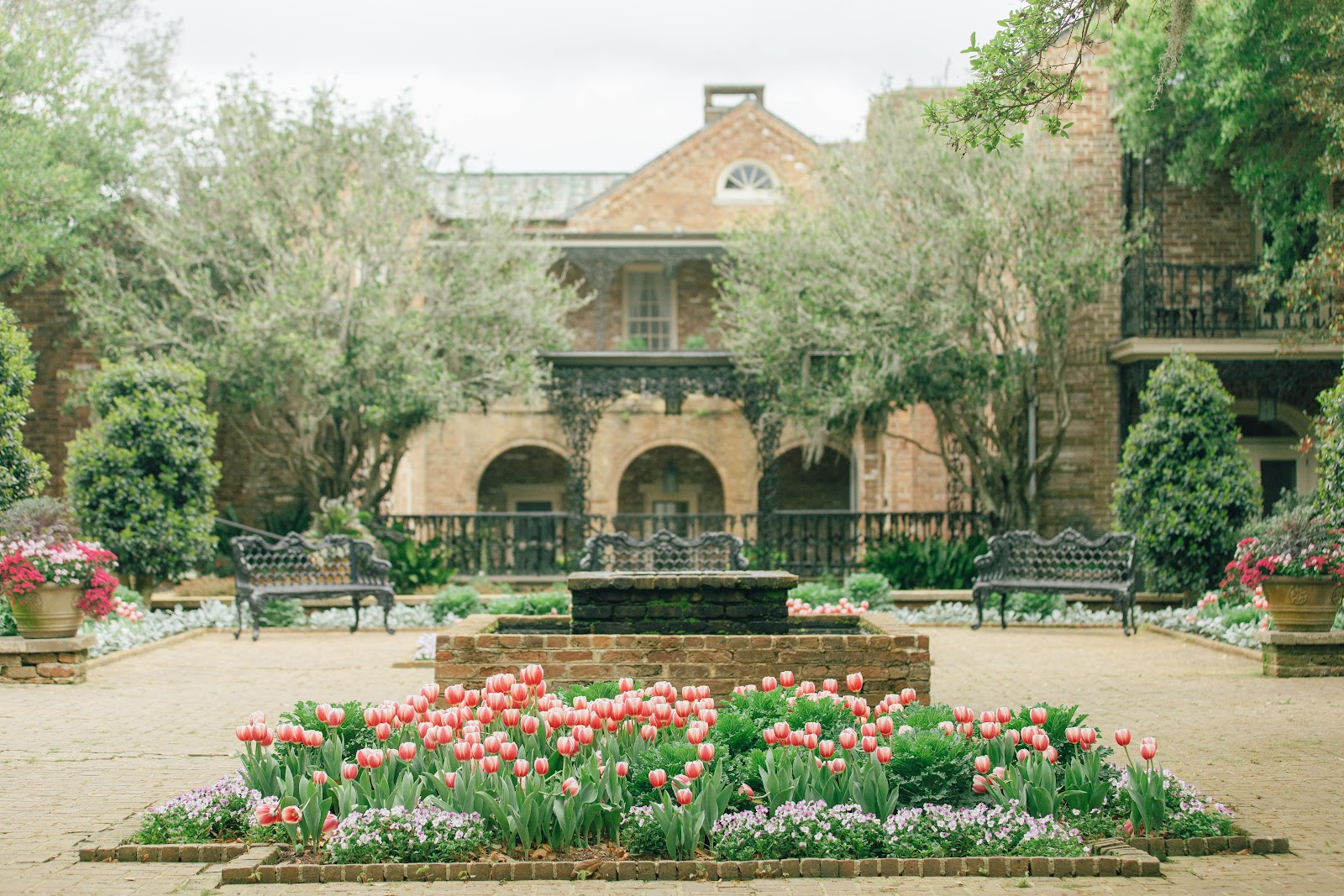
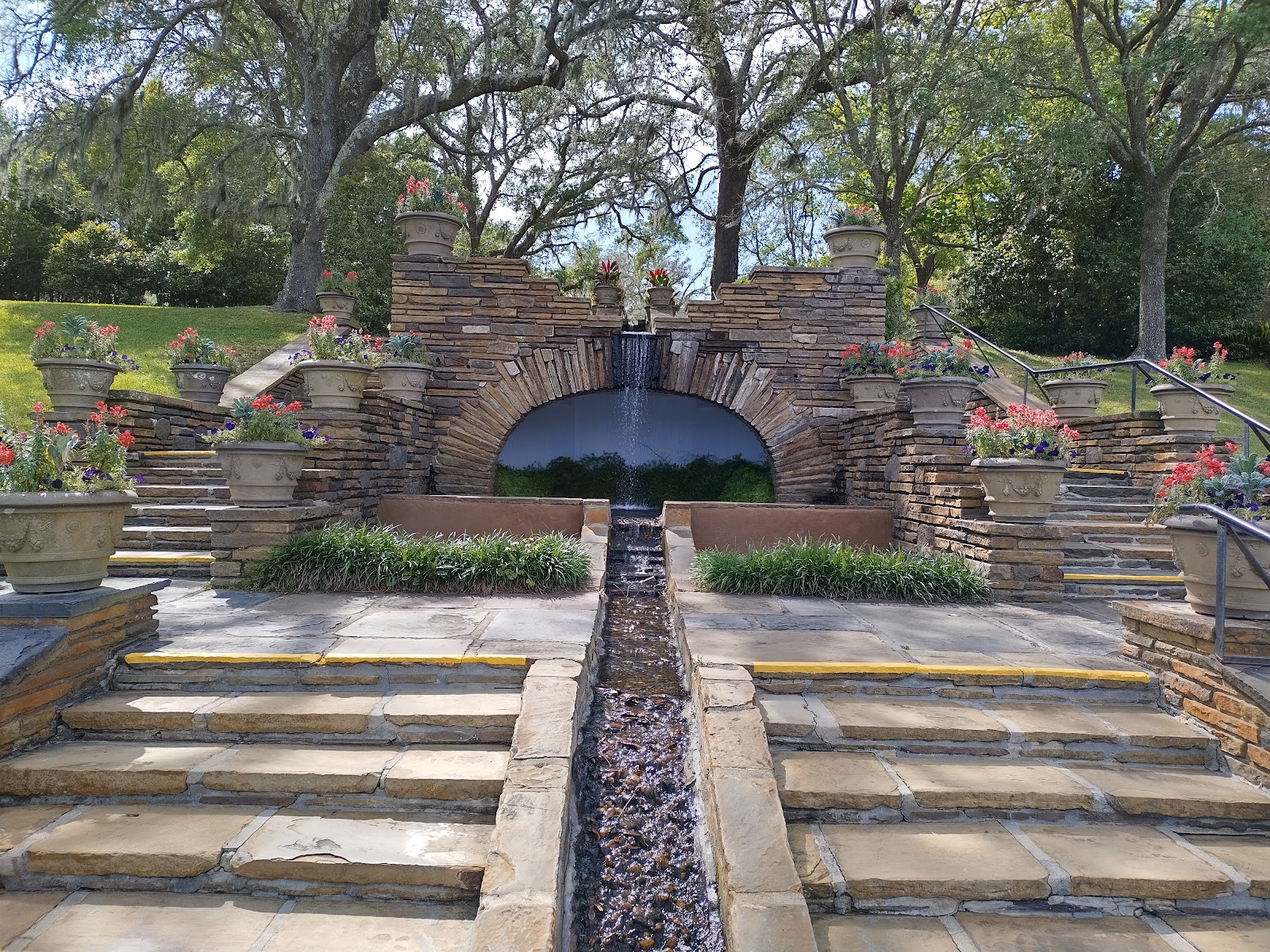
Out from under the oaks, the planted beds are the garden’s other subject and their character changes completely through the year.
A Gulf Coast garden of this kind is built around a long flowering calendar: camellias through the winter, azaleas in a spectacular burst in late winter and early spring, then bedding and summer perennials, and chrysanthemums in autumn. That means there is almost always something in bloom, and it means the garden looks fundamentally different in March, July and November.
Asking what is actually in bloom on the date is the most useful piece of preparation available, because it decides whether the beds are the subject or the background.
Flower colour needs the standard exposure discipline and it matters most with azaleas, which are frequently intensely saturated pink, magenta and red. A saturated red is the first thing in any frame to lose detail — it clips in one channel while the rest of the picture still looks correct — so exposing for the reds is the rule, and skin can be lifted afterwards.
Thin petals transmit light, which means a bed lit from behind or the side glows rather than being lit from outside. With a garden this shaded, that backlit condition is available at the edges of the canopy rather than in the open, which is where the strongest close garden frames are made.
Water is the next element and a designed garden’s water is usually still, which makes it a proper mirror. It doubles whatever is composed above it — oaks, moss, sky, a couple at the margin — and a reflection runs about a stop darker than what it reflects. It is also a horizontal reflector, throwing light upward into faces beside it, at the cost of uplight under the chin, which something solid on one side corrects.
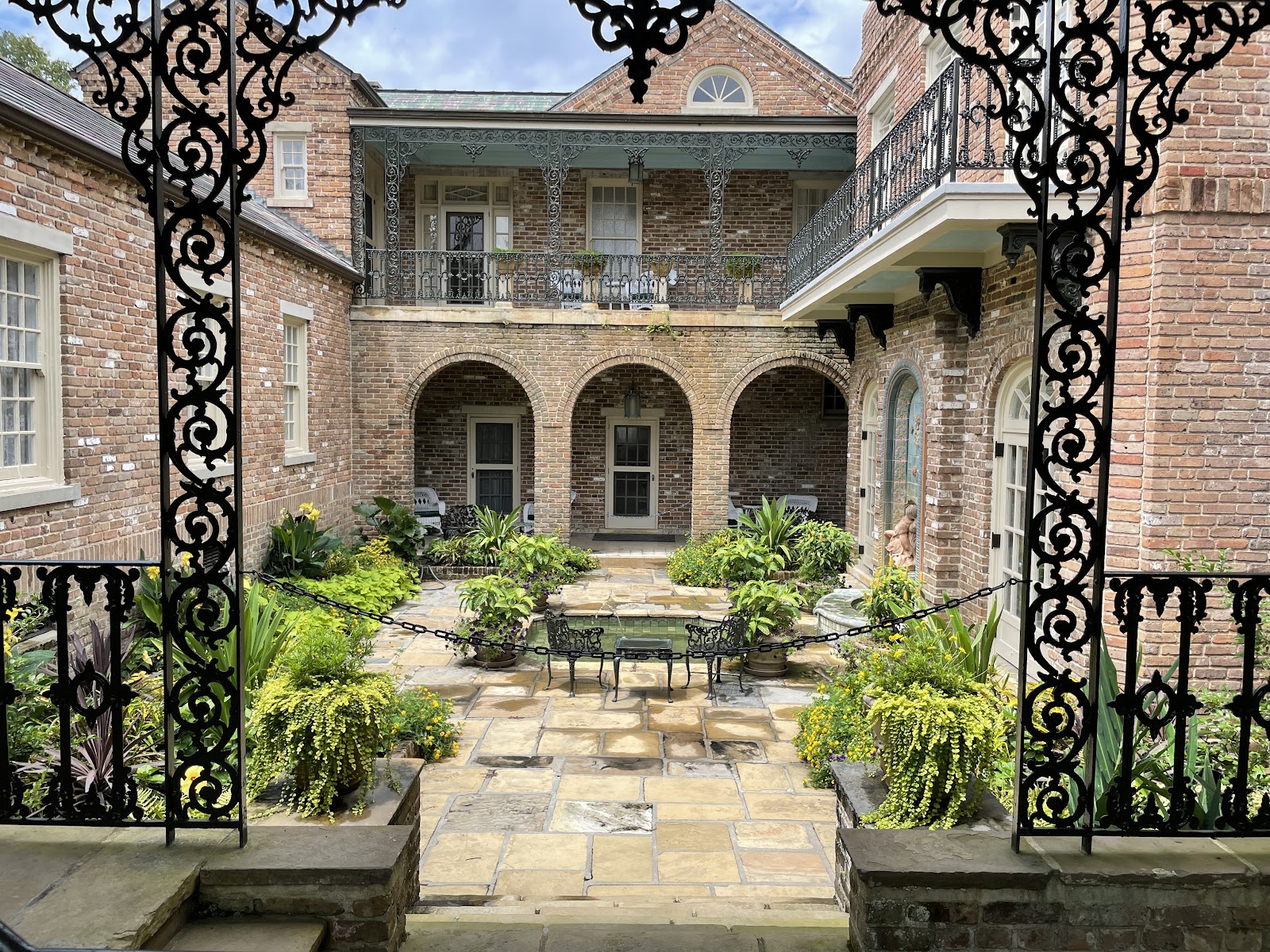
The house is the built element and a garden estate house of this period will have tall windows in rooms with high ceilings — which gives the best interior portrait light available: horizontal light entering at head height and falling off steeply into a dark room. A metre from the glass, turned about forty-five degrees to it, room lights off, and a custom white balance set on a face, because a window looking into dense oak canopy delivers strongly green light.
The metering indoors runs the dark-room way: a meter looking at a substantial interior overexposes a face by a couple of stops, so metering on skin and letting the room stay dark. Whether the house may be used at all, and under what conditions, is a question with a definite answer.
The humidity is the condition running under everything and it has three effects worth naming.
It softens contrast, which means the difference between deep shade and bright sun is slightly less extreme here than in dry country — helpful, and the reason a Gulf Coast garden is more forgiving than a desert one.
It reduces clarity at distance, which means any long view across the garden or toward the bay is hazier than it looks to the eye. That argues against wide landscape frames and for the close, layered, canopy-framed pictures the garden is better at anyway.
And it warms and diffuses the light at the ends of the day, which flatters skin and gives a long soft golden period rather than a sharp one. It also produces morning fog and heavy dew, which in a garden hung with moss is the most atmospheric condition it offers — a dawn visit in the cooler months is worth the early start.
The practical Gulf Coast notes are heat and insects. Summer here is genuinely hot and humid, which makes an outdoor ceremony between June and September a welfare matter first: shade, water and an early or late hour do more than any camera decision. And mosquitoes are a real consideration in a humid garden, which is worth raising with a couple rather than discovering.
- Live oak canopy is the most reliable light here; choose the mossier tree
- Backlight the Spanish moss — it transmits, and it glows
- Expose for the reds in any azalea bed; they clip before anything else
- Custom white balance per position: canopy, moss and paths all differ
- Ask what is in bloom. It changes the whole look of the day
The Gulf Coast year
Coastal Alabama has a humid subtropical climate with mild winters, a long hot summer and a flowering calendar that runs almost year-round — which makes the season here more about what is in bloom than about whether the site works.
Winter is mild and it is genuinely usable. Frost is occasional rather than reliable, the live oaks are unchanged because they are evergreen, and camellias flower through the coldest months — which means a January wedding here has both full canopy and colour in the beds, something no northern garden can offer.
The December sun at this latitude reaches about thirty-six degrees above the horizon, which is low enough that the whole short day rakes rather than floods — and under oak canopy that means the light comes in almost horizontally beneath the limbs rather than down through them, which is the most beautiful condition the garden receives.
Winter is also when the humidity drops and the air is clearest, which means the long views work better in January than in July. And morning fog is frequent in the cooler months, which in a moss-hung garden is the single most atmospheric condition available.
Late winter into early spring is the garden’s own event and it is the reason such places exist. Azaleas flower in a concentrated burst — typically from late February into early April on this coast — and a great Gulf Coast garden in azalea season is a wall of saturated colour under evergreen oak. Dogwood and wisteria follow, and the whole period is the busiest and most spectacular of the year.
The window is short and it cannot be moved, which makes it worth asking about specifically rather than assuming. And the practical note is that it is also when the garden is most visited.
Spring proper is warm, green and comfortable, with the light lengthening. It is the most straightforward season overall.
The honest spring caveat for Alabama is severe weather. This state sits in one of the most tornado-prone regions in the country, with a pronounced spring peak and a secondary one in late autumn, and severe thunderstorms are a real feature from March through May. That makes a named covered alternative with real capacity a requirement rather than a courtesy, and it is a conversation to have rather than a footnote.
Summer is hot and humid — commonly the low nineties Fahrenheit with high humidity, which makes the heat index considerably higher — and it is a welfare season rather than a technical one. The oaks make it workable where an open site would not be; the answer is early morning, late evening and deep canopy, and the middle of the day is for indoors.
Afternoon thunderstorms are near-daily in July and August, which is a real planning fact. And the Gulf hurricane season runs from roughly June through November with a peak from August into October: direct hits are uncommon and the effects of a passing system are not, and it cannot be planned for, only acknowledged.
Autumn is the best season for comfort and reliability. The heat breaks in October, the humidity drops, the air clears, and chrysanthemums give the garden its last flush of colour. Autumn leaf colour in the deciduous element comes late here — late October into November, and further into November than most of this guide — and against dark evergreen oak it reads at full saturation.
November is also the second severe-weather peak, which is worth knowing. But on balance late October and early November are the easiest and most comfortable dates of the year here, and the garden is quiet again.
More frames from Bellingrath Gardens

Bellingrath Gardens wedding photography: common questions
Why are live oaks so useful?
They have a dense, broad, low-spreading evergreen crown on a massive trunk, so one tree shades a large area — and it does so in February as well as August.
What is Spanish moss?
An epiphyte in the pineapple family rather than a moss. It takes moisture from the air, which is why it grows in humid country, and it does not harm the tree.
How should the moss be photographed?
Backlit. The strands are fine and translucent, so they transmit light and glow — which means standing so the light is behind the moss.
What does the humidity do?
Softens contrast, reduces clarity at distance, and warms and diffuses the light at the ends of the day. It also makes morning fog frequent in cooler months.
When are the azaleas out?
Typically late February into early April on this coast, in a concentrated burst. It is worth asking about rather than assuming.
When is the garden easiest?
Late October and early November for comfort and clear air, and January for low raking light beneath the oak limbs with camellias in flower.
More Alabama venue guides
We are writing a photographer’s guide to every venue we would happily shoot in Alabama. Here are three more, plus the full index:
- Boathouse at Lake Martin, Alexander City: The Light Through the Day
- Carillon at Forte, Prattville: One Frame, and How It Is Made
- The Club, Homewood: The One Decision That Governs Everything
Planning a wedding at Bellingrath Gardens?
Oaks, moss and a calendar worth checking. Tell us your date.