 Venue at Willow Creek, Huntsville: The Problem, and Four Ways Out
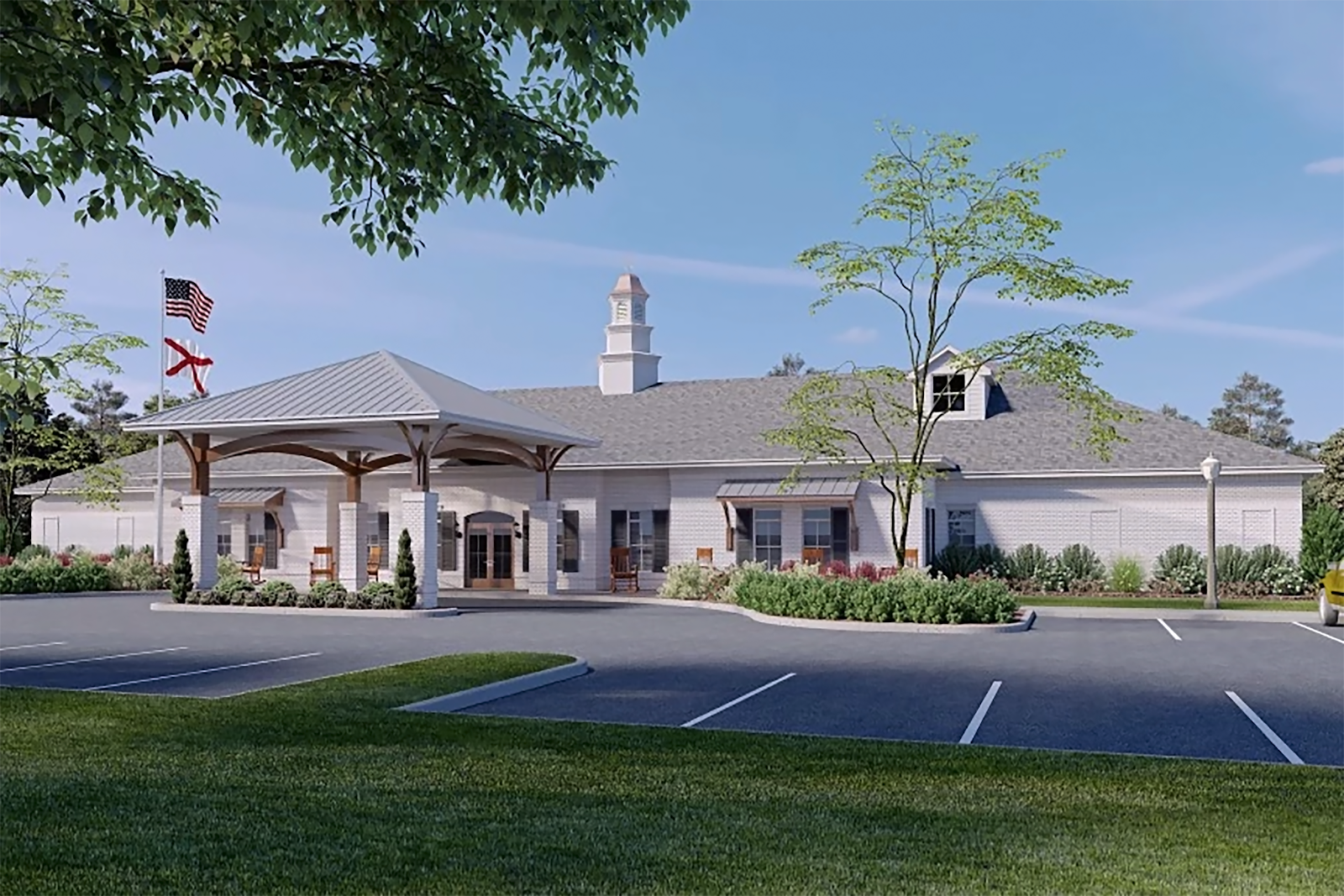
Carillon at Forte, Prattville: One Frame, and How It Is Made
A mill window sits in a wall half a metre thick. That thickness is the whole frame.
There is one frame a converted mill building gives better than any other kind of venue, and the reason is structural rather than decorative.
A subject stands in a tall industrial window opening — inside the reveal itself, not beside it — with the dark mill interior behind them and the light coming in horizontally past half a metre of brick on either side.
What makes it work is the thickness of the wall. A mill was built in load-bearing masonry, which means the walls are thick and the window openings are deep — and a deep reveal acts as a snoot, restricting the light and giving a sharper fall-off across a face than any thin-walled building can. The light arrives from a narrow band rather than from a wide one, which is the difference between a modelled face and a flat one.
The second part of it is the scale of the openings. Mill windows are tall, because the building needed daylight to work in before electric light — which means the light enters at head height and above, rather than from below the eyeline as a domestic window does.
And the third part is the interior. Mill brick, timber and cast iron absorb, which means the space behind the subject drops away to near-black without anything being done — so the frame is a lit face in a deep opening against darkness, and it needs no equipment at all.
That combination is rare. A church gives the darkness but not the reveal; a modern building gives the glass but neither; a house gives the reveal but at a domestic scale. A mill gives all three.
We have not photographed a wedding at the Carillon at Forte; converted mill buildings behave consistently. Which spaces are included, whether the original window openings are accessible, whether the lighting can be dimmed, the covered alternative, and what the actual timings are are questions for their team — and access to the window reveals is worth confirming, because they are sometimes blocked by fittings or glazing.
Carillon at Forte at a glance
| Where | A converted mill building at Prattville, central Alabama |
| The frame | A face standing in a deep window reveal against a dark interior |
| Why it works | A thick wall restricts the light, which sharpens the fall-off across a face |
| The interior | Brick, timber and iron absorb, so the background goes near-black for free |
| Ask first | Access to the window reveals, spaces included, lighting control, timings |
How the frame is made
The position is the first decision and the point of it is to be inside the reveal rather than beside the window. Standing in the opening puts the brick on both sides of the subject, which restricts the light to a narrow horizontal band — and that narrowness is what makes the fall-off across the face sharp rather than gentle.
A step back into the room gives a wider source and a softer, flatter result, which is a perfectly good picture and a different one. The frame described here depends on being in the opening.
The turn is the second decision and it is the same as at any window: about forty-five degrees to the light gives a lit side, a shadowed side and a gradient between them. The catchlight confirms it — and in a deep reveal the catchlight is a distinctive shape, a narrow vertical rather than a broad rectangle, which is itself a tell that the frame is working.
The background is the third and in a mill it requires nothing. Brick, timber and cast iron absorb across the spectrum, which means the interior behind a subject in a window opening is two or three stops down at least — frequently more. That is the separation the frame depends on and it is free.
The exposure is the fourth and it runs the dark-room way in its strongest form. A meter looking at a mill interior tries to lift it toward mid-grey, which overexposes a face by two stops or more — and the correct frame has a great deal of near-black in it, because that is what the building is.
So: metering on skin, in manual, with the interior allowed to go black. Metering off a hand in the same light as the face is the fastest reliable method, and the check is whether the brick has gone dark rather than grey.
The white balance is the fifth and it needs setting on a face rather than trusting a preset, because two things tint the light in a mill window. The brick of the reveal itself is warm-toned and it bounces onto anything standing between it — which means the light reaching a face from the sides is warmer than the light reaching it from the opening. And what is outside the window tints the rest: sky is cool, a sunlit brick wall opposite is warm, and dense summer canopy is green.
Thirty seconds on a face in position handles all of it, and it needs resetting when the opening changes.
Direct sun is the one thing that breaks the frame and in a mill it breaks it distinctively. A deep reveal in direct sun produces a hard-edged shaft with a sharp shadow line across the opening — which on a wall or a floor is a beautiful graphic subject and on a face is not. Half a metre either way usually clears it; a north-facing or shaded opening avoids it; and the shaft itself is worth photographing as a subject in its own right rather than only as a hazard.
Where the openings have been reglazed with modern glass, the reveal is still there and the frame still works — but the glass may reflect, which means a few degrees off perpendicular removes the camera from it.
And where a mill has many openings on more than one aspect, the position can be chosen for the direction of the light as well as for the background. A building with windows on four sides has a north-facing opening giving soft even light at any hour, and a south-facing one giving strong directional light with a shaft in it — which means the same frame is available in two completely different qualities.
What breaks it, and the rest of the building
Blocked openings break the frame and that is the practical thing to check. Converted mills frequently have their window reveals filled with fittings, services, seating or decorative treatment — which means the position described here may not exist in the room the wedding is in, even though it exists elsewhere in the building.
Asking which openings are accessible, and walking the building once to find them, is ten minutes of preparation that decides whether the frame is available at all.
A painted or pale interior breaks it in the other direction. Where a conversion has painted the brick white — common, and understandable — the walls bounce rather than absorb, which lifts the background and fills the shadow side of the face. The reveal still gives direction, but the near-black surround is gone and the frame becomes a soft high-key one instead.
That is a different picture and not a worse one. It also inverts the metering: a white-painted mill interior makes a meter underexpose rather than overexpose, so the correction is brighter than the camera suggests rather than darker.
Overhead fittings break it as they break every window frame. Downlights or pendants in a converted mill put a hard band on the top of a head and leave the eyes dark, and they are usually a different colour from the daylight. Switching them off is free where it is possible.
The rest of the building is variations on the same physics plus the resources a mill gives.
The structure is the first: cast iron columns, heavy timber beams, exposed brick piers and a high ceiling. Those are strong repeating lines, which means a frame built along them reads as intended and one built across them reads as accidental — and the geometry punishes carelessness, because there is nothing forgiving in an industrial interior. Square and level, checked rather than assumed.
Height is the second and it is usually underused. A mill is tall, and where there is a mezzanine, a gallery or a stair, a position above the floor makes the volume legible as a shape rather than an expanse — which is the most distinctive wide frame such a building offers and takes nothing but climbing.
The textures are the third and they are worth photographing close as well as wide: patched brick, bolt plates, worn plank, the marks of machinery that is no longer there. Those details place a set of pictures in this building rather than any other.
For the evening reception the standard method applies. Expose the ambient about a stop or a stop and a half under what skin needs, so the fittings keep their presence and the brick and timber keep their depth, then add one source for the faces gelled warm to match, just above what the ambient gives the skin, and diffused so it does not read as flash. A high dark ceiling is not a usable bounce surface; a pale nearby wall or a modifier is.
Outdoors, a mill site in central Alabama gives the building’s own exterior — brick, which takes raking light far better than flat light, so the architectural frames belong in the last two hours — and whatever the setting provides. A mill is usually on water, because that is why it was built there, which means a race, a pond or a river is frequently part of the site: a horizontal reflector that doubles the building and throws light upward into faces beside it.
The trees, where they exist, are the shade: central Alabama mixed hardwood and pine, with the canopy edge giving soft directional light in front and darkness behind. And the metering reverses there from the brick’s, which is the discipline of the whole site.
The practical Alabama notes apply. Summer heat and humidity make an outdoor session between June and September an early or late proposition, and whether a large masonry building is cooled is a real question. Afternoon thunderstorms are near-daily in July and August. And spring is the state’s severe-weather peak, which makes a named covered alternative a requirement — at a mill that is usually the building itself.
- Stand in the reveal, not beside it — the thickness is the frame
- Meter on skin and let the brick go dark; that near-black is the building
- Set white balance on a face; the reveal’s brick warms the light from the sides
- Check which openings are accessible before the day; many are blocked
- If the brick is painted white the metering reverses and the frame softens
The central Alabama year
Central Alabama has a humid subtropical climate with mild winters and a long hot summer, and a large masonry building is close to weather-independent — which means the season decides the light through the openings and the outdoor half of the day.
Winter is the best season for the frame this guide is built around, and the reason is the sun’s angle. The December sun at this latitude reaches about thirty-six degrees above the horizon, which means light enters a tall window almost horizontally and travels much further into a deep room than a high summer sun does — and it arrives at exactly the head height the frame wants.
For a deep reveal that is decisive: in winter the band of usable light inside the opening is at its widest and the fall-off across a face is at its most graded. A mill is better lit in January than in June, and by a large margin.
Winter also means the deciduous canopy outside is down, which for a window facing trees changes the light from green-tinged to clean neutral — a real difference in a building where the white balance already has the brick to contend with.
Snow, when it comes, is the best natural fill available outdoors and against dark mill brick it gives the widest brightness range the property offers — expose for the snow and let the brick go dark, overexposing deliberately relative to the meter, which snow fools by about two stops. Snow also reflects light up into every window and measurably brightens a dim interior.
Frost and morning fog are the more common winter conditions, and a mill building rising out of river fog is one of the strongest exterior frames the site offers.
Late winter into spring brings the flowering: camellias through the cold months, then redbud, dogwood, azaleas and wisteria from March into April. Against dark mill brick that saturated colour reads at full strength.
The honest spring caveat is severe weather. Alabama sits in one of the most tornado-prone regions in the country with a pronounced peak from March through May, and severe thunderstorms are a real feature. A named covered alternative with real capacity is a requirement — and a large masonry mill is a good answer to it.
Spring proper is the most comfortable season: warm, green, long-lit, the canopy leafing out through April and the water at its fullest.
Summer is hot and humid and it is the hardest season. Low nineties Fahrenheit with high humidity pushes the heat index considerably higher, and a large masonry building holds heat unless it is cooled — which is worth asking about directly.
The summer effect on the frame is the one to note: a high sun barely enters a tall window at all, which narrows the usable band inside the reveal considerably and pushes the light toward the top of the opening rather than across it. Standing further into the opening is the fix.
Afternoon thunderstorms are near-daily in July and August, and on a mill site with water the post-storm condition — wet brick, full race, saturated colour — is the best short window of the season.
Autumn is the best season overall. The heat breaks in October, the humidity drops, the air clears, and the hardwood colour arrives late — typically from the last week of October into mid-November, weeks later than New England. Against dark brick and dark timber that colour reads at full saturation, and by then the sun is low enough that the interior light is improving again.
Late October and early November are the easiest and most beautiful dates of the year here, with the caveat that November is the state’s second severe-weather peak.
More frames from Carillon at Forte
Carillon at Forte wedding photography: common questions
What is the frame?
A subject standing inside a deep mill window reveal, with the dark interior behind them. The thickness of the wall restricts the light and sharpens the fall-off.
Why in the reveal rather than beside the window?
Standing in the opening puts brick on both sides, which narrows the source. A step back into the room gives a wider, softer, flatter result.
How do I expose it?
On skin, in manual, with the brick allowed to go dark. A meter looking at a mill interior overexposes a face by two stops or more.
Why set the white balance on a face?
The reveal’s brick is warm-toned and bounces onto the subject from the sides, while what is outside the window tints the rest.
What breaks the frame?
Blocked openings, a white-painted interior, and direct sun in the reveal. The first is worth checking before the day.
When is the frame strongest?
January. A low sun enters a tall window almost horizontally, which widens the usable band inside the reveal and grades the fall-off.
More Alabama venue guides
We are writing a photographer’s guide to every venue we would happily shoot in Alabama. Here are three more, plus the full index:
- The Club, Homewood: The One Decision That Governs Everything
- Columns at Fairhope, Spanish Fort: A Walk Through the Site
- Estate at Shoal Creek, Stemley: What It Suits and What It Does Not
Planning a wedding at Carillon at Forte?
One frame, and a wall half a metre thick. Tell us your date.