 Salmonberry Inn, Anchorage: One Frame, and How It Is Made
Pioneer Ridge Estate, Wasilla: The Problem, and Four Ways Out
The mountains are magnificent. What lies between you and them is not.
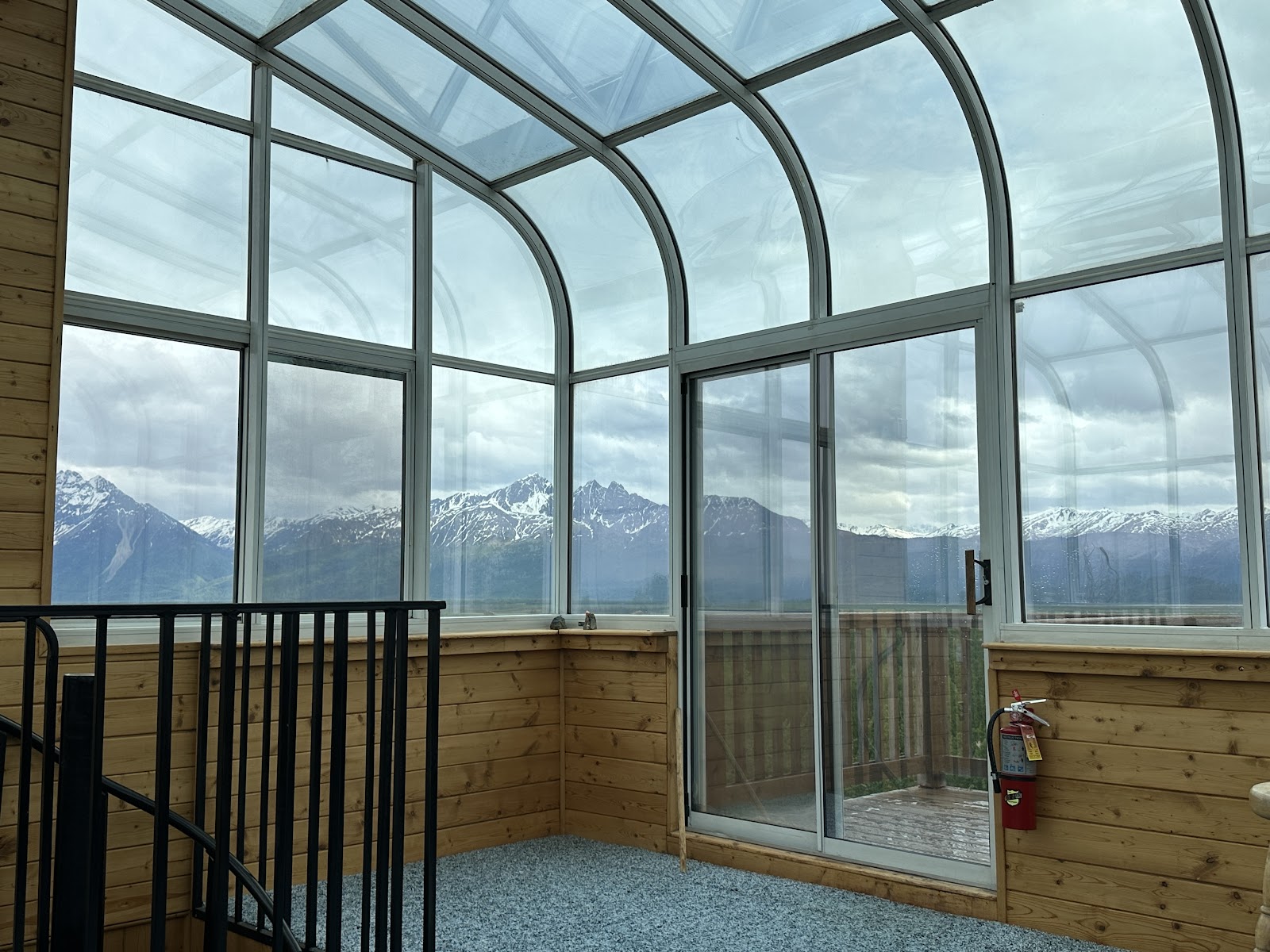
The problem at a hillside property above the Mat-Su valley is a specific and solvable one: the view is magnificent and the middle distance is not.
Alaska’s Matanuska-Susitna valley is the state’s most settled rural area, which means that a view from a hillside here takes in the Chugach or the Talkeetna mountains on the skyline and, between them and the camera, a broad valley of roads, utility lines, cleared lots, outbuildings and dispersed housing.
None of that is unattractive in itself. It is simply what a working valley looks like, and it is the thing that stops a wide frame from being a landscape photograph — because a wide lens from a hillside includes all of it, and the eye goes to the nearest recognisable thing rather than to the mountains beyond.
Three related difficulties follow. The wide frames are compromised in a way that is hard to see on a small screen and obvious at full size. The ceremony position, if it faces the view, has the same problem behind the couple. And utility lines in particular are almost invisible to the eye and unmissable in a photograph, because they cross an otherwise empty sky.
The fourth element is the light, which is the site’s compensation. At around sixty-one degrees north the sun reaches only about fifty degrees above the horizon at midsummer noon and far less the rest of the year, which means it rakes rather than falls at every hour — and a hillside position gains the sun earlier and keeps it later than the valley floor below.
There are four ways out. We have not photographed a wedding at the Pioneer Ridge Estate; hillside properties in this valley behave consistently. Which spaces are included, the covered alternative, what the wind exposure is, and what access there is on the property are questions for their team — and the valley’s wind in particular is worth asking about.
Pioneer Ridge Estate at a glance
| Where | A hillside property above the Mat-Su valley at Wasilla, Alaska |
| The problem | A magnificent skyline with a settled working valley in front of it |
| Way one | Compress: a long lens removes the middle distance entirely |
| Way two | Go up or go low. Way three: watch for the lines |
| Way four | Use the seasons — snow and colour both simplify the valley |
Ways one and two: compression, and camera height
The first way out is compression and it solves most of the problem in one decision.
A longer lens does two things at once. It magnifies the mountains so they fill the frame behind a couple rather than sitting as a band on the horizon — which is what the view deserves. And it excludes the middle distance entirely, because a narrow angle of view from a hillside looking at a skyline simply does not contain the valley floor.
That is the single most useful move here and it is worth stating plainly: the wide lens is the enemy of this site and the long lens is its best friend. In the clean cool air of southcentral Alaska that compression holds detail well, which is why the frame works.
The practical form of it is to stand further back from the couple than feels natural and to shoot at a long focal length, which also flattens the apparent distance between them and the mountains — making the range look closer and larger than it does to the eye.
The second way out is camera height, and it works in both directions.
Going higher on the hillside raises the horizon line relative to the middle distance, which means the mountains occupy more of the frame and the valley less. A position a few metres up a slope can remove a whole band of development from a frame that included it.
Going lower does the opposite and it is the more useful of the two. A low camera puts the foreground — grass, berry ground, a slope, a fence line, a flower bed — across the bottom of the frame, which hides everything immediately behind it. From a hillside, a camera at knee height with the ground rising to the horizon can eliminate the entire valley floor and leave only foreground and mountains.
That is the most effective single fix available at any site with an untidy middle distance, and it costs nothing but kneeling.
The combination of the two — low camera, long lens, subject standing on ground that rises behind them — produces a frame with three clean layers: foreground, couple, mountains. Nothing else needed.
The exposure for any of these frames goes on the mountains rather than on skin, with the faces lifted by a close warm-gelled source. Metering on faces gives a white sky and a washed-out range, which is the standard failure at every view venue — and close matters because a hillside bounces some light but not enough to lift a backlit face: a source at two metres needs roughly a quarter of the output it needs at four.
And the ceremony position deserves the same thought in advance. If the seating faces the view, then the background of every ceremony frame is whatever is behind the couple — which means walking the position beforehand and looking through a long lens from where the photographer will stand is ten minutes that decides the coverage.
Ways three and four: the lines, and the seasons
The third way out is to look for the things the eye skips, and utility lines are the first of them.
Overhead power and telephone lines are almost invisible when looking at a landscape, because the brain edits them out — and they are unmissable in a photograph, because they cross an otherwise clean sky as hard dark diagonals. In a settled valley they are everywhere, and the commonest way a good frame is spoiled at a site like this is a wire nobody noticed.
The fix is entirely positional and it takes a second: before the first frame in any position, look at the sky in the viewfinder rather than at the subject. A step to one side, a lower camera, or a slightly different angle usually removes the wire — and where it does not, a tighter frame will.
The other things the eye skips are roofs, vehicles, signage and fencing in the middle distance, and the same discipline handles them. Checking the background rather than the subject in the first frame of every position is the whole of the technique, and it is the difference between a set of pictures that look like a landscape and a set that look like a garden with a view.
The fourth way out is seasonal and it is the most powerful of all, because both of Alaska’s strongest seasons simplify the valley.
Snow is the first. A snow-covered valley is a simplified valley: cleared lots become white ground, roads become lines under snow, outbuildings become shapes, and the whole middle distance reduces to a pale plane. What was busy becomes quiet, which means the wide frames that fail in July work in January — and with the mountains white as well, the frame becomes a study in tone rather than a record of a settled valley.
Snow is also the best natural fill available outdoors, lifting every shadow and throwing light upward into faces. Snow against near-black spruce is the widest brightness range in this guide — expose for the snow and let the conifer go black, overexposing deliberately relative to the meter, which snow fools by about two stops.
The second is autumn colour, which works differently but to the same effect. In late August the alpine tundra on the Chugach turns red and orange across whole slopes and the birch and cottonwood in the valley turn gold — which means the skyline and the near ground become the brightest and most saturated parts of the frame while the middle distance stays green and grey. The eye goes to the colour, which is exactly where it should go.
Between those two, the valley’s own vegetation is the other resource. Spruce is the shade and the dark background: the canopy edge a metre or two inside a stand gives soft directional light in front and near-darkness behind, three or four stops of free separation — and the metering correction is to meter on skin, because dark spruce makes a meter overexpose a face.
Birch is the counterpart, with bright white bark that makes a stand a pale background of vertical lines. White birch against near-black spruce is the northern signature and the Mat-Su valley has it everywhere — and both of them, used as backgrounds, remove the valley from the frame entirely.
The wind is the practical constraint and this valley is known for it: strong downslope winds funnel out of the Matanuska valley and across the area, which means a lightstand is a liability and a held modifier is a sail. Handheld or bracketed sources are the working configuration, planned from the start.
And the hillside’s timing advantage is worth using. A slope position gains the sun earlier and keeps it later than the valley floor, which extends the good light at both ends — and because the sun’s path is shallow at this latitude, the low warm light lasts two or three hours rather than forty minutes and in June runs until near eleven at night.
- Long lens, always. A wide lens from a hillside includes everything you don’t want
- Get low: foreground across the bottom of the frame hides the valley floor
- Look at the sky in the viewfinder before the first frame — wires are invisible to the eye
- Snow simplifies the whole middle distance; so does autumn colour on the skyline
- Spruce and birch as backgrounds remove the valley entirely
The Mat-Su year
This valley has a southcentral Alaskan climate that leans continental: drier and sunnier than the coast, colder in winter, and with the enormous daylight swing that defines Alaska.
Midwinter gives about five and a half hours of daylight with the sun reaching only about five degrees above the horizon, which means the whole short day is an extended twilight — soft, raking and blue-toned. From a hillside with white mountains around a white valley, that is among the most beautiful light in this guide.
Winter is also the season that solves the site’s central problem, for the reasons above. A snow-covered valley is simplified almost to abstraction, and with a low sun raking across it the wide frames that are compromised in summer become the best the property has. That is a genuine argument for a winter date rather than a consolation.
The costs are cold that drains batteries fast, a camera that fogs when brought into a heated building, a short day, and the valley wind, which in winter adds serious chill. Spares in an inside pocket and bodies bagged until they warm.
Winter is aurora season from roughly September to April on clear nights, and the Mat-Su valley has dark skies away from Anchorage. Northern lights over a snow-covered valley with the Chugach behind is available nowhere else in this guide — tripod, wide fast lens, a few seconds to half a minute, and a party willing to stand still in the cold.
Break-up in April and May is the least attractive time of year and at a hillside site it is the worst possible combination: dirty patchy snow in the valley, mud, bare trees, and every untidy element of the middle distance fully visible with nothing to hide it. Early May here is not spring in any recognisable sense, and it is the one part of the year when the site’s problem has no solution.
June is when it turns and it turns fast. The green arrives within a fortnight, which helps considerably — a green valley reads better than a brown one — and the days are enormous. Mosquitoes arrive with the green and are a genuine consideration in June and early July, less so on an open breezy hillside than in the woods.
July is the warmest month and the greenest, and fireweed gives the strongest colour of the Alaskan summer: tall magenta spires across cleared ground and roadside in quantity. On a hillside that is a real foreground resource — a low camera with fireweed across the bottom of the frame hides a great deal of valley.
July is also the clearest month for the distant ranges, which matters here because the Alaska Range to the northwest is only visible on clear days and it is the most spectacular thing the view contains.
Late August into September is the best season overall. Birch and cottonwood in the valley turn gold; the alpine tundra on the Chugach turns red and orange across whole slopes; the first snow appears on the peaks, locally called termination dust; and the nights are dark enough for aurora while the days are still long.
That colour distribution is what makes autumn work here: the brightest, most saturated parts of the frame are the skyline and the near ground, and the middle distance is the dullest part of the picture rather than the most noticeable. It is the season in which the site’s problem solves itself.
The window is roughly the last week of August through the middle of September, and the light arrives at a civilised hour rather than at ten at night.
October brings the rain and the dark, and by November the snow is establishing and the valley is simplifying again.
More frames from Pioneer Ridge Estate
Pioneer Ridge Estate wedding photography: common questions
What is the central problem?
A magnificent mountain skyline with a settled working valley in front of it — roads, wires, cleared lots and outbuildings in the middle distance.
What is the main fix?
A longer lens. Compression fills the frame with mountains and excludes the middle distance entirely; a wide lens includes all of it.
What else works?
A low camera with foreground across the bottom of the frame, which hides everything immediately behind it. It costs nothing but kneeling.
What is easiest to miss?
Overhead wires. The eye edits them out and a photograph does not, so look at the sky in the viewfinder before the first frame in any position.
Does the season help?
A great deal. Snow simplifies the whole valley to a pale plane, and autumn puts the colour on the skyline and the near ground where the eye should go.
Which season should we avoid?
Break-up in April and early May — patchy snow, mud, bare trees, and every untidy element fully visible with nothing to hide it.
More Alaska venue guides
We are writing a photographer’s guide to every venue we would happily shoot in Alaska. Here are three more, plus the full index:
- Rustic Rose Ranch, Palmer: Field Notes
- Salmonberry Inn, Anchorage: One Frame, and How It Is Made
- Settlers Bay Lodge, Wasilla: Field Notes
Planning a wedding at Pioneer Ridge Estate?
A view worth framing properly. Tell us your date and we will plan the lenses.