 The Venetian, Garfield: The Building’s Own Logic
Grand Marquis, Old Bridge: The Problem, and Four Ways Out
Four light sources, four colours, one face. No white balance fixes that — a decision does.
The problem at a large banquet venue is colour, and it is worth stating precisely because it is the one technical issue that cannot be fixed afterwards.
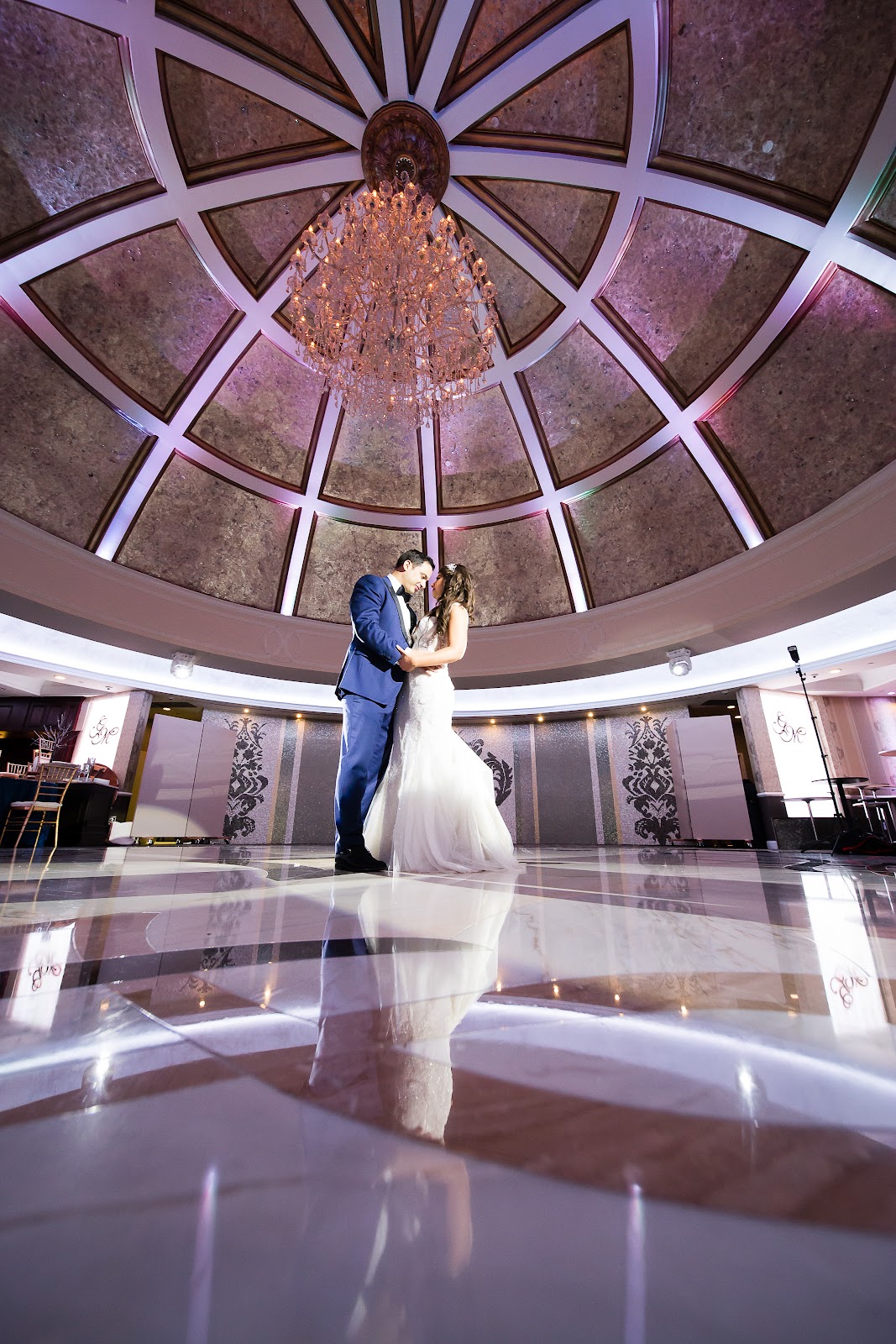
A wedding at a venue of this kind happens almost entirely under artificial light, and that light is not one thing. A single room may contain warm incandescent or filament-look fittings, cooler white LED downlights, coloured uplighters washing the walls, candle or table lighting, illuminated bar or feature lighting, and — through any doorway — daylight from an entrance or a window.
Each of those has a different colour temperature, and several of them have a colour cast that is not on the temperature scale at all. A face standing in that mixture is lit warm on one side, cool on the other, and tinted from below or behind by whatever the uplighting is doing.
No white balance setting renders all of it correctly, and correcting for one leaves the others visibly wrong. Worse, the mixture changes as the couple moves, which means skin tone drifts from frame to frame in a way that is invisible on the day and obvious in a finished set of pictures.
That inconsistency is the real cost. A single frame with slightly odd colour is forgivable; a set of forty in which skin shifts from orange to pink to green is not, and it cannot be rescued by adjusting each one afterwards.
There are four ways out. We have not photographed a wedding at the Grand Marquis; large banquet venues behave consistently. Which rooms are included, whether the lighting can be dimmed or set, whether the uplighting colour is fixed or programmable, what daylight reaches the preparation rooms, and what the actual timings are are questions for their team — and the lighting questions decide the approach more than anything below.
Grand Marquis at a glance
| Where | A banquet venue at Old Bridge, central New Jersey |
| The problem | Several artificial colours on one face, changing as people move |
| Way one | Switch off or exclude what you can |
| Way two | Gel and dominate. Way three: decide what lands on the skin |
| Way four | Monochrome, which is a real answer rather than a retreat |
Ways one and two: subtraction, and domination
The first way out is subtraction, and it is free wherever it is possible.
In the preparation rooms it always is: turn the room lights off and work by the window. Warm bulbs against cool daylight put two colours on one face and no white balance renders both — switching them off removes half the problem in one action, and it is the single most valuable habit in a building like this.
In the function rooms it is a question rather than an action, and it is worth asking. Whether particular fittings can be switched off, whether the uplighting colour can be set to something neutral for the ceremony, and whether the house lights can be dimmed for the first dance are all things a venue of this class can usually do — and a room set up deliberately is a different room from one running its defaults.
Exclusion is the other half of subtraction. If a coloured uplighter is washing the wall a subject is standing against, moving the subject two metres removes its contribution to their skin entirely. The diagnosis is the catchlights: look at the eyes in the first frame of every new position, and they will show exactly which sources are reaching the face.
The second way out is to gel and dominate, and it is the approach that produces a consistent set of pictures across a whole evening.
Dominating means making your own source the principal light on the face — set a stop or more above what the ambient gives the skin, rather than the half-stop lift a consistent room would need. At that level the face is rendered almost entirely by your light, which means skin tone is the same wherever the couple stands and whatever the room is doing behind them.
That is the reliable answer at a venue whose lighting changes through the evening, and it is worth committing to rather than drifting into. The room still contributes the background, which is where its colour belongs.
The gel is what makes it look like it belongs rather than like flash. Most banquet lighting is warm, which means a warming gel on the source and the white balance set to the gel renders skin correctly while leaving the room’s own warmth intact. An ungelled source at a stop above a warm ambient produces a face that reads cooler than everything around it, and the eye catches that immediately even when it cannot name it.
Where the room is lit by two clearly different temperatures — warm fittings and cool LED, for instance — the gel goes to whichever is reaching the face, not to an average.
The diffusion matters too: a hard source at a stop above ambient still reads as flash, so a modifier keeps it soft enough to sit in the room. A tall ornate ceiling is not a usable bounce surface, because a flash aimed five or six metres up returns almost nothing and what returns is coloured by whatever is up there; a pale nearby wall usually is; and in a lower-ceilinged room the ceiling itself is the best bounce available, with the caution that a warm-painted one colours the light.
And the light has to travel with the subject, because nothing in a large room bounces usefully. A source at two metres needs roughly a quarter of the output of the same source at four.
Ways three and four: deciding, and monochrome
The third way out is to decide, which is what to do when subtraction and domination are not available — during a ceremony where no added light is wanted, for instance, or in a room whose lighting cannot be changed.
The rule is simple and it is the most important sentence in this guide about mixed light: set the white balance for whatever is landing on the skin, and let everything else fall where it falls.
Correct skin with a coloured room behind it is a picture. Skin rendered orange, green or pink is not, and no amount of adjustment afterwards recovers it, because the correction that fixes the face breaks everything else in the frame.
In practice that means setting the balance on a face in position rather than using a preset, and resetting it whenever the position or the lighting changes. Thirty seconds each time, and it is the difference between a coherent set and an incoherent one.
The corollary is that the room’s colour becomes a compositional element rather than an error. A magenta or blue wall behind a correctly rendered face reads as deliberate — and at a venue where the uplighting is part of the design, that is honest rather than a compromise.
The fourth way out is monochrome, and it deserves stating plainly as a real answer rather than as a retreat.
A black and white frame has no colour problem at all. The mixture that makes a colour photograph incoherent — warm from one side, cool from the other, tinted from behind — becomes simply tonal variation, which in monochrome reads as modelling rather than as error. That is not a trick; it is the reason a great deal of the best documentary wedding photography in difficult light is monochrome.
It also changes what the frame is about. Without colour, the picture depends on gesture, expression, tone and composition — which at a wedding is frequently where the interest actually is, and which suits the close documentary moments that a busy coloured room otherwise fights.
The practical approach is to shoot for both: exposing correctly and setting the white balance as above, then treating the frames where the colour is unresolvable as monochrome rather than forcing them. A set that mixes the two deliberately reads as a considered body of work; one that mixes them to hide failures reads as inconsistent, and the difference is whether the choice was made or defaulted to.
The ballroom exposure underneath all of this is the standard one and it does not change. Expose the ambient about a stop or a stop and a half under what skin needs, so the fittings hold their structure and the room keeps depth, then add light for the faces. The instinct to raise sensitivity until the room looks bright produces the characteristic bad picture: flat, uniformly warm, no depth, every table identical — and it makes the colour problem worse rather than better, because it lifts every unwanted cast along with everything else.
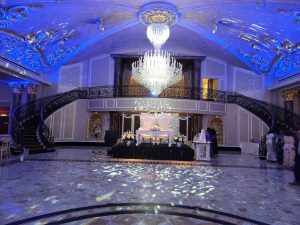
Two other things are worth knowing in these rooms. A polished dance floor doubles every source and every figure standing on it, which is the venue’s best single frame when it is composed deliberately and a mess when it is not — a few degrees of camera angle is the difference. And drapery is the matte surface that behaves like a dark wall: it absorbs, goes two or three stops below a lit face, and has no reflection to manage, which makes it the most reliable background in a room full of light.
- Room lights off wherever possible — it removes half the problem for nothing
- Dominate with your own gelled source for consistent skin all evening
- Set the white balance for what lands on the skin; never average
- Monochrome is a real answer to unresolvable mixed light, not a retreat
- Expose the room a stop under; raising sensitivity makes the colour worse
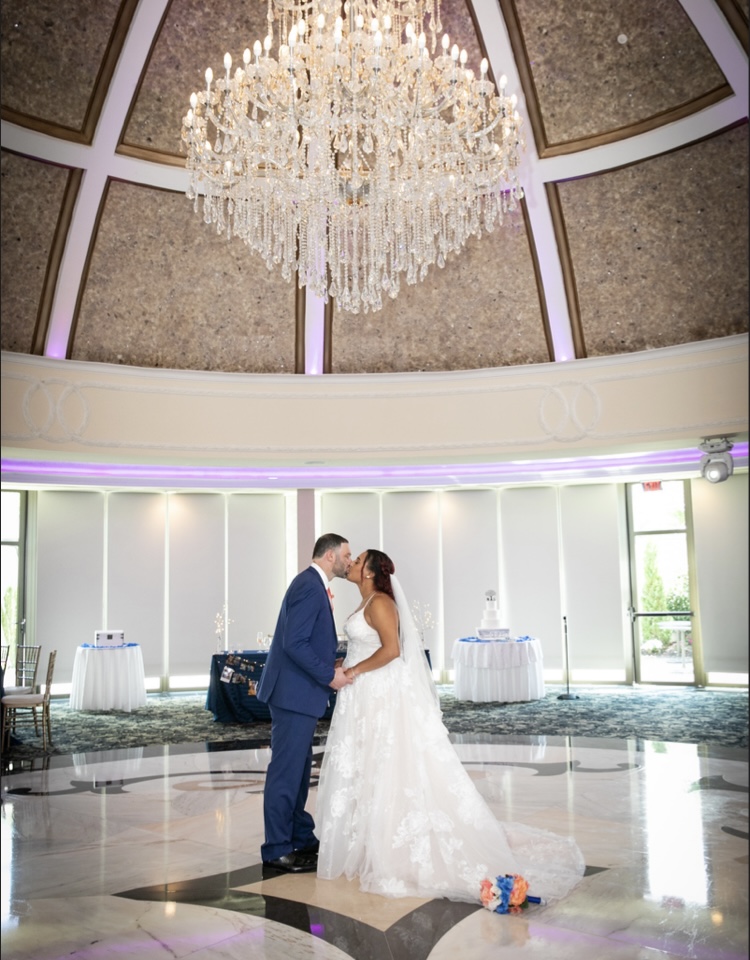
The central New Jersey year
A banquet venue is among the most weather-independent in this guide, which means the season affects the outdoor half of the day and the preparation-room light rather than whether anything works.
Winter is cold with snow in most years, and for a building like this it is close to irrelevant — the honest argument for a February date and a strong one.
Where winter helps is the daylight, and it helps in the one place that solves the colour problem. The December sun at this latitude reaches only about twenty-six degrees above the horizon, which means it enters any window almost horizontally and travels much further into a room than a high summer sun does — so a preparation room with a window is better lit in January than in June, and the usable band beside the glass is much wider.
A room lit entirely by daylight with the fittings off has no mixed-colour problem at all, which makes winter the season in which the venue’s central difficulty is easiest to sidestep for at least part of the day.
Winter’s other advantage is the early evening: any after-dark exterior frame, with the building lit from within, is available from mid-afternoon rather than after eight, which means it fits inside a normal running order rather than falling outside it.
Snow is the outdoor asset — the best natural fill available, lifting every shadow and throwing light upward into faces — and snow against a dark façade gives the widest brightness range on the site: expose for the snow and let the building go dark, overexposing deliberately relative to the meter, which snow fools by about two stops.
The costs are a short day, cold hands, batteries draining faster, and a cold camera fogging when carried from a winter forecourt into a heated ballroom. Spares in an inside pocket and bodies bagged until they warm.
Early spring is the weakest outdoor part of the year: bare trees, brown ground and wet footing. Indoors it makes no difference, which at a venue built around its interiors is no loss.
Late spring is mild and green, with planting softening any exterior frames through May. The complication is the long days: in June the good low light arrives after eight in the evening, which at a venue with a fixed portrait slot means the best exterior light falls after the reception has started — worth negotiating in advance rather than regretting.
Summer is hot and humid — commonly upper eighties Fahrenheit and above with high humidity — with afternoon thunderstorms a real feature from June into August. Indoors none of that matters; outdoors the middle of the day belongs to any porte-cochère or solid-roofed structure rather than to open ground.
The summer effect indoors is worth noting: a high sun barely enters a window at all, which means the preparation rooms are at their darkest relative to the fittings in June — and that is exactly when the temptation to leave the room lights on is strongest, and when it does the most damage.
Autumn is the best season for the outdoor half and the most convenient for a scheduled venue. The humidity breaks in September, the air reaches its clearest of the year, and foliage in central New Jersey peaks from the middle of October into early November, over two or three weeks because the species turn at different rates.
The scheduling advantage is that the days are short enough for the good light to fall inside a normal afternoon slot rather than hours after it. And for a venue whose whole day happens under mixed artificial light, twenty minutes outdoors in clean autumn daylight gives the finished set of pictures a consistency and a season that nothing inside the building can.
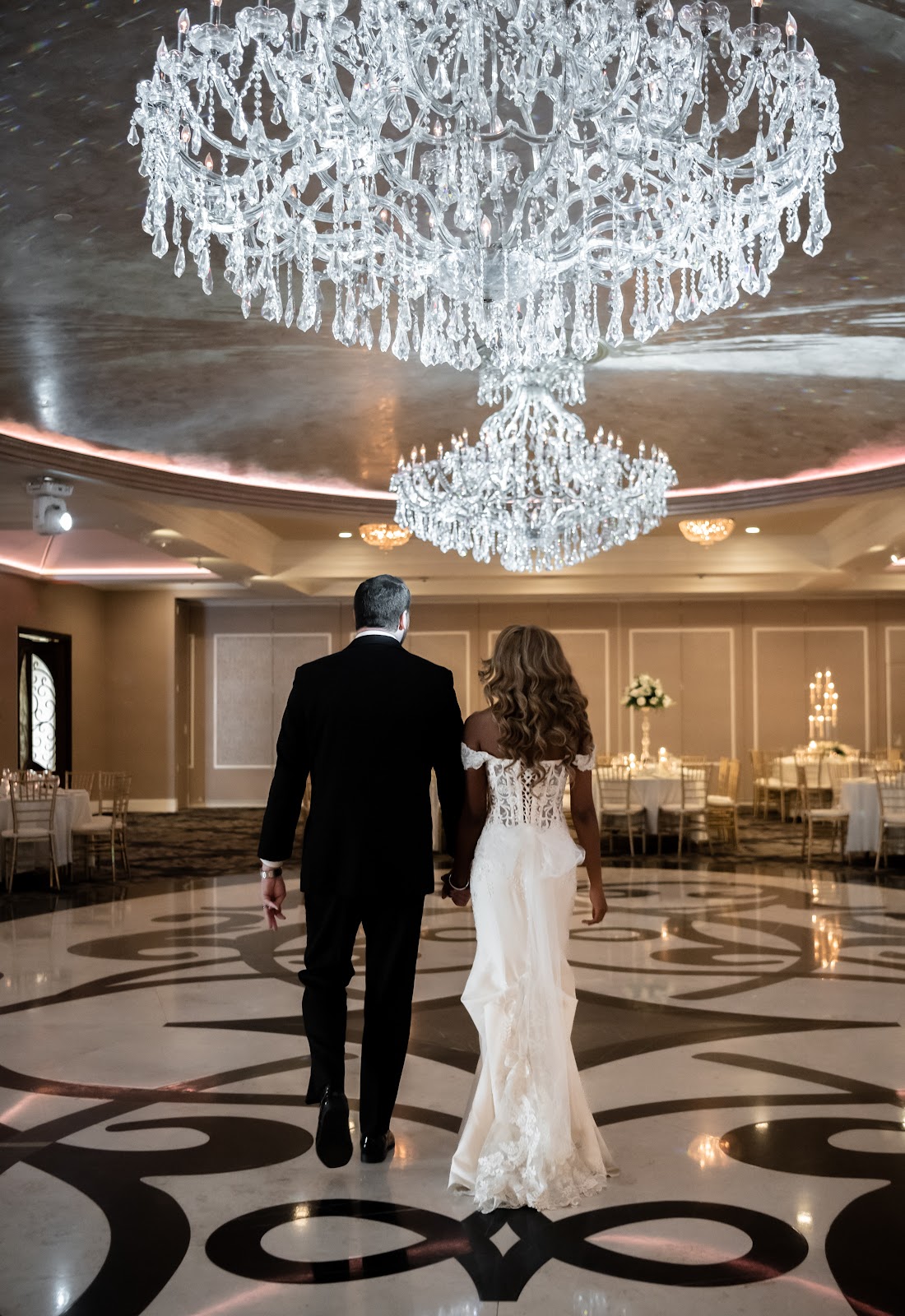
More frames from Grand Marquis
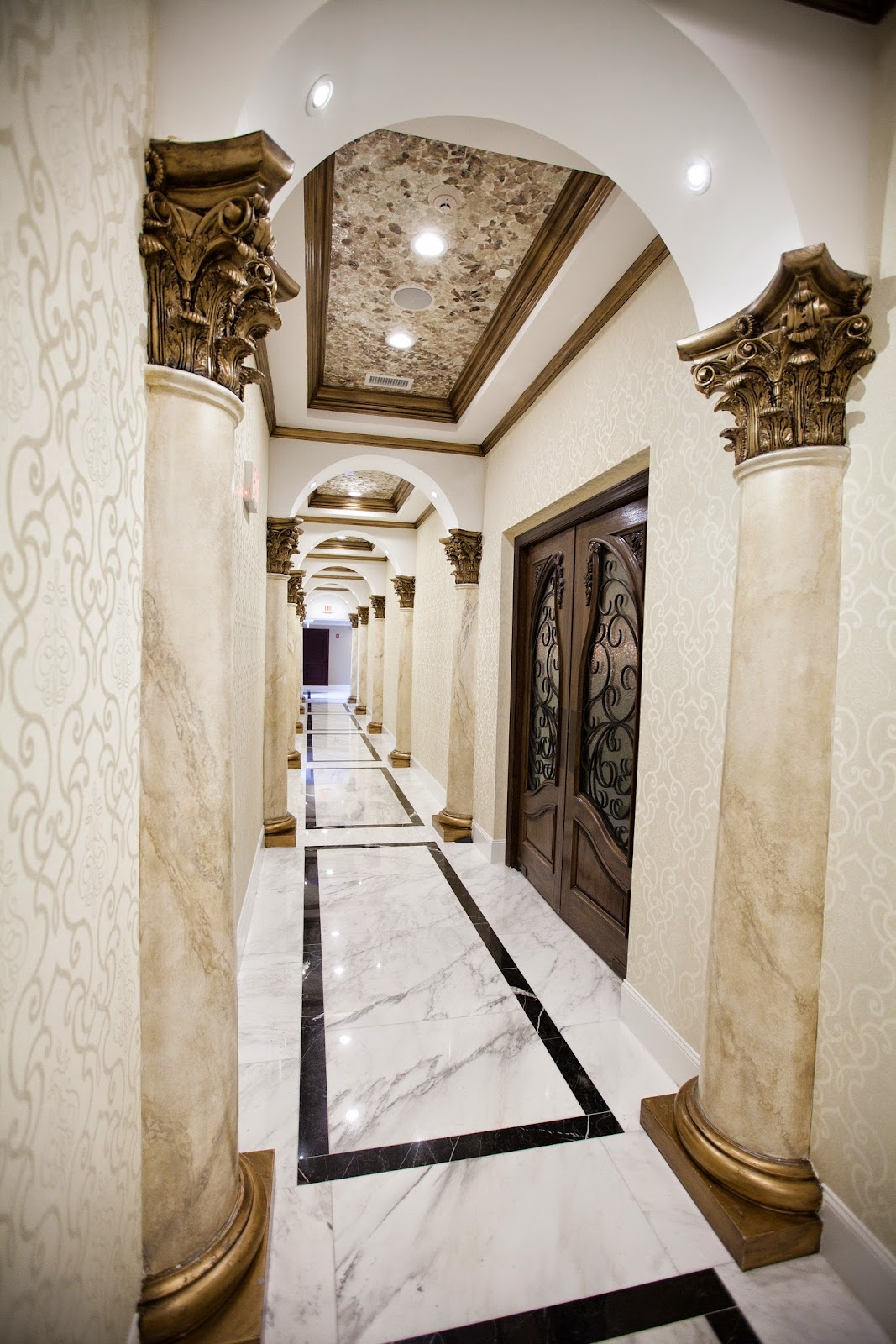
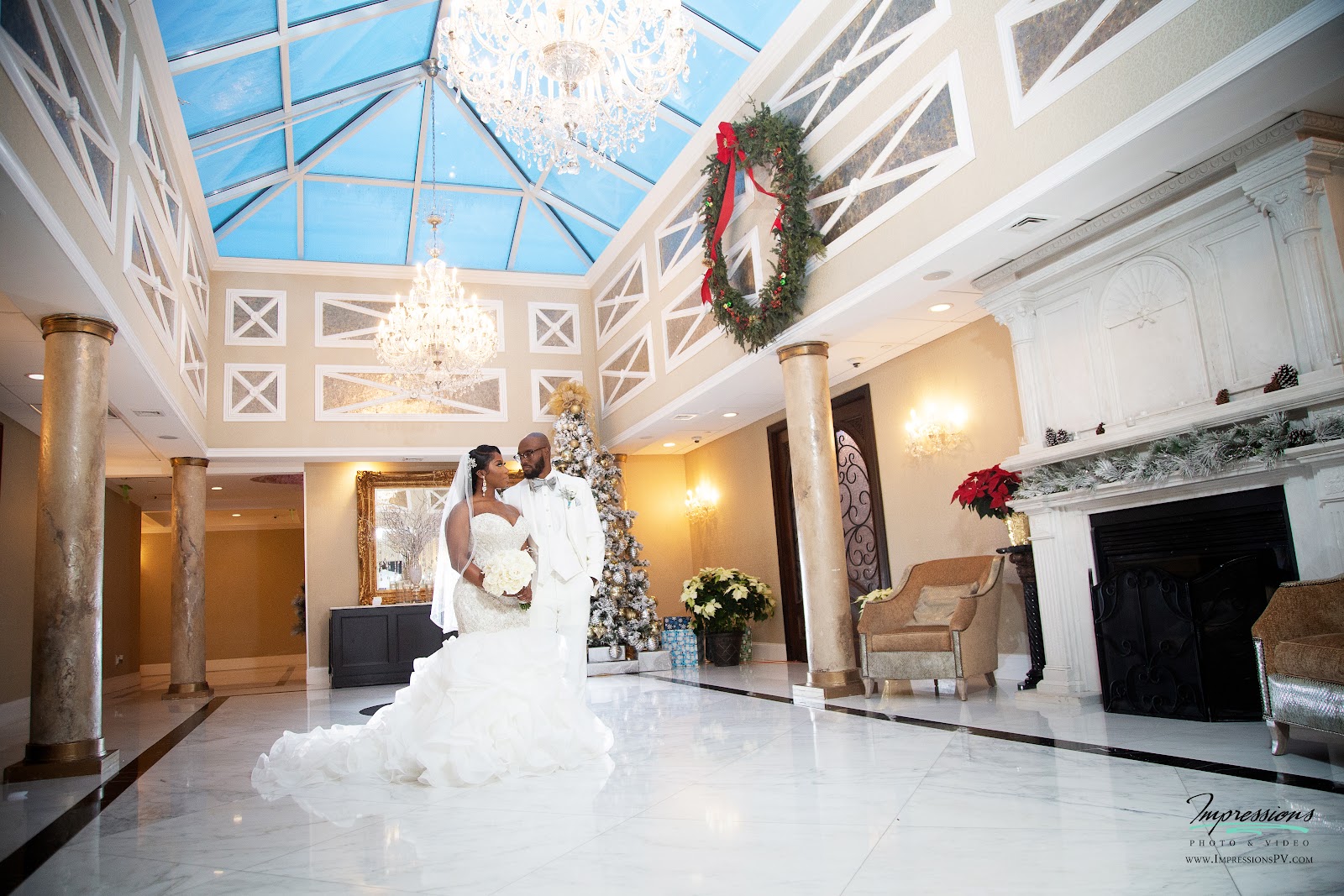
Grand Marquis wedding photography: common questions
Why is mixed colour the central problem?
Because it cannot be fixed afterwards. The correction that renders a face properly breaks the rest of the frame, and skin tone drifts across a whole set.
What is the free fix?
Turn the room lights off wherever possible, starting with the preparation rooms. Warm bulbs against window light put two colours on one face.
How do I keep skin consistent all evening?
Make your own gelled source dominant on the face — a stop or more above the ambient — so the room contributes only the background.
What if I cannot add light, as in a ceremony?
Set the white balance for whatever is landing on the skin and let everything else fall where it falls. Never average.
Is black and white a legitimate answer?
Yes. Monochrome has no colour problem at all, and the mixture that ruins a colour frame becomes tonal modelling instead.
Does raising sensitivity help?
No — it lifts every unwanted cast along with everything else and removes the room’s depth. Expose the room a stop under and add light instead.
More New Jersey venue guides
We are writing a photographer’s guide to every venue we would happily shoot in New Jersey. Here are three more, plus the full index:
- Grounds for Sculpture, Hamilton: A Walk Through the Site
- Highlawn Pavilion, West Orange: The Light Through the Day
- Laurita Winery, New Egypt: Field Notes
Planning a wedding at Grand Marquis?
Mixed light, handled deliberately. Tell us your date and what the room can do.