 Park Hyatt Aviara, Carlsbad: The One Decision That Governs Everything
University of California Botanical Garden, Berkeley: A Walk Through the Site
This garden is arranged by where plants come from. Walk it and the light changes with the geography.
This is a walk through the site in the order a wedding day tends to use it, and the reason to walk it rather than list it is that a research botanical garden is organised on a principle no ornamental garden uses.
It is arranged geographically. A garden of this kind groups its collections by region of origin — Mediterranean, Asian, Californian, South African, South American, and so on — because the point is scientific rather than decorative. Which means that walking a few hundred metres moves through completely different vegetation types, and therefore through completely different light.
That is the site’s defining photographic fact. A Mediterranean bed is open, silvery and bright. An Asian woodland bed is dark and green with broad-leaved canopy. A Californian section is oak and chaparral. A redwood grove is nearly black. Each of those needs a different exposure, a different white balance and a different idea of where the subject should stand, and they are minutes apart.
The second fact is the terrain. A garden in a hills canyon is steep, which means paths climb, ground is rarely level, and the canyon walls block the sun for hours at each end of the day — so the direct-sun day here is shorter than the day in the sky above it.
We have not photographed a wedding at the UC Botanical Garden; canyon botanical gardens behave consistently. Which areas are available for a ceremony, guest limits, what the covered alternative is, whether any glasshouse or building is usable, and what the path access is like in formal shoes are questions for the garden, and those answers shape the day more than anything here.
University of California Botanical Garden at a glance
| Where | A canyon in the Berkeley hills, above the university |
| The organising idea | Collections grouped by region of origin, not by appearance |
| The consequence | Light, colour and exposure change every few hundred metres |
| The terrain | Steep canyon: short direct-sun day, and climbing paths |
| Ask first | Areas available, guest limits, covered alternative, path access |
The open collections, and the canyon clock
Start with the open collections, because on a clear day they are where the light arrives first and leaves last.
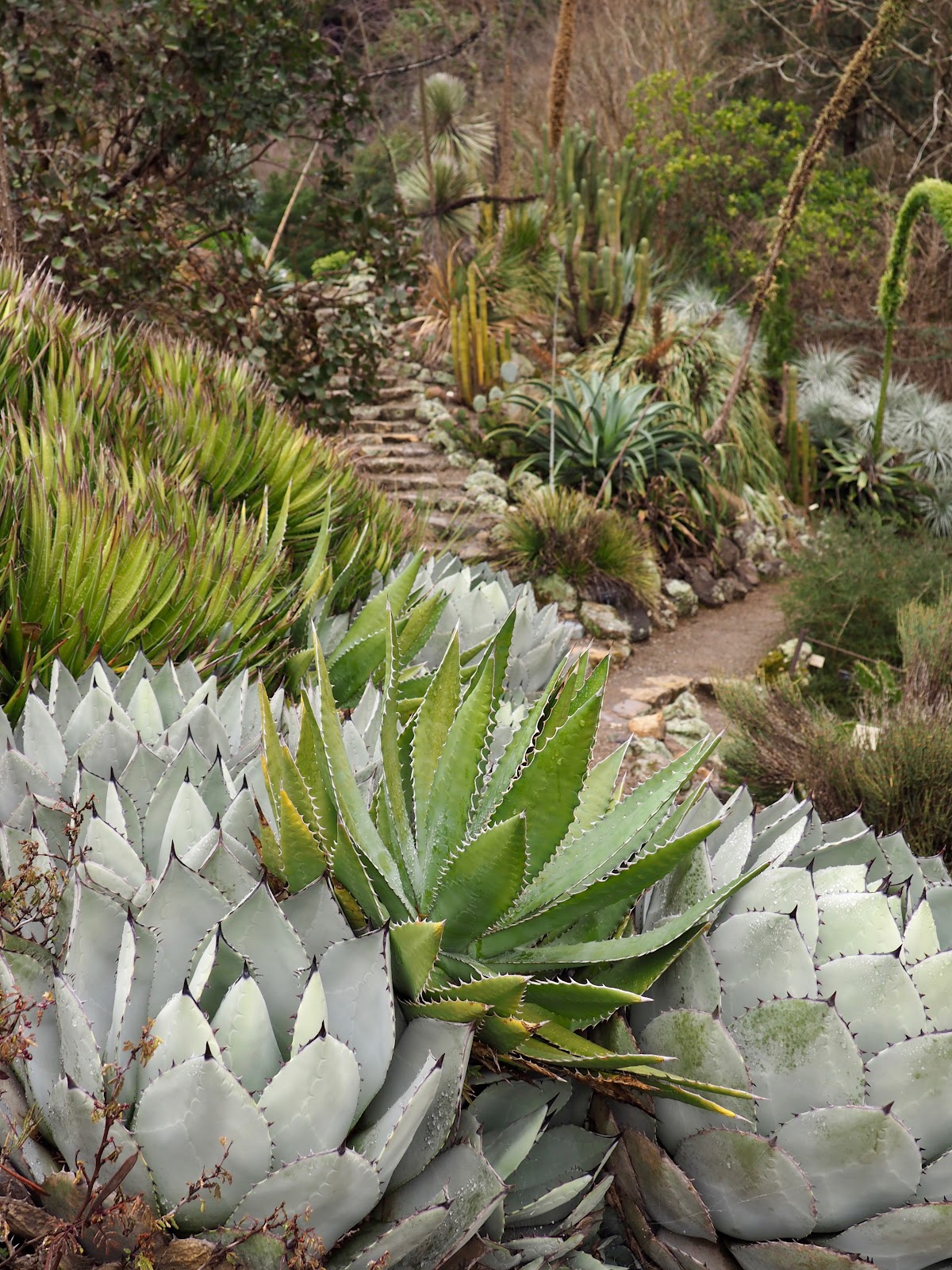
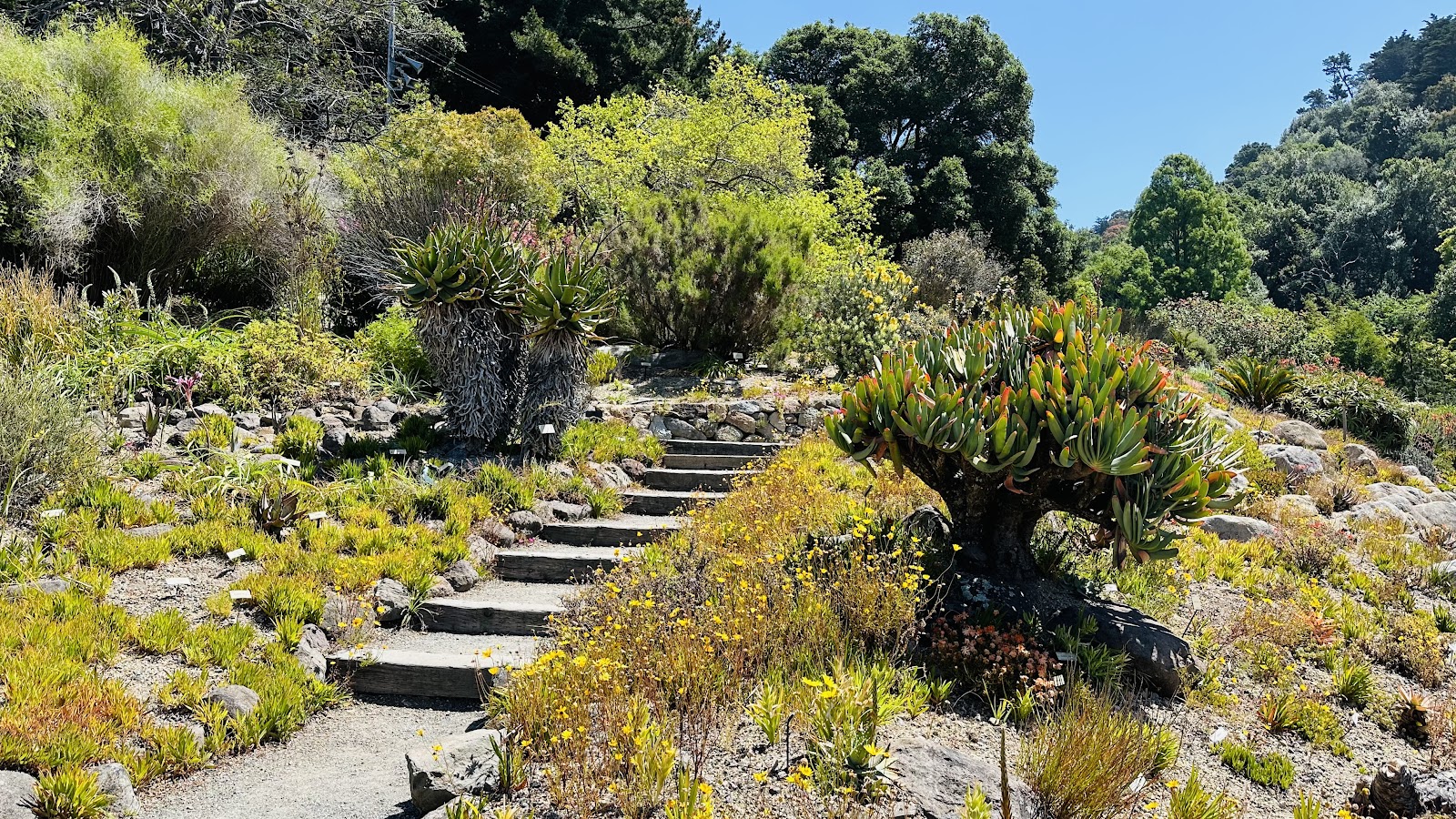
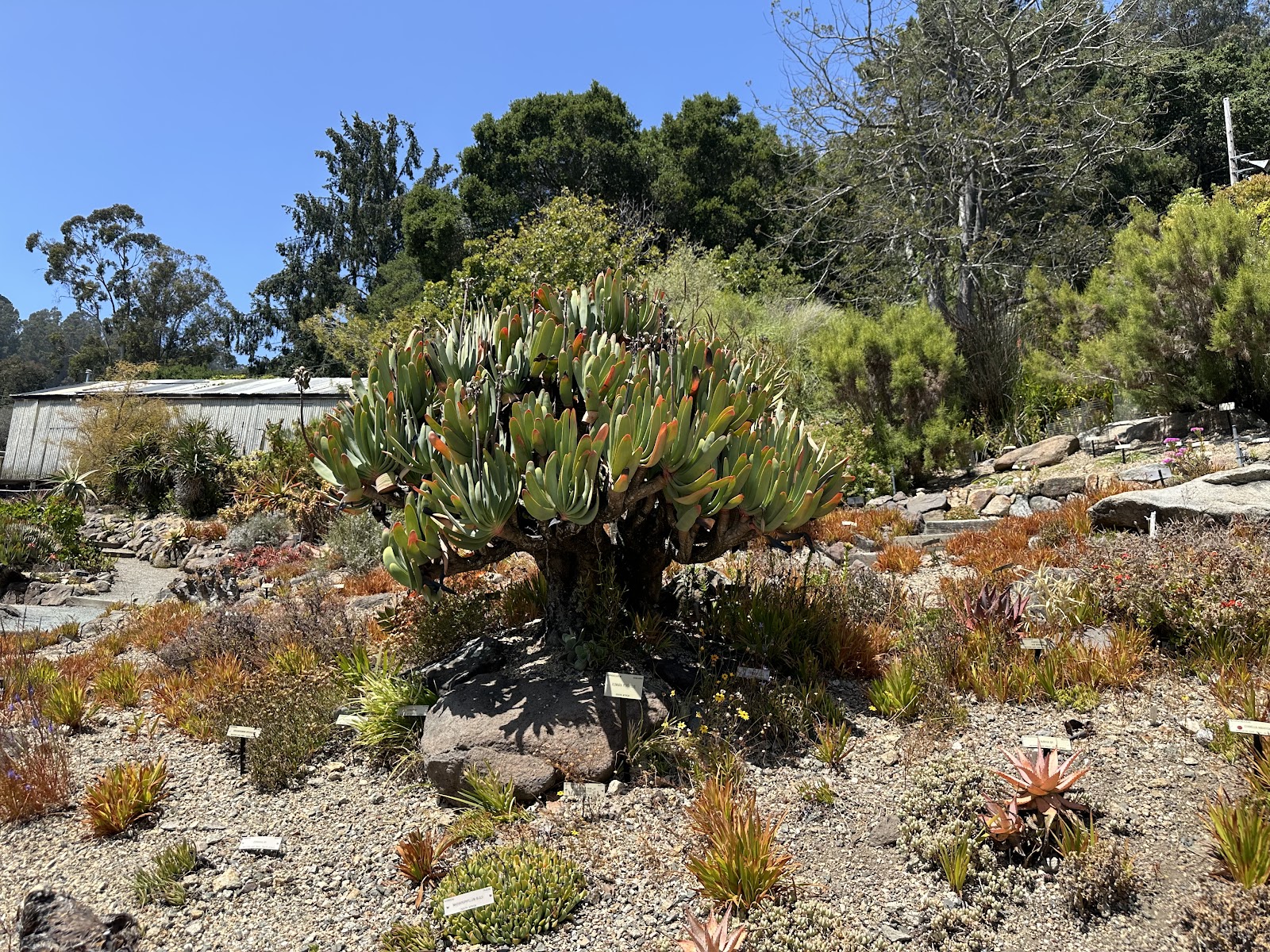
Mediterranean and dry-climate beds are the brightest ground in the garden. The plants are adapted to sun: small leaves, grey or silver foliage, sparse open structure, and a good deal of pale gravel or dry soil between them. Silver foliage is a reflector, which means these beds bounce light around and read high-key, and they are the one part of the garden where a meter will underexpose rather than overexpose — so the correction is brighter than the camera suggests, metered on skin.
They also give almost no shade. Dry-climate planting is low and open by design, so a subject in these beds at midday is in full sun with nothing overhead. That makes the open collections a morning and evening proposition and, on a bright day, a place to walk through rather than stand in.
What they give in exchange is texture and colour that exists nowhere else in a temperate garden: spines, rosettes, silver and blue-grey foliage, and flowering in seasons when other beds are dormant. A longer lens that compresses a bed into a field of that texture behind a subject is one of the strongest backgrounds in the garden.
The canyon clock is the next thing to understand and it is the fact that reorders the schedule. Because the site sits in a canyon between hill slopes, the sun clears the eastern side well after sunrise and drops behind the western side well before sunset — so the floor of the garden has a direct-sun window centred on the middle of the day, with soft even shade at both ends.
That inverts the usual rule. At most gardens the middle of the day is the difficulty and the ends are the reward. Here the ends of the day are the easy, even, workable hours everywhere, and the middle is when the dappling and contrast problems exist at all.
The practical consequence is that a late afternoon ceremony in this garden is technically easier than a midday one, and considerably easier than the sunset table implies — the shade arrives early, it is deep, and it is even. The exposures at that hour are not the exposures of an hour before, and being surprised by that is a common way to lose the light.
The interval frame follows from the same geometry. When the garden floor is in shade and the canyon’s upper slopes are still lit, a subject stands in soft even light with a brilliantly lit hillside behind — a twenty or thirty minute window, made by lifting the faces with a close warm-gelled source rather than by underexposing the slope to match them.
And because the garden is on a slope, there are viewpoints looking out of the canyon toward the bay. Those are the only wide views on the site and they are worth finding on a walk beforehand: they need exposing for the distance with the faces lifted, because metering on skin gives a white sky and a washed-out bay — and they carry marine haze, so they are sharpest in the morning or after a front has passed.
The woodland collections, the glass, and the practicalities
The woodland collections are the other half of the garden and they behave in the opposite way to the open beds.
Asian and temperate woodland sections have broad-leaved canopy, which filters rather than blocks — so they dapple, and they dapple at a scale that is hard to see until it is on a face. The test is universal and it is the only one that matters under any canopy: look at the face rather than the ground, and a bright patch on skin means move a metre.
What those sections give is transmitted light, which is the most flattering condition in the garden. Broad thin leaves held flat pass light through as well as blocking it, so the light beneath a deciduous canopy is soft, even and coloured by the leaves — green in summer, and in autumn the colour of whatever the canopy has turned. A maple in full colour lights everything beneath it in its own colour, and there is nothing else like it.
That colour is precisely why a custom white balance set on a face in position matters here more than at most venues. In a geographically organised garden a subject can move from green transmitted light, to silver-bounced light off dry foliage, to near-neutral light in an open glade, within a hundred metres — and one preset cannot be right for all three. Resetting per position is thirty seconds and it changes every frame.
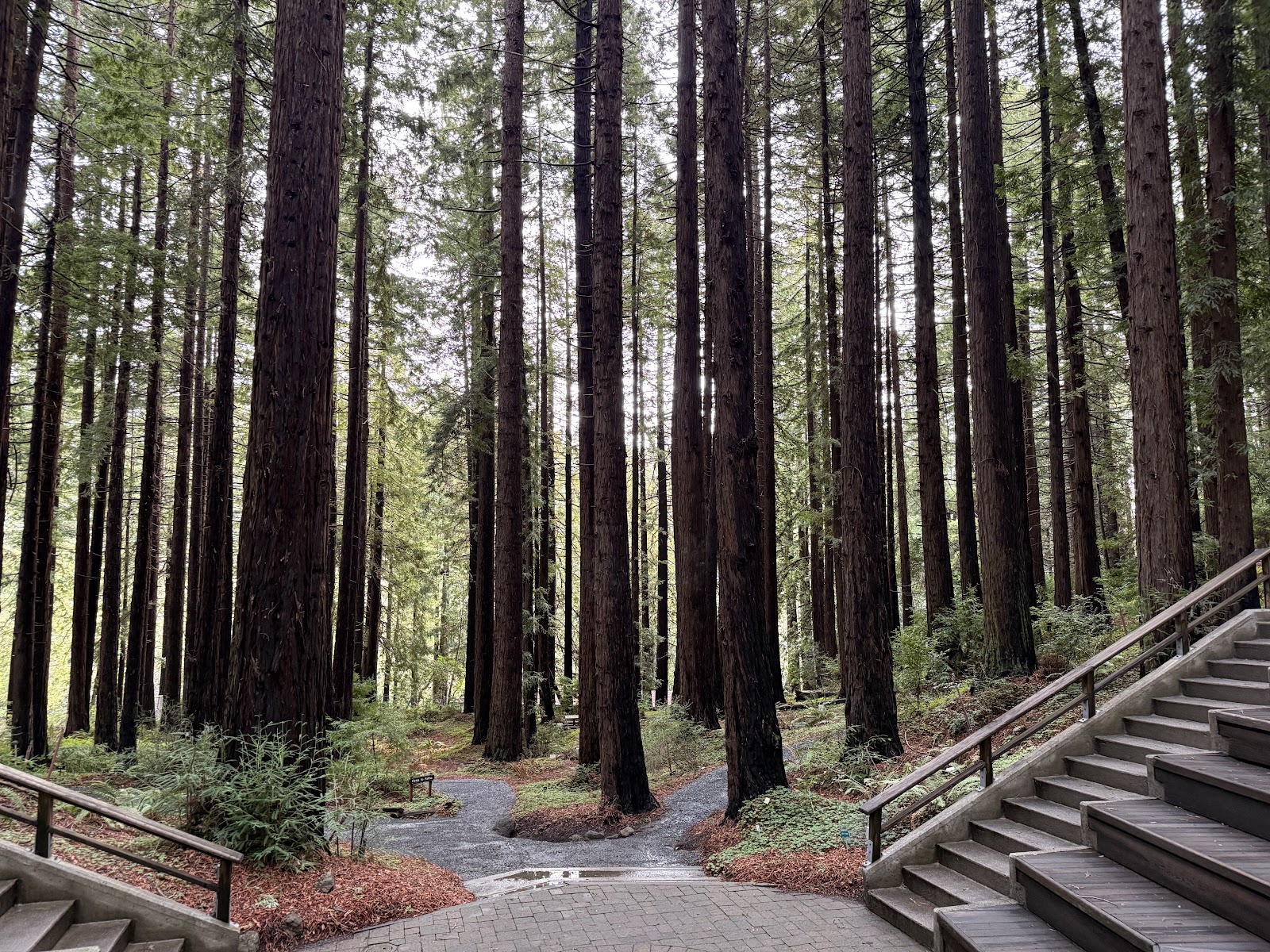
Redwood and dense conifer sections are the darkest ground in the garden and they are the shade. Coast redwood blocks almost everything and its bark absorbs rather than reflects, which means the floor of such a section can sit five stops below the open sky and nothing bounces back into a face. That is a low-key environment and it photographs as one: a lit face against near-black, which is a strong picture, where the same section lifted until it is legible is a muddy grey one.
Added light there has to be close, because nothing bounces — a source at two metres needs roughly a quarter of the output it needs at four — and gelled, because filtered green light and reddish bark are not neutral.
The exposure discipline across the whole garden follows from these extremes. A meter looking at dark conifer overexposes a face by a couple of stops; a meter looking at silver dry-climate planting underexposes it by a stop or more. Both conditions exist minutes apart, which is exactly what automatic exposure cannot handle. Manual, metered on skin, reset at every transition.
Glasshouses, where they are available, are the best light on any botanical site. The whole envelope is a diffuser, so light arrives from every direction at once, soft and abundant, with no hard shadow anywhere — and it is warm and windless, which in a Berkeley hills canyon in the morning is not a small thing.
Two cautions inside glass. The light is overwhelmingly from above, which leaves eye sockets dark, so a subject facing outward toward a glass wall rather than standing under the ridge gets the modelling the roof alone does not give. And dense planting inside glass bounces green into everything, which is another custom white balance rather than a preset.
The practicalities of a steep research garden deserve stating because they shape the day. Paths climb and the ground is rarely level, which means a party in formal shoes moves slowly and three positions close together produces more than six spread across the slope. Strong verticals in planting and structures make an out-of-level frame obvious, and on sloping ground the instinct to level to the slope rather than to gravity is easy to follow by accident.
A working research garden also has irrigation, labels, stakes, propagation frames and staff activity in it, and those are either composed out or accepted as what the place is. Accepting them is more honest — a plant label in a frame says research garden rather than ornamental garden, which is what this is — and pretending otherwise produces pictures that could be anywhere.
And it is cooler and often foggier here than in the city below, because the hills catch the marine air coming across the bay. A party will feel that in the evening in a way they do not expect in California.
- The light changes with the collection — reset exposure and white balance
- Manual throughout: silver beds underexpose, conifer overexposes
- Canyon clock: sun in the middle of the day, even shade at both ends
- Check the face, not the ground, under any broad-leaved canopy
- Glasshouses are the best light; face outward, not up
The garden year
A geographically organised garden has an unusually long season, because collections from different hemispheres flower at different times — which means there is something at its peak in almost every month rather than one spring flush.
The wet season runs roughly November through March, and a covered alternative is not optional in those months. What rain gives a canyon garden is its best self: wet bark, saturated foliage, running water in the canyon, moss on stone, and soft even light with no dappling anywhere. The garden’s principal technical problem disappears in the rain, and a grey day here should be offered to a couple as an improvement rather than an apology.
Winter is also when the southern-hemisphere and Mediterranean collections do things nothing else does: South African and Australian plants flower in the northern winter because they are on the other calendar, which means strong colour in January and February when a conventional garden is bare. That is a genuine argument for a winter date here and almost nobody knows it.
Late winter brings the Asian collections’ early flowering — magnolia and camellia through February and March at this latitude, a month or more ahead of most of the country — which against wet dark canopy is the strongest spring frame the garden has, and lasts a week or two.
Spring is the fullest season: the Californian collections flower with the native wildflower season, the woodland collections leaf out, the canyon is green, and the light is lengthening. It is the easiest time here overall.
Summer in the Berkeley hills is mild and frequently foggy in the morning, because the hills intercept the marine layer coming across the bay — cooler than the inland valleys by a wide margin, with afternoons that clear and warm. That pattern is convenient: a soft morning that works everywhere and a bright afternoon for the open collections.
By midsummer the Californian sections have gone dormant and golden, which is what that flora actually does — the dry season is its winter — and it is worth explaining rather than apologising for. Meanwhile the summer-rainfall collections are at their greenest, so the garden looks like two seasons at once, which is one of the more interesting things it offers.
Autumn brings the clearest air of the year and the least fog, which makes the views out of the canyon toward the bay their sharpest. Then the deciduous collections turn — through November here, later than in colder regions — and in a garden with dark conifer and redwood sections, yellow and scarlet against near-black is the strongest colour contrast available anywhere in this guide.
Fire risk is the honest note for the East Bay hills in the dry months, and it belongs in a planning conversation. Smoke rather than flame is the likelier photographic reality: a layer of it turns the sun orange, flattens contrast, and shifts everything warm in a way no white balance fully resolves. It cannot be planned for, only acknowledged, and what the garden’s own contingency is remains a fair question.
Winter light is the technical gift and in a canyon it is decisive. The December sun at this latitude reaches only about thirty degrees above the horizon, which in a canyon between slopes means the floor may receive very little direct sun at all for weeks. That sounds like a loss and it is the easiest light of the year: entirely soft, entirely even, no dappling anywhere, and workable from the moment the garden opens until it closes.
More frames from University of California Botanical Garden
University of California Botanical Garden wedding photography: common questions
What makes a research botanical garden different?
It is arranged by region of origin rather than by appearance, so the vegetation type — and therefore the light, colour and exposure — changes every few hundred metres.
What does that mean practically?
Reset exposure and white balance at every transition. Silver dry-climate beds make a meter underexpose; dark conifer makes the same meter overexpose.
When is the garden easiest to photograph?
The ends of the day, and any grey day. A canyon gets its direct sun in a window centred on the middle of the day, which is when the problems exist.
Where is the real shade?
The redwood and dense conifer sections, which block almost everything. Broad-leaved woodland collections filter and dapple instead.
Is winter worth considering?
Genuinely. Southern-hemisphere and Mediterranean collections flower in the northern winter, and a low sun may never reach the canyon floor — the easiest light of the year.
When is the colour best?
November, when the deciduous collections turn. Against the near-black conifer sections it is the strongest colour contrast in this guide.
More California venue guides
We are writing a photographer’s guide to every venue we would happily shoot in California. Here are three more, plus the full index:
- Viansa Winery, Sonoma: The One Decision That Governs Everything
- Wayfarers Chapel, Palos Verdes: One Frame, and How It Is Made
- The Carneros Resort, Napa: The Light Through the Day
Planning a wedding at University of California Botanical Garden?
A garden that changes every hundred metres. Tell us your date and we will walk it.