 Park Hyatt Aviara, Carlsbad: The One Decision That Governs Everything
Post Ranch Inn, Big Sur: One Frame, and How It Is Made
Two people, a thousand feet of air, and the ocean. Everything here is a version of that frame.
There is one frame this place exists to give, and it is worth building properly because everything else on the property is a variation on it.
Two people stand near the edge of a cliff on the western face of a coastal range, with the Pacific a long way below and behind them and nothing else in the picture. No building, no planting, no horizon line other than the ocean’s own. The scale is the subject: the drop is on the order of a thousand feet, and the frame’s job is to make that legible without making the people incidental.
It works because of geography that occurs in very few places. The Santa Lucia Range rises almost directly out of the Pacific along this stretch of coast, which means the elevation and the water are in the same place rather than separated by a shelf of flat land — and a site partway up that face looks down on the ocean rather than across at it.
It is also the reason the frame is difficult. A shaded face against a sunlit ocean is a four or five stop difference, the wind on an exposed western face is constant, and the marine layer that forms along this coast can remove the ocean from the picture entirely with no notice at all.
We have not photographed a wedding at the Post Ranch Inn; exposed cliff-top sites on this coast behave consistently. Which areas are available, guest limits, the covered alternative, and what the access arrangements are — the coast highway here is subject to closure from landslides and the drive is long from either direction — are questions for their team, and access in particular is worth confirming close to a date rather than early.
Post Ranch Inn at a glance
| Where | A cliff-top on the Santa Lucia coast at Big Sur |
| The frame | Two people, a thousand feet of air, and the Pacific |
| The problem | Four or five stops between a shaded face and a lit ocean |
| The wind | Constant on an exposed western face — plan handheld |
| Ask first | Access and highway status, guest limits, covered alternative |
How the frame is built
The lens is the first decision and it is counterintuitive. The instinct at a place like this is to go wide, because the view is enormous — and a wide lens is exactly what destroys the frame. It renders the ocean as a small pale band at the top of the picture, reduces the drop to nothing, and makes the people small in a way that reads as distance rather than as scale.
A longer lens does the opposite. It compresses the layers — headland, water, horizon — and brings them forward, so the ocean becomes a wall of texture behind the couple rather than a strip above them. It also flattens the apparent distance between the subject and the drop, which is what makes the height read.
The one situation for a wide lens is when the frame is about the drop rather than the distance: shot from above and to one side, with the couple small on a spur of rock and the cliff falling away beneath them, a wide lens gives the vertigo that a long one cannot. Both frames are worth making and they are different pictures.
The exposure is the second decision and it is the one that decides whether the frame works at all. A sunlit ocean and a shaded face differ by four or five stops, which exceeds what a single exposure holds once skin tone and water texture are both required. There are two honest resolutions and one that is not.
Expose for the ocean and light the faces. The ambient is set so the water holds its colour and its surface texture, and a source lifts the faces to match. That is the frame, and the source has to be close — because nothing out on a cliff bounces, and light falls off with the square of distance, so a source at two metres needs roughly a quarter of the output of the same source at four.
Or expose for the faces and let the ocean go bright. Legitimate, and it makes the picture about the couple rather than the place — which at a site chosen entirely for the view is usually the wrong trade, but not always.
The dishonest option is the average, which gives a grey ocean and slightly dark faces and fails at both ends. It is what automatic metering produces, which is why this frame is made in manual.
The gel on the added source is the detail that separates a frame that belongs from one that looks composited. Late light on this coast is strongly warm, and an ungelled flash reads cooler than everything around it — the eye catches that immediately even when it cannot name it. Warm gel on the source, and the white balance set to the gel.
The wind is the third decision, and it is a decision rather than a condition because it dictates the equipment. An exposed western face on this coast has wind almost all the time, which means a lightstand will go over and a held modifier is a sail. The configuration is a source in a hand or on a bracket, planned that way from the start rather than discovered at six in the evening.
Wind also does things to the subjects that are worth naming in advance. A veil on a cliff edge is unpredictable and can be magnificent or ruinous within a single frame, which means shooting many more frames than usual. Long hair moves constantly. Fabric flattens on one side and balloons on the other. A wedding party who expect that are far happier than one who do not.
And safety is part of building the frame, not separate from it. A cliff edge with a thousand feet beneath it, in wind, with people in unfamiliar shoes and long clothing, is a place to work conservatively — back from the edge, with the compression of a long lens doing the work that proximity would otherwise do. A photograph is not worth a step.
What breaks it, and what else the site gives
The marine layer breaks the frame completely and it is the likeliest thing to. Along this coast, cool water and warm air produce a fog layer that can sit against the cliff face, below it, or above it, and it forms and clears on a timescale of minutes rather than hours.
When it sits at the site, the ocean is simply gone: a white wall two metres away, no view, no horizon, no scale. That is the frame’s total failure, and there is no technique that recovers it.
What there is instead is a completely different and genuinely beautiful picture — two figures on a cliff edge in featureless white, with the world removed. Fog light is flat, cool and low in contrast, so it needs dark surfaces behind the subject to give any separation, a custom white balance set on a face rather than a preset, and one subtle source just off the camera axis to restore the modelling it removes. Treated as its own frame rather than as a failed version of the other one, it is one of the strongest things this coast produces.
And when the layer sits below the site rather than at it, which happens often, the result is the best frame of all: standing in clear sun above a solid white floor with the tops of the headlands emerging from it. That is worth being ready for early and late in the day, because the layer typically rises in the evening and sinks after dawn.
Direct midday sun breaks the frame in the other direction. High sun over open water clips, the surface loses its texture and becomes a flat glare, and faces on an exposed cliff have dark eye sockets and hard shadows under the chin with nothing to shade them. Midday on a cliff-top is not a portrait hour, and the honest answer is to schedule around it rather than to solve it.
Backlight is where the site is strongest and it is the specific gift of a west-facing coast. In the last hour the sun is over the water and behind the subject, which gives rim light on hair and shoulders, a luminous ocean, and a sky that holds colour — and the exposure goes on the sky with the faces lifted by a close gelled source. Metering on skin at that hour produces a white sky and throws away the entire reason for a west-facing cliff.
The ten minutes after the sun has gone is the best window of the day here. Wind frequently eases, the ocean holds the colour of the sky, and the whole scene sits within a range a single exposure can hold — which makes it both the calmest and the technically easiest moment of the entire day. It belongs in the running order explicitly rather than being hoped for.
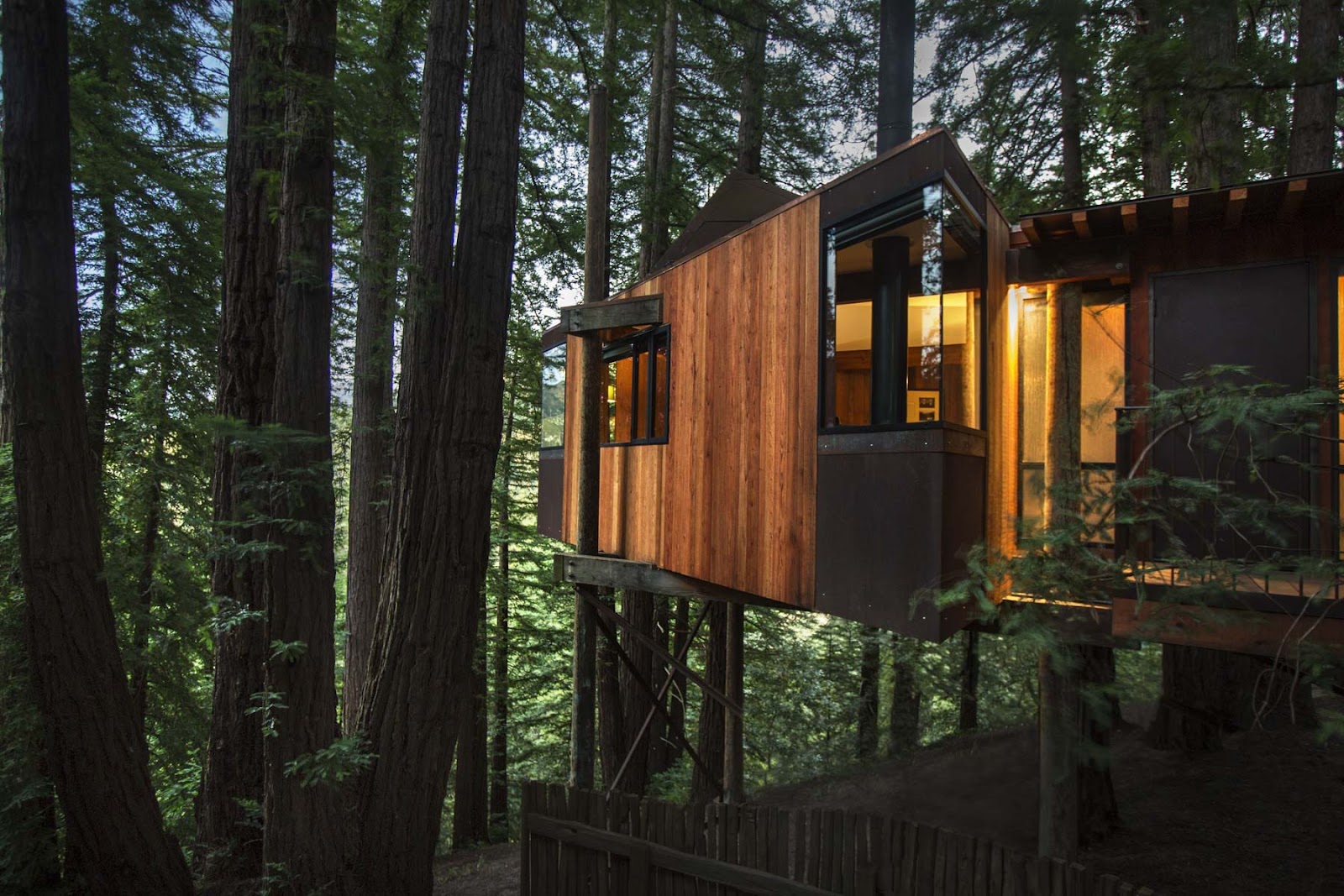
Away from the cliff, the site gives two other environments. The vegetation on this coast is coastal scrub and, in the draws, redwood and oak — and redwood is the darkest canopy there is, blocking almost everything and absorbing rather than reflecting from its bark. A face at the edge of such a stand has near-total darkness behind it, which is three or four stops of free separation and the exact opposite problem to the cliff: here a meter overexposes rather than underexposes, so manual and metered on skin either way.
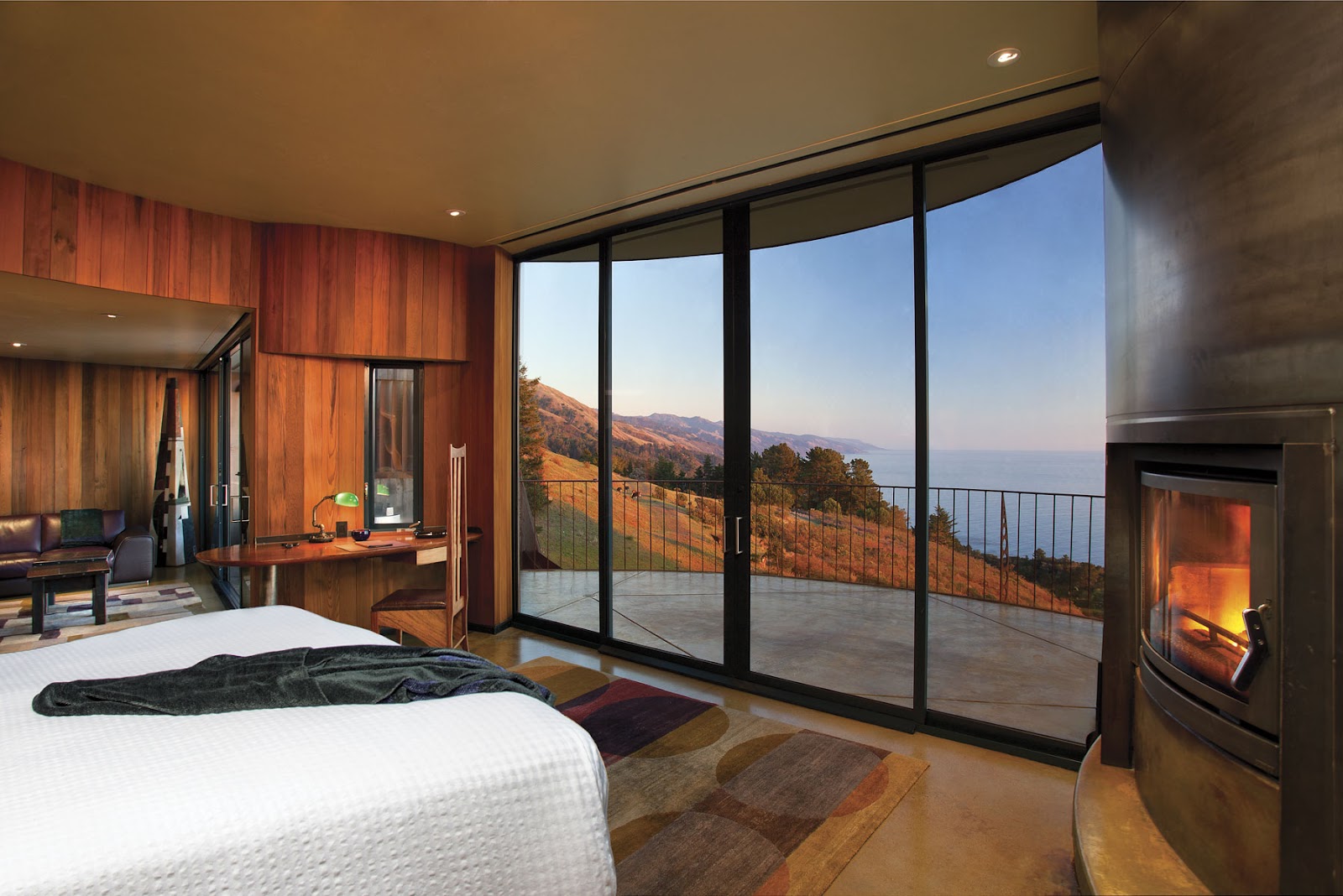
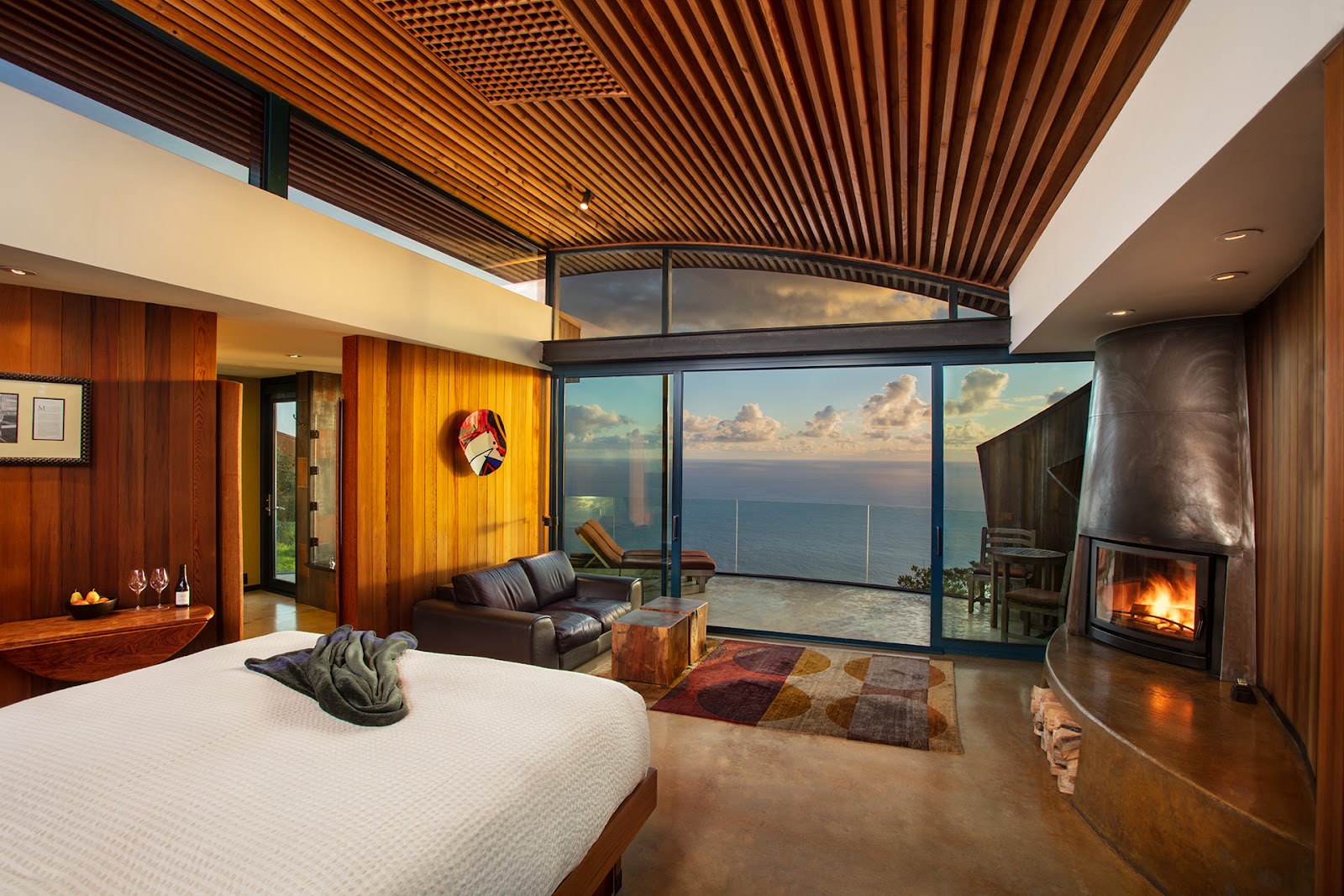
Interiors on a property of this kind are typically timber, glass and dark stone, oriented at the view. That means the windows are both the light and the subject: exposing for the view silhouettes the subject, exposing for the subject whites out the view, and the resolution when both are wanted is a close source at the window’s brightness. Turning off the room lights first is free and removes the mixed-colour problem entirely.
And wind-carried salt is a practical note that matters on this coast: it gets onto front elements and into everything, and a cloth in a pocket and lens changes made in shelter is the whole of the answer.
- Longer lens compresses the layers and makes the height read; wide loses it
- Expose for the ocean and light the faces close and gelled, or the reverse
- Plan handheld sources — a stand on an exposed western face will go over
- Work back from the edge and let the lens do the work
- The ten minutes after sunset is the calmest and the easiest of the day
The Big Sur year
This coast has its own calendar and it does not match either inland California’s or most people’s expectations of the state.
The wet season runs roughly November through March and this coast receives a great deal of rain, because the range forces the air upward as it comes off the ocean. Storms here are substantial, and a covered alternative is not optional in those months.
Rain also has a consequence unique to this stretch of coast: the highway is subject to closure from landslides, and a closure can last a long time. That is a planning fact rather than a photographic one, and it is the single most important thing to confirm close to a date rather than at the time of booking.
What winter gives in exchange is the most dramatic conditions of the year. Storm light on this coast — broken cloud, shafts on water, spray on headlands — is extraordinary and brief, and the air after a front has passed is the clearest it ever gets, which is when the compressed long-lens frames hold the most detail. Winter also has the fewest foggy days, which surprises people.
And winter is when the water is most alive: big swell breaking on the rocks below, which on a long lens from a cliff-top is a subject in its own right. Grey whales pass along this coast on migration through the winter and early spring, close enough inshore to be seen from height, which is a real presence rather than a detail.
Spring is green and the hills here are green only in the wet half of the year — turning gold by early summer and staying that way until the rains. Wildflowers on the coastal slopes run through spring, which in open scrub is a genuine foreground rather than a garnish. Spring is also when the fog begins to build.
Summer is the fog season and it is the counterintuitive part of the year. The strongest upwelling of cold water happens in summer, which is exactly when the marine layer is most persistent — so June, July and August on this coast are frequently grey and cool, with temperatures far below what people expect of California in July.
That is a real conversation to have with a couple. A summer wedding on this coast is more likely to be foggy than clear, and the honest framing is that the fog is one of the two great frames here rather than the absence of the other one.
September and October are the best months by a clear margin. The fog retreats, the air warms, the light is long and low, and the ocean is at its most legible — and it is also when the water is warmest and the swell most moderate. If a date is movable, this is the answer.
Autumn colour is not a feature on a largely evergreen coast, though the sycamores and maples in the canyons turn yellow through November, which against dark redwood is a strong contrast in the sheltered parts of a property.
Winter light is the technical bonus and on a west-facing cliff it is substantial. The December sun at this latitude reaches only about thirty-three degrees above the horizon, so the whole short day rakes across the water and the headlands rather than falling onto them — which means the surface texture of the ocean and the modelling of the cliffs is available all day rather than for an hour. On the light alone, a clear winter day here is the best of the year.
More frames from Post Ranch Inn
Post Ranch Inn wedding photography: common questions
Why not use a wide lens for such a big view?
It reduces the ocean to a pale band and the drop to nothing. A longer lens compresses the layers, brings the water forward and makes the height read.
How is the frame exposed?
For the ocean, with the faces lifted by a close warm-gelled source — or for the faces, letting the water go bright. The average fails at both ends.
What about the wind?
Constant on an exposed western face. Plan handheld sources from the start, and tell a couple that a veil will be unpredictable.
What happens if the fog comes in?
The view is gone completely. Treated as its own frame — two figures in featureless white — it is one of the strongest pictures this coast gives.
When is summer fog worst?
June through August, because the cold-water upwelling that causes it peaks in summer. September and October are the clear months.
What should we confirm before booking?
Highway access. This coast is subject to landslide closures that can last a long time, and it is worth checking close to the date.
More California venue guides
We are writing a photographer’s guide to every venue we would happily shoot in California. Here are three more, plus the full index:
- Rosewood Sand Hill, Menlo Park: The One Decision That Governs Everything
- Solage Calistoga: What It Suits and What It Does Not
- Sunstone Winery, Santa Ynez: Field Notes
Planning a wedding at Post Ranch Inn?
A thousand feet of air and one frame. Tell us your date and we will plan the hour.