 The Henry Clay: Lighting a 1920s Lodge Building
The Lexington Opera House: One Frame, and How It Is Made
The usual theatre frame looks at the stage. The better one here looks back at the house.
The frame most photographers make in a theatre is a couple on a lit stage seen from the auditorium, and it is a good frame. In a Victorian opera house there is a better one, and it faces the other way.
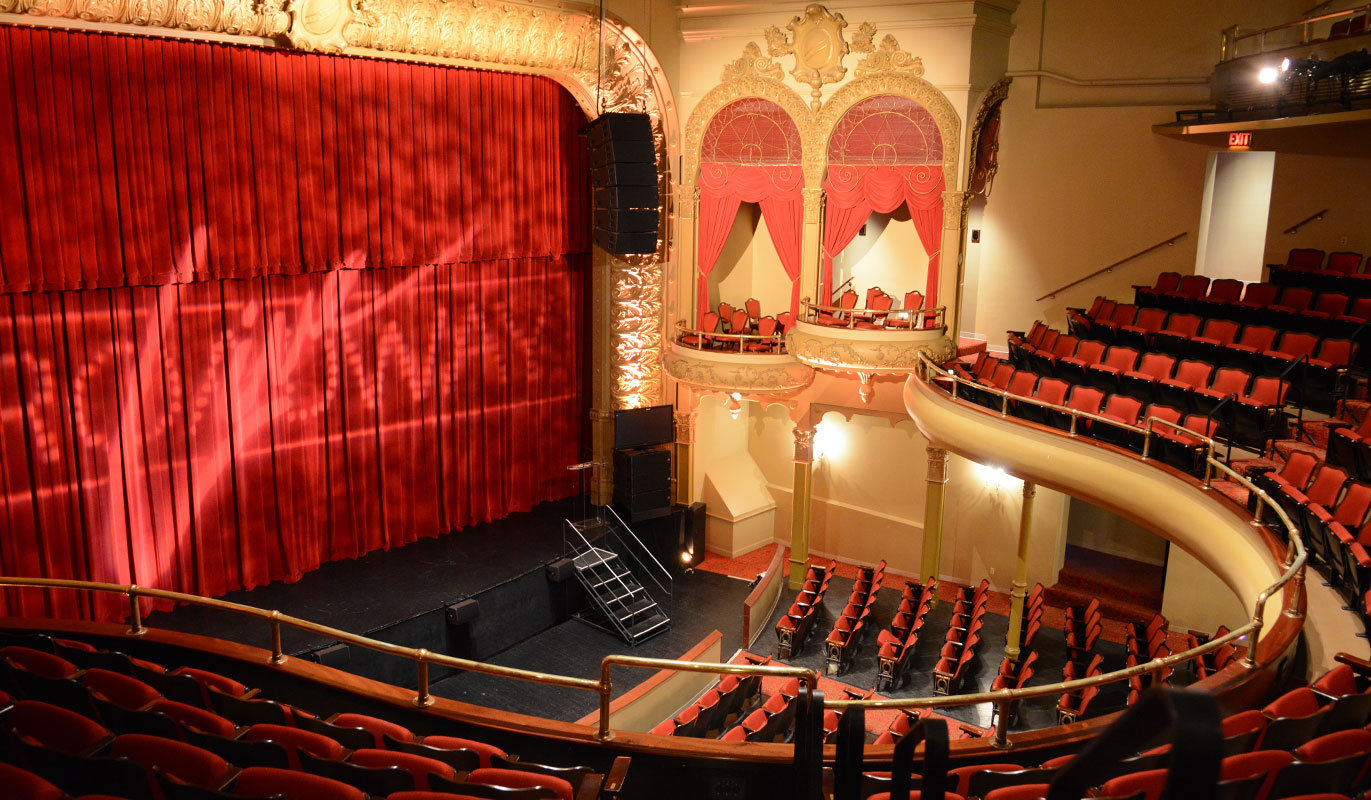
The frame is a couple standing on the stage, photographed from the stage itself or from the wings, with the auditorium behind them: tiers of boxes and balconies curving away, ornamental plasterwork on every level, and rows of seats receding into darkness. In a horseshoe-plan Victorian house those tiers wrap rather than sit flat, which means the background curves around the couple instead of running behind them.
That is a composition nothing else provides. A modern theatre is a fan of seats on a slope; a Victorian house is a vertical, decorated, curved volume — and the couple stands at the focus of it, which is exactly what the architecture was designed to do for a performer.
Six decisions make it, and the first is about who has to help. We have not photographed a wedding at the Lexington Opera House; Victorian opera houses behave consistently. Whether the house lighting can be set, whether the stage may be used, and what the access arrangements are are questions for their team — and the first of those determines whether the frame is possible at all.
The Lexington Opera House at a glance
| Where | Lexington, Kentucky |
| The frame | A couple on stage with the tiered house curving behind them |
| Why it works | A horseshoe plan wraps the background around the subject |
| The dependency | The house lights have to be on, which is the venue’s to do |
| Ask first | House lighting control, stage access, access arrangements |
Decisions one to three: the house lights, the position, the exposure
The first decision is not the photographer’s. This frame requires the auditorium to be lit, because an unlit house behind a couple is simply black — and house lighting is the venue’s to switch on. So the first question is whether the house lights can be brought up, and to what level.
Where they can, the frame is available and everything below applies. Where they cannot, the auditorium behind becomes a dark field, which is a different and still perfectly good picture — a couple on a lit stage against blackness — but it is not this one.
Ask for the house lights at a moderate level rather than full. Full house lighting is bright and even, which flattens the tiers; a lower level leaves the upper boxes and the back of the balcony darker than the front, which gives the volume depth and makes the plasterwork read. A dimmer setting rather than a switch is what to ask for.
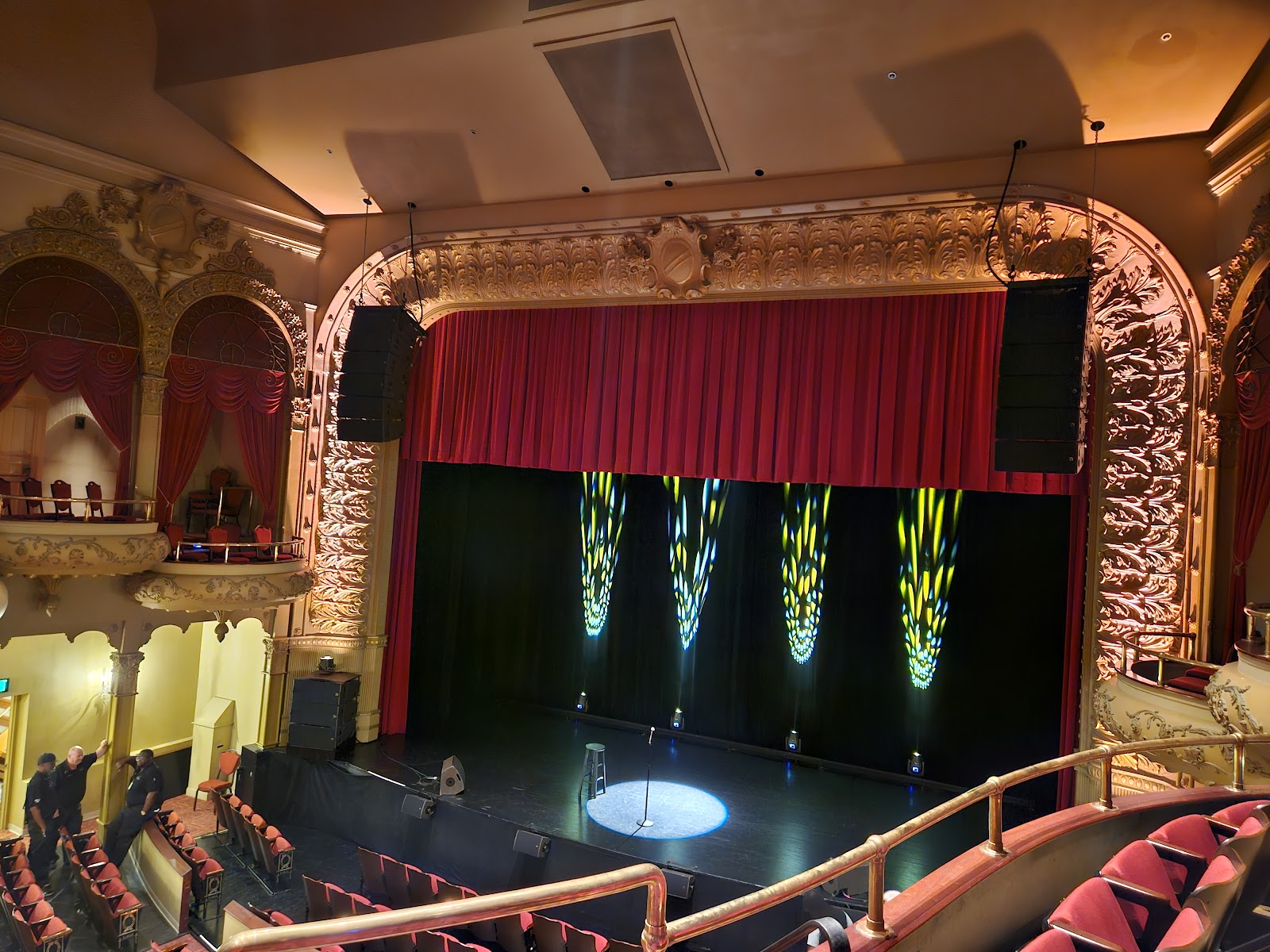
The second decision is the camera position, and there are three worth trying. From the stage itself, looking out, which puts the whole house in the frame and the couple in front of it — the widest and most architectural version. From the wings or the side of the stage, looking across, which gives the couple in profile with the tiers curving behind on one side. And from a box or the front of the balcony, looking down and across, which puts the stage and part of the house in one frame and gives elevation.
The first is the frame this piece is about. It needs a wide lens, a central position and a check on the edges, because a Victorian proscenium is not symmetrical from every point and a badly placed camera puts a light fitting or a fire exit in a corner.
The third decision is the exposure and it is a balance rather than a choice. The couple are on a lit stage; the house is lit at a lower level; and the two need to be within about two stops of each other for both to read.
So the stage lighting should be brought down rather than the house brought up, if there is a choice — a softly lit couple against a moderately lit house holds together, while a brightly lit couple against a dim house does not. Failing that, the couple get a modest source of their own at about a stop above the house level, and the stage rig is left off.
Working in manual is essential, because a frame containing a lit subject and a large moderately lit volume will be metered differently by an automatic system every time. And a slow shutter is likely, which means the couple has to hold still — worth saying to them rather than assuming.
Decisions four to six: the colour, the plasterwork, the alternative
The fourth decision is the colour and a Victorian house is usually a single warm register, which is a gift. House lighting in a restored theatre is typically warm and reasonably consistent across the volume, which means one white balance serves the whole frame — unlike a hotel, where three temperatures land on the same face.
The exception is the stage rig, which may be tungsten, LED or both. If the couple are lit by the rig and the house by its own fittings, those may not match — and the fix is to set white balance for whichever is on the faces and let the house go slightly warm or cool, which reads as depth rather than as error.
Saturated gels are the thing to avoid on faces. A coloured gel is a narrow-spectrum source, so skin lit by it has almost no information in two of its three colour channels and no editing recovers what was never recorded. Coloured light belongs behind or above, and asking for any wash to be set open white is entirely reasonable.
The fifth decision is the plasterwork, which is the house’s ornament and the thing that makes the frame Victorian rather than merely theatrical. Moulded plaster, painted decoration, gilding and applied ornament all read only when light runs along them — light facing a decorated surface flattens it into a field of one colour, while light skimming it lifts every profile.
In an auditorium the light that rakes comes from the house fittings themselves, which are usually mounted on the tier fronts or under the balconies — so the ornament near a fitting reads and the ornament away from one does not. Looking at which parts of the house are grazed rather than faced, before deciding the camera position, is what makes the difference between a decorated background and a brown one.
The sixth decision is the alternative, because this frame depends on the venue’s cooperation and may not be available.
The first alternative is the reverse: a couple on a lit stage photographed from the dark house, which is the classic theatre frame and gives the most complete separation available in any building — a pool of light with absolute darkness around and behind, needing no equipment at all if the rig can be set. Ask for a warm front wash at a low angle rather than the overhead default, which fills eye sockets with shadow and cuts a line under every chin.
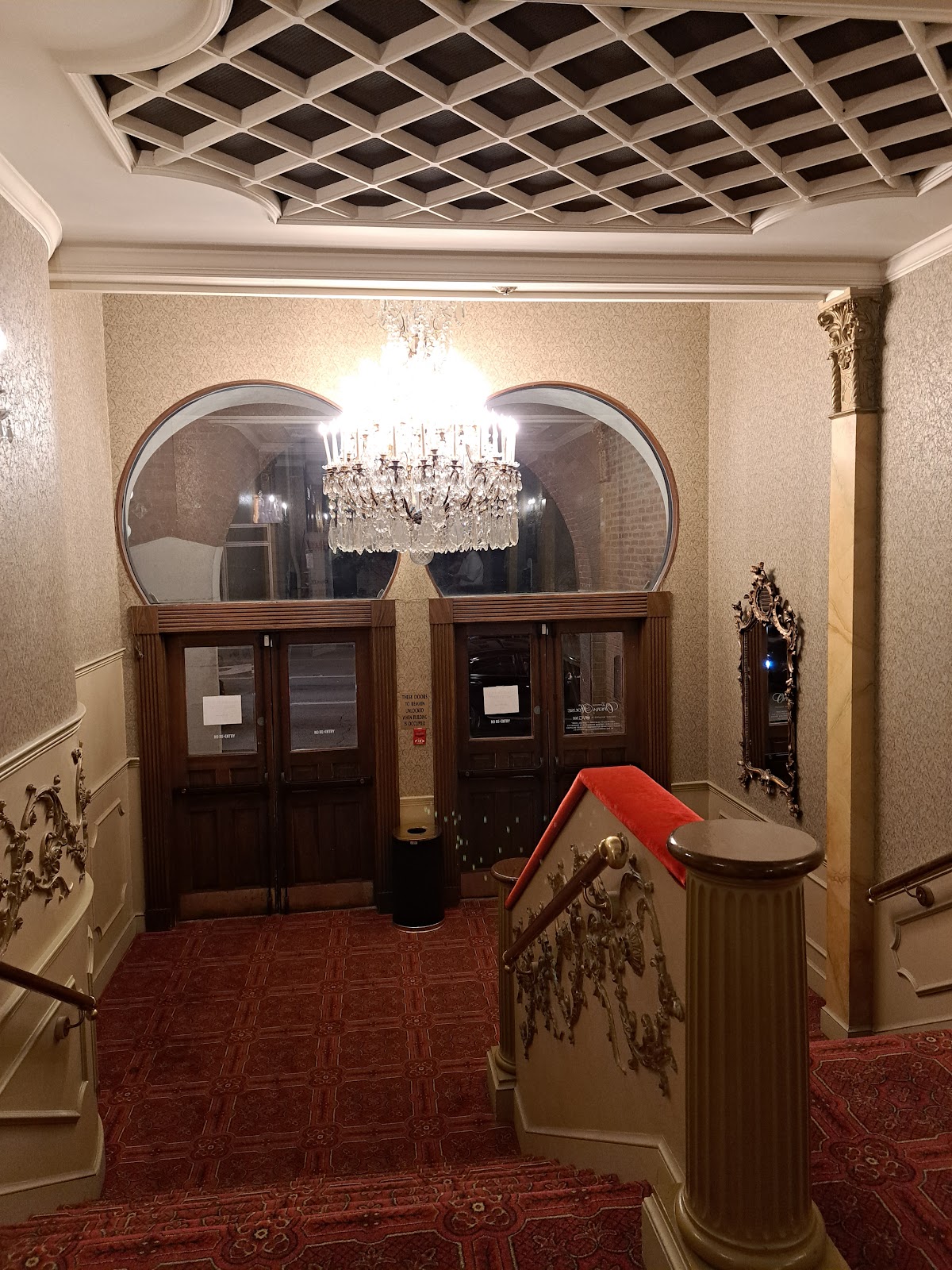
The second is the foyer. A Victorian theatre foyer is ornate, mirrored, chandeliered and frequently glazed to the street — which makes it the only significant daylight in the building and the place where the large groups belong, about three metres back from any glazing so a row is evenly lit. It also has mirrors, which show a badly placed light at full brightness, so the fifteen-second check from the camera position applies.
And the third is the stair, which in a building of this period is the best single architectural feature: elevation, a line for a descent, and a vertical composition. It wants light from one side, because overhead light on a stair shadows every eye socket at once.
- Ask whether the house lights can be brought up — and to a moderate level, not full
- Three positions: from the stage, from the wings, from a box
- Bring the stage down rather than the house up; work in manual
- One white balance serves a warm Victorian house — unlike a hotel
- Note which plasterwork is grazed by a fitting and which is merely faced
Outside, and the Kentucky year
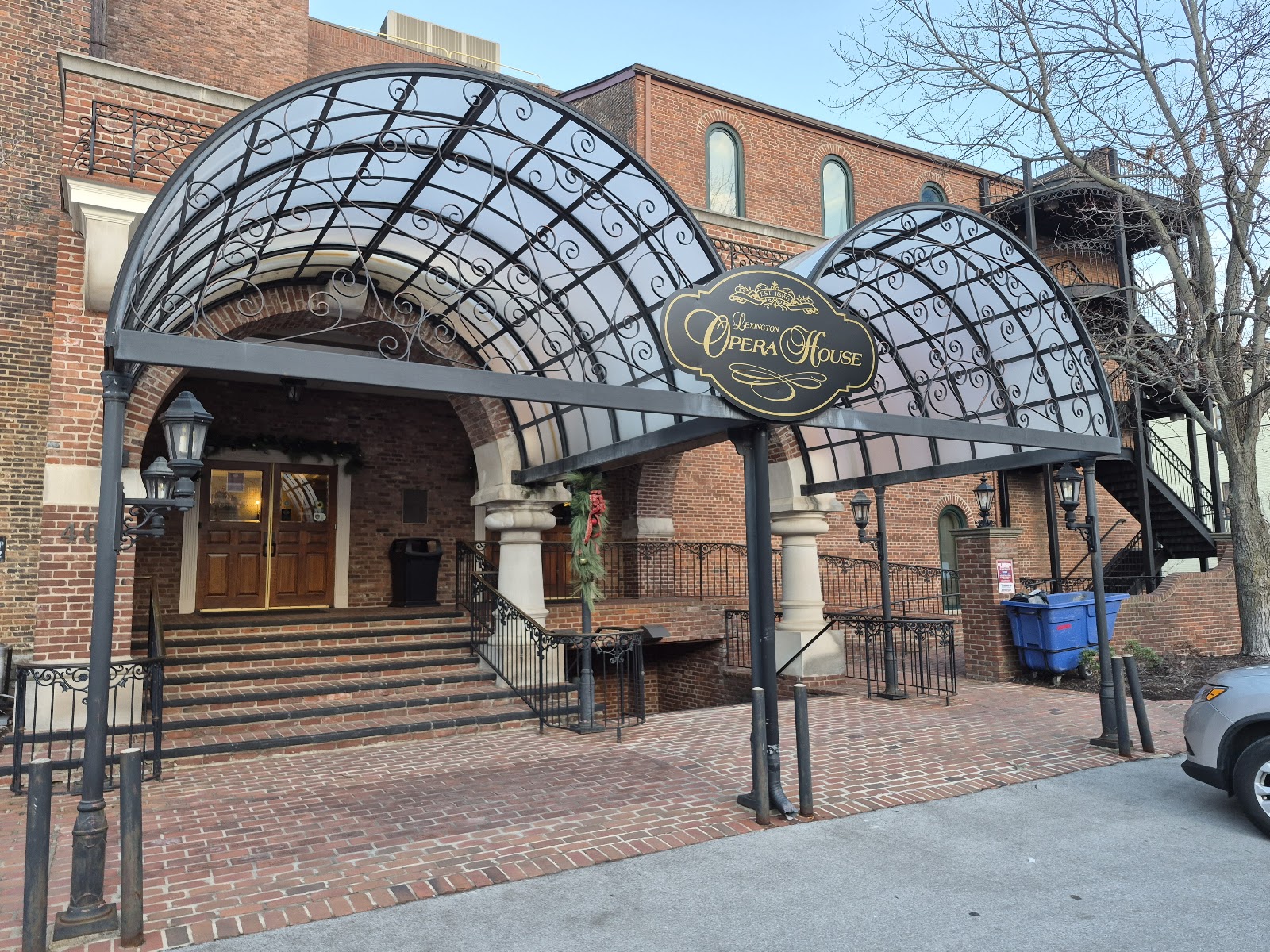
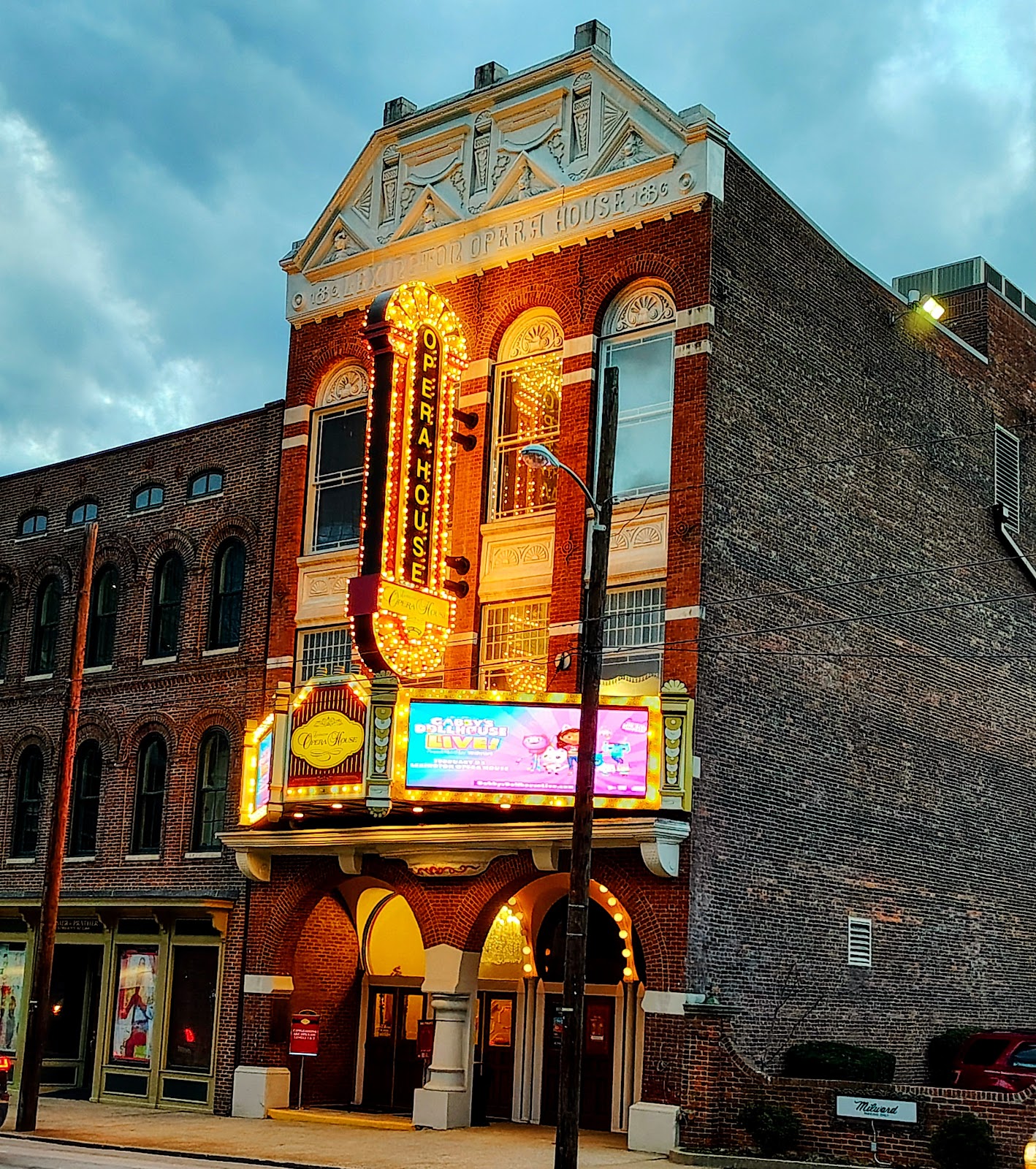
Outside, a Victorian theatre in a mid-sized city has one advantage a large-city venue does not: streets wide enough to stand back in, which means the building can be photographed whole. That is worth one frame, and the marquee or entrance canopy is worth two — a daylight version where the architecture reads, and an after-dark one where the lighting is the subject.
The after-dark version needs the standard rule, because illuminated signage is narrow-spectrum and does not render skin: the lit entrance goes behind or above the couple, and one gelled source of your own lights the faces, gelled warm to match with white balance set to the gel.
Brick and limestone are the local materials. Brick is a warm mid-toned reflector rather than a dark absorber, which means a sunlit elevation is a genuine soft source — a couple three or four metres out from one, facing it, is well lit for nothing, with a custom white balance set on a face. Pale Kentucky limestone does the same more strongly, and both read as material only under raking light, so a walk to find the skimmed elevation is worth more than any accessory.
The timed frame is the crossing: twenty-five to forty minutes after sunset, when the sky still holds colour at about the brightness of the building’s own lighting, so one exposure holds couple, building and sky. For a theatre with a lit entrance against a deep sky that is the strongest exterior frame available — and since the interior does not change through the day, taking ten minutes for it costs nothing.
Beyond the city, this is the Bluegrass: rolling pasture with plank fencing and mature specimen trees standing alone in open ground. Those old crowns give genuinely full shade over an area a group can stand in, which in a humid summer is the most valuable outdoor condition there is — and the fencing gives long painted lines that rake beautifully in low sun and lead the eye through a frame.
The seasons here are a humid transition between continental and subtropical. Summer is hot and genuinely humid, and the humidity rather than the heat is the photographic fact: moist air scatters light, which softens shadows and slightly flattens distance. Severe thunderstorms are a real possibility from spring through summer, which at an entirely indoor venue costs a decision rather than a picture.
The fogging problem is severe in this climate and a theatre makes it worse, because the house is cooled hard for occupancy: a body carried straight out into July air fogs on every surface at once and does not clear quickly, so a bag opened twenty minutes early is the whole fix.
Autumn is the best exterior light of the year: humidity drops, the air clears, low sun arrives at a civilised hour, and the colour in this rolling country usually peaks from late October into early November. Winter is mild with frost rather than sustained freeze, and a December midday sun at about thirty degrees above the horizon rakes brick and limestone all day — which makes winter the one season the middle of the day works outdoors, and the best one for the city’s architecture.
More frames from The Lexington Opera House
The Lexington Opera House wedding photography: common questions
What is the frame?
A couple on stage photographed with the tiered auditorium behind them — boxes and balconies curving away, with the plasterwork reading on every level.
What does it depend on?
The house lights being on, which is the venue’s to arrange. Ask for a moderate level rather than full, because full lighting flattens the tiers.
How should the exposure be balanced?
Bring the stage lighting down rather than the house up. A softly lit couple against a moderately lit house holds together; the reverse does not.
Is the colour difficult?
Less than in a hotel. A Victorian house is usually a single warm register, so one white balance serves the whole frame.
What makes the plasterwork read?
Raking light from the house fittings themselves. Ornament near a fitting reads; ornament away from one flattens to a field of one colour.
What if the house lights cannot be raised?
The classic reverse frame — a couple on a lit stage against a black house, which gives the most complete separation available in any building.
More Kentucky venue guides
We are writing a photographer’s guide to every venue we would happily shoot in Kentucky. Here are three more, plus the full index:
- The Louisville Slugger Museum: A Working Factory Inside a Museum
- The Mary Todd Lincoln House, Lexington: What It Suits, and What It Does Not
- The Muhammad Ali Center, Louisville: The Light Through a Day
Planning a wedding at The Lexington Opera House?
Ask for the house lights first. Tell us your date and we will make the frame.